Buying through this banner helps support the forum!
Page 99 of 104 FirstFirst ... 4989949596979899100101102103104 LastLast
Results 1,471 to 1,485 of 1549

Thread: Classical Listening

  1. #1471
    Artist and Bibliophile stlukesguild's Avatar
    Join Date
    Jul 2006
    Location
    The USA... or thereabouts
    Posts
    6,083
    Blog Entries
    78
    I am always uncomfortable with the use of 'classical music' as a catch all expression for that which exists outside the genre of popular music.

    How does one define "popular music"? Offenbach, Lehard, Strauss II etc... were all the "popular music" of their time. To a great extent, the same can be said of Mozart, Dowland, or many examples of medieval or Renaissance folk music ("Greensleeves"?).
    Beware of the man with just one book. -Ovid
    The man who doesn't read good books has no advantage over the man who can't read them.- Mark Twain
    My Blog: Of Delicious Recoil
    http://stlukesguild.tumblr.com/

  2. #1472
    Registered User Emil Miller's Avatar
    Join Date
    Jul 2008
    Location
    London, England
    Posts
    6,499
    Quote Originally Posted by stlukesguild View Post
    I am always uncomfortable with the use of 'classical music' as a catch all expression for that which exists outside the genre of popular music.

    How does one define "popular music"? Offenbach, Lehard, Strauss II etc... were all the "popular music" of their time. To a great extent, the same can be said of Mozart, Dowland, or many examples of medieval or Renaissance folk music ("Greensleeves"?).
    Well much would depend on the definition of 'popular' which my dictionary gives as ....'pleasing to or esteemed by the general public or a specific group or an individual.'
    So on that basis, some of the examples you have given might have appealed to the general public whilst others might have been popular with a specific group and others with individuals. But popular music in contemporary terms would refer almost exclusively to recordings of songs that are accessed electronically, rather than works from the musical periods I have mentioned, although there may be exceptions that underline the rule
    "L'art de la statistique est de tirer des conclusions erronèes a partir de chiffres exacts." Napoléon Bonaparte.

    "Je crois que beaucoup de gens sont dans cet état d’esprit: au fond, ils ne sentent pas concernés par l’Histoire. Mais pourtant, de temps à autre, l’Histoire pose sa main sur eux." Michel Houellebecq.

  3. #1473
    in angulo cum libro Petrarch's Love's Avatar
    Join Date
    Dec 2005
    Location
    California
    Posts
    2,333
    Blog Entries
    24
    I return to a forum after multiple years' absence, find a few posts on a thread mentioning popularity and classical music, and immediately make myself that person by posting this:

    https://www.youtube.com/watch?v=sFvQOc4xS2k

    Seriously, though, I was having a conversation with a classical music appreciator just the other day in which I found myself arguing in favor of movie themes as probably one of the most productive and enduring forms of orchestral (or what we often lump under that unwieldy umbrella, "classical") music. Not only was I thinking of the now common "movie night" live performances of film scores that have now become common annual events for many orchestras, but of how the genre fits into a longer tradition, not only of music associated with Opera and Ballet (in both of which cases the music is an integral component directly linked with the words or movements being delivered on stage), but also of composers who wrote incidental music for the stage, including Beethoven's Coriolan and Egmont music, Grieg's Peer Gynt suite, Shubert's Rosamund music, Mendelssohn's Midsummer accompaniment, etc. Such music, like music for film is, as the designation suggests, "incidental," supposedly only there as an ornamentation to the spoken theatrical piece, and yet, of those mentioned above all of the plays but Midsummer and Peer Gynt have been largely forgotten as the motivating reason for the (originally much subordinate) musical composition, while the music itself has been incorporated separately into the cannon of classical music.

    The questions of what incidental theatrical music is, and what its newer cousin the film score is do put some useful pressure on what is defined as "popular." Historically speaking, for example, we know a few of the ballads and tunes that were originally sung on the stage during some of Shakespeare's plays. When plays that were originally part of the popular culture become canonical, as in the case of Shakespeare, do the songs that were an integral part of it also attain some sort of canonical status? What if the tune is no longer popular but the plays still are (the reverse of Rosamund's fate in which the Schubert lives on without the play)? And what if one of the tunes Shakespeare fancied also got some attention from Robert Moreley: https://www.youtube.com/watch?v=zVSogD3IvS4 while another lapsed into Elizabethan obscurity?

    Certainly one cannot imagine Star Wars being studied in the future without Williams' score. What are we missing when we watch certain silent films for which the original score was lost? What films might be more valued if we had the music, and which might be almost entirely forget-able without it? Where does a composer coming directly out of the late romantic style like Korngold place along the popular-classical spectrum, and does his association with a popular medium like the 1938 Adventures of Robinhood affect this? http://youtu.be/uT6dLPfSCL8
    What of the recent Lord of the Rings soundtrack: http://youtu.be/1OvmsZ5-gYw ? Unlike Star Wars, I had to google the name of the composer for that one--Howard Shore--indicating that the music isn't garnering as much fame and popularity as an artistic production separate from the Peter Jackson's (no googling required) film, and yet I find it pleasant enough to listen to that I can see it branching off to stand on its own as a piece something like Bruch's Scottish Fantasy.

    Come to that, how does a popular, mixed media work like a film blur the boundaries of genres created to describe stand alone musical performances. For example, the Chicago Symphony Orchestra has a "Night at the Movies" series that has encompassed everything from John Williams' Wagneresque Star Wars motifs to Henry Mancini's jazzy Pink Panther score, and a lot else beside harder still to place in a box.

    Of course the most important question is whether or not St. Luke's will allow movie scores on his classical music thread. And, if that doesn't seem too big a stretch, my brother recently brought to my attention the fact that a number of classical orchestras nationwide have recently hosted performances of "classic" video game scores. So, the real question is whether, if I post the Pacman or Mario Brothers music to this thread I will be immediately exiled from these forums for another few years. I'll give it a try:

    Mario Brothers: http://youtu.be/_9bB7r0M9kg
    Pacman: http://youtu.be/3AEoXhRc8ws (warning: listening to more than 10 seconds may result in slightly incapacitated thinking skills, but the full 10 hours provided is probably some unconstitutional form of torture)

    Perhaps I deserve exile.

    "In rime sparse il suono/ di quei sospiri ond' io nudriva 'l core/ in sul mio primo giovenile errore"~ Francesco Petrarca
    "Follies and nonsense, whims and inconsistencies do divert me, I own, and I laugh at them whenever I can."~ Jane Austen

  4. #1474
    Artist and Bibliophile stlukesguild's Avatar
    Join Date
    Jul 2006
    Location
    The USA... or thereabouts
    Posts
    6,083
    Blog Entries
    78
    Yes. I wholly agree that film scores share a commonality with opera, ballet, and incidental music... including Schubert's Rosamunde:

    https://www.youtube.com/watch?v=-N7ltIYWdP4

    https://www.youtube.com/watch?v=3t0TIhKoUbY

    There are certainly any number of brilliant musical moments in film scores:

    https://www.youtube.com/watch?v=Wwf96OEaYBg

    https://www.youtube.com/watch?v=PgF-rcHcPqE

    https://www.youtube.com/watch?v=al21Vtlsg4A

    https://www.youtube.com/watch?v=HWqKPWO5T4o

    https://www.youtube.com/watch?v=yAtvMRz4mAY

    I think the problem with film scores as opposed to the other incidental music forms is that it is the film and not the music that sets the pace... and to an incredible degree. A composer may be directed to establish exactly 2 minutes and 12 seconds of intense, dramatic music, followed by exactly 23 seconds of a beautiful theme as the love interest in the film enters, followed by 17 seconds of a darker theme as the villain appears, etc... In many ways, the use of the motif places film music as an heir to Wagner... which shouldn't be surprising, considering all of Wagner's heirs, such as Korngold, who went into the business. If film music survives over the long-run (outside of the films themselves), I suspect it will take the form of the suite... with the strongest passages preserved and re-structured (and at times re-orchestrated) into a more coherent form... again, not unlike what we see with many ballets.
    Beware of the man with just one book. -Ovid
    The man who doesn't read good books has no advantage over the man who can't read them.- Mark Twain
    My Blog: Of Delicious Recoil
    http://stlukesguild.tumblr.com/

  5. #1475
    Alea iacta est. mortalterror's Avatar
    Join Date
    Mar 2008
    Location
    LA
    Posts
    1,914
    Blog Entries
    39
    Has there been a more popular orchestral score in the twenty-first century than Requiem For a Dream's Lux Aeterna by Clint Mansell?
    http://www.youtube.com/watch?v=yVIRcnlRKF8
    "So-Crates: The only true wisdom consists in knowing that you know nothing." "That's us, dude!"- Bill and Ted
    "This ain't over."- Charles Bronson
    Feed the Hungry!

  6. #1476
    Registered User
    Join Date
    Aug 2009
    Posts
    3,093
    Point taken on film music. I rather like Philip Glass' music for "The Hours":

    https://www.youtube.com/watch?v=pvA7ZcsKFcQ

    But I do find the choices made by Classic FM are often banal, perhaps because they are happy to churn out background music for car drivers, and films are full of undemanding background music...

    Great point on ballet suites St. Luke, I tend to get bored listening to full ballets, but not the suites.

    Walton made a good stab at producing suites from his film scores:

    https://www.youtube.com/watch?v=JUt5ysms3sU

    Incidental music for films and plays that has serious pretensions to become classical music, like Egmont & Star Wars, is usually in overture form - so it's really designed to be stand alone anyway! Such pieces are usually short, and not the best work of the composer, apart from Williams... and maybe Walton...

  7. #1477
    Registered User Emil Miller's Avatar
    Join Date
    Jul 2008
    Location
    London, England
    Posts
    6,499
    Film music is all too often a pastiche of the major composers' works, particularly in the orchestration, and while enjoyable on its own level it often doesn't stand up to any but the most indulgent musical examination. Philip Glass's music for The Hours is something of an exception as not all of it was composed for the film, and Glass's musical education included studying with Nadia Boulanger. It's ironic that William Walton's music may best be remembered for his film scores rather than Belshazzar's Feast or the viola concerto while his Crown Imperial march resembles a grandiloquent version of Elgar at his most 'nobilmente'.

    http://youtu.be/2AKIFKwSSoE
    "L'art de la statistique est de tirer des conclusions erronèes a partir de chiffres exacts." Napoléon Bonaparte.

    "Je crois que beaucoup de gens sont dans cet état d’esprit: au fond, ils ne sentent pas concernés par l’Histoire. Mais pourtant, de temps à autre, l’Histoire pose sa main sur eux." Michel Houellebecq.

  8. #1478
    Registered User prendrelemick's Avatar
    Join Date
    Nov 2008
    Location
    Yorkshire
    Posts
    4,871
    Blog Entries
    29
    We have Howard Shore's Lord of the Rings on our CD changer in the car. It's music, it's played by The Royal Philharmonic, it sounds like a classical piece, it can stand alone without the film perfectly well, so although it is definitely a pastiche I'd say it qualifies.

    I remember when some major film scores went a bit experimental in the early days of electronic music, it didn't really work, possibly because the job of the music is essentially background, so traditional orchestration is familiar enough not to jar.
    ay up

  9. #1479
    Card-carrying Medievalist Lokasenna's Avatar
    Join Date
    Feb 2009
    Location
    In a lurid pink building...
    Posts
    2,769
    Blog Entries
    5
    Quote Originally Posted by prendrelemick View Post
    We have Howard Shore's Lord of the Rings on our CD changer in the car. It's music, it's played by The Royal Philharmonic, it sounds like a classical piece, it can stand alone without the film perfectly well, so although it is definitely a pastiche I'd say it qualifies.
    It's a nice score, though it always annoys me - all those bloody celtic harmonies wafting around where they have no place to be. I doubt Toller's would approve, given his desire to create a uniquely English mythology...

    Some movie scores can be superb, to the extent that they can stand apart from the film and still be enjoyable - I knew the soundtrack from The Piano for years before I saw the film, and wonderful though the movie was I'm not quite sure it lived up to its superb music. One of my favourite lesser-known composers in Erich Korngold, whose movie scores rank among his best work - Robin Hood, The Seahawk, Captain Blood, and The Private Lives of Elizabeth and Essex suites are superb orchestral works that one can enjoy without ever having seen the films from which they are taken. The lines are further blurred in his wonderful Violin Concerto in D major, a work designed only for the concert hall that nevertheless samples and develops on some of the themes he used for his movie scores.

    I also like John Williams, though he isn't in the same league...

    Video game music is, slowly, getting more mainstream appeal. There was a minor brouhaha when several game themes made their way in the Classic FM Hall of Fame (which is a UK-based public poll of the 'best' 100 classical pieces), the station itself noting the controversy:

    http://www.classicfm.com/hall-of-fam...-fame-opinion/

    The station subsequently released a programme that was intended to introduce non-gamers to video game music, which is summarised here: http://www.classicfm.com/discover/vi...er-game-scores.

    Of course, there are still people who stick their noses in the air out of sheer bloodymindedness - in much the same way as they used to discount film music. I've been a keen gamer for many years, and part of that experience has been enjoying the music - indeed, it's probably what got me into classical music in the first place. And whilst I've not found anything in a video game to rival Wagner or Beethoven, there's plenty that I have enjoyed.

    And, of course, some video game composers directly relate their music to earlier, more famous works - Nobuo Uematsu is probably most famous for this, but they all do it. Take his 'One-Winged Angel' (http://www.youtube.com/watch?v=GGe6ZsxqhQw) which riffs on Carmina Burana, or his 'Dancing Mad' (http://www.youtube.com/watch?v=jMFCM0SKbnY), a complicated and leitmotif heavy piece whose third movement of quotes Bach's Toccata and Fugue in D minor.
    "I should only believe in a God that would know how to dance. And when I saw my devil, I found him serious, thorough, profound, solemn: he was the spirit of gravity- through him all things fall. Not by wrath, but by laughter, do we slay. Come, let us slay the spirit of gravity!" - Nietzsche

  10. #1480
    Alea iacta est. mortalterror's Avatar
    Join Date
    Mar 2008
    Location
    LA
    Posts
    1,914
    Blog Entries
    39
    I'm surprised in a discussion of great soundtrack music Ennio Morricone's scores to A Fistful of Dollars, The Good the Bad and the Ugly, or The Mission haven't been mentioned. The Ecstasy of Gold is so much fun to listen to!
    http://www.youtube.com/watch?v=wV0wPBYDQ6Y

    Chariots of Fire by Vangelis
    http://www.youtube.com/watch?v=TYJzcUvS_NU
    A Kaleidoscope of Mathematics by James Horner from the Beautiful Mind soundtrack
    http://www.youtube.com/watch?v=cDEx6tolC6w
    The Lawrence of Arabia theme by Maurice Jarre
    http://www.youtube.com/watch?v=jdFwhhH2x7I

    Let's not forget Lieutenant Kije by Prokofiev
    http://www.youtube.com/watch?v=hINfOSlMANc
    or his Andrei Nevsky and Ivan the Terrible soundtracks
    "So-Crates: The only true wisdom consists in knowing that you know nothing." "That's us, dude!"- Bill and Ted
    "This ain't over."- Charles Bronson
    Feed the Hungry!

  11. #1481
    Registered User prendrelemick's Avatar
    Join Date
    Nov 2008
    Location
    Yorkshire
    Posts
    4,871
    Blog Entries
    29
    A Clockwork Orange is interesting, The Beethoven played on a tinny sounding electric organ without any classic orchestration. Is that Classical Music?
    ay up

  12. #1482
    Registered User Emil Miller's Avatar
    Join Date
    Jul 2008
    Location
    London, England
    Posts
    6,499
    Quote Originally Posted by prendrelemick View Post
    A Clockwork Orange is interesting, The Beethoven played on a tinny sounding electric organ without any classic orchestration. Is that Classical Music?
    The music is, but the performance isn't.
    "L'art de la statistique est de tirer des conclusions erronèes a partir de chiffres exacts." Napoléon Bonaparte.

    "Je crois que beaucoup de gens sont dans cet état d’esprit: au fond, ils ne sentent pas concernés par l’Histoire. Mais pourtant, de temps à autre, l’Histoire pose sa main sur eux." Michel Houellebecq.

  13. #1483
    Registered User Emil Miller's Avatar
    Join Date
    Jul 2008
    Location
    London, England
    Posts
    6,499
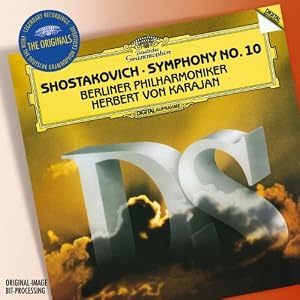
    I picked up on this collection by chance. They are all marvellous renditions but the Karajan Shostakovich N0.10 and the Bernstein N0.7 are nothing short of stupendous. Even if one doesn't appreciate the music, the playing almost defies belief. The Tilson Thomas Mahler 2nd is also an amazing performance.

    http://youtu.be/wGVAaVOyzEA
    "L'art de la statistique est de tirer des conclusions erronèes a partir de chiffres exacts." Napoléon Bonaparte.

    "Je crois que beaucoup de gens sont dans cet état d’esprit: au fond, ils ne sentent pas concernés par l’Histoire. Mais pourtant, de temps à autre, l’Histoire pose sa main sur eux." Michel Houellebecq.

  14. #1484
    Artist and Bibliophile stlukesguild's Avatar
    Join Date
    Jul 2006
    Location
    The USA... or thereabouts
    Posts
    6,083
    Blog Entries
    78
    Karajan's Shosty 10 has long been acknowledged as the recording by which all others are measured:


    Admittedly, I need to listen more to Shostakovitch' and Prokofiev's symphonies. I am far more familiar with other genre by each.
    Beware of the man with just one book. -Ovid
    The man who doesn't read good books has no advantage over the man who can't read them.- Mark Twain
    My Blog: Of Delicious Recoil
    http://stlukesguild.tumblr.com/

  15. #1485
    Registered User Emil Miller's Avatar
    Join Date
    Jul 2008
    Location
    London, England
    Posts
    6,499
    Quote Originally Posted by stlukesguild View Post

    Karajan's Shosty 10 has long been acknowledged as the recording by which all others are measured:


    Admittedly, I need to listen more to Shostakovitch' and Prokofiev's symphonies. I am far more familiar with other genre by each.

    I have just checked it out in my Gramophone Good CD Guide and they say much the same. They also give pride of place to Bernstein's 7th; which reminds me of the feud that developed between Stokowski and Toscanini who were both desperate to conduct the first performance outside of Russia when the score was smuggled out of Leningrad during the German siege of the city in WWII. In the event, Toscanini won and made a celebrated recording with the NBC Symphony Orchestra for RCA.
    "L'art de la statistique est de tirer des conclusions erronèes a partir de chiffres exacts." Napoléon Bonaparte.

    "Je crois que beaucoup de gens sont dans cet état d’esprit: au fond, ils ne sentent pas concernés par l’Histoire. Mais pourtant, de temps à autre, l’Histoire pose sa main sur eux." Michel Houellebecq.

Similar Threads

  1. Listening While Reading
    By subterranean in forum General Chat
    Replies: 36
    Last Post: 02-06-2011, 04:00 PM
  2. Latin making a comeback?
    By quasimodo1 in forum General Literature
    Replies: 13
    Last Post: 12-17-2007, 05:21 PM
  3. Which One Do You Like Most Among Chinese Classical Poets
    By worldwalker in forum Poems, Poets, and Poetry
    Replies: 15
    Last Post: 09-21-2007, 01:39 PM
  4. Classical and Modern Tragedy
    By arabian night in forum General Literature
    Replies: 1
    Last Post: 10-02-2005, 12:52 PM
  5. Classical Music
    By IWilKikU in forum General Chat
    Replies: 12
    Last Post: 04-17-2004, 11:54 PM

Posting Permissions

  • You may not post new threads
  • You may not post replies
  • You may not post attachments
  • You may not edit your posts
  •