Page 2 of 2 FirstFirst 12
Results 16 to 25 of 25

Thread: Conic sections-The ellipse

  1. #16
    Registered User
    Join Date
    Aug 2009
    Posts
    3,093
    Quote Originally Posted by Kyriakos View Post
    Btw, Mal4Mac, i am not sure if the answer given in your link is correct...
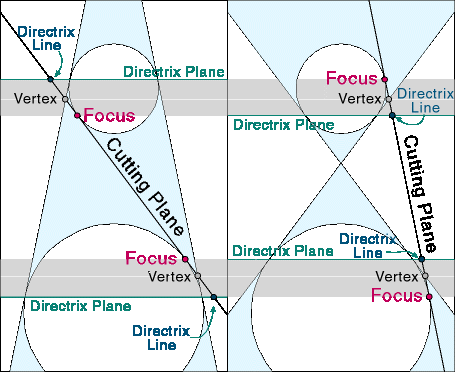
    I'd expect there might be one slice where the focus coincides with the axis. But look at this:


    It seems quite obvious the axis is no way near the focus. Check out this for some more great pictures of Dandelin spheres:

    http://www.clowder.net/hop/Dandelin/Dandelin.html

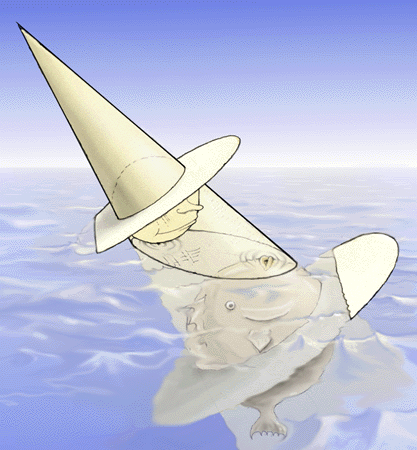
    I especially like this one:


    A floating ball head [Dandelin sphere] wearing a dunce-cap
    The ocean surface plane defined by the cone meeting the water is the conic section (here it's an ellipse).
    Where the ball head touches the water is a focus.
    Where the fish [Dandelin sphere] kisses the air is a focus.

    Note, I've simplified the original description. For instance, I don't see why a mosquito net is needed!

    Wonderful resource on Japanese temple geometry (they were obsessed with ellipses):

    http://www.physics.princeton.edu/~tr...legeometry.pdf
    Last edited by mal4mac; 09-14-2013 at 06:07 AM. Reason: add

  2. #17
    confidentially pleased cacian's Avatar
    Join Date
    Nov 2011
    Location
    London
    Posts
    13,930
    Hi Kyriakos
    what i am trying to say is that in the second picture for example. the lines going through the axis are straight but the ellipse or axis is not even on the surface it being drawn. it is tilted and therefore the ellipse will appear uneven compare to the top one on the cone. the reason for this is that one is trying to force a straight line from top to bottom going through the ellipse which is tilted. the end result is the axis appear uneven or uncentered.
    therefore the theory is flawed or shall i say it does not work
    it is not the ellipse that the issue here it is the line that is drawn straight. in other one cannot draw a straight line through the ellipse and expect evenness. it does not work.
    so either draw a tilted line to go according to the ellipse or don't either way it is not going to work because the top circle of the cone is going to come uncentered too.
    so there is no such a thing uncentered ellipse it is the drawing of the line that is uncentered or the issue.
    it may never try
    but when it does it sigh
    it is just that
    good
    it fly

  3. #18
    Executioner, protect me Kyriakos's Avatar
    Join Date
    Jun 2010
    Location
    Last Circle
    Posts
    884
    Thank you both for your replies

    I think (not sure) that this is what could be said here:

    @Cacian: the ellipse is not uncentered, if it is drawn as a 2d shape. Then its obvious "center" is the point where its major and minor axis meet. However in a 3d space the ellipse is not drawn on a surface, but has two very uneven in size curves. So the focus points are related to those curves in 3d space, in fact they seem to be the "center" of the smaller curve (in reality the smaller cone made as part of a conic system after the original larger cone, as shown in my figure #2), and then the point in equal distance to it from the other side of the 2d ellipse "center" point.

    @Mal4Mac: from the images i saw of the Dandelin spheres they always are formed in the inverted ellipse in regards to the angle of the ellipse towards the base of the cone. In my own image the cone is inverted. In your own it is upright (what matters is not the cone by itself, but also the angle of the ellipse in 3d space). So it seems to me that as long as the ellipse is angled/tilted in the way i presented in my image, it always will have its real focus point in the axis of the cone. Whereas if it is angled in the inverted way, the axis will not have any focus point in it...
    Last edited by Kyriakos; 09-14-2013 at 06:21 AM.
    βῆ δ᾿ ἀκέων παρὰ θῖνα πολυφλοίσϐοιο θαλάσσης·
    (he walked silently on the edge of the loudly heard wave-breaking sea)
    Iliad A:34
    Read articles in my Patreon
    Watch videos in my Youtube

  4. #19
    confidentially pleased cacian's Avatar
    Join Date
    Nov 2011
    Location
    London
    Posts
    13,930
    However in a 3d space the ellipse is not drawn on a surface, but has two very uneven in size curves.
    exactly and that is because the straight line is being forced/ going through it. take the line out and the curves are perfectly even without interrupting it with a line to measure it.
    one does not measure using a diagram it does not work
    Last edited by cacian; 09-14-2013 at 06:48 AM.
    it may never try
    but when it does it sigh
    it is just that
    good
    it fly

  5. #20
    Registered User
    Join Date
    Aug 2009
    Posts
    3,093
    Quote Originally Posted by Kyriakos View Post
    @Mal4Mac: from the images i saw of the Dandelin spheres they always are formed in the inverted ellipse in regards to the angle of the ellipse towards the base of the cone. In my own image the cone is inverted. In your own it is upright (what matters is not the cone by itself, but also the angle of the ellipse in 3d space). So it seems to me that as long as the ellipse is angled/tilted in the way i presented in my image, it always will have its real focus point in the axis of the cone. Whereas if it is angled in the inverted way, the axis will not have any focus point in it...
    Sorry, I don't see that at all. Can you prove it, or produce a few diagrams that might convince me? Or find a page that supports your statement?

  6. #21
    Executioner, protect me Kyriakos's Avatar
    Join Date
    Jun 2010
    Location
    Last Circle
    Posts
    884
    I cannot prove it, although to me (again instinctively) it seems to be true. I will certainly look a lot more into this though... At any rate if the ellipse is tilted in the manner/direction shown in the Dandelin illustration, it is obvious it won't ever have a focus point in the axis of the cone.
    βῆ δ᾿ ἀκέων παρὰ θῖνα πολυφλοίσϐοιο θαλάσσης·
    (he walked silently on the edge of the loudly heard wave-breaking sea)
    Iliad A:34
    Read articles in my Patreon
    Watch videos in my Youtube

  7. #22
    Executioner, protect me Kyriakos's Avatar
    Join Date
    Jun 2010
    Location
    Last Circle
    Posts
    884
    Hm... I did some more thinking/calculations, and i wonder if the true focus point of the ellipse is the point where the axis of the cone meets the major axis of the ellipse, as long as that point they meet in is in the periphery which is smaller than the base of the cone and is further away from the basis of the cone than it is to the pinnacle of the cone.

    Might be true. Will rework on it though.
    βῆ δ᾿ ἀκέων παρὰ θῖνα πολυφλοίσϐοιο θαλάσσης·
    (he walked silently on the edge of the loudly heard wave-breaking sea)
    Iliad A:34
    Read articles in my Patreon
    Watch videos in my Youtube

  8. #23
    Executioner, protect me Kyriakos's Avatar
    Join Date
    Jun 2010
    Location
    Last Circle
    Posts
    884
    Did some more reading on this, changing my view


    What i was looking for was not, in the end, the actual position of the conic axis as one identified in the corresponding focal point on the side of the cone where the smaller of the curved parts of it is( since indeed i now know this would mean the ellipse is a circle), but for the relative distance of the conic axis to that focus point, as opposed to the distance of the conic axis to the center of the ellipse

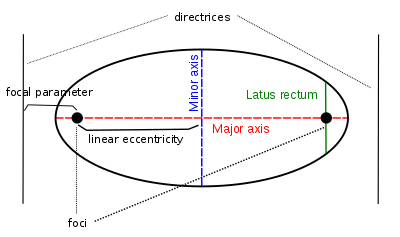
    I think that the opposite focus point will always be in a larger linking line to the Latus Rectum (which is the chord uniting the edges of the smaller curve of the ellipse), or at least its center, than the focus on its own side. Often it would be a case of one of the straight lines of a right triangle, and the hypothenuse linking them. I wonder if this always will be the case as a ratio between the two distances (given a specific example of such a triangle and its sides). My will was just to know under which minimal requirements involving the conic axis and the focus points, one can tell what a particular element related to the eccentricity of the ellipse will be: how it is tilted in regards to the base of the right/circular based cone.

    In other words, what i am asking is if you can know which vertex of the ellipse is the higher one, if you define height not in regards to the cone itself (cause it can be inverted) but to a cartesian, stable axis.
    Last edited by Kyriakos; 09-15-2013 at 04:46 AM.
    βῆ δ᾿ ἀκέων παρὰ θῖνα πολυφλοίσϐοιο θαλάσσης·
    (he walked silently on the edge of the loudly heard wave-breaking sea)
    Iliad A:34
    Read articles in my Patreon
    Watch videos in my Youtube

  9. #24
    Maybe YesNo's Avatar
    Join Date
    Oct 2010
    Location
    For Mill, South Carolina
    Posts
    9,532
    Blog Entries
    2
    Quote Originally Posted by Kyriakos View Post
    In other words, what i am asking is if you can know which vertex of the ellipse is the higher one, if you define height not in regards to the cone itself (cause it can be inverted) but to a cartesian, stable axis.
    I never heard of Dandelin spheres before and the thread is interesting.

    Perhaps this is completely incorrect, but it seems to me that there are infinitely many planes that would cut a cone to project the same ellipse (or other conic section) onto a 2 dimensional space. Looking at it from the perspective of a particular plane that cuts the cone, one of the foci would be further away from that axis of the cone, however, once that set of points in the intersection of the cone with the plane is mapped to a 2 dimension space, that information is lost.

    Just a guess based on the previous discussion.

  10. #25
    Executioner, protect me Kyriakos's Avatar
    Join Date
    Jun 2010
    Location
    Last Circle
    Posts
    884
    You are correct However the actual ellipse might be said (although it doesn't have to, and it seems in reality it does not either) to exist in a specific 3d location, unlike the 2d projection of it which is mostly some sort of standard for an unlimited number of different cases of surface tilt or cone tilt or cone size...

    However by now i gathered that one can never know the actual tilt of the ellipse if he only knows information relative to the conic axis, the focus points, and that the shape is indeed an ellipse (even if he also knows that its minor axis is a lot smaller than the major axis). This has to do with the 3d shape being not bound by any stable direction that the 2d shape- or we as humans- are, eg the set downward direction in the cartesian axis, or the force of gravity which pulls one down, with "down" being the same for a relatively small part of the environment he is in (ie he is not in the antipodal parts of the planet, or something significantly towards that).

    However i needed to examine this for a short story, which i now completed, and in the story obviously gravity is involved, so "down" is indeed a set direction for the narrator. Moreover the impossibility to know a tilt for the 3d shape of the ellipse is incorporated in the storyline now as well
    Last edited by Kyriakos; 09-16-2013 at 01:53 AM.
    βῆ δ᾿ ἀκέων παρὰ θῖνα πολυφλοίσϐοιο θαλάσσης·
    (he walked silently on the edge of the loudly heard wave-breaking sea)
    Iliad A:34
    Read articles in my Patreon
    Watch videos in my Youtube

Page 2 of 2 FirstFirst 12

Similar Threads

  1. ace bit 1 sections and fragments
    By David Strugnell in forum General Writing
    Replies: 2
    Last Post: 07-08-2011, 05:36 AM
  2. A couple of sections from a much larger poem
    By blainebeckner in forum Personal Poetry
    Replies: 6
    Last Post: 11-02-2010, 12:16 PM
  3. Authors Sections
    By Stewart in forum The Literature Network
    Replies: 3
    Last Post: 11-15-2006, 10:01 AM
  4. It needs: Tolkien and Unknown sections.
    By Jared in forum Book & Author Requests
    Replies: 2
    Last Post: 06-11-2002, 09:19 PM

Posting Permissions

  • You may not post new threads
  • You may not post replies
  • You may not post attachments
  • You may not edit your posts
  •