Buying through this banner helps support the forum!
Page 87 of 104 FirstFirst ... 3777828384858687888990919297 ... LastLast
Results 1,291 to 1,305 of 1549

Thread: Classical Listening

  1. #1291
    Registered User Emil Miller's Avatar
    Join Date
    Jul 2008
    Location
    London, England
    Posts
    6,499
    Interesting take on piano concertos St Lukes. I was listening to Ashkenazy in an interview on BBC radio recently and he made a similar point in that before the invention of the Forte piano, Bach, Haydn and Mozart's music was very contained and there are almost no big chords or huge technical problems in it. Piano music only began to come into its own with Beethoven, Schubert and Schumann and even here the piano was constrained by fewer octaves than that of the present day concert grand. One wonders what the old masters would have done had they had such an extended instrument at their disposal.
    Thank you for the Yuja Wang Prokofiev although I prefer his 1st piano concerto to his others. The item you have given for Rachmaninov No.2 is in fact Chopin's second concerto and although the Ravel is a contender for the greatest piano concerto of the 20th century, the definitive performance is, by general consent, that of Michelangeli.
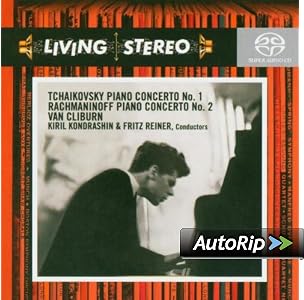
    We have spoken of the Tchaikovsky/Van Cliburn performance before and it remains unbeaten to this day.
    Over the last couple of days I have been listening to Youtube performances of the Brahms No.1, which has long been a favourite of mine, and one of the best, believe it or not, is by Glen Gould and the Winnipeg Symphony orchestra.
    Brahms bestrides the post Beethoven symphonic scene like a colossus and epitomises Germany for me. Helene Grimaud gives a marvellous performance of the first concerto in the acoustically stunning Baden Baden Festhalle and it's noticeable that Yuja Wang has yet to attempt grappling with the profundity of either of the Brahms concertos despite an already extensive repertoire.
    Of the others, I would say that Richter's Liszt No.1 is as perfect as I have heard, but for unbelievably dynamic playing, there is a Youtube video of a performance made for Chinese television by Yuja Wang that I doubt even the composer could have bettered.
    I really like the Gershwin even though it is a bit superficial and flashy and I imagine that Ms Wang will attempt it at some time if only because of its flashiness: a quality that she sees in Rachmaninov's Paganini variations.
    The Rach 3 is such a staple of the repertoire that it's almost impossible to choose a favourite but Ashkenazy with Constantine Silvestri would be my personal choice.
    As for Beethoven, I agree that 3, 4, and 5 are probably the best among his concertos but, once again, people are spoilt for choice with numerous performances in the catalogue.
    Greig and Schumann epitomise the romantic concerto although Grieg has been out of favour for some while, but your choice of Pollini for the Schumann is probably as good as it gets.
    "L'art de la statistique est de tirer des conclusions erronèes a partir de chiffres exacts." Napoléon Bonaparte.

    "Je crois que beaucoup de gens sont dans cet état d’esprit: au fond, ils ne sentent pas concernés par l’Histoire. Mais pourtant, de temps à autre, l’Histoire pose sa main sur eux." Michel Houellebecq.

  2. #1292
    King of Dreams MorpheusSandman's Avatar
    Join Date
    Feb 2008
    Location
    The Heart of the Dreaming
    Posts
    3,097
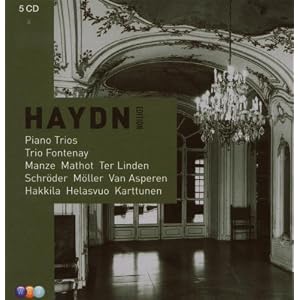
    Speaking of the fortepiano's invention, I have a set of selected Haydn piano trios on Warner that discusses how his work straddled the transition from the harpsichord to the fortepiano, and how you can tell this by how his writing for the instrument changed. The set is interesting in that the early works are recorded with a harpsichord and the later with a period fortepiano, and there is a marked difference in the writing. I don't know if I would say that piano music "came into its own" with Beethoven and Schubert, since I find that there's very little lacking in Mozart's piano concertos compared to later efforts, and even many of Haydn's late sonatas stand up well to their romantic counterparts (though I know I'm in the minority with that opinion).

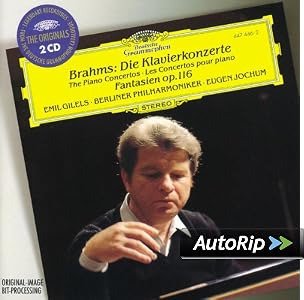
    I'm often curious as to the apparent split over the popularity of Brahms' two PCs amongst listeners and performers. Performers seem to uniformly prefer the 2nd, since it's more intricate, while most listeners prefer the 1st. I started out preferring the 1st, but over time I find myself revisiting the 2nd more. It lacks the overt drama of the 2nd, but I also think it has more subtle tones and shifts and seems slightly more coherent overall. As for recordings, I have a slight preference for Curzon/Szell in the 1st, and Gilels/Jochum in the 2nd, though there are quite a few fine performances of both. I haven't heard Gould, though.

    I really couldn't second Pollini for Schumann, though. I love Pollini as a pianist, but I've never cared for his Schumann. My (perhaps surprising) first pick would Argerich/Harnoncourt, neither of which sound like a traditional pick for Schumann, but their version on Teldec is superb. The Lupu/Previn version is also just about as good as it gets.
    "As far as we can discern, the sole purpose of human existence is to kindle a light of meaning in the darkness of mere being." --Carl Gustav Jung

    "To absent friends, lost loves, old gods, and the season of mists; and may each and every one of us always give the devil his due." --Neil Gaiman; The Sandman Vol. 4: Season of Mists

    "I'm on my way, from misery to happiness today. Uh-huh, uh-huh, uh-huh, uh-huh" --The Proclaimers

  3. #1293
    Artist and Bibliophile stlukesguild's Avatar
    Join Date
    Jul 2006
    Location
    The USA... or thereabouts
    Posts
    6,083
    Blog Entries
    78
    I'm with you in not accepting this. In fact, I really appreciate the combination of levity and profundity in much of Mozart and Haydn's work that's sadly missing in many of their successors. I've always said that I think that levity made the profound moments stand out all the more...

    Oh, I quite agree... but we live in a Romantic/Post-Romantic age regardless of the passing of Modernism, and the heart worn on the sleeve and gushing emotions (especially of the tragic sort) are imagined as inherently more profound than wit, humor, elegance, levity... or "beauty". From my experience on music forums, Mozart is THE composer of the "Big Three" whose achievements are most often called into question... especially by younger listeners. Beethoven is clearly a tragic individual... and Bach is unassailable because they tend to be less knowledgeable of the Baroque as a whole, and because there is no way to deny the intellectual and emotional/spiritual seriousness of the music. But poor Mozart... all that joy! He can't be taken seriously.

    In terms of Haydn, I'd even extend this beyond the symphonies and quartets to the piano trios and sonatas, both of which are still sadly underrated. Haydn's mature sonatas were as much ahead of their time as his mature work in the other genres, and his trios, while perhaps not as deep, contain some of the best music to come out of the classical period.

    I agree... except that I would add the masses and the two great oratorios, The Creation and The Seasons... and The Seven Last Words is also brilliant... in the original quartet form, and as a choral work.

    http://www.youtube.com/watch?v=oQ1EjrH0U3w

    Both get better with repeat listens. Someone on another board once asked if there were any horror operas, and I said the only one I know of Bluebeard's Castle, which isn't ostensibly horror, yet is still strangely terrifying. It really needs Hungarian singers, though, to get the poetry of the text right. The famous Kurtesz has better singers, but overall I prefer the Ivan Fisher version, with its superior sonics and native Hungarian cast. Pelleas is similar to Bluebeard in that, in both, atmosphere is just as important as having the best singers and right conductor, and a lot of atmosphere comes down to sound, which is probably why I love the Boulez recording, even though it doesn't have the starriest cast.

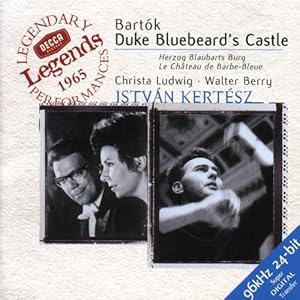
    I have the classic Kertész, Ludwig, Berry recording:


    Both the lead singers are brilliant... and being actually husband and wife brought a certain intensity to the psychological horror of the work. I was so blown away on first listen that I immediately felt the work rivaled Strauss Salome among the "horror" operas of the 20th century... and I am a sworn Straussian with multiple recordings of almost every last one of his operas.

    I recently picked up Ernest Ansermet's classic old recording (1952) of Pelleas et Melisande (along with most of his recordings of Debussy, Ravel, and the late 19th/early 20th century French repertoire). I have Boulez' recording as well... but never warmed to it. Indeed I'm not overly fond of Boulez' the conductor at all (although he does some marvelous Mahler). I feel he stress the Modernist aspects of composers like Debussy and Ravel over their 19th century Impressionist/Post-Romantic elements.

    I might also be biased in that I don't like Boulez the composer and Boulez the music critic was a jerk.

    One thing I quickly learned is that Handel was incapable of composing bad or boring music, and even his work from his early 20s (as you note) are of an extraordinary high quality. I fell in love with Glossa's series of his Italian Cantatas...

    Oh yes... I absolutely adore these. I was turned on to them my a member of a music forum who is a true Handelian. He also led me to Jordi Savall's brilliant rendering of the Water Music and Royal Fireworks which elevated these old musty warhorses into the real genius that they are.

    About the only knock against Handel's operas is that they're so consistently good... it's hard to pick that one (or those few) standouts to place amongst the best operas ever. Most critics agree on Mozart's "big four" operas, or the 5-6 best from Wagner and Verdi, but I suspect if you asked Handelians their favorite Handel opera, you'd get a lot of different answers.

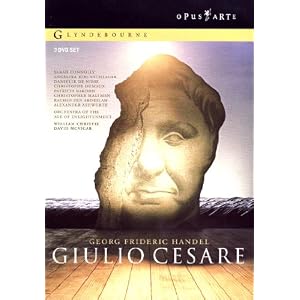
    That's been the problem. When I first began to dig into Handel's operas I asked the Handel fanatics where to start, and there were no consistent agreed upon responses... outside of Giulio Cesare... and I suspect this is due in part to the marvelous recent production:


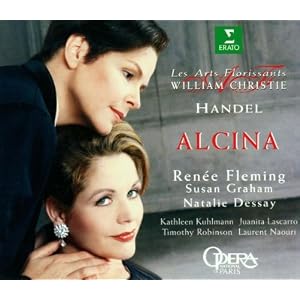
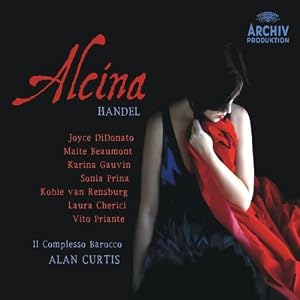
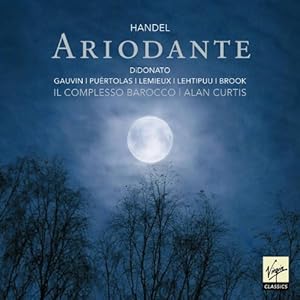
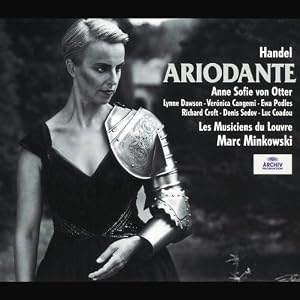
    Giulio Cesare is probably his most well-known and beloved outside Handelians, yet I think there are a few that are even better--certainly every bit its equal. Ariodante and Alcina, eg; both of which have been served by some amazing recordings.

    Indeed!


    So, yeah, you'll get no argument from me against Handel as an opera composer, or composer of any kind.

    The Baroque seems to be the period currently undergoing the greatest revival. When I first began to listen to classical music there was little available by Handel (in most record stores) beyond The Messiah, Water Music, Royal Fireworks, Organ Concertos, Concerti Grossi... and maybe one or two other oratorios Saul and Solomon, probably. Bach's whole cantatas were being recorded by Helmuth Rilling and Vivaldi was almost limited exclusively to The Four Seasons and a couple other concertos. The whole of Handel's oeuvre is now available... and many of the operas have been recorded several times and by the finest performers. Now Vivaldi is enjoying a revival. His operas are coming out of the vaults, and we are discovering that they, along with his vocal works in general, are better than his concertos... often rapidly written to the limitations of his young all-girl orchestras. Philippe Jaroussky's recording of arias by Johann Christian Bach suggests a hidden wealth there... as with recent recordings of Alessandro Scarlatti and others. I rejoice in this because I am a real fan of the Baroque... but also because I began my journey through classical music with the three big Baroque composers: Bach (The Brandenburgs) Handel (a box set of the Water Music, Royal Fireworks, and Organ Concerti) and Vivaldi (The Four Seasons and the concertos for mondolin).
    Beware of the man with just one book. -Ovid
    The man who doesn't read good books has no advantage over the man who can't read them.- Mark Twain
    My Blog: Of Delicious Recoil
    http://stlukesguild.tumblr.com/

  4. #1294
    Artist and Bibliophile stlukesguild's Avatar
    Join Date
    Jul 2006
    Location
    The USA... or thereabouts
    Posts
    6,083
    Blog Entries
    78
    For me, no Rachmaninoff cycle matches that of Earl Wild:


    ... although there are brilliant recordings of individual works... including Van Cliburn's No. 2 from the same disc as the Tchaikovsky:


    I came to Brahms' concertos in the best way possible... through the classic DG recording of Emil Gilels and Jochum:


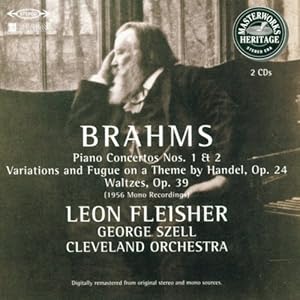
    I still love this one... but I've also come around to Szell and Fleisher:


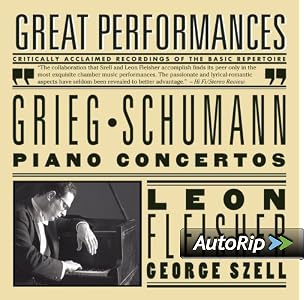
    Szell/Fleisher is also my choice for Schumann:


    Szell brought the whole of Schumann's symphonies alive for me as well by approaching them in the firm belief (which is followed through in the performances) that these works are every bit as great as the symphonies of Beethoven, Schubert, and Brahms.
    Beware of the man with just one book. -Ovid
    The man who doesn't read good books has no advantage over the man who can't read them.- Mark Twain
    My Blog: Of Delicious Recoil
    http://stlukesguild.tumblr.com/

  5. #1295
    King of Dreams MorpheusSandman's Avatar
    Join Date
    Feb 2008
    Location
    The Heart of the Dreaming
    Posts
    3,097
    Quote Originally Posted by stlukesguild View Post
    From my experience on music forums, Mozart is THE composer of the "Big Three" whose achievements are most often called into question... especially by younger listeners.
    Yes, I've noticed this as well. Whenever I hear the complaint I just point them to the quintuple invertible fugato in the coda of the 41st. Whatever one thinks about the aesthetic substance of these works, one can't listen to that with a knowledge of what's happening and not be impressed by Mozart's compositional talent.

    Quote Originally Posted by stlukesguild View Post
    I have the classic Kertész, Ludwig, Berry recording: Both the lead singers are brilliant... and being actually husband and wife brought a certain intensity to the psychological horror of the work. I was so blown away on first listen that I immediately felt the work rivaled Strauss Salome among the "horror" operas of the 20th century... and I am a sworn Straussian with multiple recordings of almost every last one of his operas.
    Musically, that recording is nearly perfect, but there's something about that libretto that, IMO, just demands native Hungarians to read it. Interesting you mention Strauss, since I'm relatively unfamiliar with his operas outside of Elektra and Rosenkavalier. He's one of the gaps in my listening, and I need to rectify that.

    Quote Originally Posted by stlukesguild View Post
    I recently picked up Ernest Ansermet's classic old recording (1952) of Pelleas et Melisande (along with most of his recordings of Debussy, Ravel, and the late 19th/early 20th century French repertoire). I have Boulez' recording as well... but never warmed to it. Indeed I'm not overly fond of Boulez' the conductor at all (although he does some marvelous Mahler). I feel he stress the Modernist aspects of composers like Debussy and Ravel over their 19th century Impressionist/Post-Romantic elements.
    I'm not a fan of Boulez at at all, and unlike yourself I don't even care for his Mahler (for a more modernistic Mahler approach I vastly prefer Gielen). However, I do love his recording of Pelleas, and much of that may have to do with the superior sound quality, since I'm also an audiophile and value the bet combinations of audio and performance quality. There are some works that demand superior audio, and Pelleas is one of them.

    Quote Originally Posted by stlukesguild View Post
    Oh yes... I absolutely adore these. I was turned on to them my a member of a music forum who is a true Handelian. He also led me to Jordi Savall's brilliant rendering of the Water Music and Royal Fireworks which elevated these old musty warhorses into the real genius that they are.
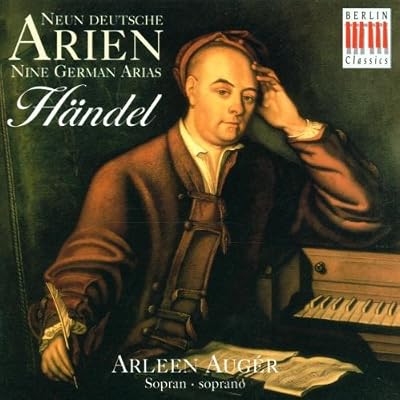
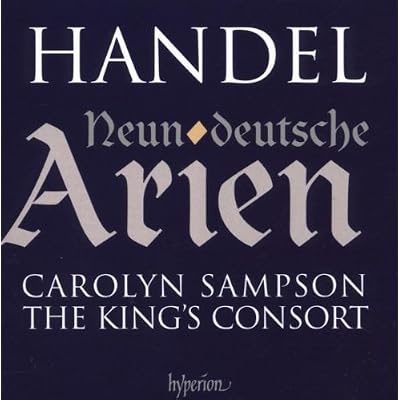
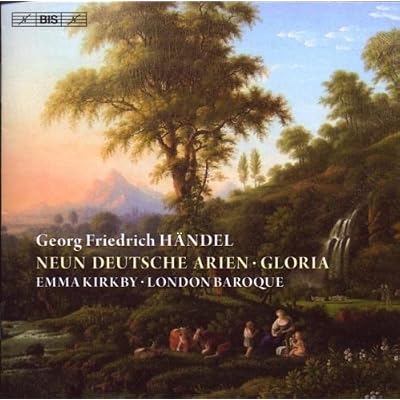
    I love Savall's recordings of those pieces as well. Another of the gems in my Handel collection are the three recordings I have of his Nine German Arias, with Emma Kirkby, Arleen Auger, and Carolyn Sampson:


    Talk about being spoiled for great baroque singers!

    Quote Originally Posted by stlukesguild View Post
    Indeed!
    Don't forget the Arleen Auger version, which may be my overall favorite:


    Quote Originally Posted by stlukesguild View Post
    The Baroque seems to be the period currently undergoing the greatest revival.
    Indeed. The explosion of Handel recordings have been, especially, a wonderful surprise, especially the Oratorio series by Robert King on Hyperion and Opera series by Alan Curtis on Virgin. Vivaldi's Complete Sacred Music on Hyperion is another gem (and also the place where I first discovered the divine Carolyn Sampson). About the only composer I feel has been (somewhat) left out has been Purcell, whom has become a favorite of mine over the last couple of months. Again I have to praise King and Hyperion for recording their complete Sacred Music (as well as Odes and Secular Solo Songs), but we need more focus on his music outside of Dido & Aeneas and The Fairy Queen.
    "As far as we can discern, the sole purpose of human existence is to kindle a light of meaning in the darkness of mere being." --Carl Gustav Jung

    "To absent friends, lost loves, old gods, and the season of mists; and may each and every one of us always give the devil his due." --Neil Gaiman; The Sandman Vol. 4: Season of Mists

    "I'm on my way, from misery to happiness today. Uh-huh, uh-huh, uh-huh, uh-huh" --The Proclaimers

  6. #1296
    Artist and Bibliophile stlukesguild's Avatar
    Join Date
    Jul 2006
    Location
    The USA... or thereabouts
    Posts
    6,083
    Blog Entries
    78
    Musically, that recording is nearly perfect, but there's something about that libretto that, IMO, just demands native Hungarians to read it. Interesting you mention Strauss, since I'm relatively unfamiliar with his operas outside of Elektra and Rosenkavalier. He's one of the gaps in my listening, and I need to rectify that.

    I'm a sworn Wagnerian and Straussian... which may be why I find Brahms the biggest composer that I struggle with. After all, he was the antithesis of Wagner. There is a certain density to his work that I find works best with his chamber works... and admittedly chamber music is the one genre I am least enamored of. I far away prefer opera, choral music, and vocal music in general followed by symphonic music, concertos, and even work for solo instrument before chamber music as a genre. Of course there are endless exception... Mozart's clarinet quintet and quintet for piano and winds and Brahms' clarinet works among these. Oddly enough, my favorite composer, J.S. Bach, is notorious for music far more dense than anything Brahms composed... and there is an element to Bach's cantatas... among my favorite works... that are far closer to chamber music in the way he groups instrumentalists and vocalists, than they are to opera or even Handel's operatic oratorios.

    Returning to Strauss... I came to him through Wagner... and he was probably Wagner's greatest heir. Salome was the opera that first blew me away. How can you lose with a libretto based on the Biblical tale of Salome and John the Baptist retold by Oscar Wilde? Teresa Stratas' performance on DVD is absolutely riveting. Strauss' operatic achievements are unrivaled among 20th century composers... and a good deal of this is owed to the fact that Strauss took care to work with some of the finest librettists... unlike Puccini, for example... much as I love his operas.

    Vivaldi's Complete Sacred Music on Hyperion is another gem.

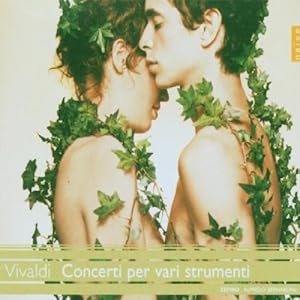
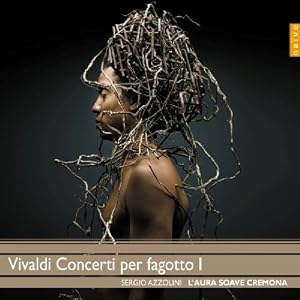
    I haven't picked that one up as of yet. Perhaps I found it a bit overpriced for a box set. However I do have a good amount of Vivaldi's vocal music of all genre. The Naive label is especially good with performers/conductors including Sandrine Piau, Magdalena Kozena, Marie-Nicole Lemieux, Philippe Jaroussky, Rinaldo Alessandrini, Concerto Italiano, Fabio Biondi and Europa Galante, Jordi Savall, etc...
    The only negative is to be found in the cover art... which often looks like rejects from a bad fashion shoot:


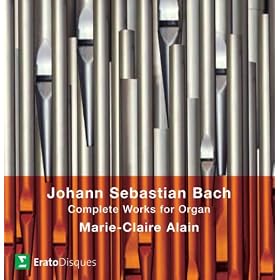
    Right now I'm listening to Bach, Bach, and more Bach... as the result of two recent box-set purchases:


    I have Helmut Walcha's early mono recordings of the organ works and any number of recordings of selected works... so I had to pick up a more contemporary recording... and went with Marie-Claire Alain highly revered second recording of the complete works. Her performance... and the sound of the organs employed... is absolutely marvelous.


    I picked up this monster set after the price dropped to just around $40 US... just pennies per disc. I already have a good many of John Eliot Gardiner's recordings of the cantatas, as well as all of those by Philippe Herreweghe, a slew of those by Suzuki, Karl Richter, Joshua Rifkin, Lorraine Hunt Lieberson, the Purcell Quartet, etc... Gardiner is my preferred choice... but Rilling recorded some of the first cantatas that I ever heard... and his performances still hold well... and for the price... well, there was really no choice.
    Beware of the man with just one book. -Ovid
    The man who doesn't read good books has no advantage over the man who can't read them.- Mark Twain
    My Blog: Of Delicious Recoil
    http://stlukesguild.tumblr.com/

  7. #1297
    Registered User FenwickS's Avatar
    Join Date
    Oct 2012
    Posts
    40
    I'm surprised by the amount of discussion around Baroque music. I personally prefer Romantic music, I am obsessed with Chopin and simply adore his Nocturnes. I do believe there's a connection between my age (I'm in my early twenties) and my strong connection to the Romantic Era and aesthetics, I feel as though the romantic in me is at its peak and I cannot compare between the sensation of hearing one of Bach's fugues, to that of hearing a romantic serenade. I also believe that will change in time and as I grow older I will become closer to the freshness of the Baroque.
    "Without art, the crudeness of reality would make the world unbearable."- George Bernard Shaw

  8. #1298
    Clinging to Douvres rocks Gilliatt Gurgle's Avatar
    Join Date
    Jun 2009
    Location
    Texas
    Posts
    2,716
    My son mentioned the highschool orchestra is currently working on Bedřich Smetana's Má Vlast Moldau (Vltava)-City of Prague
    The images in the video are amazing...

    http://www.youtube.com/watch?v=kdtLuyWuPDs

    A visit to Prague is on my bucket list.

    .
    "Mongo only pawn in game of life" - Mongo

    http://www.youtube.com/watch?v=SKRma7PDW10

  9. #1299
    Registered User Emil Miller's Avatar
    Join Date
    Jul 2008
    Location
    London, England
    Posts
    6,499
    Quote Originally Posted by FenwickS View Post
    I'm surprised by the amount of discussion around Baroque music. I personally prefer Romantic music, I am obsessed with Chopin and simply adore his Nocturnes. I do believe there's a connection between my age (I'm in my early twenties) and my strong connection to the Romantic Era and aesthetics, I feel as though the romantic in me is at its peak and I cannot compare between the sensation of hearing one of Bach's fugues, to that of hearing a romantic serenade. I also believe that will change in time and as I grow older I will become closer to the freshness of the Baroque.
    I am not surprised. There is a certain preciousness with aficionados of early music that doesn't carry conviction in the face of the obvious superior development of musical form that occurred later. It's as though the fact that post-baroque music reached an ever widening audience, it no longer became the province of a few but attracted a growing number of people to the art of music. There are few things as moving as Richard Strauss's Tod und Verklärung or as exciting as Dvorak's 7th symphony, to give only two examples of the much greater capacity of the musicians of the 19th century. Don't get me wrong; today I was playing (badly as usual) Haydn and Bach on the piano and I appreciate their obvious musicality but I can tell you that they're considerably easier to play than the piano transcription I have of the very romantic overture to Humperdinck's Hansel and Gretel opera first performed in 1893.
    "L'art de la statistique est de tirer des conclusions erronèes a partir de chiffres exacts." Napoléon Bonaparte.

    "Je crois que beaucoup de gens sont dans cet état d’esprit: au fond, ils ne sentent pas concernés par l’Histoire. Mais pourtant, de temps à autre, l’Histoire pose sa main sur eux." Michel Houellebecq.

  10. #1300
    King of Dreams MorpheusSandman's Avatar
    Join Date
    Feb 2008
    Location
    The Heart of the Dreaming
    Posts
    3,097
    Quote Originally Posted by stlukesguild View Post
    I'm a sworn Wagnerian and Straussian... which may be why I find Brahms the biggest composer that I struggle with.
    The reverse is true of me, in that I've struggled (somewhat) with Wagner and Strauss after coming to the romantics through Mozart and Haydn, but found Brahms (and Schumann) a near perfect fusion of what I loved about both periods. I've yet to even dive into Wagner's Ring cycle, because I know when I do so I won't be able to do it half-way. It's somewhat of a daunting Everest.

    Quote Originally Posted by stlukesguild View Post
    I haven't picked that one up as of yet. Perhaps I found it a bit overpriced for a box set. However I do have a good amount of Vivaldi's vocal music of all genre. The Naive label is especially good with performers/conductors...
    I have several of the Naive releases as well and they are of a remarkably consistent high quality. As for the Hyperion box set, since Hyperion are imported they can be a tad on the expensive side. I tend to watch out for Amazon sellers like FabulousCD and stores like ImportCDs for their much cheaper prices. I think Fabulous CD has the Vivaldi box set for $65, which amounts to just about $6 per disc.

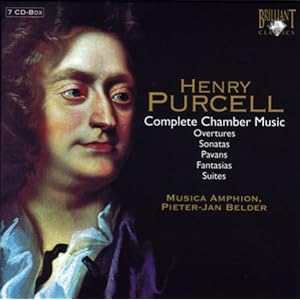
    Lately I've been listening to this menagerie:


    Thoughts: Schumann's songs are terribly underrated. He may be the greatest lied composer outside Schubert. There are so many hidden gems throughout this 10-disc set. The general thought is that Schumann's music peaked early on and went downhill after that, but I've never found this to be true, and certainly not in his lieder where there are relatively unknown masterpieces like his Op. 90: http://www.youtube.com/watch?v=zw6E8IUuP9Y (that link is actually taken from this set)

    Purcell's instrumental music is equally strangely ignored. Both of the sonata sets are just superb from beginning to end, melting with Purcell's trademark bittersweet melodies and harmonies. The keyboard suites are almost as good. Much like Handel, I've yet to hear any bad Purcell, but this is especially music I feel I could wrap myself up in and never want to leave.

    This set of Haydn's piano trios (not complete) is interesting in that it encompasses several trios performing them in different configurations, with the early works using a harpsichord and period instruments, and the later works using a more modern approach ala Beaux Arts Trio; there's even a disc that swaps the violin for a flute, purportedly because such a substitution would've been common in Hadn's day given the venue. It's a fascinating study of how elastic these trios are, and how they evolved along with Haydn and the fortepiano as an instrument. I wouldn't recommend this as a first choice, but definitely worth picking up for anyone familiar with the BAT's famous set.
    "As far as we can discern, the sole purpose of human existence is to kindle a light of meaning in the darkness of mere being." --Carl Gustav Jung

    "To absent friends, lost loves, old gods, and the season of mists; and may each and every one of us always give the devil his due." --Neil Gaiman; The Sandman Vol. 4: Season of Mists

    "I'm on my way, from misery to happiness today. Uh-huh, uh-huh, uh-huh, uh-huh" --The Proclaimers

  11. #1301
    King of Dreams MorpheusSandman's Avatar
    Join Date
    Feb 2008
    Location
    The Heart of the Dreaming
    Posts
    3,097
    Quote Originally Posted by FenwickS View Post
    I'm surprised by the amount of discussion around Baroque music. I personally prefer Romantic music, I am obsessed with Chopin and simply adore his Nocturnes.
    I don't think this discussion has been centered on Baroque at all, considering St. Lukes and I have been talking about Strauss, Wagner, Bartok, and Debussy in addition to Handel, Haydn, Bach, et al. I actually posted a few pages back that I was listening heavily to Chopin (I also added an "especially" in relation to his Nocturnes) and Brahms' Chamber Music. For me, I don't think I innately "prefer" any era, and just tend to play whatever I'm in the mood for. I get bored if I listen to any single composer, genre, or era too much, so I tend to switch it up frequently. So I went from Chopin/Brahms to a lot of Purcell and Handel, now I'm throwing in some Schumann and Haydn.

    Quote Originally Posted by Emil Miller View Post
    I am not surprised. There is a certain preciousness with aficionados of early music that doesn't carry conviction in the face of the obvious superior development of musical form that occurred later. It's as though the fact that post-baroque music reached an ever widening audience, it no longer became the province of a few but attracted a growing number of people to the art of music. There are few things as moving as Richard Strauss's Tod und Verklärung or as exciting as Dvorak's 7th symphony, to give only two examples of the much greater capacity of the musicians of the 19th century. Don't get me wrong; today I was playing (badly as usual) Haydn and Bach on the piano and I appreciate their obvious musicality but I can tell you that they're considerably easier to play than the piano transcription I have of the very romantic overture to Humperdinck's Hansel and Gretel opera first performed in 1893.
    See above: I don't think there's been an excess of baroque/classical music discussion at all. As for most of this post, I really don't know what to make of it. There's an "obvious superior development of music form" in later music? Really? It seems to me that form began to disintegrate during Romanticism. Wagner, Liszt, et al. were looking to do away with the classic forms altogether, and their influence had practically succeeded by the time of modernism. Classic forms gave way to nonce compositions that didn't have to follow any forms. I'm not exactly against this either, since I love, eg, the hulking monstrosities that are Mahler's symphonies.

    As for "post-Baroque music reaching an ever widening audience," I don't know how that's relevant or that it's even true. A composer like Purcell was a celebrity in his day, and wrote music for the theaters in which a great many of the general population attended. Handel's operas and oratorios were immensely popular as well... they weren't just composing/playing for patrons, the royal courts, and the elites. As for such pieces being "considerably easier to play," I'm not sure what that has to do with anything either, but Bach at his most difficult is not easier to play than anyone, perhaps save for Liszt at his most difficult... even then, The Goldberg Variations aren't really "easier" than a purely show-off technical piece like this: http://www.youtube.com/watch?v=2X_hOY6tEvM The challenges are merely different. Haydn always wrote relatively simple piano pieces since he was never a virtuoso and had no cause to show off.

    Last edited by MorpheusSandman; 02-03-2013 at 05:50 PM.
    "As far as we can discern, the sole purpose of human existence is to kindle a light of meaning in the darkness of mere being." --Carl Gustav Jung

    "To absent friends, lost loves, old gods, and the season of mists; and may each and every one of us always give the devil his due." --Neil Gaiman; The Sandman Vol. 4: Season of Mists

    "I'm on my way, from misery to happiness today. Uh-huh, uh-huh, uh-huh, uh-huh" --The Proclaimers

  12. #1302
    Artist and Bibliophile stlukesguild's Avatar
    Join Date
    Jul 2006
    Location
    The USA... or thereabouts
    Posts
    6,083
    Blog Entries
    78
    There is a certain preciousness with aficionados of early music that doesn't carry conviction in the face of the obvious superior development of musical form that occurred later. It's as though the fact that post-baroque music reached an ever widening audience, it no longer became the province of a few but attracted a growing number of people to the art of music. There are few things as moving as Richard Strauss's Tod und Verklärung or as exciting as Dvorak's 7th symphony, to give only two examples of the much greater capacity of the musicians of the 19th century. Don't get me wrong; today I was playing (badly as usual) Haydn and Bach on the piano and I appreciate their obvious musicality but I can tell you that they're considerably easier to play than the piano transcription I have of the very romantic overture to Humperdinck's Hansel and Gretel opera first performed in 1893.

    Come on, Emil. Art changes... but it does not become inherently better or worse. I might just as well speak of the obvious superiority of artistic form of 19th century literature as opposed to Shakespeare or Dante or 19th century painting as opposed to Michelangelo and Titian. I love Romanticism as much as anyone. Brahms, Wagner, Mahler, Schubert, Chopin, Tchaikovsky, Mussorgsky, Richard Strauss, Massenet, Berlioz, Bizet, Bruckner, Humperdinck, etc... account for a large portion of my collection of music... but in no way is the music of the Baroque... or the Classical era less moving or exciting:

    http://www.youtube.com/watch?v=0WLedpz9a40

    http://www.youtube.com/watch?v=_2zc0wTORSI

    http://www.youtube.com/watch?v=ceazCccMvzI

    http://www.youtube.com/watch?v=dnlaCenlNHk

    http://www.youtube.com/watch?v=dK1_vm0FMAU

    http://www.youtube.com/watch?v=463jDvbw3LQ

    http://www.youtube.com/watch?v=wFM9WYz6J2s

    http://www.youtube.com/watch?v=RKvd4tMkFHc

    http://www.youtube.com/watch?v=Q5RHDwdaanQ

    http://www.youtube.com/watch?v=-Qgg1IZWMdw

    http://www.youtube.com/watch?v=LxcMZl6YwNs

    http://www.youtube.com/watch?v=ZCSEEvEm3uc

    http://www.youtube.com/watch?v=8dmWAve3Pvk

    I don't see (or rather "hear") how any of this music is something affected with "preciosity".
    Beware of the man with just one book. -Ovid
    The man who doesn't read good books has no advantage over the man who can't read them.- Mark Twain
    My Blog: Of Delicious Recoil
    http://stlukesguild.tumblr.com/

  13. #1303
    the beloved: Gladys's Avatar
    Join Date
    Oct 2007
    Location
    Australia
    Posts
    1,609
    Quote Originally Posted by MorpheusSandman View Post
    The general thought is that Schumann's music peaked early on and went downhill after that, but I've never found this to be true, and certainly not in his lieder where there are relatively unknown masterpieces like his Op. 90: http://www.youtube.com/watch?v=zw6E8IUuP9Y
    Thank you for this magnificent link; I keep playing it. I suspect there is much great Schumann I'm yet to discover.
    "Love does not alter the beloved, it alters itself"

  14. #1304
    Registered User Emil Miller's Avatar
    Join Date
    Jul 2008
    Location
    London, England
    Posts
    6,499
    Quote Originally Posted by MorpheusSandman View Post
    I don't think this discussion has been centered on Baroque at all, considering St. Lukes and I have been talking about Strauss, Wagner, Bartok, and Debussy in addition to Handel, Haydn, Bach, et al. I actually posted a few pages back that I was listening heavily to Chopin (I also added an "especially" in relation to his Nocturnes) and Brahms' Chamber Music. For me, I don't think I innately "prefer" any era, and just tend to play whatever I'm in the mood for. I get bored if I listen to any single composer, genre, or era too much, so I tend to switch it up frequently. So I went from Chopin/Brahms to a lot of Purcell and Handel, now I'm throwing in some Schumann and Haydn.

    See above: I don't think there's been an excess of baroque/classical music discussion at all. As for most of this post, I really don't know what to make of it. There's an "obvious superior development of music form" in later music? Really? It seems to me that form began to disintegrate during Romanticism. Wagner, Liszt, et al. were looking to do away with the classic forms altogether, and their influence had practically succeeded by the time of modernism. Classic forms gave way to nonce compositions that didn't have to follow any forms. I'm not exactly against this either, since I love, eg, the hulking monstrosities that are Mahler's symphonies.

    As for "post-Baroque music reaching an ever widening audience," I don't know how that's relevant or that it's even true. A composer like Purcell was a celebrity in his day, and wrote music for the theaters in which a great many of the general population attended. Handel's operas and oratorios were immensely popular as well... they weren't just composing/playing for patrons, the royal courts, and the elites. As for such pieces being "considerably easier to play," I'm not sure what that has to do with anything either, but Bach at his most difficult is not easier to play than anyone, perhaps save for Liszt at his most difficult... even then, The Goldberg Variations aren't really "easier" than a purely show-off technical piece like this: http://www.youtube.com/watch?v=2X_hOY6tEvM The challenges are merely different. Haydn always wrote relatively simple piano
    pieces since he was never a virtuoso and had no cause to show off.
    I do not wish to denigrate masters of the Baroque, anymore than their predecessors, but simply to point out that music, as it developed from the early 19th century, greatly enhanced its capacity for musical expression. This occurred partly as a result of social change following the 1789 and 1830 revolutions in France and the subsequent revolutions throughout Europe in 1849: leading to a growing secularisation of society and, by extension, the arts. The cantatas of JS Bach had already given way to sonata form that gradually progressed to less formally explicit compositions that did indeed lead to the 'hulking monstrosities' of Mahler's symphonies. In speaking of 'musical form', I was not referring to the use of the diatonic scale but form in its overall sense.
    Similarly, I was not implying that the operas of Purcell, Handel etc. were not well supported, but merely pointing out that the aforementioned revolutions ushered in a great increase in the middle classes that increased the number of people who were not only appreciative audiences of music but through economic developments were able to buy an instrument, most usually a piano, and actually play music for themselves.

    It's common knowledge that JS Bach was a devotee of counterpoint and that many of his compositions are more complex as a result, but it would be foolish to deny that something as complex as the Brahms/Paganini variations for piano could have been composed by Bach or his contemporaries, even though Brahms made a particular study of Bach's music as an aid to writing his own. Similarly, Mozart, who was the favourite composer of Richard Strauss and Tchaikovsky, would have been unable to produce anything like Ein Heldenleben or the Piano Concerto No.1 in B flat minor.

    As StLuke points out, art changes and, while I agree that it doesn't mean that it does not become inherently better or worse, if music hadn't changed it would still be in the straightjacket of pre-sonata form.


    stlukesguild

    I don't see (or rather "hear") how any of this music is something affected with "preciosity".
    This is the impression I get from people who discuss early music on BBC3 ,which is devoted largely to broadcasting concerts and discussion of serious music
    "L'art de la statistique est de tirer des conclusions erronèes a partir de chiffres exacts." Napoléon Bonaparte.

    "Je crois que beaucoup de gens sont dans cet état d’esprit: au fond, ils ne sentent pas concernés par l’Histoire. Mais pourtant, de temps à autre, l’Histoire pose sa main sur eux." Michel Houellebecq.

  15. #1305
    King of Dreams MorpheusSandman's Avatar
    Join Date
    Feb 2008
    Location
    The Heart of the Dreaming
    Posts
    3,097
    Quote Originally Posted by Gladys View Post
    Thank you for this magnificent link; I keep playing it. I suspect there is much great Schumann I'm yet to discover.
    You're very welcome. In case you missed parts V-VII of that cycle: http://www.youtube.com/watch?v=a7WcYY9wtv8

    I can't recommend Hyperion's complete collection of his lieder enough. I've listened to it twice in the past several weeks. Besides the music, it has some of the best liner notes I've ever read; I actually teared up when Graham Johnson was describing Schumann's last days with Clara. Here's two more great cycles from his late songs:
    Op. 98: http://www.youtube.com/watch?v=vRNuosV8txM
    Op. 107: http://www.youtube.com/watch?v=lf_cL...Fj6WlhBJLGL_aJ
    There's also this stunning beauty: Op. 96 no. 1 "Nachtlied" http://www.youtube.com/watch?v=DOb3YZTk7lo

    Quote Originally Posted by Emil Miller View Post
    I do not wish to denigrate masters of the Baroque, anymore than their predecessors, but simply to point out that music, as it developed from the early 19th century, greatly enhanced its capacity for musical expression...
    It greatly enhanced its capacity for musical expression and, in general, declined in its ability to masterfully use the classic forms (with few exceptions like Brahms). Counterpoint practically became a lost art, and even those that studied Bach could not match his level of sophistication in such forms. The sonata form came to dominate, and then gradually dissipated in itself, becoming practically unrecognizable. Perhaps the biggest loss in this growing concern with emotional expression through music over musical expression was choral music, and there's very little in the post-baroque period that stands up with the masterpieces of Bach, Handel, and Purcell. Yes, you can find plenty of exceptions, but they tend to be quite singular exceptions. Even Haydn and Mozart, perhaps the best practitioners of choral music after Bach, only have a handful of works that stand up favorably to his Bm Mass, Matthew's Passion, John's Passion, and the best cantatas, not to mention the great oratorios of Handel and the secular and sacred choral masterpieces of Purcell and Monteverdi. As you said about not wanting to denigrate the baroque masters, I don't want to denigrate the post-baroque masters either, but there were certainly great losses to counterbalance what was gained. It just depends on what you, personally, value most.

    It's true that the middle classes gained greater access to playing and reading music themselves, but I don't think this has much to do with popularity. Theater was likely the most popular form of entertainment during the baroque period, and it gained even greater popularity when Purcell began composing music for it. There are many accounts of people going primarily for the music and only secondarily for the plays themselves. Plus, Handel's operas and oratorios were frequently huge hits that sold out wherever they played, and it certainly wasn't only the upper classes that were attending those events. It's a bit like saying that film is more popular now because more people have access to camcorders and editing software, but this has little to do with, say, theater attendance, which has actually declined (as opposed to increased) with the availability of such things.

    There's no doubt in my mind that Bach could've composed Brahms' Paganini Variations if such a style had been prevalent in his day, and the same goes for Mozart and Ein Heldenleben. Most all composer compose music that is reflective of what the popular styles of their day are. At best, they borrow bits and pieces from the past, and perhaps push what is contemporary into new territories. Bach may not have composed anything with a complexity identical to Brahms' Paganini Variations, but neither did Brahms compose anything with a complexity identical to the fugues in The Well-Tempered Clavier, so I don't really see why you're holding one type of complexity over another. It takes as much technical ability and discipline to play The Goldberg Variations as it does any piece in the repertoire. This is all a bit like saying that Shakespeare couldn't have produced anything like Eliot's The Waste Land, which is true, but it's equally true to say that no modern poet has composed a sonnet series remotely like Shakespeare's. Free verse developed in part because poets couldn't master the forms of the past, they couldn't escape the enormous shadows of their predecessors, and one could say a similar thing about the developments in music from the post-baroque periods. To me, it's nothing innately positive or negative, it's just how all arts work.

    Also, I rather detest the old falsity that classic forms (in any medium) are "straight-jackets." They're only straight-jackets and inhibitions to those whom haven't mastered them. Pre-classical forms are as diverse and malleable as any post-classical forms are. It's why a composer like Brahms, or even the modern neo-classical examples of composers like Stravinsky, could work in such forms and yet sound quite different from their predecessors.
    "As far as we can discern, the sole purpose of human existence is to kindle a light of meaning in the darkness of mere being." --Carl Gustav Jung

    "To absent friends, lost loves, old gods, and the season of mists; and may each and every one of us always give the devil his due." --Neil Gaiman; The Sandman Vol. 4: Season of Mists

    "I'm on my way, from misery to happiness today. Uh-huh, uh-huh, uh-huh, uh-huh" --The Proclaimers

Similar Threads

  1. Listening While Reading
    By subterranean in forum General Chat
    Replies: 36
    Last Post: 02-06-2011, 04:00 PM
  2. Latin making a comeback?
    By quasimodo1 in forum General Literature
    Replies: 13
    Last Post: 12-17-2007, 05:21 PM
  3. Which One Do You Like Most Among Chinese Classical Poets
    By worldwalker in forum Poems, Poets, and Poetry
    Replies: 15
    Last Post: 09-21-2007, 01:39 PM
  4. Classical and Modern Tragedy
    By arabian night in forum General Literature
    Replies: 1
    Last Post: 10-02-2005, 12:52 PM
  5. Classical Music
    By IWilKikU in forum General Chat
    Replies: 12
    Last Post: 04-17-2004, 11:54 PM

Posting Permissions

  • You may not post new threads
  • You may not post replies
  • You may not post attachments
  • You may not edit your posts
  •