


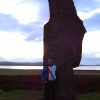
The latest poem I have been attempting to memorize is Ozymandias by Percy Bysshe Shelley. Since it was composed before 1923, I can reproduce it here:
I met a traveller from an antique land
Who said: Two vast and trunkless legs of stone
Stand in the desert...Near them, on the sand,
Half sunk, a shattered visage lies, whose frown,
And wrinkled lip, and sneer of cold command
Tell that its sculptor well those passions read
Which yet survive, stamped on these lifeless things,
The hand that mocked them, and the heart that fed:
And on the pedestal these words appear:
"My name is Ozymandias, king of kings:
Look on my words, ye Mighty, and despair!"
Nothing beside remains. Round the decay
Of that colossal wreck, boundless and bare
The lone and level sands stretch far away
The best bit is "My name is Ozymandias, king of kings. Look on my works ye mighty and despair!" I was aware of Ozymandias as a character from Alan Moore's graphic novel Watchmen, but I thought he was based on a historic figure, not a poem. I guess Ozymandius is an amalgam of an ancient Egyptian Pharoah and an ancient Persian emperor such as Cyrus the Great, and that the land kingdom was in North Africa or the Middle East somewhere. Something that interests me is that when Ozymandias was around, his kingdom must have been reasonably fertile, but has now long since turned to desert. I gather in ancient times, North African countries such as Carthage and Egypt were greener,but since then climate change or environmental degradation led to the deserts encroaching. I was also reminded of a documentary I watched about an ancient middle eastern civilization that collapsed because the irrigation they depended on gradually increased the salinity of the soil until it was impossible to grow their crops. I wondered how much Percy Bysshe Shelley would have been aware of this sort of thing when he wrote the poem in 1818.
I have a couple of other queries about the poem. Why does he say "antique" land rather than "ancient" land? Antique usually applies to artefacts, not civilizations. The line, "The hand that mocked them and the heart that fed," does not make perfect sense. Whose hand, the sculptor's or Ozymandias'. Was the sculptor mocking Ozymandias' features or was it Ozymandias mocking his court and subjects? Whose heart was it, and who was it feeding and with what? Was it, in fact, just a duff line than scanned nicely?
Here is the best recital I can find on YouTube.

 Reply With Quote

 Originally Posted by kev67


