Buying through this banner helps support the forum!
Page 20 of 24 FirstFirst ... 1015161718192021222324 LastLast
Results 286 to 300 of 359

Thread: The Visual Arts: Exploring the History of "Fine Art" and Beyond

  1. #286
    Banned
    Join Date
    Jun 2011
    Location
    Where the rain doesn't stop.....
    Posts
    763
    Blog Entries
    1
    Quote Originally Posted by stlukesguild View Post
    Thank you for showing your art…..I prefer Gerhartz’s and Coombs’ art that is full of feelings.

    There is no art that is full of feelings. A work of art is an inanimate object. The feelings are in the viewer. A work of art may inspire feelings in the viewers, but ultimately you bring these to the work. I have a response to Coombs and Gerhartz as well. I find the work overly sentimental, unrealistic, and cliche. The paintings are technically very well executed, but they strike me as pastiches of works by artists that I find far more original and far better. Artists in the same painterly tradition, including Boldini, Charles Chaplin, Anders Zorn, Watterhouse, Ingres, Girodet, Fragonard, Gainsborough, Anton Raphael Mengs, Winslow Homer, John Singer Sargent, Sorolla, Berthe Morisot, Edgar Degas, Frank Duveneck, Manet, William Merritt Chase, etc... to say nothing of Rubens, Rembrandt, Titian, Velazquez and Raphael were all far more original, far more innovative, and far better painters all around. You can't honestly express surprise if an artist you like paints in a manner that is little more than a pastiche of Impressionism or Cubism if others are likely to compare these artists to Monet and Degas or Braque and Picasso and feel that the pastiche comes up lacking. I admitted as much in connection with the artist Catherine Able, whose work I posted earlier... and admitted that it was a pastiche of Art Deco, Cubism, Tamara Lempicka, etc... While I like her work... I don't imagine that it is in any way in the same category as Lempicka... let alone Picasso and Braque.

    There are paintings full of feelings and paintings completely void of feelings. If people have vibrant bodies full of feelings, they will feel them. But I am not going into details as it is off topic.

    You are entitled to have your opinion about paintings, so I am. Please, don’t forget that it is your opinion and not the opinion of all artists or art historians. Likewise, my opinion is only my opinion.

  2. #287
    Registered User miyako73's Avatar
    Join Date
    May 2009
    Posts
    1,667
    Also, one modernist Filipino Painter named Manansala did impressive works in the 50's to 60's he called Transparent Cubism, which was original, yet you can't find his name in art history books:


    M1.jpg

    M2.jpg

    m3.jpg

    M4.jpg

    M5.jpg
    "You laugh at me because I'm different, I laugh at you because you're all the same."

    --Jonathan Davis

  3. #288
    Artist and Bibliophile stlukesguild's Avatar
    Join Date
    Jul 2006
    Location
    The USA... or thereabouts
    Posts
    6,083
    Blog Entries
    78
    We have traditions in sculptural and textile arts. But the West looks at them as exotic and too ethnic...

    Actually, that's a bias within the West as well. There are great debates concerning the divide between the so-called "fine arts" and the "applied" or "decorative arts". William Morris and the Arts and Crafts Movement, the Pre-Rapahelites, and the Bauhaus all challenged this notion... but it became re-entrenched under Clement Greenberg and other Modernist critics that used terms such as "narrative", "illustrative" and "decorative" as insults... the idea being that such works of art were less "pure".

    One of my favorite living artists, Robert Kushner...


    ...was part of the so-called "Pattern Art" movement that embraced pattern and decorative art rooted in tapestries and other decorative art forms including textile arts. Kushner traveled through the Middle-East and Japan and was struck by the absence of such a divide between applied/decorative art and "fine art". There are more than a few Western critics/historians/artists who are exploring art forms and genre once dismissed as minor in comparison with painting, sculpture, and architecture.
    Beware of the man with just one book. -Ovid
    The man who doesn't read good books has no advantage over the man who can't read them.- Mark Twain
    My Blog: Of Delicious Recoil
    http://stlukesguild.tumblr.com/

  4. #289
    Artist and Bibliophile stlukesguild's Avatar
    Join Date
    Jul 2006
    Location
    The USA... or thereabouts
    Posts
    6,083
    Blog Entries
    78
    You are entitled to have your opinion about paintings, so I am.

    The statement that a painting is an inanimate object and has no feelings is not an opinion, but a fact... unless you have some bizarre interpretation of the terns fact and opinion... or unless you can show how a painting has feeling.

    A painting can inspire feelings... but these feelings are in the audience not in the painting. Fact.

    The feelings inspired by a work of art vary between people because of the fact that the audience brings their own feelings to bear. Fact.
    Beware of the man with just one book. -Ovid
    The man who doesn't read good books has no advantage over the man who can't read them.- Mark Twain
    My Blog: Of Delicious Recoil
    http://stlukesguild.tumblr.com/

  5. #290
    Registered User miyako73's Avatar
    Join Date
    May 2009
    Posts
    1,667
    St Lukes is correct. A painting is an inanimate stimulus that can stir emotions. If you see a laughing image of a person in a canvas, it's just an image of a person with an open mouth and a distorted face. Does the painting feel happy? Nope. Is it a painting about happiness? Not necessarily. Does it make you happy? That's the question only you can answer. Even paintings which have figures that giggle make me sad. See, it is its viewer who gives emotion to a painting.


    Okay, poker game is over. I lost.
    Last edited by miyako73; 12-31-2012 at 01:29 AM.
    "You laugh at me because I'm different, I laugh at you because you're all the same."

    --Jonathan Davis

  6. #291
    Banned
    Join Date
    Jun 2011
    Location
    Where the rain doesn't stop.....
    Posts
    763
    Blog Entries
    1
    Quote Originally Posted by stlukesguild View Post
    The statement that a painting is an inanimate object and has no feelings is not an opinion, but a fact...
    This is just your opinion not a fact.

    unless you have some bizarre interpretation of the terns fact and opinion... or unless you can show how a painting has feeling.
    LOL! Well, if you don’t pick up feelings from the paintings, I am not going to explain it to you. Nobody would. As I said, you have to feel the feelings to understand what I am talking about. If you are interested to learn, I may give you some books to read so that you may understand it and evaluate your level of emotional awareness. Otherwise, I don’t want to waste your and my time. It starts with cognitive knowledge but it is the beginning and until you experience it, you wouldn’t have a clue what I am taking about.


    I have forgotten to ask you which of your paintings you presented was awarded.
    Last edited by ftil; 12-31-2012 at 03:02 AM.

  7. #292
    Registered User miyako73's Avatar
    Join Date
    May 2009
    Posts
    1,667
    My god, ftil! Do you know the meanings of "inanimate" and "object"? I seldom agree with St. Lukes; I think you don't know what you're talking about.
    "You laugh at me because I'm different, I laugh at you because you're all the same."

    --Jonathan Davis

  8. #293
    Registered User
    Join Date
    Feb 2007
    Location
    Belo Horizonte- Brasil
    Posts
    3,309
    She actually knows, she said "you have to feel" and "until you experience" and not "the painting feels" or "the painting has experience", but her desire to pull Stlukes leg is too much to admit one single agreement with him. And no cognitive theory will help out, as the majority of cognitive models focus too much on the individual. This is funny

  9. #294
    Registered User miyako73's Avatar
    Join Date
    May 2009
    Posts
    1,667
    Thanks, JC. You got that one. I did not continue to read after she said inanimate object having no feelings is not a fact. Inconsistency problem again. Damn! inconsistency.
    "You laugh at me because I'm different, I laugh at you because you're all the same."

    --Jonathan Davis

  10. #295
    Banned
    Join Date
    Jun 2011
    Location
    Where the rain doesn't stop.....
    Posts
    763
    Blog Entries
    1
    Quote Originally Posted by miyako73 View Post
    My god, ftil! Do you know the meanings of "inanimate" and "object"? I seldom agree with St. Lukes; I think you don't know what you're talking about.
    LOL! I was just curious if you were going to do what Cioran did, knowing that he was on my ignore list but for 14 pages responded to my posts.

    I guess I can expect another 14 pages..... Forums are..... delightfully entertaining.

    You have made my day.


    My gift for you.

    Rene Magritte, Le Modele Rouge

    http://store.myartmatch.com/enlarge/89442/


    Originally posted by JCamilo

    She actually knows, she said "you have to feel" and "until you experience" and not "the painting feels" or "the painting has experience", but her desire to pull Stlukes leg is too much to admit one single agreement with him. And no cognitive theory will help out, as the majority of cognitive models focus too much on the individual. This is funny
    You didn't understand what I said. I am not going to repeat it.........you already has a company.
    Last edited by ftil; 12-31-2012 at 01:57 AM.

  11. #296
    Registered User miyako73's Avatar
    Join Date
    May 2009
    Posts
    1,667
    Quote Originally Posted by ftil View Post
    LOL! I was just curious if you were going to do what Cioran did, knowing that he was on my ignore list but for 14 pages responded to my posts.

    I guess I can expect another 14 pages..... Forums are..... delightfully entertaining.

    You have made my day.


    My gift for you.

    Rene Magritte, Le Modele Rouge

    http://store.myartmatch.com/enlarge/89442/

    Didn't you just respond to my post? I thought I was on ignore. C'mon. I know you can't resist.
    Last edited by miyako73; 12-31-2012 at 02:19 AM.
    "You laugh at me because I'm different, I laugh at you because you're all the same."

    --Jonathan Davis

  12. #297
    Alea iacta est. mortalterror's Avatar
    Join Date
    Mar 2008
    Location
    LA
    Posts
    1,914
    Blog Entries
    39
    Stluke, I bet you'd probably like Tadashi Nakayama. He does a mix of modern and traditional Persian styles.
    Last edited by mortalterror; 12-31-2012 at 03:29 AM.
    "So-Crates: The only true wisdom consists in knowing that you know nothing." "That's us, dude!"- Bill and Ted
    "This ain't over."- Charles Bronson
    Feed the Hungry!

  13. #298
    Banned
    Join Date
    Jun 2011
    Location
    Where the rain doesn't stop.....
    Posts
    763
    Blog Entries
    1
    I didn't know Tadashi Nakayama.

    Nakayama begins each print by drawing the design on ordinary paper. After the design is completed, it is painted with watercolors an he may add gold and silver to help him visualize the final work. Next, Nakayama transfers each color of the design onto separate sheets of tracing paper. For example, every section of the print which will be magenta is traced onto a separate sheet of paper, every section which will be cadmium yellow is traced onto another sheet, etc....

    When all of the areas of color have been transferred onto sheets of tracing paper, the next step is to transfer the image to the woodblocks, again using one block for each of the different areas of color. Nakayama craves his blocks using chisels, awls, knives and other tools. Upon completion of the carving, he begins the printing of trial proofs. During this process, he determines the order in which the colors and the leaf gold and silver will be printed. Determining the order of colors is influenced by the shadings of color he wishes to create and it also depends to some extent on where the colors are located in the composition. For example, when certain colors are printed over others, a certain grain or striation might occur which Nakayama does not want in his print. Experience has taught him the general order of the application of colors and the optimum time for the printing of 24 carat leaf gold and silver. Nakayama's goal might be to achieve the clearest printing possible or it might be to create a kaleidoscope of brilliance by overlapping colors.

    Because Nakayama's prints are very complicated, they are very time-consuming and he is able to complete only one or two prints each year. He is the sole creator of his work and until very recent years, he did all of the work of each print. He drew the basic design, traced the colors onto the blocks, carved the blocks, printed the trial proofs and final edition. At this time, he receives some assistance in the carving of blocks and in printing. However, all stages of carving and printing are done under his supervision. He controls every stage of his creativity.
    http://www.hendricksartcollection.com/nakayama.html

    http://www.hendricksartcollection.com/nak30.html


    http://castlefinearts.com/search_res...eno=3&pn=&rpp=


    http://www.azumagallery.com/exhibiti...g%20Horses.jpg


    http://www.azumagallery.com/exhibiti...fly%20Wind.jpg


    http://www.azumagallery.com/exhibiti...g%20Horses.jpg

  14. #299
    What a shame that someone as brilliant and generous with his time as stlukesguild comes here and gives everyone, for free, an art education, and yet the thread is persistently mucked up by a couple of plonkers. Even more a shame that moderation is loose enough here to permit that to happen.

    After this post, I'll make thumbnails for the works I post.

    Robert Coombs' painting, "Almost Sundown," is, like all his works that I have seen online, nothing more than visual cliche. I'm sure he knows it. As I mentioned, he's a talented painter, which talent most shows up in his loose, free, impressionistic backgrounds, but obviously he is also a businessman who wants to make money off his art. No garret for him. And that's fine. But the rest of us can become visually educated enough to understand why paintings like this just don't sufficiently nourish the mind or the heart. They are Reader's Digest Art. If you want Shakespeare, or Dostoevsky, or even Feminist Post-Colonial Marxism, you'll have to set your sights higher.

    It's worth pursuing for a moment the literary analogy. If you are a reader and a writer and someone came along and wrote nothing but simple little stories in simple language with a formulaic plot, one-dimensional characters, simple, predictable resolutions and cheap, easy sentimentality, would that be enough for you? I should hope not.

    Compositionally, "Almost Sundown" is as basic and unchallenging as it can be: foreground, background. No visual challenge. Everything is on the surface. Easy.

    The girl's attitude and bearing, her expression, the way she twines her hair, is all formulaic. It's idealized and pedantic. Trite. The artists uses (mostly) local color to render her flesh and garments, though he becomes freer and less constricted in the background.

    I suppose the highlight of the painting is intended to be the way the sunlight plays off her hair. And it's well done. The problem is, stuff like this has been done countless times, and better. See: the Impressionists. This is what we want from art? The play of sunlight on hair? It's fine to have that. But is that all we want?

    Looking at the work, we might think: is this made at sunrise or sunset? At least that might give us something to think about. We might imagine something different about the girl's attitude and bearing, the thoughts running through her mind, if the work were made in the morning, rather than in the evening. Maybe, maybe not. But at least it would give us something to think about,

    But, no. The artist is determined to give us nothing to think about or ponder. We are offered no challenges. He has helpfully titled the work "Almost Sundown," so we aren't even allowed to reflect on the time of day depicted in the work.

    Verdict: Yawn. It's wallpaper.

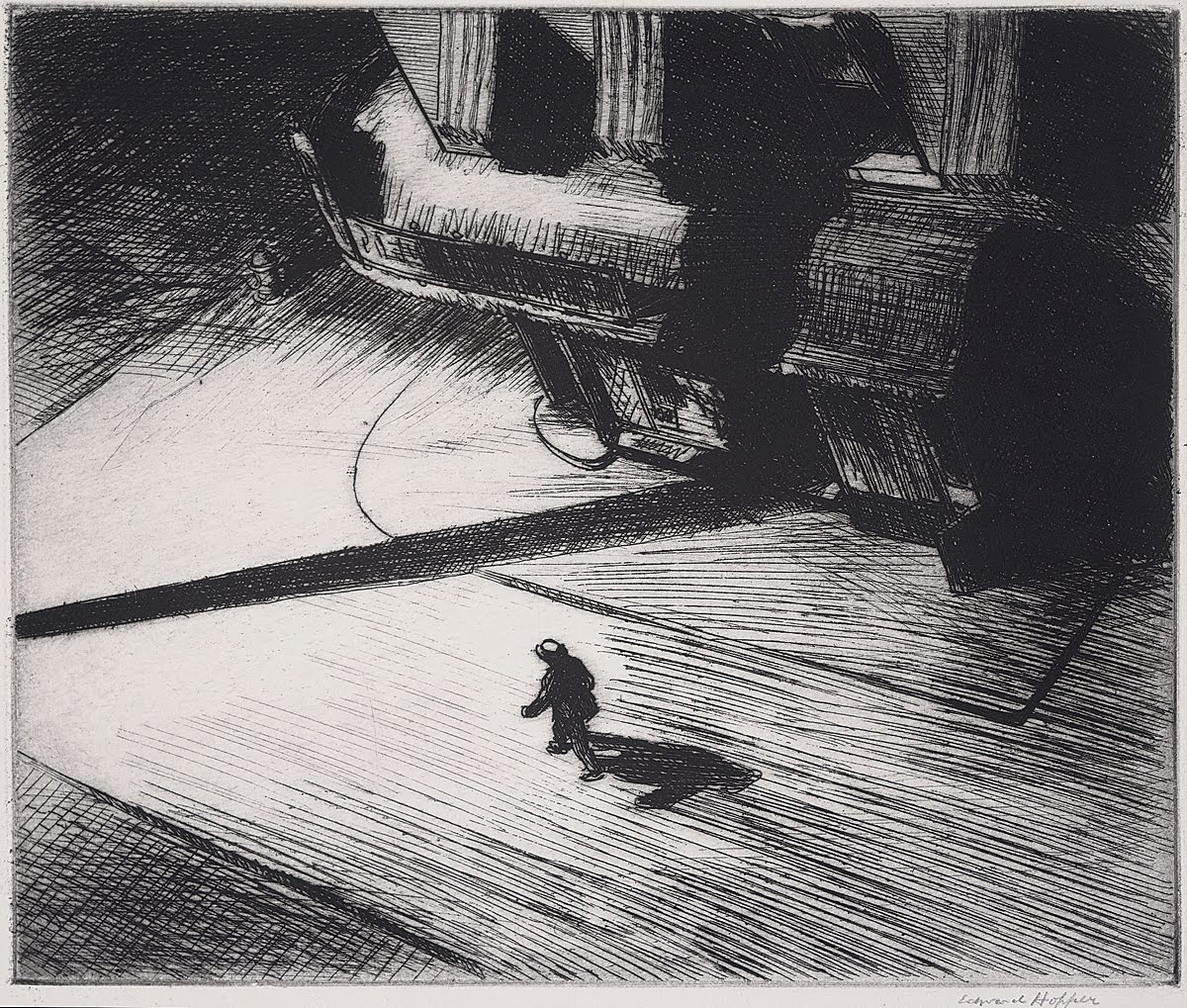
    Here's a 1921 work by Edward Hopper. It's called Night Shadows.


    Even the name sings of poetry, without giving away the meaning of the work.

    Compositionally, the work is daring and unconventional, the exact opposite of Coombs's soporific compositional cliches. It's a striking view from above, not too often seen in fine arts in general, though a staple of graphic novels.

    The inky, enigmatic shadow, that bold velvet-black line, cutting diagonally from left to right, intersects with, and provides a jarring counterpoint to, the gracefully curving expanse of the spacious white sidewalk. By itself that design is interesting to look at, even if nothing else were in the work.

    What's it a shadow of? No doubt of a streetlight. That is the source of the illumination. But as the shadow crawls up the side of the building, it becomes immense, face-like, vaguely threatening. It looms.

    Who is the man, and where is he going at this late hour? What is the storefront? We don't know. He seems to be walking at a brisk gait, and we sense that if we waited another moment, he might break out into a trot -- even into a run. Is he on some sinister mission? Or perhaps he is being pursued, and feeling threatened, in this lonely, street-lighted concrete island of the New York City night. We don't know. We are not given this information but left to ponder it.

    So much of Hopper's work is like this: enigmatic, full of isolation, asperity, foreboding and solitude. It's spooky. It reminds us that the big city, for all its hustle and bustle, its swarming mobs, is at bottom a foreboding and lonely place, a place of anomie and alienation. We're faces in the crowd. Desolation. Loneliness and death. With no solution to the riddle of why we are here or where we go, if anywhere, when we die.

    These are not the cheap, easy, facile emotions that Coombs trades in, but dark and disturbing emotions that are important precisely because they are authentic and we all must confront them whether we wish to or not. With an astonishing economy of means, and no recourse to color, Hopper has vividly evoked existentialism.

    The line work and cross-hatching by itself is expressive, and so damned interesting to look at. It is reminiscent of Rembrandt. The sharp light/dark patterns hold one's attention and prefigure Noir film of the 1940s, still two decades in the future when Hopper made this.


    Earlier I mentioned local color, and expressiveness in the visual arts. As I recall, someone took issue with my naming "expressiveness" as vital to the visual arts. I've no idea why. What is visual art, if not expression? Perhaps one could contend that some of the more extreme abstractions and simplifications of certain minimalist art are void of expression, or intended to be so, but I don't think so. Mondrian's Broadway Boogie-Woogie is one of the most expressive works I've ever encountered. Here it is:


    As to local color, what happens when the artist abandons it? Remember, local color is an attempt to reproduce as faithfully as possible the colors in the subject of the painting, the colors before one's very eyes.

    Let's look at another work with the world "night' in it. It is the Night Cafe, by Vincent Van Gogh. In it, Van Gogh abandoned local color.


    Of this painting, Van Gogh wrote to his brother Theo: "I have tried to express the terrible passions of humanity by means of red and green."

    The terrible passions of humanity by means of red and green! Not only is there expression in art, as someone earlier took issue with, but it may be done -- somehow! -- by means of red and green!

    But how?

    Red and green are complementary colors,

    What does that mean?

    Well, now we are into color theory. Color doesn't care whether you are a post-colonialist feminist Marxist, a Libertarian, a devotee of George Romney or whether your subscribe to Readers' Digest. It doesn't care about the "fiscal cliff" or anything else.

    In the painter's color wheel, there are three primary colors: red, yellow and blue. These are the linchpins of the subtractive color wheel. In the additive color wheel, such as is used in Photoshop, the three primaries are red, green and blue, and in printing cyan, magenta and yellow.

    Primary colors are colors that contain no trace of any color but themselves. That is why they are primary. They reflect the fact that the human eye is trichromatic.

    Each of the primary colors has a secondary color that is its opposite and complement. In the case of red, that color is green: which is a 50/50 mixture of the two other primaries, yellow and blue. The complement of the primary yellow is violet: a 50/50 mixture of the primaries red and blue. And the complement of the primary blue is orange, a 50/50 mixture of the two other primaries red and yellow.

    It is a curious fact about the way that the human mind is wired that these complementary colors reinforce each other. Red set against green brings out redness and greenness most powerfully. Yellow against violent brings out yellowness and violetness most powerfully. Blue against orange brings out blueness and orangeness most powerfully. This phenomenon is called complementary contrast.

    Google Joseph Albers for more on this.

    Van Gogh's painting isn't the best expression of the violent Red/Green complementary contrast, since the green of the pool-table felt is not set directly against the blood red of the walls, although the green of the ceiling does meet the red of the walls. And the painting of course contains a lot of yellow.

    The main point, though, is that by abandoning local color -- for surely the cafe did not look just like this -- Van Gogh has gained powerful expressiveness. His expression is less subtle than that of Hopper, but along the same lines: He has painted a place, he wrote, where one can go mad.

    By simple means of bold color and powerful three-point perspective, the artist has used paint by itself to pry open the door to the oubliette of the human psyche, down which he himself would ultimately plunge.

    From such simplicity does the visual arts draw upon immense resources, with searing and soaring results.

    More later.

  15. #300
    Artist and Bibliophile stlukesguild's Avatar
    Join Date
    Jul 2006
    Location
    The USA... or thereabouts
    Posts
    6,083
    Blog Entries
    78
    I actually don't like Mondrian much... and I hate Broadway Boogie Woogie. I had a college painting professor, somewhat of an Expressionist (as I was as the time) once give us a lecture on Mondrian's composition. During the lecture, I asked, "Do you REALLY like Mondrian? REALLY?" He stopped and thought for a moment, and then replied, "Well...... I really don't like Broadway Boogie Woogie. No... That's not right... I really don't like Mondrian."

    I actually like some of Mondrian's earlier works... largely because they have something of a more human touch to them. That's what I like about Sean Scully. He found a way to marry two opposite strains of abstraction: Hard-Edged Geometric Abstraction/Minimalism and Abstract Expressionism/Gesture Painting:


    I suspect my aversion to the strain of geometric Abstraction has to do with the fact that I was inundated with such as a student. A good many of my teachers were former students of Joseph Albers. The head of the painting department at my school was one of the leading figures of the Op Art movement: Julian Stanczak:


    There's a certain irony to the fact that in spite of my proclaimed aversion, geometry and pattern have become so central to my work.

    *****

    Hopper on the other hand, is brilliant. He is an example of the difference between the master craftsman and the master artist. I was able to see Hopper's Retrospective at the National Gallery a few years back. While his watercolor paintings are quite fluid and convey some of the sense of virtuosity that you find in Winslow Homer and even John Singer Sargent, his oil paintings have a certain rudimentary crudeness. I never find myself impressed by his handling of paint... let alone his drawing... which can be lumpen at times. In spite of this, the results are quite brilliant. He plays this geometry, which so well conveys a stark modern American urban landscape, against the color and isolated figures which so well convey a sense of atmosphere. Here are a few of my favorites:


    -A Room in New York


    -Night Windows

    Hopper spent some formative years in Paris and had studied the great Impressionists and Post-Impressionists. His paintings build upon the manner in which Degas, Vuiilard, and Bonnard set the viewer up as voyeurs to intimate domestic dramas. In A Room in New York we view a domestic scene through the window as if through the lens of a camera out on the balcony. The faceless man sits reading the evening paper while his faceless wife turns away and absent-mindedly plunks a few keys on the piano. They are separated by the table and the door... yet the red chair enveloping the man and the woman's red dress suggests an undercurrent of passion... unrequited desire.

    In Night Windows, Hopper takes the voyeuristic view even further. We look across the street through the windows of a neighboring apartment. We are offered but a few suggestive details. The warm summer breeze blows the curtains outward. We see the edge of the bed (draped in red) and a woman clothed only in a rose (red) towel bends over (perhaps drying her hair) offering us a view of her shapely bottom. To the right, a lamp with a red shade casts forth a crimson light like those of the Red Light District in Amsterdam. Like Jimmy Stewart playing the voyeur in Rear Window, we are led into drawing all sorts of conclusions... making up narratives... many of a rather erotic nature.


    -Office at Night

    In Office at Night we are presented with a scene of a male office worker and his secretary working late into the night. The hard simplified forms presents a setting where everything is proper and business-like... but there is something unsettling about the greenish light... which is rather hellish as in Van Gogh's Night Cafe... if not as extreme. The man and the woman are framed and brought together by the light on the wall. He looks as if he is trying all he can to remain professional... unaware of the gaze his secretary makes in his direction and her voluptuous body that is barely kept contained by her tight business attire. The curved arms of the chair behind her almost reach out to caress her full buttocks... as perhaps the man desires. The entire setting conveys the sort of understated sexual tension one finds in film noir... like a scene from The Maltese Falcon or Double Indemnity.


    -Summertime

    Hopper can create a dramatic mood from the simplest of means: a curtail blowing in the wind as a lovely red-haired woman in a clinging and semi-transparent white dress steps out of a stark white building into the blinding light of the summer sun which casts raking shadows on the walls.

    I fully realized the limitations of Clement Greenberg's theories when it came to his comments on Edward Hopper. Greenberg was unable to wholly dismiss Hopper in spite of the fact that his paintings challenged all of his theories about abstraction, narrative, American provincialism, etc... He recognized the genius of the work... but was unable to admit that perhaps Hopper just might be a great painter. The best he could offer was to suggest that Hopper represented some debased strain of literature.

    Another artist who recognized the genius of Hopper was Alfred Hitchcock. The way Hopper stages his scenes, the unexpected points of view, the single figure isolated against the modern city landscape, the psycho-sexual dramas, the sexual undercurrents in a society that was ever very proper... all of these had an immense impact on Hitchcock. And who could fail to recognize this as the very model for Norman Bates' house?

    Beware of the man with just one book. -Ovid
    The man who doesn't read good books has no advantage over the man who can't read them.- Mark Twain
    My Blog: Of Delicious Recoil
    http://stlukesguild.tumblr.com/

Similar Threads

  1. Replies: 10
    Last Post: 12-13-2010, 06:11 PM
  2. Replies: 0
    Last Post: 01-11-2010, 06:59 PM
  3. "I wanted to be fine and strong and quit the law"
    By pantherhare in forum Who Said That?
    Replies: 0
    Last Post: 04-08-2009, 05:43 PM
  4. Bertrand Russell's "History of Western Philosophy"
    By vincanity1 in forum General Literature
    Replies: 6
    Last Post: 08-31-2007, 10:58 AM
  5. "The History of Tom Jones: A Foundling" by Henry Fielding
    By lrd2004 in forum Book & Author Requests
    Replies: 0
    Last Post: 02-13-2004, 03:12 AM

Posting Permissions

  • You may not post new threads
  • You may not post replies
  • You may not post attachments
  • You may not edit your posts
  •