THE AMERICAN LIBERTY LEAGUE
Although it was savaged in the press as a silly "cocktail putsch" at the time, the actions of the American Liberty League came as close as the United States has come to overthrowing the elected President in a coup d'etat. After the extent of his New Deal plans to end the Great Depression became known, many of the wealthy industrialists in the country considered President Franklin Roosevelt at the minimum a "traitor to his class" and a pawn of "Jewish Communism". They formed the American Liberty League, no gathering of crackpots, but a roll-call of the most powerful American capitalists, a list which reminds me of the credits before a PBS show...including J.P. Morgan, the DuPonts, Andrew Mellon, the Rockefellers, E.F. Hutton, and Joseph Pew of Sunoco. The value of the Liberty League, according to one estimate, was 37 billion dollars...in 1938 dollars! (Archer 1973, 31) At the time, DuPont and Alfred P. Sloan of General Motors were in control of the powerful anti-labor National Association of Manufacturers (NAM) With the help of Joseph Pews, NAM subsidized the Sentinels of the Republic, the first industrial group to declare "the New Deal is Communist" and to openly decry the "Jewish threat". (Seldes 1943, 80, 97)
During July of 1933, two men claiming to be representing the American Legion (of which we'll hear more later) came to Major General Smedley D. Butler, looking for a man to help rally the members of the "bonus army", a group of disgruntled World War I veterans estimated at 500,000 men. These men stated that they were planning to combine the American Legion, the Bonus Army and the Veterans of Foreign Wars into a new group based on the Croix de Feu, a powerful Fascist veterans organization in France. Just a few years before, the Bonus Army had been dispersed from Washington by Douglas MacArthur. The plan of the Liberty League was to descend upon Washington with this "army" and install Butler in a position as the Director of National Security, essentially making him an "assistant President" to "help" President Roosevelt. In reality, Roosevelt would have been a mere puppet. (Archer 1973, 24-25; Seldes 1947, 210) Although it was censored from published versions of later Congressional testimony, they indicated that the DuPonts were willing to finance weaponry for the entire army. (Archer 1973, 161)
When he realized what the men wanted, Butler was aghast. He called on James Van Zandt, the head of the Veterans of Foreign Wars, in concern. Van Zandt was also approached by representatives of the Liberty League and quickly rebuffed them. Butler wanted to go to Congress and the press, but needed evidence, so he continued to meet with the men from the Liberty League, while an editor friend assigned reporter Paul French of the Philadelphia Record and the New York Post to investigate. Butler drew more names and information from the men, and thinking that he was nearly ready to "come around", they offered him $18000 in cash on 24 September 1933. The meetings continued for another year, until French broke the story on 20 November 1934. (Archer 1973, 139, 178)
When questioned by Congress, Van Zandt corroborated the plot, along with Douglas MacArthur, Colonel Theodore Roosevelt Jr., and the former Commander of the American Legion, Hanford MacNider, who were also approached by agents of the Liberty League. (Archer 1973, 176)
Nearly unknown today, Smedley D. Butler is a real hero in many respects. He turned down money and power in the service of his country, and also continued to speak candidly about his career in the Marines. He went on the radio to continue the attack against the Liberty League and groups like it, and staged a speaking tour in 1935. He wrote a book, War Is a Racket, in which he made the following statement: "I spent 33 years [in the Marines] and during that period I spent most of my time being a high-class muscle man for Big Business, for Wall Street and the bankers. In short, I was a racketeer for capitalism...I helped purify Nicaragua for the international banking house of Brown Brothers in 1909-1912. I brought light to the Dominican Republic for American sugar interests in 1916. In China in 1927 I helped see to it that Standard Oil went its way unmolested." (Archer 1973, 209, 219; Seldes 1947, 212)
Butler refused an attempt to draft him for a run against Roosevelt in 1936, but Butler did succeed in getting Congress to pass a bonus bill for the World War I veterans over Roosevelt's veto. (Archer 1973, 227) Thus rather than lead them into treason, he gave the "Bonus Army" the just due it had been demanding since 1919.
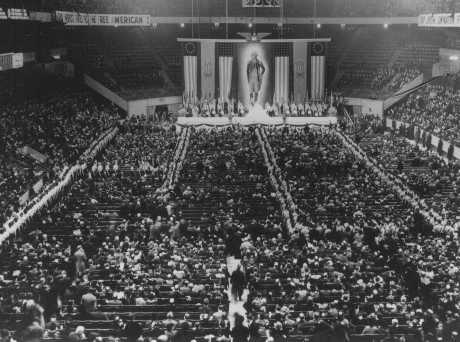
With their candidate soundly defeated, the American Liberty League collapsed after the election of 1936. (Archer 1973, 229) This was the end of the true Fascist uprising in the United States. Many groups continued, as we shall see, but they were never able to muster great monetary or logistical support from industrialists again, as they had in Germany, Japan and Italy. As a political force, anti-Semitism didn't work, as the Jews were already integrated into American society, unlike in Europe; racial hatred in America was more successfully directed against blacks, a lesson the German American Bund and other American Fascists learned (fortunately) too late. After the collapse of the Liberty and the assassination of Huey Long, the contest for control of the American government moved from brute unconstitutional force to political oratory. (Ward 1935, 56)



Originally Posted by kiki1982