How would you describe the characteristics of postmodern literature? Do you believe that postmodernism has depth, considering it tends to focus on the surface description?


How would you describe the characteristics of postmodern literature? Do you believe that postmodernism has depth, considering it tends to focus on the surface description?
Umberto Eco one commented that postmodernism had become useless, because to fans it meant 'things that I like', and to opponents it meant 'things that i don't like'.
Let's have a better and more definite philosophical movement. H0w about "reality"? It will be based on the worls as it actually is, rather than as some people might want it to be.
I feel that, in many ways, postmodern literature shows exactly that. People tend to focus on the surface of things without getting into the very core and meat of who another person is or what things mean. If you walk down the street and look at other people, all you see are their meaningless faces which go in and out of your mind as quick as lightening. There is nothing deeper there unless you actually stop and reflect on each individual. PoMo focuses on the surface of who characters are and allows the reader to dive into the deeper meaning independently. It is almost like meeting a person and, in the beginning, they are just a face and through time and refection, their true self emerges. PoMo displays the person as just a basic character and then, through time, allows the reader to develop them independently.Originally Posted by PeterL

I don't know that I am necessarily a fan of PoMo for this very reason, but I am trying to give it a chance. I tend to like juicier stories with lots of descriptive writing and deep characters and PoMo literature does the exact opposite.
If we take art for example, Van Gogh's "a pair of shoes" would not be a postmodern work of art.
This image of shoes tells a story deeper than the shoe itself. It tells a time based on the style of shoe, perhaps the occupation of the shoe's wearer, a socio-economic class, etc. The shoes have too much of a story there.
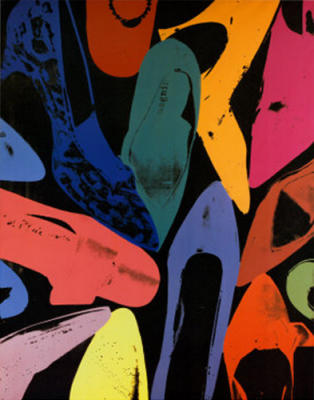
However, on the flip side, Andy Warhols Diamond Dust Shoes would be considered Postmodern because it is simply...shoes. Nothing more. There is not much to be said for the wearer of the shoes or the story behind the shoes. It is surface level. Nothing deeper.
My question is what can we take from Postmodern literature? What is the purpose of it? How does it apply to our world today? What's the reasoning for it at all? These are things that I wrestle with because many people say that Postmodern literature and art has depth in its own way. I want to know how it does and in what way it does.
if there are fans of Postmodern lit, please help me out
I like PMLondonderry already. Welcome to the forum!
I'll read over this a little closer tomorrow, when my brain is more awake.
Umberto Eco once commented that "postmodernism" had become useless, because to fans it meant 'things that I like', and to opponents it meant 'things that i don't like'.
Unfortunately, I think Peter is largely correct in that the term "Postmodernism" has never been clearly defined to the point that it might be obviously differentiated from "Modernism". I'm not certain the notion that Post Modernism is limited to the mere surface and lacks depth is a fair assessment... surely not if J.L. Borges, Gabriel Garcia Marquez, Italo Calvino, Umberto Eco, Jose Saramago, Anne Carson and others can be counted among the Post-Modernists.
The same holds true for the visual arts. Pop Art is commonly identified as the point of departure from Modernism. Where the Abstract Expressionists and late Modernists held firm to the tradition of "fine art" or "high art" and embraced the necessity of artistic progress or search for the new and fully believed in Romantic notion of the artist as visionary and prophet, the Post-Modernists rejected the dichotomy of "high art" and "low art" and often blurred the boundaries between traditional "high art" and "low art" or popular culture. The Post-Modernists also made free use of irony, satire, and even humor... rejecting the pretentious Romantic notions of the artist as prophet and visionary. Finally, the Post-Modernists had little interest in the continual search for the "new" or novelty, but rather saw the whole of art history as one vast palette from which to pick and choose.
Warhol certainly represents one voice of Post-Modernism... and a shallow voice indeed. But to cite him as representative of the movement is misleading. Any of the following artists were also Post-Modernists:
R.B. Kitaj- If Not, Not Kitaj blurred sources from popular culture and art history while confronting issues as profound as Auschwitz and the Nuclear Holocaust.
Francis Bacon- Three Studies for a Crucifixion Bacon created icons to the violence and horror of the 20th century drawing upon Renaissance altarpieces, Picasso, film, medical photographs, the photography of Edward Muybridge, photographs of Hitler and Stalin, etc...
Lucian Freud- Portrait, the Big Man A close friend of Francis Bacon and a grandson of Sigmund Freud, Lucian fully rejected the striving for formal innovation and focused upon the human figure. His major predecessors were Rembrandt, Velasquez, and Hals.
Chuck Close- Self Portrait- An equal master "realist", Close explored the image of humanity as filtered through the mechanical process of photography.
Ed Paschke- Bluelight- Like Close, Paschke explored the imagery of our world as filtered through the media.
Eric Fischl- New House- Building upon Edward Hopper and film noir, Fischl explored the psycho-sexual world of the American suburbs.
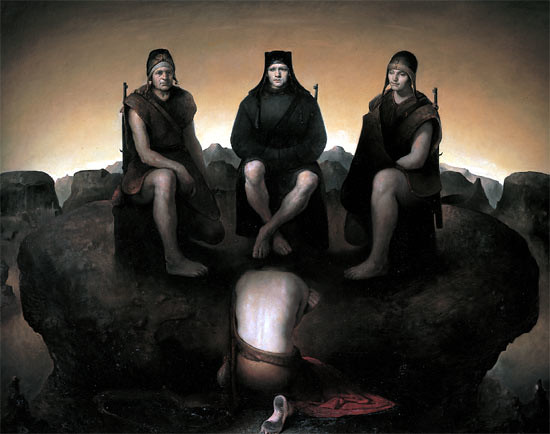
Odd Nerdrum- Seed Protectors- As an art student, Nerdrum struggled with Modernist classmates who rejected his paintings rooted in the techniques of the "old masters". His imagery employs a Mad Max, post-Apocalyptic view of a world that is at once archaic... and modern... in a style that is at one archaic and modern.
Antonio Lopez-Garcia- Ice Box- Like Nerdrum, Lopez-Garcia views a world that is at once as old as it is new. His canvases are encrusted and weathered as ancient Roman frescoes... and yet his imagery is of contemporary Spain.
Avigdor Arikha- Shirt- Abandoning the formalist innovations of abstraction and the pretensions of Modernist painting, Arikha gave up painting altogether for 7 years. The close friend of Samuel Beckett eventually returned to painting the small realities of his day to day life, declaring that history is too big... Auschwitz is too big to paint, so "I paint a tomato."
Aron Wiesenfeld- NorthWest- Begining his career as a cartoonist, Wisenfeld turned to painting bringing a strong sense of "narrative"... one of the elements most rejected by Modernist purists wishing to avoid the "literary" of "illustrational".
Clearly, none of these examples of Post-Modern painting can be easily dismissed as lacking depth or being wholly about surface.
Ultimately the term "Post Modernism" has become meaningless for the simple reason that there is no dominate voice of Modernism against which one may rebel... and there is no dominant voice that represents Post-Modernism vs any number of other "-isms".
Beware of the man with just one book. -Ovid
The man who doesn't read good books has no advantage over the man who can't read them.- Mark Twain
My Blog: Of Delicious Recoil
http://stlukesguild.tumblr.com/

Postmodern is just a term that people like throwing about to explain pretentious obscurity.
People take from postmodernism whatever they want to take. people put into postmodernism whatever they want, so t in and of itsself says nothing about the world,
I've always had a pretty simple, personal definition of what PoMo is, and that just anything that's like modernism, only weirder, or taken to another level. I think it's about as good of a measure as anything else. Pynchon, Vonnegut, some of Borges, even Joyce--all strike me as being within the realm of PoMo.
Thank you very much for a really good explanation. I have been having a hard time really grasping the whole point of Postmodernist theory (probably because you are absolutely right that it is very hard to define concretely.)
Using the art to explain it was the best tool that was used to explain it to me. While Andy Warhol is a great example, he certainly isn't the representative. He was used as an example only.
I can definitely see how the paintings that you presented would be considered Postmodern (and I really don't like any of them. I think Postmodernism and I arent going to get along but I still want to stick with it so I at least can understand it), but Odd Nerdrum- Seed Protectors spoke to me on a much deeper level than the other paintings. Would you say it is postmodern because of the fact that the artist used different techniques instead of focusing on one classical technique?
"If I knew for a certainty that a man was coming to my house with the conscious design of doing me good, I should run for my life." -Thoreau
Ní mar a dtarraingím mo chuid anála ach mar a dtugaim mo ghrá a bhfuil mé i mo chónaí
(Not where I breathe but where I love, I live)
I think the reason why I can't grasp PoMo with both hands is because it doesnt have a really clear and concrete definition. It's funny that this bothers me because, in my own personal life philosophies, I tend to stay far far away from "defining" things. It's ironic that while I like to blur the lines of definitions to human beings, I can't grasp blurred lines in literary theory!
When I asked a professor of mine what Postmodern is and what was it trying to prove, she simply said "it's just the way things are" and I sort of stood there lost again. All I can really do, at this point, is read the articles and books and try to come to my own conclusions. It seems to me that its definition is relative entirely to the reader.
"If I knew for a certainty that a man was coming to my house with the conscious design of doing me good, I should run for my life." -Thoreau
Ní mar a dtarraingím mo chuid anála ach mar a dtugaim mo ghrá a bhfuil mé i mo chónaí
(Not where I breathe but where I love, I live)
To me, something is post modern when the writer is really playing with the reader by pushing the ideas of what literature should be. Really skewed timelines, odd narrative styles, absurdism (that's definitely key to Pynchon and Vonnegut), all are what makes something PoMo. Note that all of these things, except maybe absurdism, can also be seen as modernist, but PoMo really pushes it.
An example of something post modern would be the author inserting himself into the story. Borges did this often, and is probably one of the only authors to actually make it work.
Really helpful insight that I will definitely consider when I have to read PoMo literature. As for authors inserting themselves into the story, I feel that perhaps I will have to use this as a sign of Postmodernism when I read a book that was written during the 1970s-90's when PoMo literature was, arguably, at its height. Since Chaucer also put himself into his stories, I might have a hard time using this as a tool to distinguish between PoMo and modern.
However, it will be interesting to see if this is a tool that any of the authors of the books that I am assigned to read in my Black Literary Postmodernism class will use.
Last edited by PMLondonderry; 02-07-2012 at 02:41 PM.
"If I knew for a certainty that a man was coming to my house with the conscious design of doing me good, I should run for my life." -Thoreau
Ní mar a dtarraingím mo chuid anála ach mar a dtugaim mo ghrá a bhfuil mé i mo chónaí
(Not where I breathe but where I love, I live)
One author who I think has been able to make postmodernism really work for them is Paul Auster. His New York Trilogy for example takes the relatively simple idea of a series of detective stories and twists the whole concept into an analysis of solitude, identity and human obsession.
And yes, in reference to previous comments, he does make an appearance in his own book, right there on page 7.
"Mere flim-flam stories, and nothing but shams and lies." - Sancho Panza, in Don Quixote, pt. 1, bk. 3, ch. 11 (1605)

Part of the problem is that not all critics believe postmodernism even exists. Some would argue that it is just a continuation of modernism and not really distinct in anything other than theme. On the other hand, some maintain not only that pomo exists, but that we are in a post-pomo moment. It's difficult to define what will be the defining features of an era while still living in that moment.
One thing to consider is the influence of post-structuralist philosophy and psychoanalysis. These emerged in the 50s-80s, and so we have an influx of new ideas about representation, meta-narrative, truth, cognition, and aesthetics that were not available to the modernist. One hallmark of postmodernism is then an artistic representation of these pomo philosophies at work. The other major hallmark, as pointed out by Stlukes, is the break down in distinction between high and low art.
We might also consider the influence of new media: pomo literature is at least partly characterized by the influence of television, cinema, pop music, and increasingly the internet.
"If the national mental illness of the United States is megalomania, that of Canada is paranoid schizophrenia."
- Margaret Atwood
Postmodern is just a term that people like throwing about to explain pretentious obscurity.
So where does that leave us when confronting such iconic Modernist works as Ulysses and Finnegan's Wake, Proust's Cantos, T.S. Eliot's Wasteland, the later poems of Yeats, etc?
Indeed... where does that leave with regard to John Donne?
Are we to assume that difficulty is always proof of a pretentious attempt at obscurity... or is it not equally possible that a writer creates for an audience not unlike himself or herself, that an author like Joyce or Eliot is writing for an audience that is just as well-read as themselves?
Beware of the man with just one book. -Ovid
The man who doesn't read good books has no advantage over the man who can't read them.- Mark Twain
My Blog: Of Delicious Recoil
http://stlukesguild.tumblr.com/
 Posting Permissions

 Reply With Quote