Thank you. That is all I have been trying to say.Originally Posted by mortalterror


Thank you. That is all I have been trying to say.
Exactly. It might not be a popular opinion, but the fact remains that the majority of people have very little grasp of culture, science or technology. How can we strive to become better and yet at the same time pretend that everyone is equal? That doesn't make sense.
I've heard this argument often. The thing is, I don't think that's fair to poor kids, especially in modern times when information is easy to access. This idea is outdated, money isn't a prerequisite to being considered an academic "elite" anymore. You can do a lot with a library card or a computer and a work ethic. Even someone with very little money can take full advantage of the education and chances that the government now provides and get far. Anyone could take the initiative to become educated, I come from a family of coal miners and prison guards and wasn't born with much; making excuses for me and others from my socioeconomic background is somewhat condescending (although I know you don't intend it that way). Almost every single person at my university is at least as poor as I am, we all eat pasta and work sh*tty part-time jobs and yet we can build computers from scraps, discuss classic literature and explain angiosperm reproduction in intricate detail.
Last edited by JuniperWoolf; 01-19-2012 at 08:48 AM.
__________________
"Personal note: When I was a little kid my mother told me not to stare into the sun. So once when I was six, I did. At first the brightness was overwhelming, but I had seen that before. I kept looking, forcing myself not to blink, and then the brightness began to dissolve. My pupils shrunk to pinholes and everything came into focus and for a moment I understood. The doctors didn't know if my eyes would ever heal."
-Pi


Yes but I wouldn't call it culture, sub-culture is more like it and even that may be stretching a point.
"L'art de la statistique est de tirer des conclusions erronèes a partir de chiffres exacts." Napoléon Bonaparte.
"Je crois que beaucoup de gens sont dans cet état d’esprit: au fond, ils ne sentent pas concernés par l’Histoire. Mais pourtant, de temps à autre, l’Histoire pose sa main sur eux." Michel Houellebecq.
However you rationalize it, or turn it around and around and around, the fact remains that culture is falling, has already fallen in a large perentage, and this needed to happen to insure freedom of choice for the common man. Today the economic elites are cooperating with the common man and this socialism is unstoppable. Of course, it's not communism, which we demonstrated was completely stoppable.
No it isn't, chicken little. There has ALWAYS been garbage in every time period's culture. Don Quixote was a satire on old knight-errant penny novels. Ask Pip about some of the bad-to-the-point-of-being-funny classic books that he's been reading recently.
__________________
"Personal note: When I was a little kid my mother told me not to stare into the sun. So once when I was six, I did. At first the brightness was overwhelming, but I had seen that before. I kept looking, forcing myself not to blink, and then the brightness began to dissolve. My pupils shrunk to pinholes and everything came into focus and for a moment I understood. The doctors didn't know if my eyes would ever heal."
-Pi
Three words: Castle of OtrantoAsk Pip about some of the bad-to-the-point-of-being-funny classic books that he's been reading recently.
I think this statement applies to almost every single person at most universities. Pasta and ****ty jobs is the thing to do at our age.
I wrote a poem on a leaf and it blew away...
Yes, there has always been garbage after every dinner. However, what I'm talking about is not garbage. It's where we are going, and it is unstoppable because it's the natural way of the future in freedom, evolution and globalizations. You are missing the point.
cool story bro
Yeah, what are you talking about?
__________________
"Personal note: When I was a little kid my mother told me not to stare into the sun. So once when I was six, I did. At first the brightness was overwhelming, but I had seen that before. I kept looking, forcing myself not to blink, and then the brightness began to dissolve. My pupils shrunk to pinholes and everything came into focus and for a moment I understood. The doctors didn't know if my eyes would ever heal."
-Pi
Definitely not talking about "yeah."
I was talking about university the other week. What % of the poor kids actually go? I'm all for a fairer society that gives people the opportunity. Kids with intelligence and ambition will, and have always, done well - extra well because of the barriers that exist for them that just don't for those from a priviledged background.
I see a sweeping generalisation about "the masses" from from someone who has the priviledge of having the best educational opportunities, and I feel I have to respond. I don't begrudge anyone what they or their parents have earned. Good luck to them, and all the best. It's the setting up of one group against another - worth against worthless - that really annoys me. Of course most of the masses haven't contributed as much to culture. It's obvious. My Mother in Law left school at 14 to work in a factory, as did most of the kids of her generation in the 30's and 40's. Not only were they not expected to contribute, but the expectation was that you worked hard for what you got. And that's when things were improving. In the previous century you had to be someone special to get anywhere. HG Wells toiled as an apprentice until he was able to devote time to writing.
Nowadays, as you point out, there has been a democratisation of knowledge. There definately are more opportunities, better education and better living standards. It does contribute to the opportunities, and that's fantastic. There are still barriers though for many, and these relate to money, ambition and example of the parents, and all those other things that don't necessarily come easily to those of us who have had to work hard to get where we are. The barriers are still there - we get people through our door who are feeling the effects of poverty, lack of opportunity etc decades after.
My son's year group consisted of maybe 200 kids - all boys, boys' school. I asked him how many went to university, and he said 8 or 9. That's a poor showing by any standard. There are other routes of course, and some may go later. But where will they all be now? They'll be one of the masses that our friend talks of. Written off almost in a few words.

You had me at angiosperm reproduction
Last edited by tonywalt; 01-19-2012 at 08:53 PM.
Well everyone can discuss any subject in detail with Google at their disposal; whether they actually know what it means is another matter.
"L'art de la statistique est de tirer des conclusions erronèes a partir de chiffres exacts." Napoléon Bonaparte.
"Je crois que beaucoup de gens sont dans cet état d’esprit: au fond, ils ne sentent pas concernés par l’Histoire. Mais pourtant, de temps à autre, l’Histoire pose sa main sur eux." Michel Houellebecq.

By the way, you know more about the Dutch Golden Age than I do, so it was to you I was looking for corroboration or possible correction about how big a role the middle class played.
Oh yes... the so-called Golden Age of Dutch painting was built upon a huge shift in the patronage of art. Where the patrons of almost all art prior were aristocratic (whether secular or religious... in the sense of the patronage of the aristocracy of the church: cardinals, Bishops, Popes, etc...) it was the upper-middle class... the burgher or bourgeois... who became the chief patrons of art. The result is clearly evidenced in a comparison of the works by Dutch artists such as Rembrandt, versus that of Belgian artists such as Rubens. Rembrandt and his compatriots worked to meet the desires of the bourgeois for paintings of a modest scale preferably on subjects such as the Dutch landscape:
Still life paintings that exhibit the wealth of the bourgeois in the form of exotic fruit (lemons), exotic sea food (lobster) and expensive china and glasswear:
moralizing interior scenes:
and portraits showing one's modesty and piety:
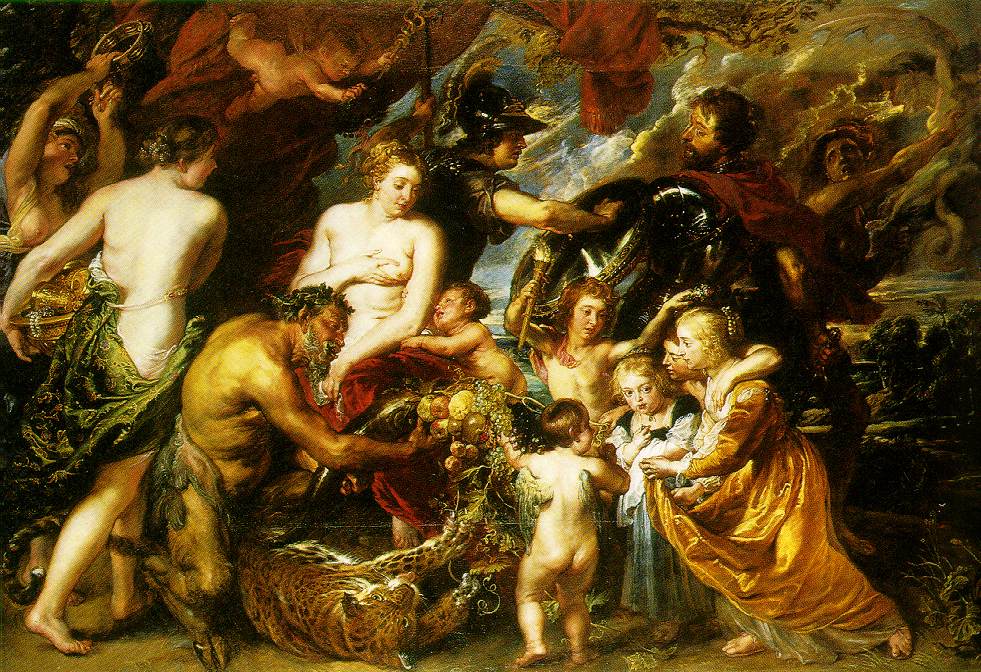
All these may be seen in contrast to the grandeur of scale and flamboyance of the Belgian paintings intended for an aristocratic audience in which dominant themes included mythological narratives:
-Perseus/Rubens
religious narratives:
-Samson/Van Dyck
-allegories:
-Allegory of Peace/Rubens
-erotic narratives:
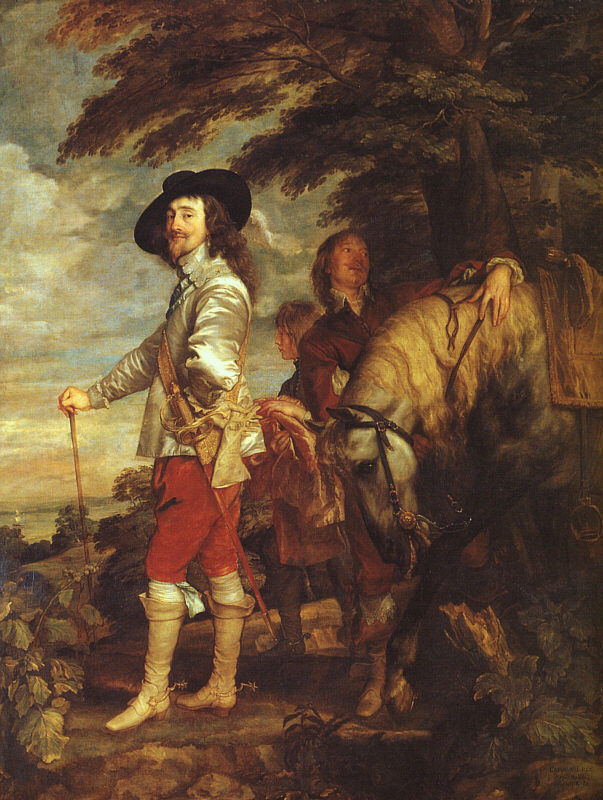
and portraits that stressed flamboyance and color:
Belgian artists such as Rubens might paint landscapes for themselves which later became quite prized by British artists... but the closest thing to the Dutch landscape that might be commissioned by an aristocratic buyer would be something like a grand hunting scene (hunting being a privilege reserved to the aristocracy):
Personally, I spite of the emotional depth of Rembrandt and the jewel-like perfection of Vermeer, I greatly prefer the color, the audacity, and the sensuality of the art of the aristocracy.
Along with the shift in patronage came the intermediary art dealer. Where the painters such as Rubens and Van Dyck would have dealt directly with the aristocratic patrons... and as such have needed to have been well-spoken, educated, and well-versed in the manners of the court, the Dutch burgher class had little time of inclination to learn about art or artists or to develop a personal relationship with them. Art became a commodity marketed by the middleman: the art dealer. It shouldn't be surprising that it is to this period that we can trace the beginning of the hostility between the artist and the bourgeois or the middle-class
Beware of the man with just one book. -Ovid
The man who doesn't read good books has no advantage over the man who can't read them.- Mark Twain
My Blog: Of Delicious Recoil
http://stlukesguild.tumblr.com/
However you rationalize it, or turn it around and around and around, the fact remains that culture is falling, has already fallen in a large perentage, and this needed to happen to insure freedom of choice for the common man. Today the economic elites are cooperating with the common man and this socialism is unstoppable.
As usual, you have completely missed the point... let alone the facts. The popular arts are certainly dominated by the tastes of the masses... for the moment. But that which remains and survives over time remains in the hands of an "elite" audience comprised of subsequent artists, critics, historians, and other academics... as well as that portion of the audience who actually follow the arts. The traditional art forms such as painting, sculpture, architecture, etc... remain almost wholly unaffected by the opinions of the masses for the simple reason that they make no economic impact upon these artists.
Beware of the man with just one book. -Ovid
The man who doesn't read good books has no advantage over the man who can't read them.- Mark Twain
My Blog: Of Delicious Recoil
http://stlukesguild.tumblr.com/
 Posting Permissions

 Reply With Quote
 And then they become one of the elite.