Buying through this banner helps support the forum!
Page 6 of 12 FirstFirst 1234567891011 ... LastLast
Results 76 to 90 of 172

Thread: mythology and religion in art

  1. #76
    Registered User billl's Avatar
    Join Date
    Apr 2009
    Posts
    2,012
    Quote Originally Posted by stlukesguild View Post
    Again, the painting is by William-Adolphe Bouguereau and is entitled Evening Mood. You may find a great wealth of Bouguereau's work at this site:

    http://www.artrenewal.org/articles/M...ar_Artists.php
    St. Lukes, you are undoubtedly mogarbobac's best hope around here, but the mission isn't quite the one you've been working on. They are looking for a similar painting with some particular elements not found in this one.

  2. #77
    Banned
    Join Date
    Jun 2011
    Location
    Where the rain doesn't stop.....
    Posts
    763
    Blog Entries
    1
    Quote Originally Posted by Paulclem View Post

    Do you have a problem with authority? Questioning is good, but don't you think there needs to be a purpose resolved in the end? In this thread I see you putting up these brilliant images with no interpretation, no linking idea and no input from you. The brief to encourage people to do their own investigation - to what? At some point there nees to be a guide, a premise and discussion. The guide is you - what's your thoughts?

    Well, I don’t want to influence people what I think for a couple of reasons. Firstly, I want to use as less as possible words to keep the reader in a right brain as images help to access unconsciousness.

    Secondly, we have been trained to be passive and not to question. In fact, there were researches done in US a decade ago according to which 2/3 American don’t have the ability to think critically at all. I don’t want to be a part of the problem. I also don’t want to be engaged in meaningless discussions that take me away from my research. By meaningless discussion I mean discussion where people fight to death to defend their beliefs rather than questioning. I love discussion that provide mental stimulation that fosters my growth.

    Thirdly, it is interesting that you ask for interpretation and guidance. Sorry, but only children need guidance and interpretation. It would be very disempowering and disrespectful to treat adults like children. After all, life is about personal growth and personal truth.

    Finally, I do have a problem with authorities. Show me the authority who is opened to criticism and challenge. Most of them become so defensive when criticized or challenged. But I love authorities who are open minded, not being afraid of any challenges.

    I would rather go back to mythology. Underworld gods are quite interesting.

  3. #78
    TobeFrank Paulclem's Avatar
    Join Date
    Jul 2009
    Location
    Coventry, West Midlands
    Posts
    6,363
    Blog Entries
    36
    I do have a problem with authorities. Show me the authority who is opened to criticism and challenge. Most of them become so defensive when criticized or challenged.

    It is interesting that you say this.

    And then this.

    Thirdly, it is interesting that you ask for interpretation and guidance. Sorry, but only children need guidance and interpretation. It would be very disempowering and disrespectful to treat adults like children. After all, life is about personal growth and personal truth.

    I find this a bit defensive if not rather abrasive. Anyway I was just making a suggestion generally not particularly for myself. No worries. I won't bother you anymore.

  4. #79
    Banned
    Join Date
    Jun 2011
    Location
    Where the rain doesn't stop.....
    Posts
    763
    Blog Entries
    1
    Quote Originally Posted by Paulclem View Post
    [COLOR="DarkRed"]

    I find this a bit defensive if not rather abrasive. Anyway I was just making a suggestion generally not particularly for myself. No worries. I won't bother you anymore.

    Well, I said that we didn’t have that much in common….But you haven’t paid attention, and as such, you have forced me to be more direct. BTW, you can only speak for yourself. I am sure that there are people who enjoy freedom of not being told what they should think.

  5. #80
    Banned
    Join Date
    Jun 2011
    Location
    Where the rain doesn't stop.....
    Posts
    763
    Blog Entries
    1
    Before I go back to gods of darkness, I want to post paintings I like very much.

    Gustave Moreau


    Saint Sebastian and the Angel


    Apollo Vanquishing the Serpent Python


    Cleopatra


    Desdemone


    Goddess on the Rocks


    Hesiod and the Muses


    Leda 2


    The Suitors - detail


    Phaethon

  6. #81
    Artist and Bibliophile stlukesguild's Avatar
    Join Date
    Jul 2006
    Location
    The USA... or thereabouts
    Posts
    6,083
    Blog Entries
    78
    St. Lukes, you are undoubtedly mogarbobac's best hope around here, but the mission isn't quite the one you've been working on. They are looking for a similar painting with some particular elements not found in this one.

    Missed the text beneath the oversized image:

    in the painting im looking for is a woman in a white silk see-thru gown, she has curly hair and wears laurels. shes standing under a archway or doorway looking at small birds bathe in a saucer. it seems to be a Romanesk or greek painting judging by the architecture but i believe it might be made within the 18th century. i had a print of it and lost it and having a hell of a time finding it again. please help ty


    John Reinhard Weguelin- Lesbia
    Beware of the man with just one book. -Ovid
    The man who doesn't read good books has no advantage over the man who can't read them.- Mark Twain
    My Blog: Of Delicious Recoil
    http://stlukesguild.tumblr.com/

  7. #82
    Banned
    Join Date
    Jun 2011
    Location
    Where the rain doesn't stop.....
    Posts
    763
    Blog Entries
    1

    Hypnos

    HYPNOS

    Hypnos (or Hypnus) was the god or spirit (daimon) of sleep. He resided in Erebos, the land of eternal darkness, beyond the gates of the rising sun. From there he rose into the sky each night in the train of his mother Nyx (Night). Hypnos was often paired with his twin brother Thanatos (Peaceful Death), and theOneiroi (Dreams) were his brothers or sons.
    Hypnos was depicted as a young man with wings on his shoulders or brow. His attributes included either a horn of sleep-inducing opium, a poppy-stem, a branch dripping water from the river Lethe (Forgetfulness), or an inverted torch.
    http://www.theoi.com/Daimon/Hypnos.html
    His palace was a dark cave where the sun never shines. At the entrance were a number of poppies and other hypnogogic plants.

    Hypnos' three sons or brothers represented things that occur in dreams (theOneiroi). Morpheus, Phobetor and Phantasos appear in the dreams of kings. According to one story, Hypnos lived in a cave underneath a Greek island; through this cave flowed Lethe, the river of forgetfulness.

    Hypnos was portrayed as a naked youthful man, sometimes with a beard, and wings attached to his head. He is sometimes shown as a man asleep on a bed of feathers with black curtains about him. Morpheus is his chief minister and prevents noises from waking him. In Sparta, the image of Hypnos was always put near that of death.
    http://en.wikipedia.org/wiki/Hypnos
    Still another story tells that Hypnos and his twin brother lived in the Underworld. Hypnos fathered three sons. These sons represented things which happened in dreams. The sons appeared in the dreams of the kings. They were known as the Oneiroi, and their names were Morpheous, Phobetor, and Phantasos.
    http://www.thegreekgods.org/Hypnos_Greek_Mythology.htm


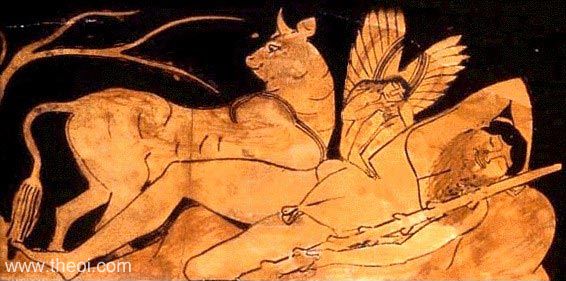
    The J Paul Getty Museum, Malibu, California

    SUMMARY

    The winged god Hypnos (Sleep personified) crouches in slumber on the chest of the giant Alkyoneus. The giant reclines in sleep, holding his club, and surrounded by his cattle. Herakles (not shown) sneaks up upon him.


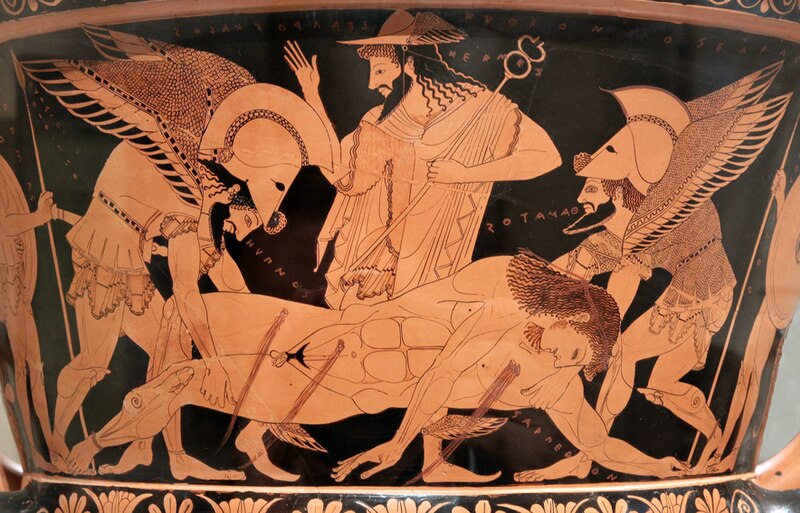
    Hypnos and Thanatos carrying dead Sarpedon, while Hermes watches. Inscriptions in ancient Greek: HVPNOS-HERMES-θΑΝΑΤΟS (here written vice versa). Attic red-figured calyx-krater, 515 BC.


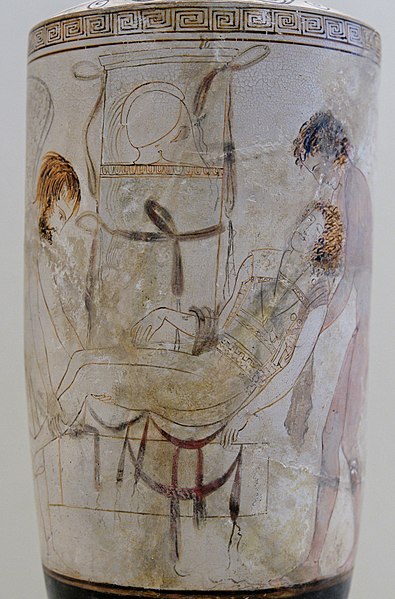
    Hypnos and Thanatos carrying the body of Sarpedon from the battlefield of Troy. Detail from an Attic white-ground lekythos, ca. 440 BC.


    Hypnos - relief by Johann Gottfried Schadow for a side panel on the tomb of Count Alexander von der Mark


    Johann Heinrich Füssli Sleep and Death carrying away Sarpedon of Lycia


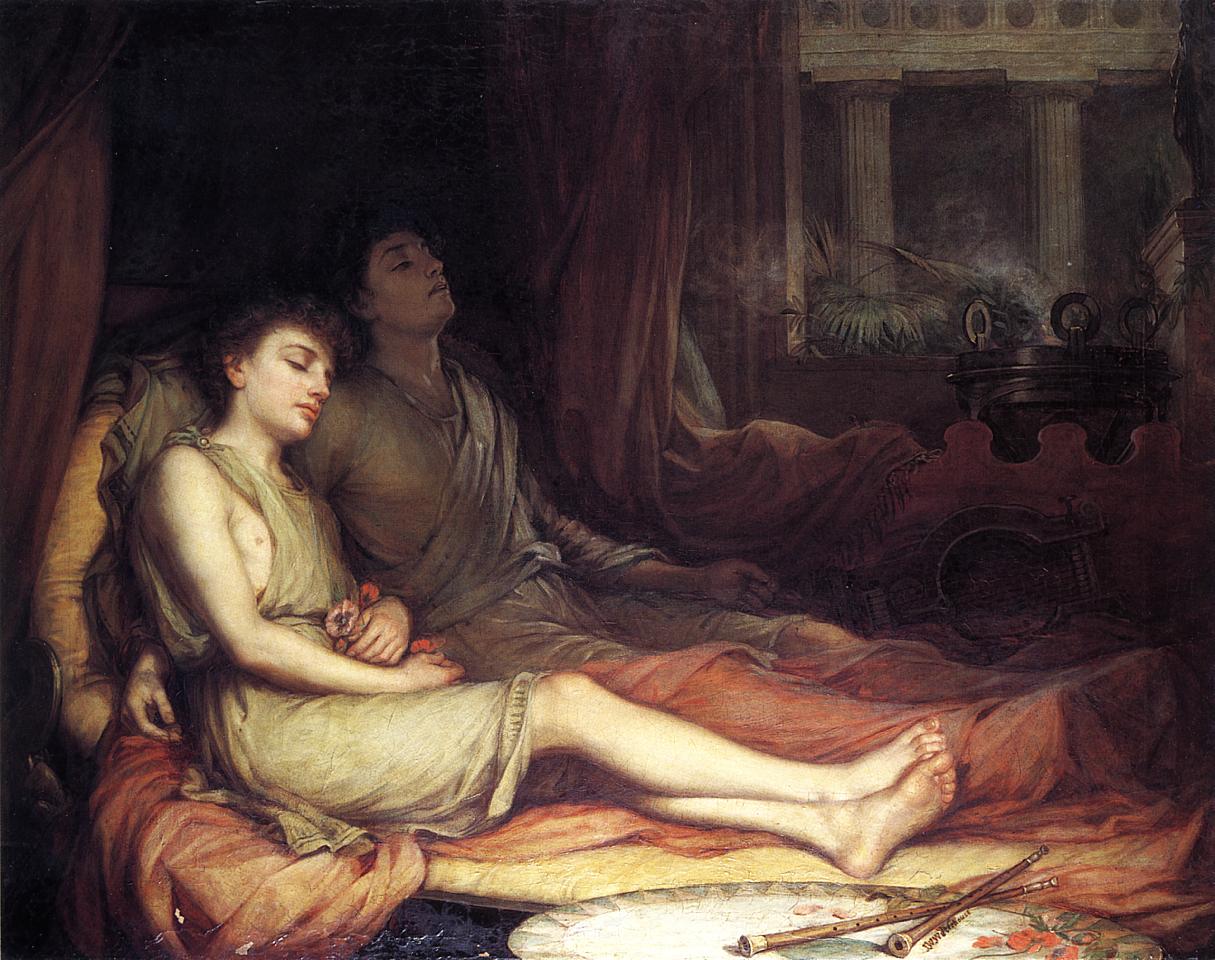
    Waterhouse, Sleep and his Half-Brother Death


    Sculpture "Thanatos draagt zijn tweelingbroer Hypnos" (Thanatos carries his twinbrother Hypnos) by Jack Poell in 1986.

  8. #83
    Banned
    Join Date
    Jun 2011
    Location
    Where the rain doesn't stop.....
    Posts
    763
    Blog Entries
    1

    goddess Nyx

    NYX was the goddess of the night, one of the ancient Protogenoi (first-born elemental gods). In the cosmogony of Hesiod she was born of Air (Khaos), and breeding with Darkness (Erebos) produced Light (Aither) and Day (Hemera), first components of the primeval universe. Alone, she spawned a brood of dark spirits, including the three Fates, Sleep, Death, Strife and Pain.

    In ancient art Nyx was portrayed as a either a winged goddess or charioteer, sometimes crowned with an aureole of dark mist.

    Hesiod, Theogony 211 ff (trans. Evelyn-White) (Greek epic C8th or C7th B.C.):
    "And Nyx bare hateful Moros (Doom of Death) and black Ker (Fate of Death) and Thanatos (Death), and she bare Hypnos (Sleep) and the tribe of Oneiroi (Dreams). And again the goddess murky Nyx, though she lay with none, bare Momos (Criticism) and painful Oizys (Misery), and the Hesperides (Evenings) . . . Also she bare the Moirai (Fates) and the ruthless avenging Keres (Deaths) . . . Also deadly Nyx bare Nemesis to afflict mortal men, and after her, Apate (Deceit) and Philotes (Sex) and hateful Geras (Old Age) and hard-hearted Eris (Strife)."
    Virgil, Aeneid 12. 848 ff :
    "Two demon fiends there are, called by the name of Furiae [Erinyes], whom darkest Nox (Night) brought forth at one and the same birth with hellish Megaera, breeding all three alike with the twining coils of serpents and giving them wings like the wind . . . the spawn of Nox (Night)."

    NYX INVOKED IN WITCHCRAFT

    Ovid, Metamorphoses 7. 192 ff (trans. Melville) (Roman epic C1st B.C. to C1st A.D.) :
    "When she [Selene the Moon] shone in fullest radiance . . . [the witch] Medea . . . went forth alone upon her roaming way, in the deep stillness of the midnight hour . . . Then to the stars she stretched her arms, and thrice she turned about and thrice bedewed her locks with water, thrice a wailing cry she gave, then kneeling on the stony ground, ‘O Nox [Nyx the Night], Mother of Mysteries, and all ye golden Astra (Stars) . . . and thou, divine triceps (three-formed) Hecate . . . and thou, kindly Tellus [Gaia the Earth], who dost for magic potent herbs provide . . . and Di Omnes Noctis (Gods of Night), be with me now! By your enabling power, at my behest . . . the deep earth groan and ghosts rise from their tombs. Thee too, bright Luna [Selene the Moon], I banish, though thy throes the clanging bronze assuage; under my spells even my grandsire’s [Helios the Sun’s] chariot grows pale and Aurora [Eos the Dawn] pales before my poison’s power."

    Ovid, Metamorphoses 10. 403 ff :
    "She [the witch Kirke] sprinkled round about her evil drugs and poisonous essences, and out of Erebos and Chaos called Nox (Night) and the Di Nocti (Gods of Night) and poured a prayer with long-drawn wailing cries to Hecate. The woods (wonder of wonders!) leapt away, a groan came from the ground, the bushes blanched, the spattered sward was soaked with gouts of blood, stones brayed and bellowed, dogs began to bark, black snakes swarmed on the soil and ghostly shapes of silent spirits floated through the air."
    Valerius Flaccus, Argonautica 5. 396 ff (trans. Mozley) (Roman epic C1st A.D.) :
    "[Medea] turned her steps to her native stream [the River Phasis], and begins her fruitless sacrifice to terror-bringing Nox (Night)."
    http://www.theoi.com/Protogenos/Nyx.html

    Children of goddess Nyx and Erebos:

    Family of the Daemones (Spirits): Greek Names

    http://www.theoi.com/Tree2.html
    MOROS (Doom)
    KER (Death Fate)
    THANTOS ( Death)
    HYPNOS (Sleep)
    THE ONEIROI (Dreams)
    EPIALES (Nightmare)
    MOMOS (Blame)
    OIZYS (misery)
    HESPERIDES (Evenings)
    THE MORAI (Fates)
    THE KERES (Deaths)
    APATE (Deceit)
    PHILOTES (sex)
    GERAS(Old Age)
    ERIS (Strife)
    DOLOS (Trickery)
    EPIPHRON (Prudence)
    SOPHROSYNE (Moderation)
    LYSSA (Rage)
    HYBRIS (Violence)



    Gustave Moreau - Night


    Night, Edward Burne-Jones


    Edward Robert Hughes, Night


    Evelyn De Morgan, Night and Sleep

  9. #84
    Banned
    Join Date
    Jun 2011
    Location
    Where the rain doesn't stop.....
    Posts
    763
    Blog Entries
    1

    Circe

    Let's continue with Circe, Medea's sister.

    Diodorus Siculus, Library of History 4. 45. 1 (Greek historian C1st B.C.) :
    "[A late rationalisation of the myth of Kirke :] She [Hekate, the daughter of Perses brother of Aeetes] married Aeetes and bore two daughters, Circe and Medea, and a son Aigialeus."

    Circe ( or Kirke) was a goddess pharmakeia (witch or sorceress) who lived with her nymph attendants on the mythical island of Aiaia. She was skilled in the magic of metamorphosis, the power of illusion, and the dark art of necromancy. When Odysseus landed on her island she transformed his men into animals, but with the help of the god Hermes, he overcame the goddess and forced her to release his men from her spell. Kirke's name was derived from the Greek verb kirkoômeaning "to secure with rings" or "hoop around"--a reference to her magical powers.

    CIRCE, a mythical sorceress, whom Homer calls a fair-locked goddess, a daughter of Helios by the Oceanid Perse, and a sister of Aeëtes. (Od. x. 135.) She lived in the island of Aeaea; and when Odysseus on his wanderings came to her island, Circe, after having changed several of his companions into pigs, became so much attached to the unfortunate hero, that he was induced to remain a whole year with her.
    Kirke was sometimes regarded as the inventress of magic and spells. In the Homeric Epigram she is invoked almost as the daimona (spirit) of magic.

    Homer's Epigrams 14 (Greek epic C8th B.C.) :
    "[Invocation to Kirke :] Daughter of Helios, Kirke the witch (polypharmake), come cast cruel spells; hurt both these men and their handiwork."

    Diodorus Siculus, Library of History 4. 50. 6 :
    "[Medea] said [to the Argonauts] that she had brought with her many drugs of marvellous potency which had been discovered by her mother Hekate and by her sister Kirke; and though before this time she had never used them to destroy human beings, on this occasion she would be means of them easily wreak vengeance upon men who were deserving of punishment."

    Diodorus Siculus, Library of History 4. 54. 5 :
    "[Medea] entered the palace [of King Kreon of Korinthos] by night, having altered her appearance by means of drugs, and set fire to the building by applying to it a little root which had been discovered by her sister Kirke and had the property that when once it was kindled it was hard to put out."
    http://www.theoi.com/Titan/Kirke.html
    Circe transformed her enemies, or those who offended her, into animals through the use of magical potions. She was known for her knowledge of drugs and herbs,
    http://en.wikipedia.org/wiki/Circe


    CIRCE
    Museum Collection: Staatliche Kunstammlungen, Albertinum, Dresden, Germany
    Date: ca 460 BC
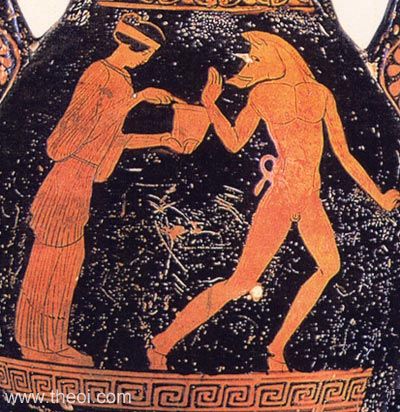
    SUMMARY
    The witch Kirke transforms one of Odysseus' men into a boar. The man is depicted partially transformed with a beast's head, tail and hooves. Kirke holds the potion and a wand in her hands.


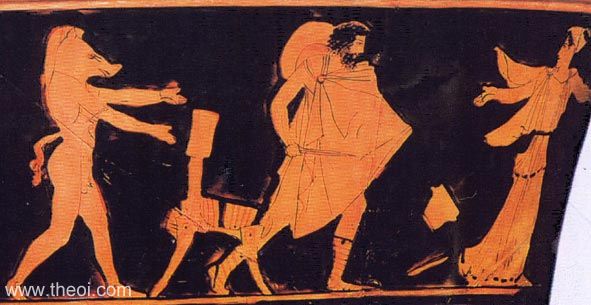
    ODYSSEUS & KIRKE
    Museum Collection: Metropolitan Museum, New York City, USA
    Period: Classical
    SUMMARY
    Odysseus threatens the witch Kirke with his sword. She flees from her chair, dropping her wand and potion. One of Odysseus' men is shown in partially transformed with the head and tail of a boar.

    Ovid, Metamorphoses 10. 403:
    "She [the witch Cirke] sprinkled round about her evil drugs and poisonous essences, and out of Erebos and Chaos called Nox (Night) and the Di Nocti (Gods of Night) and poured a prayer with long-drawn wailing cries to Hecate. The woods (wonder of wonders!) leapt away, a groan came from the ground, the bushes blanched, the spattered sward was soaked with gouts of blood, stones brayed and bellowed, dogs began to bark, black snakes swarmed on the soil and ghostly shapes of silent spirits floated through the air."
    http://www.theoi.com/Protogenos/Nyx.html


    Sorceress John William Waterhouse


    Circe Offering the Cup to Odysseus, byJohn William Waterhouse.


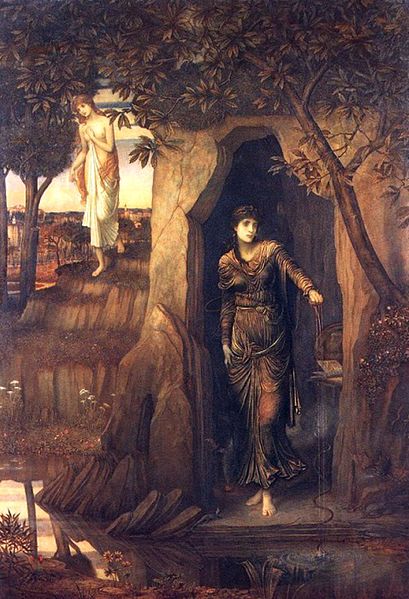
    Circe Invidiosa - John William Waterhouse


    Dosso Dossi, Circe


    Lorenzo Garbieri Circe


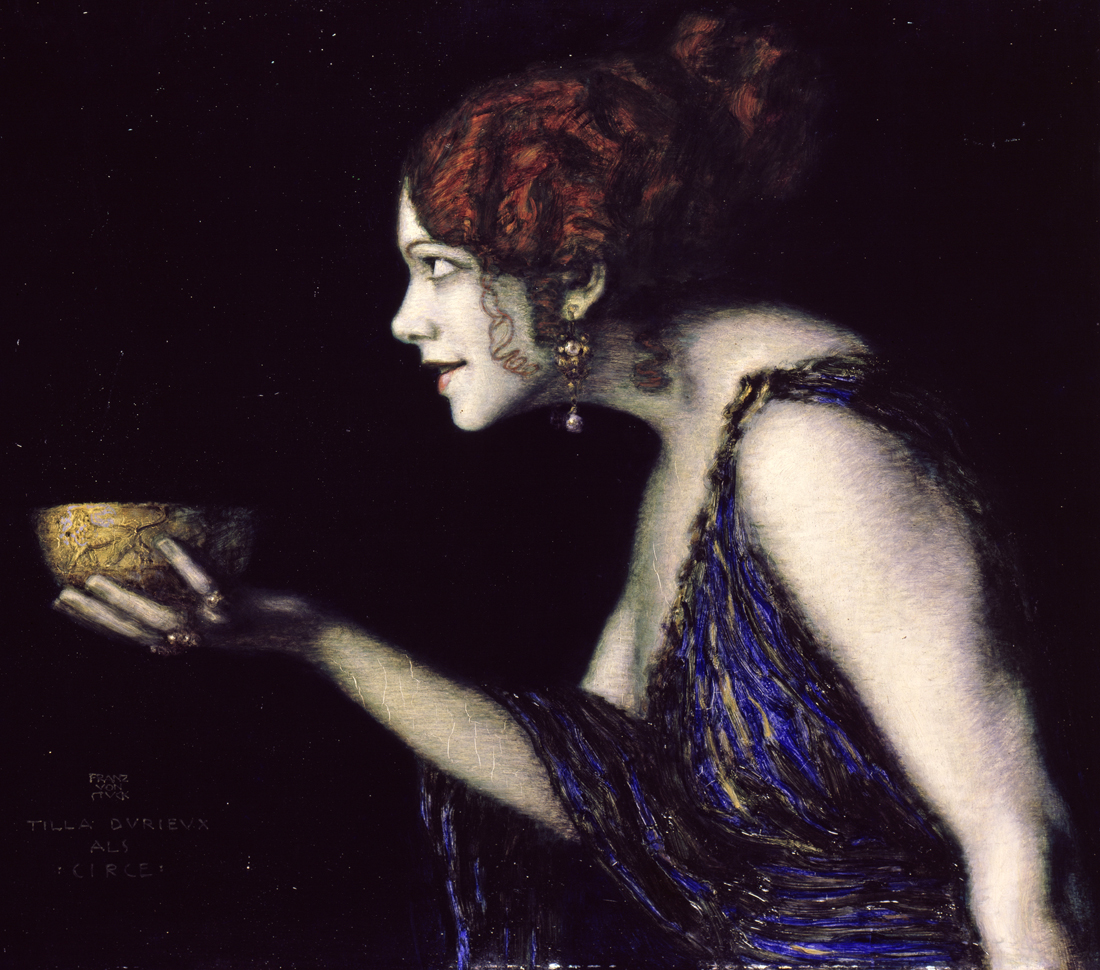
    Franz von Stuck Tilla Durieux als Circe


    Circe , Edward Burne-Jones

    Dante Gabriel Rossetti

    The Wine of Circe
    Year written: 1869
    Written for the picture 'The Wine of Circe' by Sir Edward Burne-Jones. Large watercolour, 1863-9. Crouching Circe puts potion in jar, as new ships put into her harbour; black panthers, ex-sailors, earlier potion drinkers, snuffle about their female bewitcher. Exhibited 1869.

    Dusk-haired and gold-robed o'er the golden wine
    She stoops, wherein, distilled of death and shame,
    Sink the black drops; while, lit with fragrant flame,
    Round her spread board the golden sunflowers shine.
    Doth Helios here with Hecate combine
    (O Circe, thou their votaress?) to proclaim
    For these thy guests all rapture in Love's name,
    Till pitiless Night give Day the countersign?

    Lords of their hour, they come. And by her knee
    Those cowering beasts, their equal heretofore,
    Wait; who with them in new equality
    To-night shall echo back the unchanging roar
    Which sounds forever from the tide-strown shore
    Where the dishevelled seaweed hates the sea.


    John Melhuish Strudwick.Circë and Scylla.

    George Holt discovered Strudwick’s work in the collection of rival Liverpool shipowner William Imrie at the Holmstead, North Mossley Hill Road. In 1890 he decided he wanted his own painting by the artist and purchased this subject, taken from Greek mythology as retold by the Roman author Ovid. The enchantress Circe, jealous of the maid Scylla with whom her favourite Glaucus has fallen in love, poisons the water in which Scylla is about to bathe, turning her into a sea monster.


    Elisabetta Sirani,Circe


    John Flaxman


    Gustav-Adolf Mossa, Circé


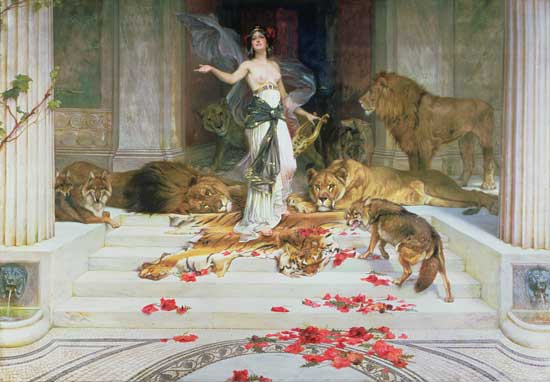
    John Collier, Circe


    Briton Riviere Circe and her Swine.


    Arthur Hacker, Circe


    Giovanni Benedetto Castiglione, GiovanniBenedettoCastiglione-Circe-Changing-Ulysses-Men-into-Animals


    Circe, Wright Barker


    Maxfield Parrish Circe Palace


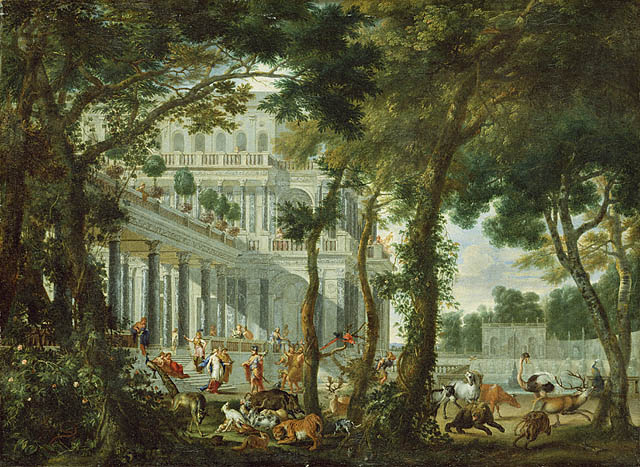
    Wilhelm Schubert von Ehrenberg (animals by Carl Borromäus Andreas Ruthart), "Ulysses at the Palace of Circe"

  10. #85
    Banned
    Join Date
    Jun 2011
    Location
    Where the rain doesn't stop.....
    Posts
    763
    Blog Entries
    1
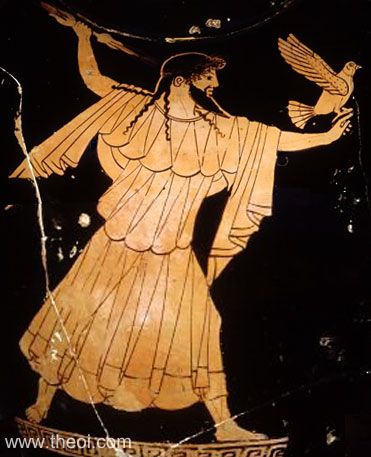
    Zeus is armed with thunder and lightning, and the shaking of his aegis produces storm and tempest (Il. xvii. 593) : a number of epithets of Zeus in the Homeric poems describe him as the thunderer, the gatherer of clouds, and the like.
    http://www.theoi.com/Olympios/Zeus.html

    ZEUS

    Musée du Louvre, Paris, France
    Date: ca 470 - 460 BC
    Period: Late Archaic

    SUMMARY

    Zeus aims his lightning bolt at a giant (not shown). An eagle sits perched on his other hand.

    The Vajra
    The Sanskrit term "vajra" denoted the thunderbolt, a legendary weapon and divine attribute that was made from an adamantine, or indestructible, substance and which could therefore pierce and penetrate any obstacle or obfuscation. It is the weapon of choice of Indra, the King of the Devas in Hinduism. As a secondary meaning, "vajra" refers to this indestructible substance, and so is sometimes translated as "adamantine" or "diamond". So the Vajrayana is sometimes rendered in English as "The Adamantine Vehicle" or "The Diamond Vehicle".
    A vajra is also a scepter-like ritual object (Tibetan: རྡོ་རྗེ་ dorje), which has a sphere (and sometimes a gankyil) at its centre, and a variable number of spokes, 3, 5 or 9 at each end (depending on the sadhana), enfolding either end of the rod. The vajra is often traditionally employed in tantric rituals in combination with the bell or ghanta; symbolically, the vajra may represent method as well as great bliss and the bell stands for wisdom, specifically the wisdom realizing emptiness or lack of inherent existence.
    http://en.wikipedia.org/wiki/Vajrayana
    Another explanation of vajra.

    Since a "vajra" is a diamond, this term means "The Diamond Way.
    http://uwacadweb.uwyo.edu/religionet...m/bglossry.htm
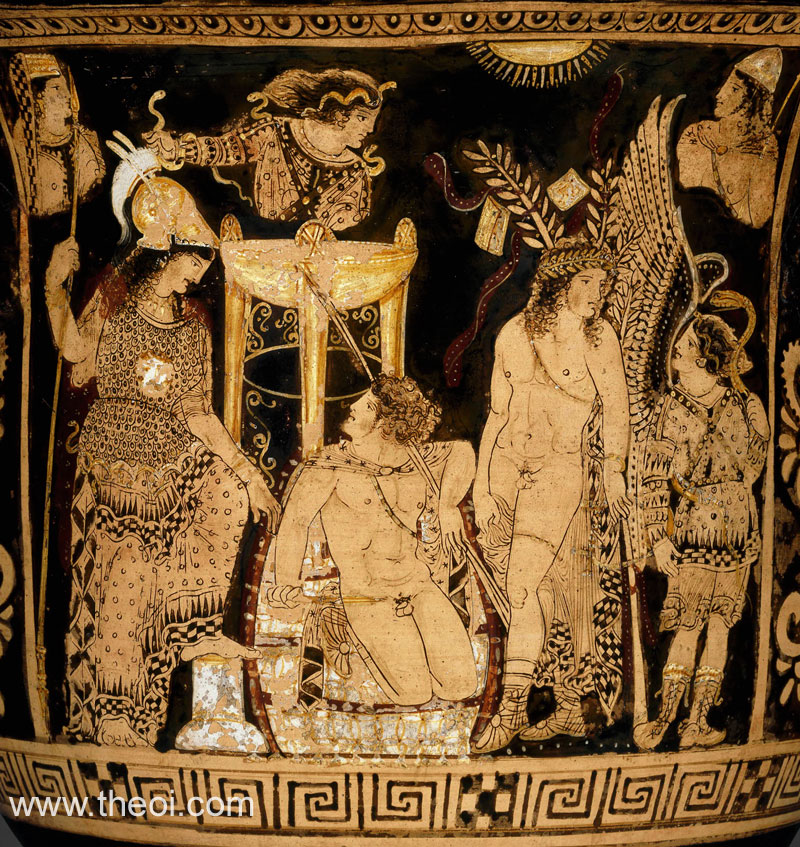
    We have omphalos stone in Greek mythology.


    ORESTES AT DELPHI

    British Museum, London, United Kingdom
    Date: ca 350 - 340 BC
    Period: Late Classical

    SUMMARY

    Orestes seeks refuge from the avenging Furies (Erinyes) of his mother Klytaimnestra at the shrine of Delphoi. He grasps hold of the omphalos stone beneath the sacred tripod as a suppliant of the god. Apollon receives him, and turns to face one of the pursuing Erinyes. He is wreathed in laurel, and holds a laurel branch staff. On the other side stands Athene, Orestes' patron-goddess, who has guided him to the altar. She wears a helm and her gorgon-headed aigis cloak. Above her is the ghost of Klytaimnestra, who drives the Erinyes against her son to avenge the crime of matricide. The two Erinyes are depicted as huntresses, wearing short-skirts and hunting boots. Their arms and hair are wreathed with poisonous serpents. One of the pair is winged.

    In Hindu we have The Mantra Om Kali Ma.
    Shiva is called OM Shiva, Krishna OM Krishna. In Buddhism we have The Mantra Om Mani Padme Hum. Sai Baba is called OM Sai Ram, Adi DA is called OM Adi Da.
    And OMphalos.

    So, Goddess Kali is called KALI MA. In Islam KALIMAH means that there is no God but Allah. Is it a coincidence of perhaps not.

    Goddess Kali is called OM KALI MA and in India they worship Kali Yoni.


    A fine example of yoni puja:
    A male and female pray and offer their thanks to the Goddess,
    here represented by the stylised vulva.
    From the Sixty-Four-Yogini temple at Bheragat.
    Madhya Pradesh, 12th century.

    So, if Islam KALIMAH means that there is no God but Allah.Do we have KALI Yoni?

    At Mecca the Goddess was Shaybah or Sheba, the Old Woman, worshipped as a black aniconic stone like the Godess of the Scythian Amazons. The sacred Black Stone now enshrined in the Kaaba at Mecca was her feminine symbol, marked by the sign of the yoni, and covered like the ancient Mother by a veil.
    http://goddesschess.blogspot.com/200...-at-mecca.html
    More connection of Islam with Vedic Shiva and Kali.

    The great Muslim traveler from Valencia, Ibn Jubayr (1145-1217) describes the emotion he felt on touching the stone, The stone, when one kisses it, has a softness and freshness which delights the mouth; so much so that he who places his lips upon it wishes never to remove them. It suffices, moreover, that the Prophet said that it is the Right Hand of God on Earth.

    Muslim pilgrims visiting the Kaaba temple go around it seven times. In no other mosque does the circumambulation prevail. Hindus invariably circumambulate around their deities. This is yet another proof that the Kaaba shrine is a pre-Islamic Indian Shiva temple where the Hindu practice of circumambulation is still meticulously observed.
    (…)
    Recital of the Namaz five times a day owes its origin to the Vedic injunction of Panchmahayagna (five daily worship- Panch-Maha-Yagna) which is part of the daily Vedic ritual prescribed for all individuals.
    Muslims are enjoined cleanliness of five parts of the body before commencing prayers. This derives from the Vedic injuction ‘Shareer Shydhyartham Panchanga Nyasah’.
    http://ristorantemystica.wordpress.c...-of-the-kaaba/

    Black Stone in Kaaba


    Let’s look at more connections.

    The noun form venus means "love" and "sexual desire" in Latin and has connections to venerari (to honour, to try to please) andvenia (grace, favour) through a possible common root in an Indo-European *wenes-, comparable to Sanskrit vanas- "lust, desire".
    Venus' name might embody the function of honours and gifts to the divine when seeking their favours: such acts can be interpreted as the enticement, seduction or charm of gods by mortals. The ambivalence of this function is suggested in the etymological relationship of the root *venes- with Latin venenum (poison, venom), in the sense of "a charm, magic philtre".
    http://www.enotes.com/topic/Venus_(mythology)
    philtre means potion


    The Love Potion, Evelyn de Morgan


    Intrestingly enough goddess Venus is called Venus Kallipygos.
    The Venus Kallipygos or Aphrodite Kallipygos, also known as the Callipygian Venus, all literally meaning "Venus (or Aphrodite) of the beautiful buttocks"[
    http://en.wikipedia.org/wiki/Venus_Kallipygos

    We can also find Kali Limni.


    Let’s look at Olympus and Mount Kailash.

    According to the Homeric account Zeus, like the other Olympian gods, dwelt on Mount Olympus in Thessaly, which was believed to penetrate with its lofty summit into heaven itself (Il. i. 221, &c., 354, 609, xxi. 438). He is called the father of gods and men (i. 514, v. 33; comp. Aeschyl. Sept. 512), the most high and powerful among the immortals, whom all others obey (Il. xix. 258, viii. 10, &c.). He is the highest ruler, who with his counsel manages every thing (i. 175, viii. 22), the founder of kingly power, of law and of order, whence Dice, Themis and Nemesis are his assistants (i. 238, ii. 205, ix. 99, xvi. 387; comp. Hes. Op. et D. 36 ; Callim.Hymn. in Jov. 79). http://www.theoi.com/Olympios/Zeus.html


    Hinduism

    Hindus regard Mount Kailash as the earthly manifestation of Mount Meru - the spiritual center of the Universe. It is a World Pillar, its roots in the lowest hell and its top kissing the heavens. On the summit sits Lord Shiva sits in a state of perpetual meditation with his consort Parvati. Below, Manasarovar floats in the shadow of holy Kailash as the lake formed in the mind of God.
    Some traditions also aver that the mountain is Shiva’s lingam and Lake Manasarovar below is the yoni of his consort Parvati.
    http://buddhistsymbols.info/kailash/

    Shiva and Parvati On Mount Meru


    Buddhism
    Mount Kailash is known in Tibetan as Kang Rimpoche (meaning “Precious One of Glacial Snow”), or by its aboriginal name Ti-Se.

    The Tantric Buddhists believe that Kailash is the home of the Buddha Demchog(Chakrasamvara in Sanskrit, whose name is in fact, an epithet of Shiva) who represents supreme bliss, and his consort Dorje Phamo. The two symbolize compassion and wisdom, making Kailash and Manasarovar the perfect complement: father and mother of the Earth. Dorje Phamo is usually associated with a small peak next to Kailash called Tijung.
    http://buddhistsymbols.info/kailash/


    Chakrasamvara Yab-Yum With Dorje Phamo


    According to one of legends, the Buddha emanated the mandala palace on the top of Mount Kailash and adopted this archetype deity form of Chakrasamvara to teach the knowledge of tantrato Shiva and Parvati.
    http://buddhistsymbols.info/kailash/

  11. #86
    Registered User
    Join Date
    Aug 2011
    Posts
    944
    I like all these fabulous paintings, something of which we have yet to interpret. It created a mood inside me with the justification that humans often feeling remorse for the indulgences they had in their lives could justify the urges and they were culturally, religiously entrenched inside us and we thru our moral senses try to uproot them and in the course of it they get more deeply entrenched.

    Such ancient paintings, sculptures scattered in different scriptural texts in most religions need reinterpretations. Freud had done a good job and yet that was far from being complete. Human motives are so wild and untamable that our civilization tries to smother them. That is why we have stresses and anxieties since they are not addressed in our society.
    In our ancient society our deep seated urges are symbolically interpreted. Temples are sacred places yet sex was figuratively put on view and some of the truths society and religion bottling up are laid bare symbolically and conscientiously.

    These paintings have some messages I always want to address and yet it is not that easy since our language is not rich enough to contain some profound truths these paintings depict. If we can marry the symbolisms of these paintings with modern interpretations for making it intelligible to the layperson I am sure we can dig up some of the deep seated human impulses and address them consequently that will leave healing effects on our sick society

  12. #87
    Banned
    Join Date
    Jun 2011
    Location
    Where the rain doesn't stop.....
    Posts
    763
    Blog Entries
    1
    Quote Originally Posted by osho View Post
    I like all these fabulous paintings, something of which we have yet to interpret. It created a mood inside me with the justification that humans often feeling remorse for the indulgences they had in their lives could justify the urges and they were culturally, religiously entrenched inside us and we thru our moral senses try to uproot them and in the course of it they get more deeply entrenched.
    Such ancient paintings, sculptures scattered in different scriptural texts in most religions need reinterpretations. Freud had done a good job and yet that was far from being complete. Human motives are so wild and untamable that our civilization tries to smother them. That is why we have stresses and anxieties since they are not addressed in our society.
    In our ancient society our deep seated urges are symbolically interpreted. Temples are sacred places yet sex was figuratively put on view and some of the truths society and religion bottling up are laid bare symbolically and conscientiously.

    These paintings have some messages I always want to address and yet it is not that easy since our language is not rich enough to contain some profound truths these paintings depict. If we can marry the symbolisms of these paintings with modern interpretations for making it intelligible to the layperson I am sure we can dig up some of the deep seated human impulses and address them consequently that will leave healing effects on our sick society
    Yes, ancient temples were sacred places….where “sacred prostitution” was performed. Today, guru centers are not free from violent acts and rape of women. Those paintings and artifacts have some message but it has nothing to do with healing our society. If you look deeper at gods cults, for example Dionysus/Bacchus, you have to ask how sexual orgies, ritual madness, and drunkenness can heal society. I agree that society needs healing but I totally disagree that it can happen through pagan practices of worshiping gods with prostitution, ritual madness, or drunkenness.

  13. #88
    Registered User
    Join Date
    Aug 2011
    Posts
    944
    Quote Originally Posted by ftil View Post
    Yes, ancient temples were sacred places….where “sacred prostitution” was performed. Today, guru centers are not free from violent acts and rape of women. Those paintings and artifacts have some message but it has nothing to do with healing our society. If you look deeper at gods cults, for example Dionysus/Bacchus, you have to ask how sexual orgies, ritual madness, and drunkenness can heal society. I agree that society needs healing but I totally disagree that it can happen through pagan practices of worshiping gods with prostitution, ritual madness, or drunkenness.
    All I want to say is we have hidden desires. Do you agree? We often see funny dreams. Sometime we have sex with the ones we never can conceive of in our wakefulness. And some people fail to interpret this and Freud did it well. If I see a beautiful lady on the street it is not unnatural for me to weave a dream to be with her. Yet consciously, socially, ethically I try to distance myself from the initiation. Every one has a fantasy though we do not express them though write them thru poems or novels.

    From that standpoint all I feel is most of what we see in temples about erotic statues or orgies have some implications that have their roots in our unconscious states. These erotic are not improper or obscene as you think.

    These ancient texts or pagan cultures are reflective of our real natures. We choose to blanket us by our social values. Come out of the cover you will find your real self, not the painted self.

  14. #89
    Banned
    Join Date
    Jun 2011
    Location
    Where the rain doesn't stop.....
    Posts
    763
    Blog Entries
    1
    Quote Originally Posted by osho View Post
    All I want to say is we have hidden desires. Do you agree? We often see funny dreams. Sometime we have sex with the ones we never can conceive of in our wakefulness. And some people fail to interpret this and Freud did it well. If I see a beautiful lady on the street it is not unnatural for me to weave a dream to be with her. Yet consciously, socially, ethically I try to distance myself from the initiation. Every one has a fantasy though we do not express them though write them thru poems or novels.

    From that standpoint all I feel is most of what we see in temples about erotic statues or orgies have some implications that have their roots in our unconscious states. These erotic are not improper or obscene as you think.

    These ancient texts or pagan cultures are reflective of our real natures. We choose to blanket us by our social values. Come out of the cover you will find your real self, not the painted self.


    Hey, you can only speak for yourself. If I see a beautiful lady……I don’t have a dream to be with her. LOL! I may be moved by her beauty. That’s all.
    Our perception is different. You can’t make assumptions that everybody feels and thinks as you do. As I said earlier, we have a different idea about eroticism and I wouldn’t want blood thirsty Kali’s eroticism.

    I hear you that those pagan temples reflect your nature. Again, don’t make assumptions that it applies to everybody.

    You may be happy with the idea of temple prostitution, I don’t. I am sure that many women would share my opinion.

    BTW, I don’t take seriously Freud theory. A number of psychiatrists moved away from his theory and developed growth promoting theory.

  15. #90
    Original Poster Buh4Bee's Avatar
    Join Date
    May 2009
    Location
    At the north border
    Posts
    3,381
    Blog Entries
    156
    Freud had an agenda and interpreted the world as he saw fit. This also means that he was wrong at times. Not everything is about sex, and often our dreams can only be interpreted by the person who had the dream. Particularly if the person is insightful about herself.

Page 6 of 12 FirstFirst 1234567891011 ... LastLast

Similar Threads

  1. Banned books
    By Lara in forum General Literature
    Replies: 250
    Last Post: 12-12-2015, 04:16 PM
  2. Why I believe in God?
    By laidbackperson in forum Religious Texts
    Replies: 938
    Last Post: 11-27-2011, 05:49 PM
  3. The Man with the Blue Guitar
    By Virgil in forum Poems, Poets, and Poetry
    Replies: 50
    Last Post: 07-09-2009, 11:36 PM
  4. The novel
    By Newcomer in forum Jane Eyre
    Replies: 23
    Last Post: 03-06-2009, 09:29 AM
  5. Why do you conceive the Bible is difficult?
    By Deng Xiang in forum Religious Texts
    Replies: 65
    Last Post: 09-12-2008, 09:01 PM

Posting Permissions

  • You may not post new threads
  • You may not post replies
  • You may not post attachments
  • You may not edit your posts
  •