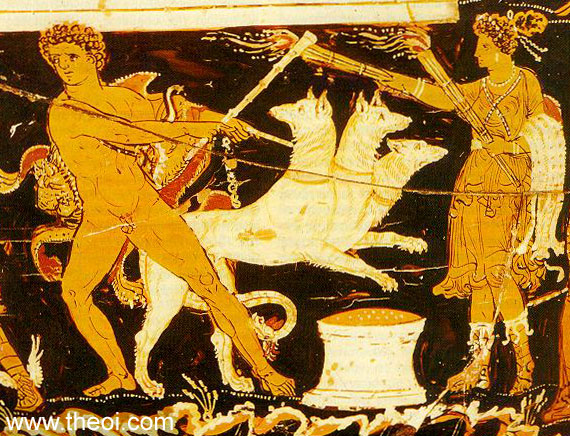
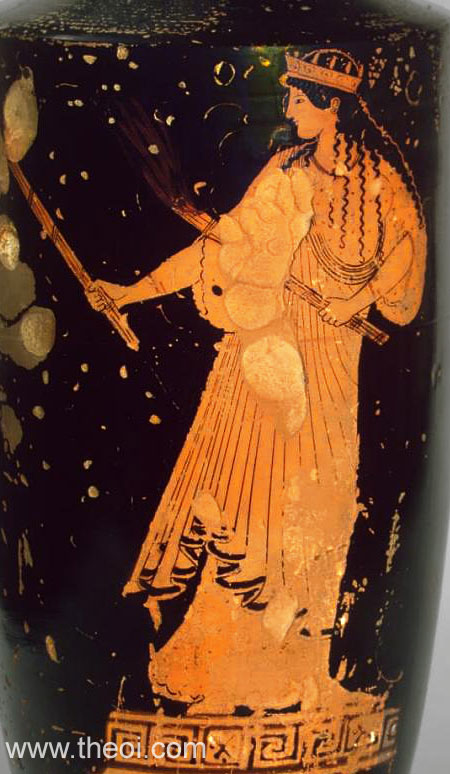
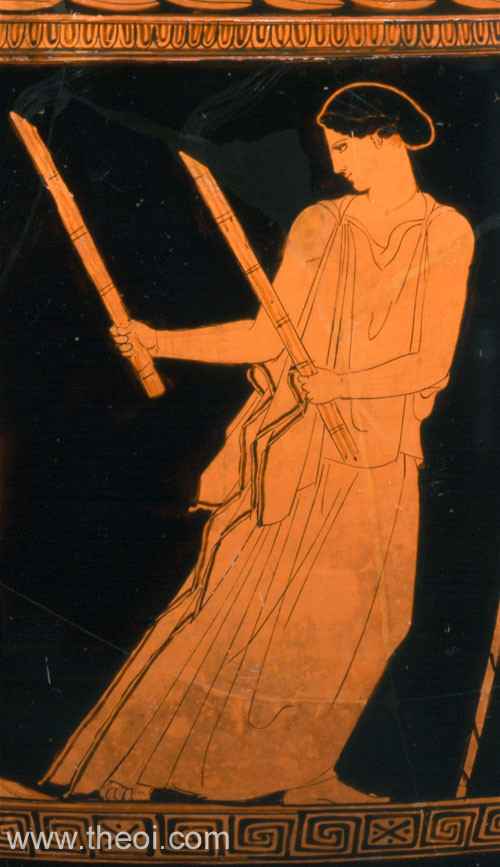
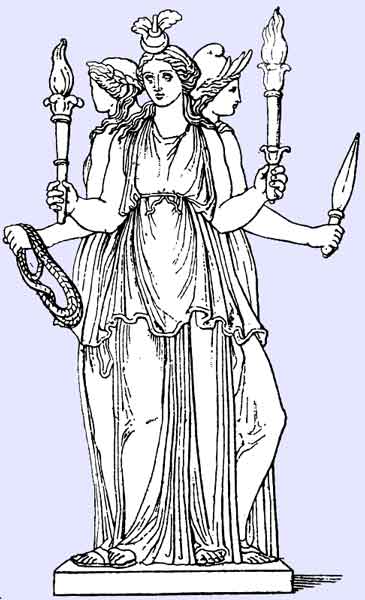
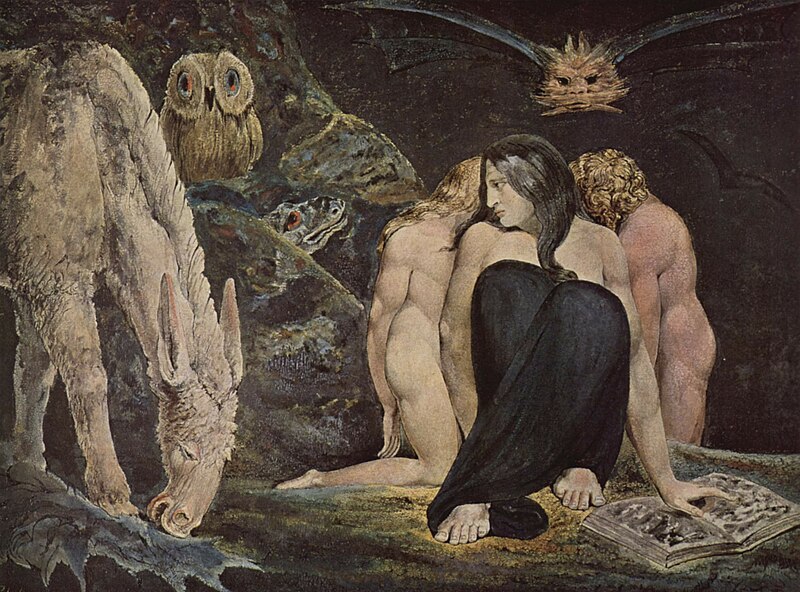
HEKATE (or Hecate) was the goddess of magic, witchcraft, the night, moon, ghosts and necromancy. Hekate was usually depicted in Greek vase painting as a woman holding twin torches.
HECATE GODDESS OF THE NIGHT
"Torch-bearing Hekate holy daughter of great-bosomed Nyx (Night)." - Greek Lyric IV Bacchylides, Frag 1B
"Hekate ... pleased with dark ghosts that wander through the shade ... nightly seen." - Orphic Hymn 1 to Hecate
GODDESS OF NECROMANCY & GHOSTS
The gods Hekate, Persephone and Haides presided over the oracles of the dead and the art of necromancy, the summoning forth of the ghosts of the dead.
"The lady Hekate was minister and companion to Persephone [goddess of the underworld]." - Homeric Hymn 2 to Demeter 436
"Hekate ... pleased with dark ghosts that wander through the shade; Perseis, solitary goddess." - Orphic Hymn 1 to Hecate
"The Sibyl [performing the rites of necromancy at the oracle of the dead at Cumae] first lined up four black-skinned bullocks, poured a libation wine upon their foreheads, and then, plucking the topmost hairs from between their brows, she placed these on the altar fires as an initial offering, calling aloud upon Hecate, powerful in heaven and hell. While other laid their knives to these victim’s throats, and caught the fresh warm blood in bowls, Aeneas sacrifices a black-fleeced lamb to Nox (Night), the mother of the Furiae, and her great sister, Terra (earth), and a barren heifer to Proserpine. Then he [Aeneas] set up altars by night to the god of the Underworld [Hades], laying upon the flames whole carcases of bulls and pouring out rich oil over the burning entrails. But listen! - at the very first crack of dawn, the ground underfoot began to mutter, the woody ridges to quake, and a baying of hounds was heard through the half-light: the goddess was coming, Hecate. [a path then opened up for the Sibyl & Aeneas to travel down to Hades]." - Virgil, Aeneid 6.257
HEKATE GODDESS OF WITCHCRAFT
I)
GODDESS OF MAGIC
"[Athena] sprinkled her [Arakhne] with drugs of Hecate (Hecateidos herbae), and in a trice, touched by the bitter lotion [the girl was metamorphosed into a spider]." - Ovid, Metamorphoses 6.139
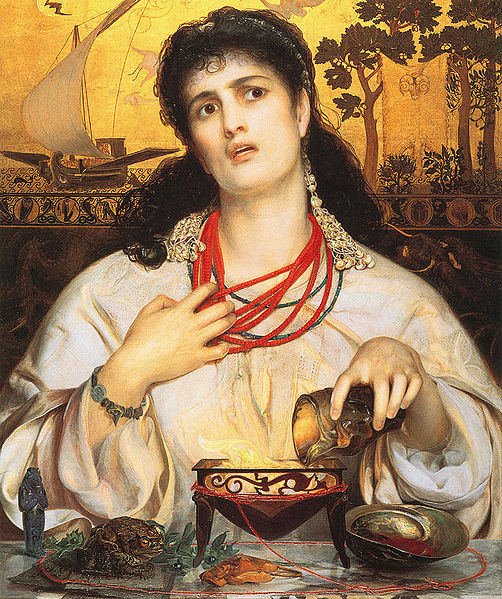
Hekate was the source of the magical power of the witch Medea. Most of her magic is described as nocturnal and / or necromantic.
"[Argos, nephew of Medea, to Jason:] ’You have heard me speak of a young woman [Medea] who practices witchcraft under the tutelage of the goddess Hekate. If we could win her over, we might banish from our minds all fear of your defeat in the ordeal [yoking the fire breathing bulls of Aeetes]." - Apollonius Rhodius, Argonautica 3.478
"She [Medea] meant to reach the temple [of Hekate]. She knew the road well enough, having often roamed in that direction searching for corpses [for necromantic rites] or for noxious roots, as witches do." - Apollonius Rhodius, Argonautica 4.48
She [Medea] reinforced her words with magic, scattering to the four winds spells of such potency as would have drawn wild creatures far away to come down from their mountain fastnesses." - Apollonius Rhodius, Argonautica 4.442
Then, with incantations, she invoked the Keres (Spirits of Death), the swift hounds of Haides (kunes Aidao) who feed on souls and haunt the lower air to pounce on living men. She sank to her knees and called upon them, three times in song, three times with spoken prayers. She steeled herself of their malignity and bewitched the eyes of Talos with the evil in her own. She flung at him the full force of her malevolence, and in an ecstasy of rage she plied him with images of death.
Apollonius Rhodius, Argonautica 4.1659
"They [the Argonauts] made fast their stern cables on the Paphlagonian coast at the mouth of the River Halys. Medea had told them to land there and propitiate Hekate with a sacrifice. But with what ritual she prepared the offering, no one must hear. Nor must I let myself be tempted to describe it; my lips are sealed by awe. But the altar they built for the goddess on the beach is still there for men of a later age to see." - Apollonius Rhodius, Argonautica 4.245
"In the deep stillness of the midnight hour ... she [Medea] stretched her arms to the stars ... O Nox [Nyx the Night], Mother of Mysteries, and all ye golden Astra (Stars) who with Luna [Selene the Moon] succeed the fires of day, and thou, divine triceps (three-formed) Hecate, who knowest all my enterprises and dost fortify the arts of magic." - Ovid, Metamorphoses 7.162
http://www.theoi.com/Khthonios/Hekate.html




















 Originally Posted by YesNo









 Another example is Bronte Baxter who had been involved in Maharsishi movement for 17 yers and left too and her website is popular. There are more websites, of course, and I am happy about as I was involved in Eastern religions but not any more.