Buying through this banner helps support the forum!
Page 2 of 12 FirstFirst 1234567 ... LastLast
Results 16 to 30 of 172

Thread: mythology and religion in art

  1. #16
    Maybe YesNo's Avatar
    Join Date
    Oct 2010
    Location
    For Mill, South Carolina
    Posts
    9,532
    Blog Entries
    2
    Quote Originally Posted by ftil View Post


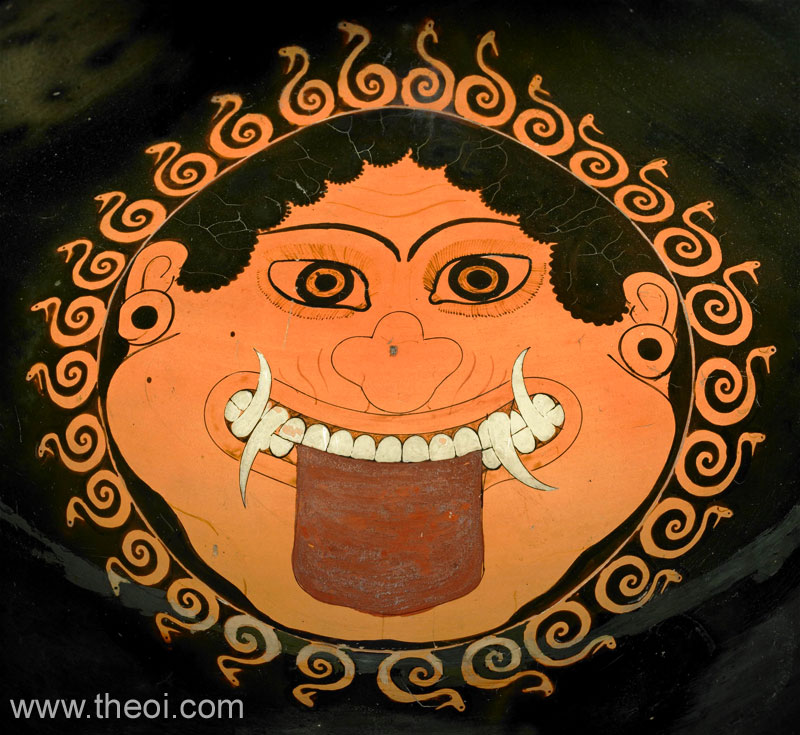
    I liked that round picture of the Gorgon with the strange teeth. I hope it doesn't bite itself.

    It looks like there are a lot of snakes associated with females, but why? I understand the snake was associated with wisdom and lived in the earth, but that is as far as I've got.

  2. #17
    Banned
    Join Date
    Jun 2011
    Location
    Where the rain doesn't stop.....
    Posts
    763
    Blog Entries
    1
    Quote Originally Posted by apollo1234 View Post
    This is cool. I bookmarked it and added it to stumble upon. I love paintings and fantasy stuff. I recently wrote a cool fantasy story on my blog. shortstorynow.blogspot.com . Go check it out. Subscribe if you like it.
    Thanks, I will visit your blog. Hm....fantasy but mythology intertwine with all religions and it is present in our lives. You have inspired me to explore Apollo.

    Apollo, one of the great divinities of the Greeks, was, according to Homer (Il. i. 21, 36), the son of Zeus and Leto. Hesiod (Theog. 918) states the same, and adds, that Apollo′s sister was Artemis. Neither of the two poets suggests anything in regard to the birth-place of the god, unless we take Lukêgenês (Il. iv. 101) in the sense of "born in Lycia," which, however, according to others, would only mean "born of or in light."

    According to some traditions, he was a seven months′ child (heptamênaios). The number seven was sacred to the god; on the seventh of every month sacrifices were offered to him (hebdomagetês, Aeschyl. Sept. 802; comp. Callim. Hymn. in Del. 250, &c.), and his festivals usually fell on the seventh of a month.

    1.The god who punishes and destroys(oulios) the wicked and overbearing, and as such he is described as the god with bow and arrows, the gift of Hephaestus. (Hom. Il. i. 42, xxiv.605, Od. xi. 318, xv. 410, &c.; comp. Pind. Pyth. iii. 15, &c.)

    The circumstance of Apollo being the destroyer of the wicked was believed by some of the ancients to have given rise to his name Apollo, which they connected with apollumi, "to destroy." (Aeschyl. Agam.1081.)

    2. The god of song and music. We find him in the Iliad (i. 603) delighting the immortal gods with his play on the phorminx during their repast ; and the Homeric bards derived their art of song either from Apollo or the Muses. (Od. viii. 488, with Eustath.) Later traditions ascribed to Apollo even the invention.

    3. The god of prophecy. Apollo exercised this power in his numerous oracles, and especially in that of Delphi. (Dict. of Ant. s. v. Oraculum) The source of all his prophetic powers was Zeus himself (Apollodorus states, that Apollo received the mantikê from Pan), and Apollo is accordingly called "the prophet of his father Zeus." (Aeschyl. Eum. 19); but he had nevertheless the power of communicating the gift of prophecy both to gods and men, and all the ancient seers and prophets are placed in some relationship to him. (Hom. Il. i. 72, Hymn. in Merc. 3, 471.) The manner in which Apollo came into the possession.
    http://www.theoi.com/Olympios/Apollon.html



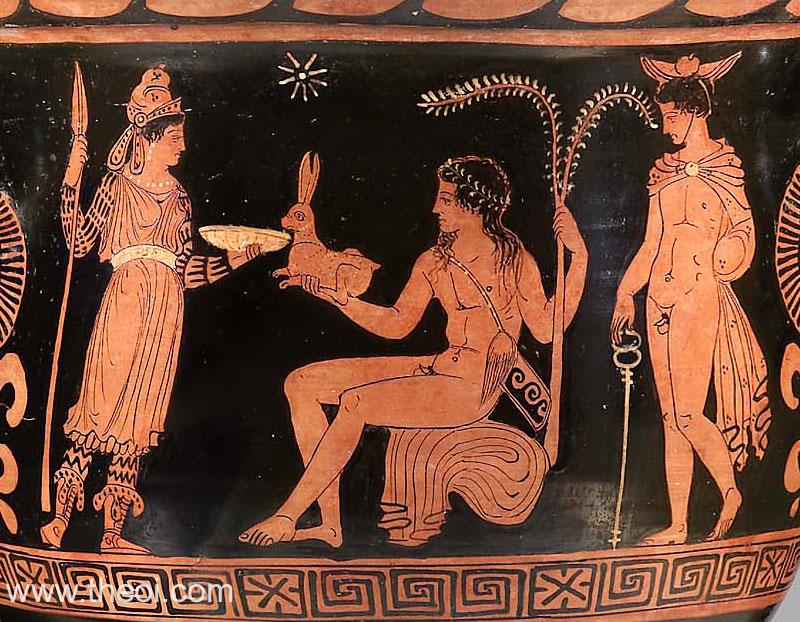
    BENDIS, APOLLO & HERMES

    Musem of Fine Arts, Boston, Massachusetts, USA Date: ca 370 - 360 BC


    SUMMARY

    The Thracian goddess Bendis, dressed in a northern body suit, and wielding a hunting spear, is greeted by the gods Apollon and Hermes. Apollon is seated on a rock, wearing a quiver, and holding in one hand a laurel branch, and the other a hare, which he offers to the goddess. Hermes wears a petasos (traveller's cap) and leans on his caduceus wand.


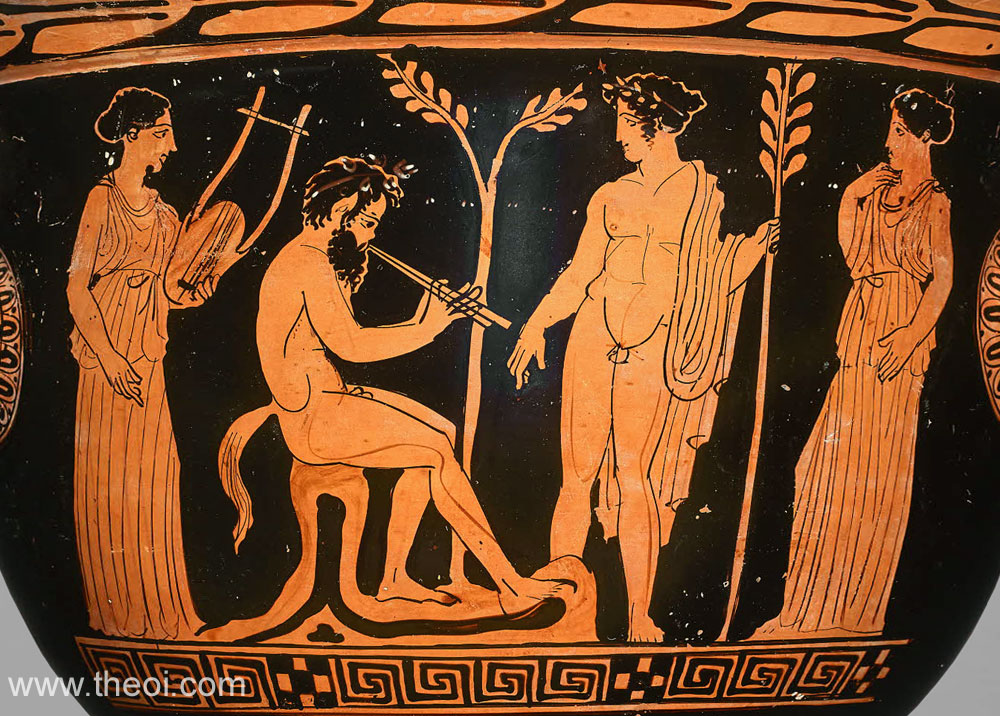
    APOLLO & MARSYAS

    Museum Collection: Musée du Louvre, Paris, France


    SUMMARY

    The satyr Marsyas challenges Apollon to a musical contest. He sits on a rock playing his double-flute, and is shown with the features common to his kind: pug nose, horse's tail and ears. Beside him stands Apollon holding a laurel branch staff, and to either side a pair of Mousai (Muses), one holding a lyre, the other a scroll box, who have been appointed as judges in the contest.


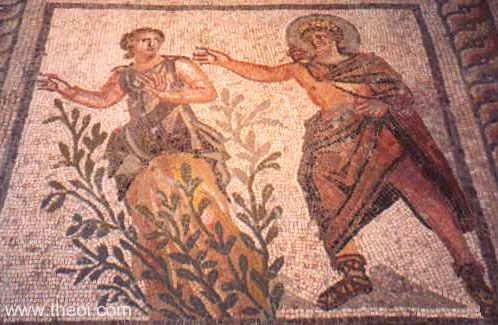
    APOLLO & DAPHNE

    Antakya Museum, Antakya, Turkey C2nd - C3rd AD


    SUMMARY

    Daphne is transformed into a laurel tree as she runs fleeing from the amorous pursuit of the god Apollon. The Nymphe is depicted in mid-transformation with laurel-branches rising from the earth to encompass her form. The god reaches out in futility to grasp her. He is shown crowned with a shining aureole.


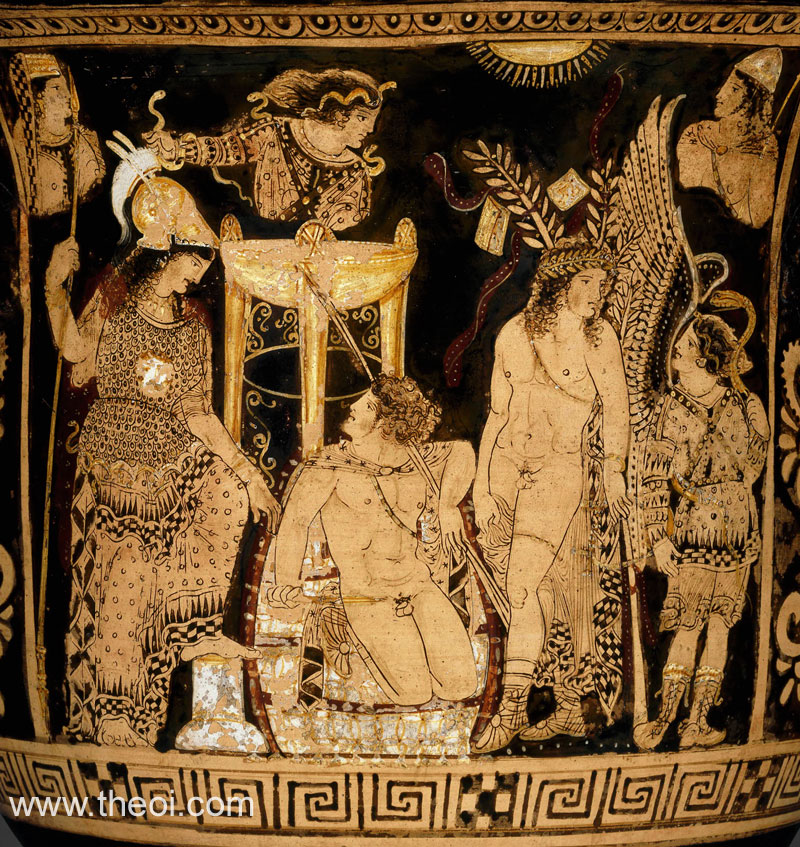
    ORESTES AT DELPHOI

    British Museum, London, United Kingdom, Date: ca 350 - 340 BC


    SUMMARY

    Orestes seeks refuge from the avenging Furies (Erinyes) of his mother Klytaimnestra at the shrine of Delphoi. He grasps hold of the omphalos stone beneath the sacred tripod as a suppliant of the god. Apollon receives him, and turns to face one of the pursuing Erinyes. He is wreathed in laurel, and holds a laurel branch staff. On the other side stands Athene, Orestes' patron-goddess, who has guided him to the altar. She wears a helm and her gorgon-headed aigis cloak. Above her is the ghost of Klytaimnestra, who drives the Erinyes against her son to avenge the crime of matricide. The two Erinyes are depicted as huntresses, wearing short-skirts and hunting boots. Their arms and hair are wreathed with poisonous serpents. One of the pair is winged.
    An omphalos is an ancient religious stone artifact, or baetylus. In Greek, the word omphalos means "navel" (compare the name of Queen Omphale). According to the ancient Greeks, Zeus sent out two eagles to fly across the world to meet at its center, the "navel" of the world. Omphalos stones used to denote this point were erected in several areas surrounding the Mediterranean Sea; the most famous of those was at the oracle in Delphi. The plant genus Omphalodes in the family Boraginaceae is commonly called navelwort. It is also the name of the stone given to Cronus in Zeus' place in Greek mythology.
    http://en.wikipedia.org/wiki/Omphalos


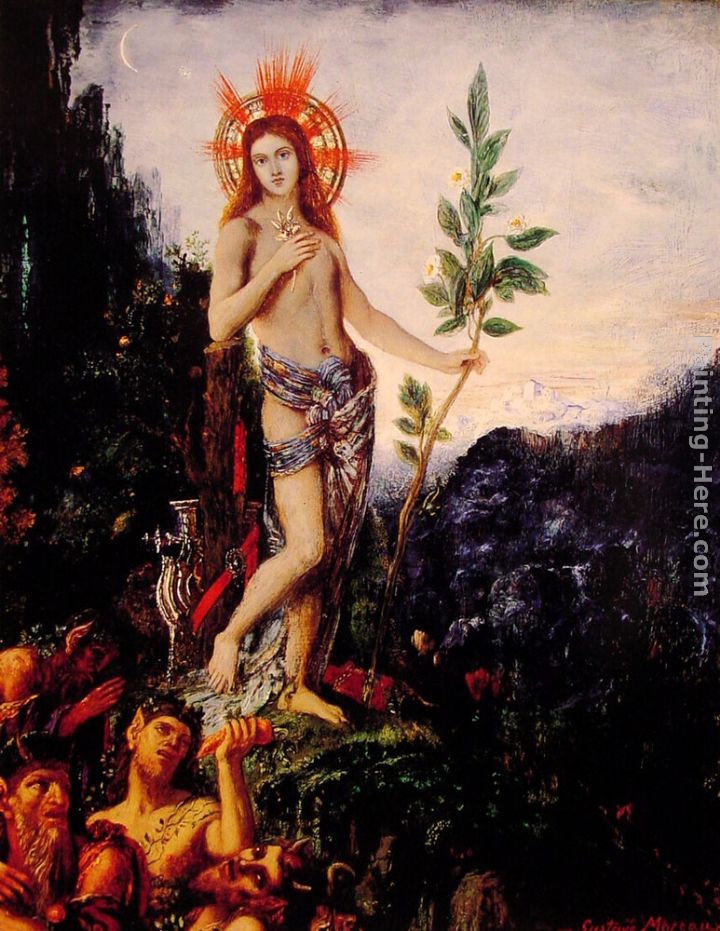
    Gustave Moreau Apollo and the Satyrs


    Eugene Delacroix : Apollo Slays Python


    Apollo and Marsyas, Romanelli


    Apollo and the python snake, Cornelis De Vos.


  3. #18
    Banned
    Join Date
    Jun 2011
    Location
    Where the rain doesn't stop.....
    Posts
    763
    Blog Entries
    1
    Quote Originally Posted by jersea View Post
    I'm glad that you brought this over to a new thread. This is so awesome to look at as I read. Hopefully, I can make some intelligent connections as I am on the summer slosh brain. Haha!
    I am glad that you like it. Please bring any part of Ovid you want to see in art.
    We can make connections together.

  4. #19
    Banned
    Join Date
    Jun 2011
    Location
    Where the rain doesn't stop.....
    Posts
    763
    Blog Entries
    1
    Quote Originally Posted by YesNo View Post
    I liked that round picture of the Gorgon with the strange teeth. I hope it doesn't bite itself.

    It looks like there are a lot of snakes associated with females, but why? I understand the snake was associated with wisdom and lived in the earth, but that is as far as I've got.
    It is true and it is in most cultures. The same applies to frogs that were associated with male gods. I will post frog themes soon.

  5. #20
    Maybe YesNo's Avatar
    Join Date
    Oct 2010
    Location
    For Mill, South Carolina
    Posts
    9,532
    Blog Entries
    2
    I was originally thinking that the snake was a symbol for a female, but perhaps as a symbol the snake is male, one of the female's companions.

  6. #21
    Banned
    Join Date
    Jun 2011
    Location
    Where the rain doesn't stop.....
    Posts
    763
    Blog Entries
    1
    Snakes or serpents are present in every culture. I am puzzeled as I find more about it.

    Serpent is a word of Latin origin (from serpens, serpentis "something that creeps, snake") that is commonly used in a specifically mythic or religious context. Snakes have been associated with some of the oldest rituals known to humankind.
    http://en.wikipedia.org/wiki/Serpent_(symbolism)


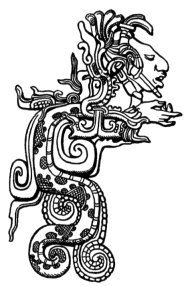
    The Maya Vision Serpent


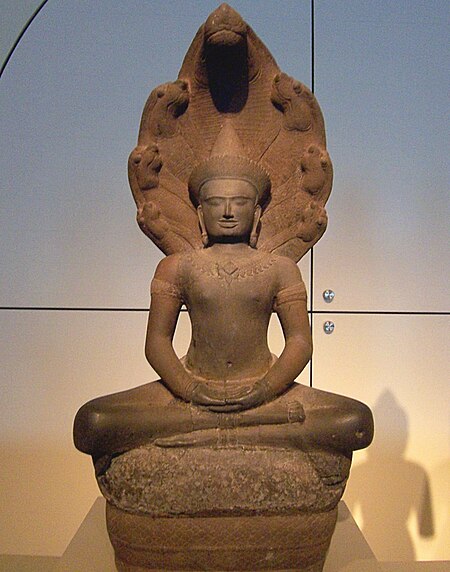
    This Cambodian statue, dated between 1150 and 1175 A.D., depicts the meditating Buddha being shielded by the naga Mucalinda.

    This motif recalls the story of the Buddha and the serpent king Mucalinda: as the Buddha sat beneath a tree engrossed in meditation, Mucalinda came up from the roots of the tree to shield the Buddha from a tempest that was just beginning to arise.


    "Naga" (Sanskrit:नाग) is the Sanskrit/Pāli word for a deity or class of entity or being, taking the form of a very large snake, found in Hinduism and Buddhism.


    Naga Figure Gasa Dzong, Bhutan Hoysala sculpture of a Naga couple, Halebidu.


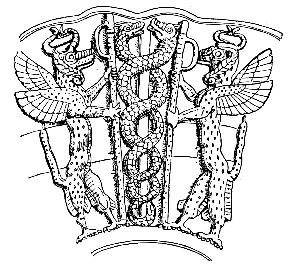
    The Sumerian deity, Ningizzida, is accompanied by two gryphons; it is the oldest known image of two snakes coiling around an axial rod, dating from before 2000 BCE.


    Ancient North American serpent imagery often featured rattlesnakes.


    Contemporary poster of a Mami Wata, "serpent priestess" painted by German (Hamburg) artist Schleisinger, ca. 1926, displayed in shrines as a popular image of Mami Wata in Africa and in the Diaspora.


    Mami Wata is venerated in West, Central, Southern Africa, and in the African diaspora in the Caribbean and parts of North and South America. Mami Wata spirits are usually female, but are sometimes male.
    ]http://en.wikipedia.org/wiki/Mami_Wata


    A Horned Serpent is a popular image in Northern American natives' mythology.


    The antlered deity of the Gundestrup cauldron, commonly identified with Cernunnos, holding a ram-horned serpent and a torc.


    Horned serpents (rattlesnakes) tied together on a Mississippian sandstone plate from the Moundville Archaeological Site


    Johann Urlich Krauss


    The Flying Serpent, insignia of the Israeli Paratroopers Brigade

  7. #22
    Banned
    Join Date
    Jun 2011
    Location
    Where the rain doesn't stop.....
    Posts
    763
    Blog Entries
    1
    Cosmic serpents

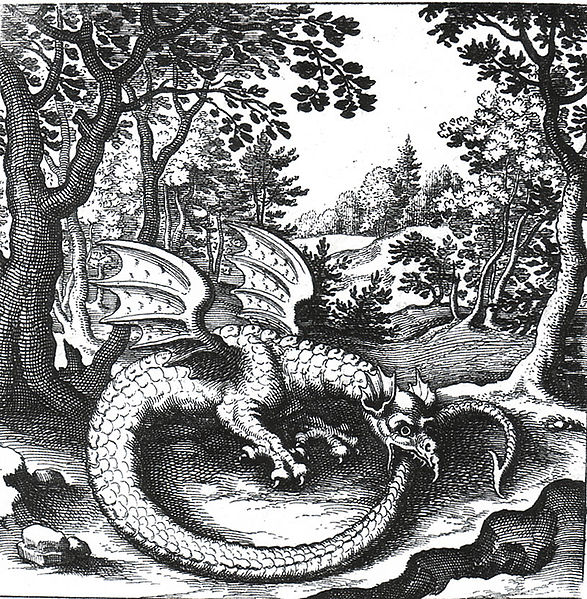
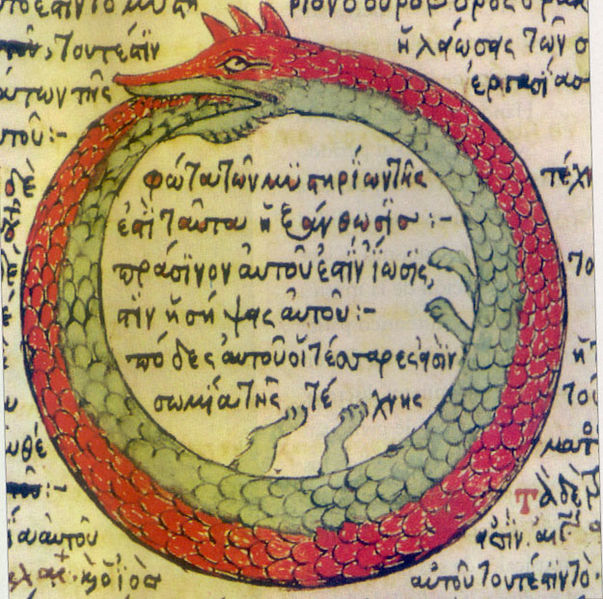
    The serpent, when forming a ring with its tail in its mouth, is a clear and widespread symbol of the "All-in-All", the totality of existence, infinity and the cyclic nature of the cosmos. The most well known version of this is the Aegypto-Greek Ourobouros. It is believed to have been inspired by the Milky Way as some ancient texts refer to a serpent of light residing in the heavens. The Ancient Egyptians associated it with Wadjet, one of their oldest deities as well as another aspect, Hathor.
    http://en.wikipedia.org/wiki/Serpent_(symbolism)


    Engraving by Lucas Jennis, in alchemical tract titled De Lapide Philosophico.


    Drawing by Theodoros Pelecanos, in alchemical tract titled Synosius (1478).


    Emblem of the Theosophical Society


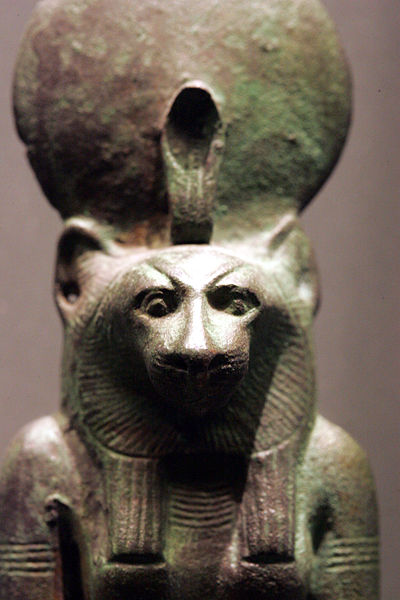
    In Egyptian mythology, Wadjet, or the Green One (Egyptian w3ḏyt; also spelled Wadjit, Wedjet, Uadjet or Ua Zit and in Greek, Udjo, Uto, Edjo, and Buto among other names), was originally the ancient local goddess of the city of Dep,[1] which became part of the city that the Egyptians named Per-Wadjet, House of Wadjet, and the Greeks called Buto,[2] a city that was an important site in the Predynastic era of Ancient Egypt and the cultural developments of the Paleolithic. She was said to be the patron and protector of Lower Egypt and upon unification with Upper Egypt, the joint protector and patron of all of Egypt with the "goddess" of Upper Egypt. The image of Wadjet with the sun disk is called the uraeus, and it was the emblem on the crown of the rulers of Lower Egypt. She was also the protecter of women in childbirth and kings.
    http://en.wikipedia.org/wiki/Wadjet


    Wadjet as Wadjet-Bast, depicted as the body of a woman with a lioness head, wearing the uraeus


    Relief of Wadjet, Hatshepsut temple, Deir el-Bahari, Theban Necropolis, Egypt

    http://upload.wikimedia.org/wikipedi...0px-Edfu44.JPG

    Wall relief of Wadjet and Horus in Cradle chapel, temple of Edfu, Egypt

  8. #23
    Banned
    Join Date
    Jun 2011
    Location
    Where the rain doesn't stop.....
    Posts
    763
    Blog Entries
    1
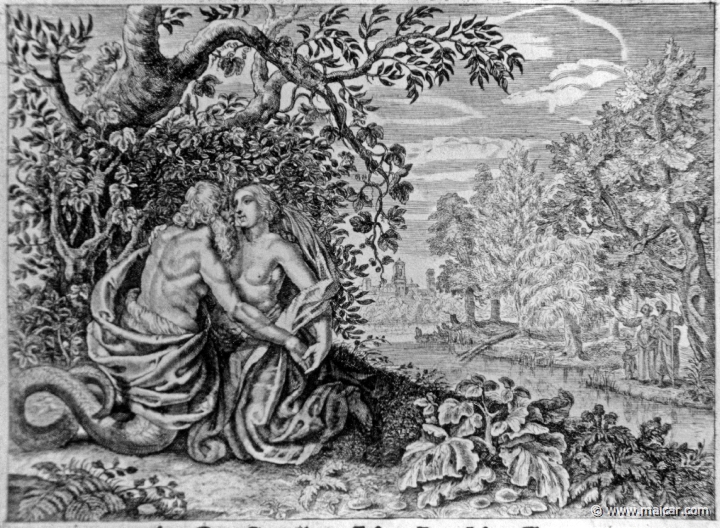
    We have more snake themes in mythology. Cadmus and Harmonia transformed into serpents.


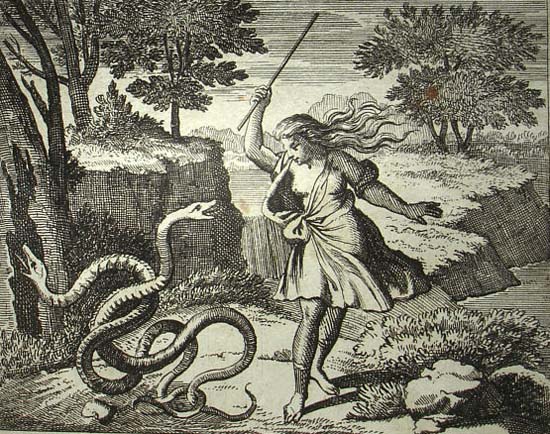
    Snakes know a thing or two about sex, we learn, from the story of Tiresias in Ovid’s Metamorphoses. There was no more appropriate creature to instruct Eve about it. When Tiresias encountered two snakes having sex, he rapped them with his stick but then he found himself changed into a woman. He deserved this, for he should not have interrupted them. Seven years later he came across another pair of snakes having sex and wondered if he rapped them whether it would reverse him back to a man. It did indeed and whether it was the snakes’ power or the gods’ to effect such changes, Ovid isn’t telling. But Ovid does place it in the context of an argument between Zeus and Hera over who has the greater pleasure from sex, men or women. I don’t know the answer to this question myself, but Zeus said women, Hera said men. Tiresias, having lived as both, agreed with Zeus that it was women. So Hera struck him blind. Zeus tried to compensate by giving him “second sight.” The snakes came out of it unscathed.

    Tiresias also appears in Homer’s Odyssey and the classic Greek Oedipus plays, and in Dante’s Inferno and Milton’s Paradise Lost, in Tennyson and T.S. Eliot (did The Waste Land in turn inspire Virginia Woolf’s Orlando?). Nowadays Tiresias is an icon of the transgendered community and I’d like to think he is the source of the idea that too much sex can make you go blind.

    http://www.sexualfables.com/Why-Snak...-About-Sex.php


    The engraving of Tiresias, Johann Ulrich Krauss, from a 1690 edition of Ovid’s Metamorphoses.

  9. #24
    Banned
    Join Date
    Jun 2011
    Location
    Where the rain doesn't stop.....
    Posts
    763
    Blog Entries
    1
    YesNo wrote:

    There is something about this river Styx that seems to have control over these gods.

    The Styx was a river in Greek mythology that formed the boundary between Earth and the Underworld (often called Hades which is also the name of this domain's ruler). It circles the Underworld nine times. The rivers Styx, Phlegethon, Acheron, and Cocytus all converge at the center of the underworld on a great marsh, which is also sometimes called the Styx. The other important rivers of the underworld are Lethe, Eridanos, and Alpheus.
    The gods were bound by the Styx and swore oaths on it.
    http://en.wikipedia.org/wiki/Styx


    A 19th-century interpretation of Charon's crossing by Alexander Litovchenko.


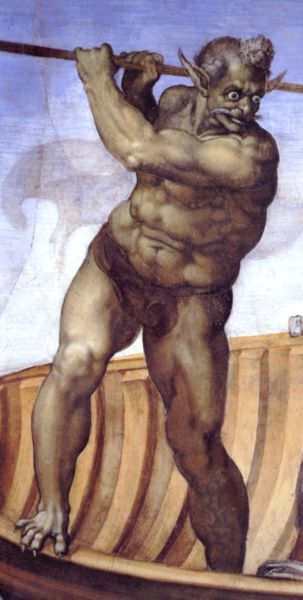
    Charon as depicted by Michelangelo


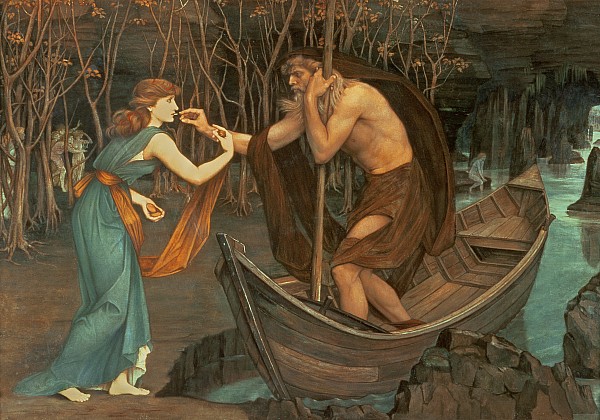
    Charon and Psyche, John Roddam Spencer Stanhope


    Styx was primarily a feature in the afterworld of Greek mythology, and was adopted into the Christian mythology of Hell of Christianity, notably in The Divine Comedy and "Paradise Lost". The ferryman Charon is believed to have transported the souls of the newly dead across this river into the underworld, though in the original Greek and Roman sources, as well as in Dante, it was the river Acheron that Charon plied. Dante put Phlegyas over the Styx and made it the fifth circle of Hell, where the wrathful and sullen are punished by being drowned in the muddy waters for eternity, with the wrathful fighting each other.
    http://en.wikipedia.org/wiki/Styx
    Let's look at William Blake paintings. His words are thought provoking as he said, "The promise of the divine in man, made in The Marriage of Heaven and Hell, is at last fulfilled"


    Inferno, Canto XXIV, Thieves


    Inferno, Canto XIV, 46-72, Capaneus the Blasphemer


    Inferno, Canto XXXIV, 22-64, Lucifer at the last section of the nineth circle


    Inferno, Canto XIX, 42-120, The simoniac Pope


    Lucifer and the Pope in Hell


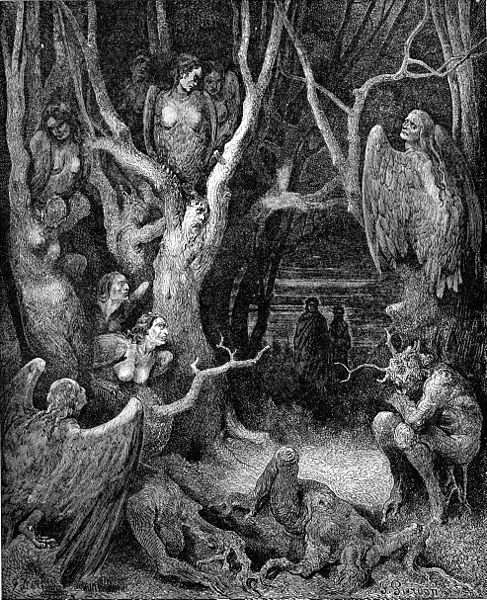
    Inferno, Canto XIII, 1-45, The Wood of Self-Violators: The Harpies and the Suicides


    Inferno, Canto XII, 12-28, The Minotaur (Seventh Circle)


    Satan, Sin, and Death- Satan Comes to the Gates of Hell


    The Great Red Dragon and the Woman Clothed in Sun


    The Great Red Dragon and the Woman Clothed with the Sun


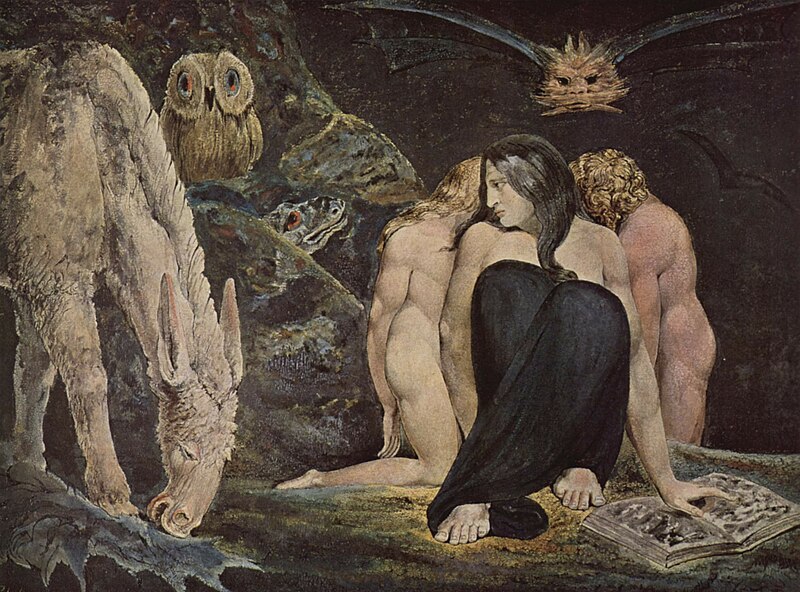
    The Night of Enitharmon's Joy Blake's vision of Hecate, Greek goddess of black magic and the underworld and Three Fates.

  10. #25
    Banned
    Join Date
    Jun 2011
    Location
    Where the rain doesn't stop.....
    Posts
    763
    Blog Entries
    1
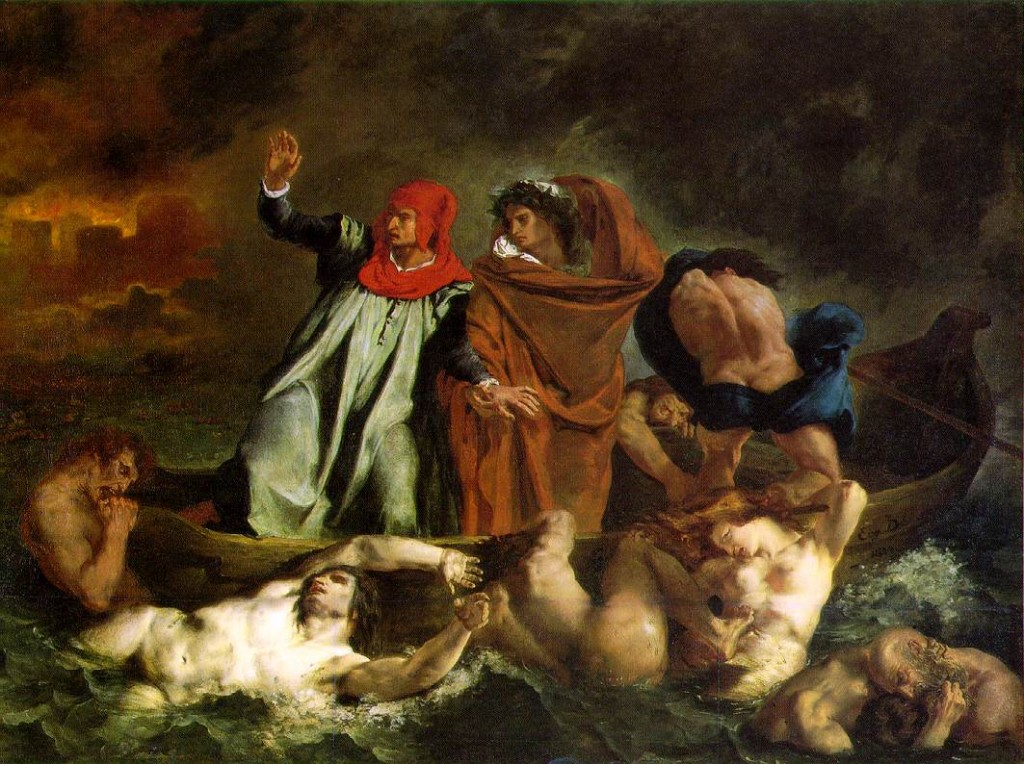
    Eugene Delacroix


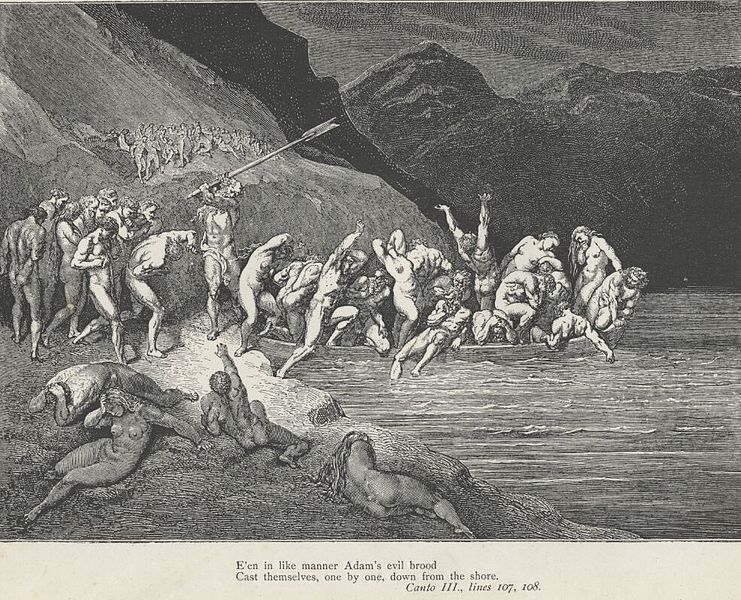
    Charon collects the spirits into his boat in Dante Alighieri's Inferno Canto 3 lines 107-108, Gustave_Doré


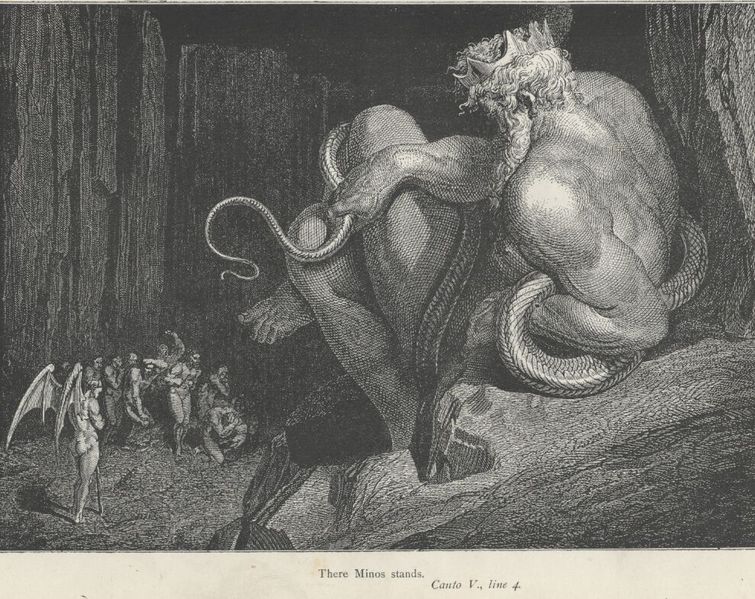
    Minos stands in judgement in Dante's Inferno Canto, Gustave Doré


    Inferno Canto 9 verse


    Dante's guide rebuffs Malacoda and his fiends in Inferno Canto 21 between ditches five and six in the eight circle


    Inferno Canto 12 verses 73-74


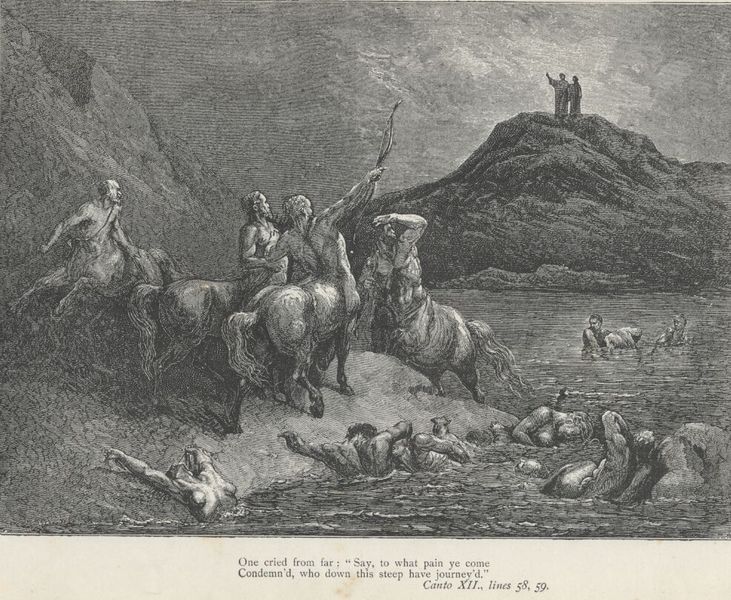
    Inferno Canto 12 verses 58-59

  11. #26
    Banned
    Join Date
    Jun 2011
    Location
    Where the rain doesn't stop.....
    Posts
    763
    Blog Entries
    1
    There are two paintings of Blake that brought my attention but I don't know the meaning yet.


    Purgatorio, Canto XXX, 60-146 Beatrice Addressing Dante, William Blake


    The Lovers' Whirlwind, Francesca da Rimini and Paolo Malatesta


  12. #27
    Banned
    Join Date
    Jun 2011
    Location
    Where the rain doesn't stop.....
    Posts
    763
    Blog Entries
    1
    When I looked at this painting, I associated it with Zeus.

    ZEUS was the king of the gods, the god of sky and weather, law, order and fate. He was depicted as a regal man, mature with sturdy figure and dark beard. His usual attributes were a lightning bolt, royal sceptre and eagle.
    http://www.theoi.com/Olympios/Zeus.html
    Zeus struck and killed Capaneus with a thunderbolt, and Evadne threw herself on her husband's funeral pyre and died.
    http://en.wikipedia.org/wiki/Capaneus
    It is interesting how mythology intertwines with Divine Comedy, isn't it?


    Inferno, Canto XIV, 46-72, Capaneus the Blasphemer


  13. #28
    Banned
    Join Date
    Jun 2011
    Location
    Where the rain doesn't stop.....
    Posts
    763
    Blog Entries
    1
    Another association of Blake painting.


    The Great Red Dragon and the Woman Clothed with the Sun


    A Gustave Doré wood engraving of Geryon for Dante's Inferno


    L'Infranchissable Obstacle, Wojtek Siudmak

    [/PHP]

  14. #29
    Banned
    Join Date
    Jun 2011
    Location
    Where the rain doesn't stop.....
    Posts
    763
    Blog Entries
    1
    YesNo has opened a Pandora box with associations. Mythology and Divine comedy. It is strange, isn't it?

    Inferno, Canto XII, 12-28, The Minotaur (Seventh Circle)


    Gustave Moreau,Translated title: The Dead Poet Borne by a Centaur. c.1890


    Franz von Stuck, Walking Ride


    Amazon and Centaur, Franz von Stuck


    The most common theory holds that the idea of centaurs came from the first reaction of a non-riding culture, as in the Minoan Aegean world, to nomads who were mounted on horses. The theory suggests that such riders would appear as half-man, half-animal (Bernal Díaz del Castillo reported that the Aztecs had this misapprehension about Spanish cavalrymen).[10] Horse taming and horseback culture arose first in the southern steppe grasslands of Central Asia, perhaps approximately in modern Kazakhstan.
    The Lapith tribe of Thessaly, who were the kinsmen of the Centaurs in myth, were described as the inventors of horse-back riding by Greek writers. The Thessalian tribes also claimed their horse breeds were descended from the centaurs.
    Of the various Classical Greek authors who mentioned centaurs, Pindar was the first who describes undoubtedly a combined monster. Previous authors (Homer) only uses words such as pheres (cf. theres, "beasts") that could also mean ordinary savage men riding ordinary horses. However, contemporaneous representations of hybrid centaurs can be found inarchaic Greek art.

    Lucretius in his first century BC philosophical poem On the Nature of Things denied the existence of centaurs based on their differing rate of growth. He states that at three years old horses are in the prime of their life while at three humans are still little more than babies, making hybrid animals impossible

    Robert Graves (relying on the work of Georges Dumezil argued for tracing the centaurs back to the Indian gandharva), speculated that the centaurs were a dimly remembered, pre-Hellenic fraternal earth cult who had the horse as a totem.[15] A similar theory was incorporated into Mary Renault's The Bull from the Sea. Kinnaras, another half-man half-horse mythical creature from the Indian mythology, appeared in various ancient texts, arts as well as sculptures from all around India. It is shown as a horse with the torso of a man in place of where the horse's head has to be, that is similar to a Greek centaur.
    The Greek word kentauros is generally regarded as of obscure origin. The etymologyfrom ken – tauros, "piercing bull-stickers" was a Euhemerist suggestion in Palaephatus' rationalizing text on Greek mythology, On Incredible Tales (Περὶ ἀπίστων): mounted archers from a village called Nephele eliminating a herd of bulls that were the scourge of Ixion's kingdom. Another possible related etymology can be "bull-slayer".Some[who?] say that the Greeks took the constellation of Centaurus, and also its name "piercing bull", from Mesopotamia, where it symbolized the god Baal who represents rain and fertility, fighting with and piercing with his horns the demon Mot who represents the summer drought. In Greece, the constellation of Centaurus was noted by Eudoxus of Cnidus in the fourth century BC and by Aratus in the third century.

    http://www.theoi.com/Georgikos/KentauroiThessalioi.html


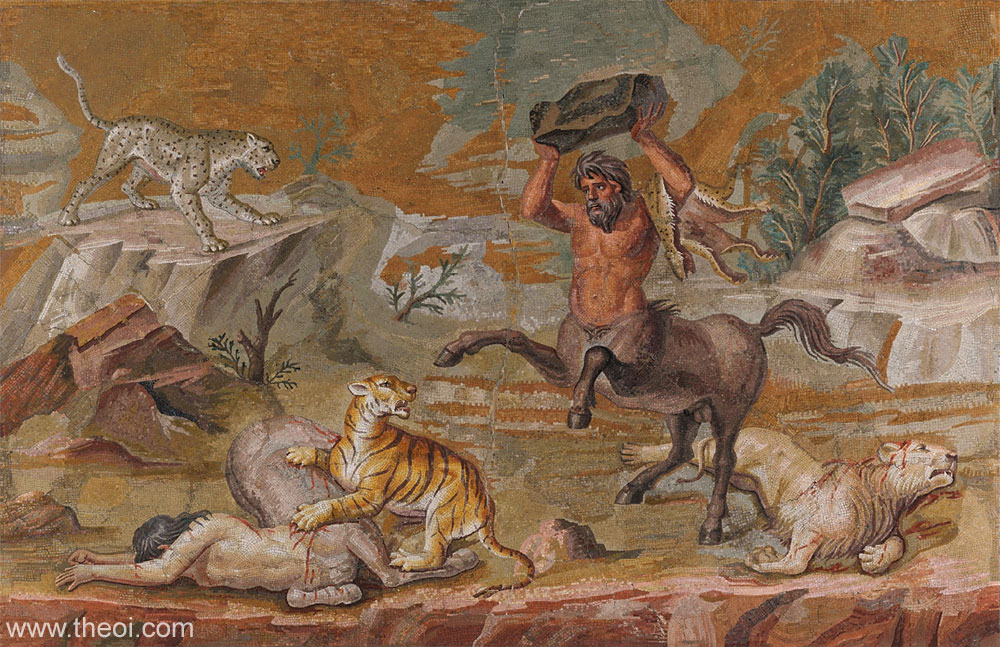
    CENTAUR, TIGERS & LEOPARDS

    Museum Collection: Altes Museum, Berlin, Germany
    Date: ca 118 - 138 AD
    Period: Imperial Roman

    SUMMARY

    A Kentauros (Centaur) casts a rock at the tiger who has slain his mate and infant child. The Kentauris (female centaur) lies dead, bloodied by the raking claws of the beast. The child Kentauris has fallen nearby with its arms stretched out towards the tail of the beast.


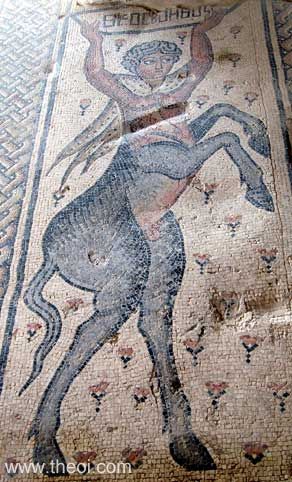
    CENTAUR
    Tzippori Collection, Haifa, Israel
    Period: Imperial Roman

    SUMMARY

    A rearing centaur draped in an animal-skin cloak and holding a bowl in his hands.


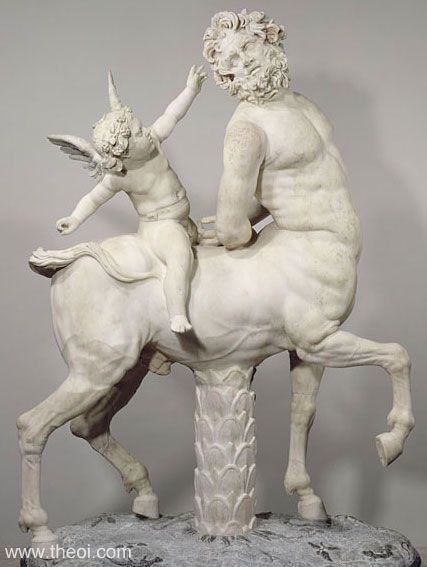
    CENTAUR & EROS

    Museum Collection: Musée du Louvre, Paris, France
    Date: C1st - C2nd AD
    Period: Imperial Roman

    SUMMARY

    The winged godling Eros (love personified) seated on the back of a centaur.


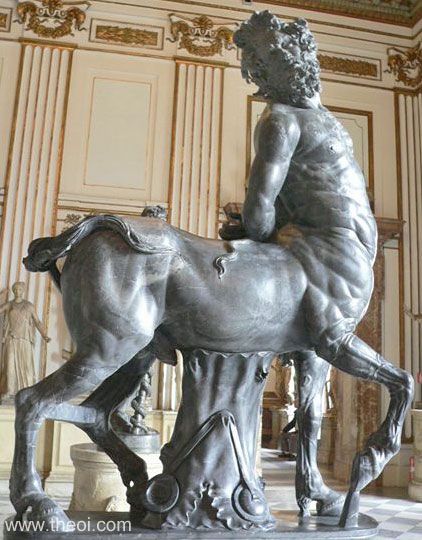
    "FURIETTI CENTAUR"

    Museum Collection: Museo Capitolino, Rome, Italy
    Period: Imperial Roman

    SUMMARY

    A half horse, half man centaur.


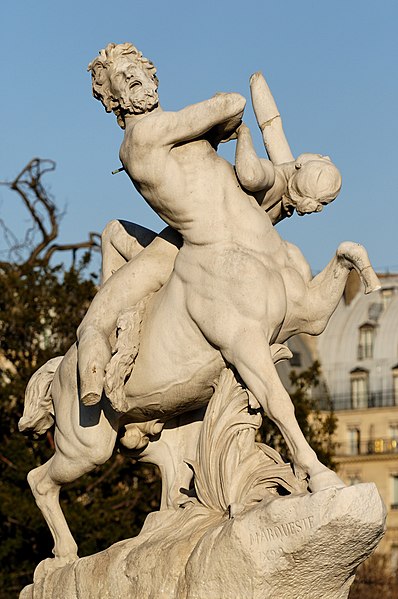
    Centaur carrying off a nymphby Laurent Marqueste, marble, 1892, Tuileries Garden, Paris.


    Theseus Defeats the Centaur (1805-1819) by Antonio Canova (1857-1822),Kunsthistorisches Museum, Vienna.


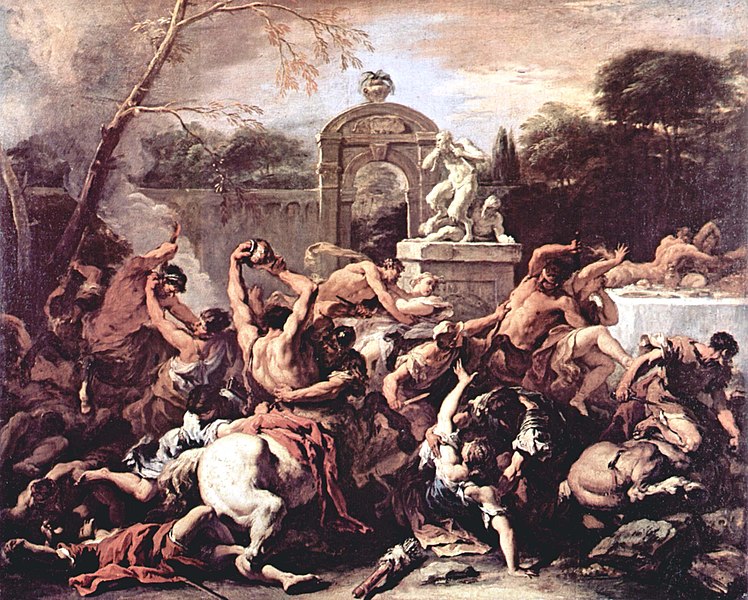
    Painting by Sebastiano Ricci, of centaurs at the marriage of Pirithous, king of the Lapithae


    Let's look at Saturn.

    In ancient Roman religion and myth, Saturn (Latin: Saturnus) was a major god presiding over agriculture and the harvest. His reign was depicted as a Golden Age of abundance and peace by many Roman authors. In medieval times he was known as the Roman god of agriculture, justice and strength. He held a sickle in his left hand and a bundle of wheat in his right. His mother was Terra and his father was Caelus. He was identified in classical antiquity with the Greek deity Cronus, and the mythologies of the two gods are commonly mixed. Saturn's wife was Ops (the Roman equivalent of Rhea) and Saturn was the father ofCeres, Jupiter, Veritas, Pluto, Neptune, and Juno, among others. Saturn had a temple on the Forum Romanum which contained the Royal Treasury. Saturn is the namesake of both Saturn, the planet, and Saturday (dies Saturni). http://en.wikipedia.org/wiki/Saturn_(mythology)


    Die Früchte der Erde werden Saturn dargereicht

  15. #30
    Banned
    Join Date
    Jun 2011
    Location
    Where the rain doesn't stop.....
    Posts
    763
    Blog Entries
    1
    And another association of Divine Comedy and mythology.


    Inferno, Canto XIII, 1-45, The Wood of Self-Violators: The Harpies and the Suicides


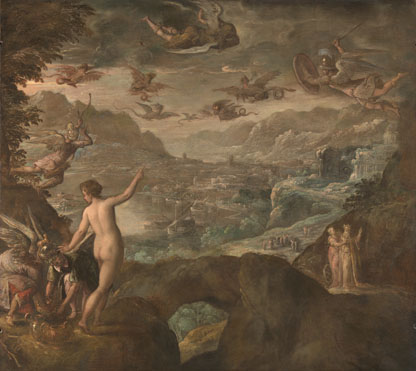
    The Harpies were the spirits of sudden, sharp gusts of wind. They were known as the hounds of Zeus and were despatched by the god to snatch away (harpazô) people and things from the earth. Sudden, mysterious dissappearances were often attributed to the Harpyiai. The Harpies were once sent by Zeus to plague King Phineus of Thrake as punishment for revealing the secrets of the gods.

    Homer mentions one Harpy called Podarge (Swiftfoot). Hesiod mentions two, Aello and Okypete (Stormswift and Swiftwing).

    In Greek mythology, a harpy ("snatcher", from Latin: harpeia, originating in Greek:ἅρπυια, harpūia) was one of the winged spirits best known for constantly stealing all food from Phineas. The literal meaning of the word seems to be "that which snatches" as it comes from the ancient Greek word harpazein (ἁρπάζειν), which means "to snatch".
    A harpy was the mother by the West Wind Zephyros of the horses of Achilles. In this context Jane Ellen Harrison adduced the notion in Virgil's Georgics (iii.274) that mares became gravid by the wind alone, marvelous to say.
    Hesiod calls them two "lovely-haired" creatures, and pottery art depicting the harpies featured beautiful women with wings. Harpies as ugly winged bird-women, e.g.in Aeschylus' The Eumenides (line 50) are a late development, due to a confusion with the Sirens. Roman and Byzantine writers detailed their ugliness.
    http://www.theoi.com/Pontios/Harpyiai.html


    PHINEUS & THE HARPY

    Museum Collection: Museo Jatta, Ruvo, Italy
    Date: ca 360 BC
    Period: Late Classical / Early Hellenistic

    SUMMARY

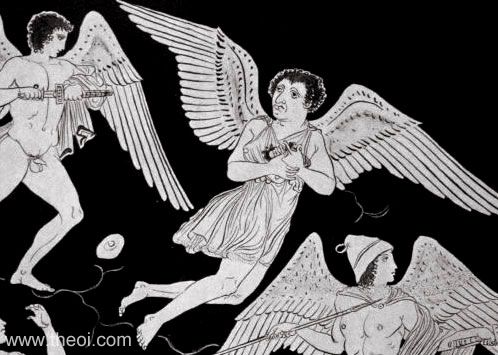
    Detail of a Harpyia and son of Boreas, from a painting depicting the theft of food from the old blind king Phineus. The Harpyia is depicted as a grotesquely, ugly winged woman dressed in a short maiden skirt. The Boread who pursues her is a handsome youth armed with spear and sword.

    NOTEThis image is a dr


    A harpy in Ulisse Aldrovandi's Monstrorum Historia, Bologna, 1642


    Inferno Forest Of Suicides


    Aeneas and his Companions Fighting the Harpies 1646-47


    Landscape with the Expulsion of the Harpies about 1590,

Page 2 of 12 FirstFirst 1234567 ... LastLast

Similar Threads

  1. Banned books
    By Lara in forum General Literature
    Replies: 250
    Last Post: 12-12-2015, 04:16 PM
  2. Why I believe in God?
    By laidbackperson in forum Religious Texts
    Replies: 938
    Last Post: 11-27-2011, 05:49 PM
  3. The Man with the Blue Guitar
    By Virgil in forum Poems, Poets, and Poetry
    Replies: 50
    Last Post: 07-09-2009, 11:36 PM
  4. The novel
    By Newcomer in forum Jane Eyre
    Replies: 23
    Last Post: 03-06-2009, 09:29 AM
  5. Why do you conceive the Bible is difficult?
    By Deng Xiang in forum Religious Texts
    Replies: 65
    Last Post: 09-12-2008, 09:01 PM

Posting Permissions

  • You may not post new threads
  • You may not post replies
  • You may not post attachments
  • You may not edit your posts
  •