


Stlukesguild
Raphael pt. II
by , 12-30-2009 at 01:22 AM (5661 Views)
Raphael entered into the Roman art scene at the peak of the High Renaissance... one of the greatest paradigm shifts in the whole of Western art history. In the eras prior, art... painting, sculpture, architecture... were seen as nothing more than a form of skilled labor, and artists were but skilled craftsmen... not far from carpenters or blacksmiths. The visual arts were not thought of as an intellectual endeavor and were not counted among the "liberal arts". In most instances the theme, symbols, and narrative details were dictated to the artist by the patrons... often through a theologian intermediary. This theologian would spell out that the Virgin Mary was to be painted wearing blue because this was a royal color (and the most brilliant blue was made of ground gemstone: lapis lazuli and more expensive than gold). She might have a red undergarment... but could never wear red as the main garment as this was the color of sex. The "scarlet woman", Mary Magdalen, would wear red, but not the Virgin. Nor could she ever wear green... the color of fertility and fecundity.
With the High Renaissance, artists began to challenge the notion that they were but craftsmen. They began to work across multiple art forms (something quite rare before) so than Brunelleschi was trained as a goldsmith, made his first mark on the art world as a sculptor, is most known as an architect, and codified linear perspective as a painter. Artists began to study the history of art as a formal discipline. Vasari's Lives of the Artists would be written a generation after Raphael while Cellini and Leonardo both wrote biographies and advice to younger artists. Artists began to look upon art as an intellectual endeavor and take up the position of "artist/scholar". Brunelleschi made in depth studies of Roman art and architecture. Michelangelo was a major poet. Alberti wrote great tomes on art, perspective, and architecture, and Leonardo was a scholar of merit in a vast array of subjects ranging from anatomy and physiology, military armaments, music, botany, flight, etc... Artists also began to study and read the latest poets and philosophers (Michelangelo was never without his Dante) and to circulate within the social world of such intellectuals (writers, scholars, etc...)
Upon first entering in the service of the Pope, Raphael was seen as something of a talented provincial and was given but a minor commission. The artist created a series of paintings for the ceiling of the Stanza della Segnatura in the Vatican illustrating Biblical themes. He rendered these well enough... bringing to them his signature sensuality and softness of form and merging it with gilded mosaic tiles:

While these paintings are lovely enough in themselves, they show little exposure to the new ideas and new concepts of what an artist is. This would all change with the great cycle of wall frescoes for the Stanza della Segnatura which soon became known as "Raphael's Stanza". The first of thes masterful paintings is the Disputa. The multiple changes wrought during the creation of this painting suggest a radical new working method in which the artist was working out ideas as the painting developed. The theme of the painting is unlike anything the artist painted earlier. It represents an idealized "dispute" between church fathers (saints, popes, scholars, etc...) as to the merit of faith vs knowledge. This, of course, was a central discussion current within the Church as scholars and Church leaders began to explore and embrace the wealth of knowledge of the classical world. Figures such as St. Francis d'Assisi would have insisted that faith alone brings man to God. Other scholars and theologians would site figures such as St. Thomas Aquinas in favor of reaching God through knowledge. Raphael shows the dispute placing figures such as St. Thomas Aquinas or St. Augustine upon one side of the dispute or another with their ranks echoed in heaven above:
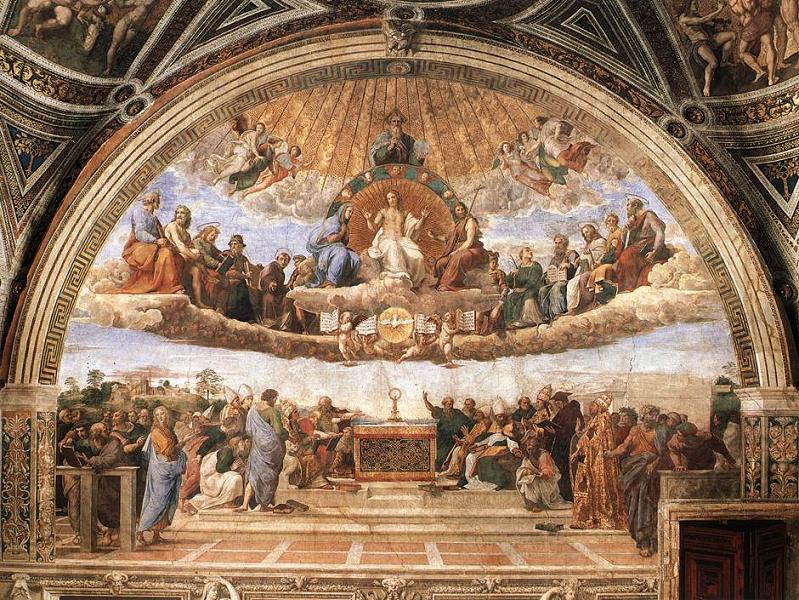
In many ways this painting stands as a precursor to Raphael's final painting, the Transfiguration, in which once again there is a dispute between the earthly or material and the spiritual.
The next great painting in this series was Parnassus. Where the Disputa illustrated one of the current debates of the Church and alluded to the effect of the current studies of classical literature, history, philosophy, and science upon Church thinking, Parnassus clearly illustrated the Neo-Platonic notion that Greece and Rome form a great continuum to the present. Gathered around the classical muses and the figure of Orpheus (or Apollo) as the father of song and poetry, one is able to survey the whole of Western poetry: Homer, Sappho, Virgil, Horace... and on to the present where we find "contemporary" Italian masters such as Dante and Petrarch.
Like the Disputa before it, Parnassus is brilliantly composed... especially considering the need for the artist to deal with the door frame. The painting is structured almost mathematically with the artist carefully weighing and balancing colors so that no single figure "pops" out too much from the whole, and the composition as a whole, like that of the painting prior, is clearly symmetrical in design.
The artist's next painting, The School of Athens, is undoubtedly one of the pinnacles of the High Renaissance and almost certainly the artist's greatest achievement. Again, multiple changes in preliminary drawings and even in the actual painting suggest that the painting process was an arduous intellectual endeavor in which the artist... quite probably in partnership with a theologian and the Papal patron... developed the complex symbolism. The School of Athens attempted to directly illustrate and proclaim support for the concepts of Neo-Platonism... the continuity of the achievements of Greece and Rome with that of the present day Rome. Classical thought was to be seen as a clear precursor to contemporary thought.
The School of Athens presents an ideal scene in which the great thinkers of the classical world (Plato, Aristotle, Socrates, Ptolemy, Zoroaster, Euclid, etc...) are seen as a great school of thought all gathered together. But at the same time... they are presented as precursors to and at one with the thinkers and scholars and creative minds of the present for they are all represented as portraits of contemporary creative thinkers.
At the center... most clearly... is Leonardo da Vinci presented as Aristotle... for Leonardo was unquestionably seen by Raphael as one of the reigning geniuses of this new era... this rebirth of classical genius... this "Renaissance". Other contemporary portraits include Pope Julius II (as Pope Gregory IX), Raphael himself, and his teacher, Perugino... and finally... as an afterthought... Michelangelo. Gaining access to the incomplete Sistine paintings through his uncle, Bramante, Raphael... who had not thought of Michelangelo as a great artistic figure until that point... was stunned by the massive power of Michelangelo's superhuman figures... such as the great Libyan Sibyl:
Where Raphael's figures are all nearly parallel to the picture plane, Michelangelo (with the mind of the sculptor) twists and turns the human body in space. Arms thrust out toward the viewer and race back. No other figure twists and turns in such a forceful torquing manner as the portrait of the great brooding Michelangelo leaning upon a great stone/marble block. The figure brings the entire painting to life through its explosive internal energy... and in the manner in which it clearly sits in contrast to the carefully balanced and symmetrical composition. Where the eye would have been rapidly led by the perspective to the central figure of Leonardo, now the eye is stopped initially by Michelengelo and jumps between the two figures... who indeed, virtually divide the Renaissance between them.
The School of Athens clearly shows Raphael at the leading edge of artistic innovation. Not only does he display a mastery of narrative in tackling current issues of philosophical debate, but he employs the most recent formal elements to achieve this: the organization of figures in space through the use of mathematical measure, the masterful understanding of anatomy (many preliminary studies are of nude figures), and one of the greatest displays of the use of formal perspective... both as a means of strengthening the illusion of real space and form... but also as a means of directing and focusing the eye.


 Go to Profile
 Mark as Read


