


Stlukesguild
William Blake: Visual Artist pt. 2
by , 07-06-2009 at 12:46 AM (21737 Views)
Surprisingly, Blake may have drawn inspiration for the imagery illuminating these early books from a source that at the time was less-than-revered: in this case the embroidered samplers that were among the only artistic expressions allowed to women:
Blake's illuminations... in which the text of his poems are woven around with branches, vines, and other (often metamorphosed) flora bear more than a striking resemblance to the artistic efforts of anonymous women embroiderers:
Intriguingly, watercolor, Blake's medium of choice for painting, was also the medium commonly allowed to women of the era. One wonders... considering Blake's radical notions concerning the sexes... as well as his own partnership with his wife Catherine in assisting in the painting of his own productions... whether Blake's preference was in part a nod to these unknown women artisans. Blake, after all, was largely shut out or dismissed by the larger "serious" art world.
While the texts of Blake's poems in the Songs of Innocence and Experience are deceptively child-like... the illustrations were recognized as perfectly suited to the illustration of childrens' literature and as such it would eventually inspire any number of Victorian illustrators of childrens' books.
Perhaps the most unique… and challenging work by Blake... at least as a work of visual art... is his Job. This work is built of a title page and 21 engraved illustrations. At first glimpse one might assume that Blake has merely illustrated the Biblical text of Job… (Even the Blake Archive makes the mistake of listing this work under illustrations of text by other writers)... but as is usual with Blake, nothing is as simple as it first appears. The usual orthodox interpretation of Job (the man) is that he represents an admirable figure of faith and patience… a good man who is tested by God by having all of his worldly belongings stripped from him, his family taken away in tragedy, and his own body stricken with painful disease… and yet he does not lose his faith in God. Blake’s Job, however, is conceived as somewhat of a critique of this orthodox interpretation.
In the first image we see Job surrounded by his family in a pastoral landscape. Job is seen as a good man, no doubt... but there are several telling details. The sun is setting. The long night is coming when Job will be sorely tested. Directly beneath the image Blake has placed the phrase, "The letter killeth; the spirit giveth life." Job embraces the letter of the law. He fears rather than loves God just as his children... kneeling before him... fear him. There is no joy... spontaneity... or music to Job's praise of God. The musical instruments all hang unused:
Utilizing images as well as inscribed quotes from the Book of Job and other Biblical texts, Blake presents the idea that Job does not begin as a man deeply faithful to God… but rather as a figure who is faithful only in appearance. He may do the right things… but for the wrong reasons. In this plate two narratives unfold before us. God calls his servant... the tempter/Satan before him. Rather than an image of horror, evil, and ugliness, Satan (mirroring Blake's notions of good and evil) is a god-like figure himself. The greatest of the angels... almost a Mercurial messenger of the Lord. In the scene below, Job clutches his books... THE LAW... and turns his back upon the sensuality joys of his children:
Following Job's tragic losses... his wealth and his children... he still clutches at the law... offering alms to the poor (not because he wishes to, but because he should- as is made clear by his use of his left hand). His piety is out of fear and for show. Again the god-like Satan rushes forth to test Job more:
Blake suggests that the various trials that Job undergoes amount to a spiritual journey… from a false believer to a truly spiritual man. In what in perhaps the most powerful image, Illustration XI:
Blake presents a Job condemned to the fires of Hell. Devils reach out from the flames below in an attempt to drag him down. Serpents entwine him. Still his hands are clutched in prayer as he looks up to the Hebrew God, Jehovah, hovering over him. Jehovah points to the tablets of the law which condemn Job while the lightning bolt of damnation leap around him. And yet… as Job glances down at Jehovah’s cloven foot and at the serpent of materialism with which he is intertwined… he realizes that this immovable God of the law is one and the same with Satan. The inscription “I know that my redeemer liveth” suggests that Job has begun to imagine that there is a better God: Jesus.
In the final image of Job, the narrative has come full circle...
It is now morning. In echoes of Dante's spiritual journey, the sun rises in the east and to the west the moon is now accompanied by two stars... the second being the morning star: Lucifer. Job's children are with him again (suggesting that the entire narrative recounts a spiritual rather than an actual physical transformation).No longer do Job's children kneel beneath him, but rather all burst into spontaneous praise upon the once silent musical instruments. Human expression... creativity... "imagination" are after all the true path to eternity to Blake.
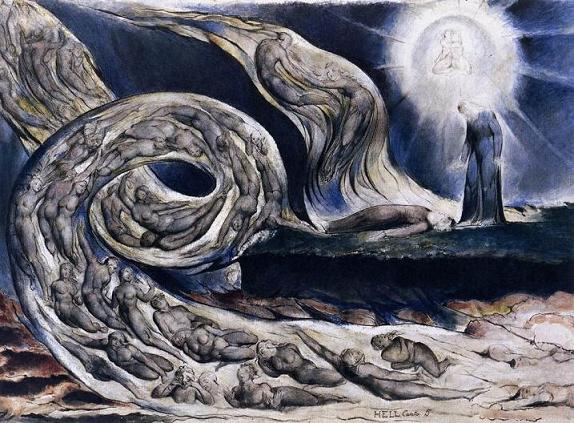
Beyond his illuminated books (to say nothing of his commercial efforts as an engraver with which he earned his keep) Blake also produced a large number of watercolor paintings illustrating scenes from the Bible, Milton, Dante, Shakespeare, and Chaucer. Some of these were bound with folios, while others were imagined as the basis for more ambitious printed books that he would never realize:
The Bible:
-Cain and Abel
-Satan Smiting Job with Sores
-The Wise and Foolish Virgins
-The Last Judgment
Dante's Divine Comedy:
-Whirlwind of the Lustful
-Antaeus Setting Down Dante and Virgil
-Canto I: The Three Beasts
Milton's Paradise Lost:
-The Fall of Adam and Eve
-Vision of the Crucifixion
-Vision of the Resurrection
One can only fantasize about what Blake might have achieved in the field of artist's books had he only had access to the techniques of color reproduction afforded by lithography and more modern photographic reproductions... to say nothing of the time lost upon commercial ventures that afforded him little pleasure or creative challenge.
Unfortunately, Blake remained largely unknown outside of a small circle of admirers during his lifetime. He never attained the recognition he deserved during his lifetime and he forever lived in near poverty. A prophet by calling and an engraver by trade he struggled to eek out a living in a highly competitive field working in what appeared to many to be a hopelessly outmoded manner… yet in many ways Blake was as innovative as a visual artist as he was as a poet. At a time when oil painting dominated the visual arts (and had dominated for centuries) Blake had the audacity to reject oil painting in favor of print, watercolor and his ideal of the “illuminated books”. While Western art reveled in the abilities of the artist to mimic the appearance of physical reality, Blake rejected such a goal as worthy of the artist, declaring “One power alone makes a poet, Imagination. The Divine Vision.” As such it should come as little surprise that few took Blake’s art seriously until the advent of Modernism when invention and imagination would triumph over the imitation of nature.
continued...




 Go to Profile
 Mark as Read


