


Stlukesguild
William Blake: Visual Artist pt. 1

by , 07-06-2009 at 12:44 AM (15986 Views)
(I posted this entry upon the William Blake discussion. Parts of it are excerpted from an earlier entry. Here, however, I sought to focus upon Blake as a visual artist)
William Blake (November 28, 1757 – August 12, 1827) may just be my single favorite British poet so I will need to offer fair warning as to the possibility of some bias. Blake has long been accepted as one of the “great six” of British Romanticism (Blake, Byron, Keats, Shelley, Wordsworth, Coleridge) and one of the greatest poets ever to have written in the English language. His achievements in the visual arts, however, have gained him near equal acclaim, and it is to his achievements as a visual artist that I'll address this posting.
Blake has been one of the most misunderstood and maligned of any major poet/artist. He is often portrayed as a half-mad genius, a wacked-out visionary who spoke to spirits, a political naif, a curmudgeon and “outsider”, a self-taught artist and poet who had little knowledge or experience of the art or literature of his predecessors or of his own time. Most of these stereotypes have but little reality to them.
Blake was a major figure both as a poet and as an artist. His achievement in two very different art forms is quite rare. Richard Wagner is recognized both for his music and for his literary abilities... having composed the librettos for his own operas (librettos that stand as literature in and of themselves). Dante Gabriel Rossetti and William Morris, both of whom admired Blake, were both artists and authors/poets of real merit... although Blake is clearly greater as both poet and artist than either. Perhaps the only figure to surpass Blake in his achievements across the artistic spectrum is that of Michelangelo, who was a master painter, sculptor, architect, and poet.
Blake had little formal education as a child... indeed, as a writer he was largely untutored... refusing to attend school as a child... and supported in this by his father, who was somewhat revolutionary in his political, social, and religious views. Nevertheless, Blake was very well-read and often of that literature which was not part of the accepted canon of his time. Of course he was well-versed in the works of Shakespeare, Dante, Milton, Chaucer, Ben Jonson, Spencer, and the Bible… but other sources of inspiration include Thomas Paine and Mary Wollstonecraft (with whom he was friends and political ally), Emanuel Swedenborg, Jean Jacques Rousseau, Plato, Plotinus, the Hermetica and the Bhagavad Gita, mythologies of the world from Egypt to Iceland to India to ancient Britain and even the Kabbalah. Not only was Blake well-read, but he was also an insightful reader who developed interpretations that freely challenged the accepted ones.
Blake may not have had the advantage of a formal education in literature... nevertheless, he was most certainly not unlearned... or self taught... especially as an artist. Blake developed an early love of drawing by copying engravings of masters such as Raphael, Michelangelo, and Albrecht Dürer. In this he was was fully supported by his father. Unable to afford apprenticeship to a painting master, Blake was initially apprenticed to the fashionable William Ryland, engraver to King George. The young William, however, however would request that his father find a more suitable match for his talents, declaring that Ryland had “the hanging look about him”. (Ryland would end on the scaffold some years later, convicted for forging currency.) Blake spent his apprentice years under James Basire. Basire’s manner of working was rather out-dated...
...stressing the linear contours and avoiding the more painterly affects that would allow for replication of paintings or the creation of more atmospheric elements. His manner, however, was perfectly suited to Blake’s own personal preferences for the linear sculptural form. Basire’s chief source of income was the result of commissioned engravings to be made of architectural and sculptural details of English churches and cathedrals:
Through his apprenticeship to Basire, Blake was exposed to the stylistic abstractions of Romanesque and Gothic art which would have been largely dismissed by most artists of the time:
"Horror Vacui" (the fear of emptiness) as witnessed in Blake's crammed compositions in many echo compositional techniques of the medieval sculptors filling the entire architectural setting:
Where Blake's abstractions or expressive "distortions" were often dismissed as proof of his incompetence or eccentricity, in reality they owe much to his study of medieval art and other sources that were largely ignored during his lifetime. Many of his images suggest older sculptural designs in which the composition was dictated by the form:
Tympanum:
Arches:
Funerary Relief Sculpture:
There are even elements in Blake's paintings which suggest Asian art:
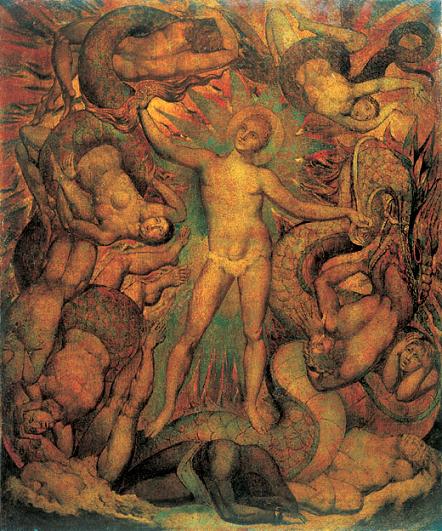
The strongest of Blake's paintings audaciously contort or distort the figure in order to make it adhere to a simple yet bold abstract compositional design:
During Blake's lifetime, such abstractions were seen as mannerisms that were eccentric in the extreme and did not adhere to naturalism. Of course Blake would have argued that he cared not whether such images followed nature. Imagination was what mattered. With the advent of Modernism Blake no longer looked so eccentric and looked even less reactionary; rather he was seen as "visionary"... or perhaps even "prophetic" in his embrace of abstract form.
In 1778 Blake enrolled in the Royal Academy. He quickly rebelled against the preference of the academy for such painterly masters as Rubens, Rembrandt, and Titian… as well as against the president of the academy, Sir Joshua Reynolds. He detested Reynold’s pursuit of “naturalism” and “generalizations” and he would write in the margins of his personal copy of Reynold’s Discourses, “To Generalize is to be an Idiot; To Particularize is the Alone Distinction of Merit”.
In 1782 Blake met John Flaxman (sculptor) and George Cumberland (one of the founders of the National Gallery, London) who would both become patrons of his work. He also met Catherine Boucher, who would become his wife. Illiterate at the time of his marriage, Blake would not only teach her to read and write, but also educate her in the art of watercolors and engraving. She would become an invaluable aid to him in the creation of his printed books and a great moral support.
In 1784 Blake and his brother, Robert opened a print shop, and began working with the radical publisher, Joseph Johnson. Through Johnson, Blake met with some of the leading intellectual dissidents of the time, including Joseph Priestly, Mary Wollstonecraft, Thomas Paine, William Wordsworth, and William Godwin. Inspired by Wollstonecraft’s views on marriage and sexuality Blake composed his Visions of the Daughters of Albion in 1793. It is quite possible that Percy Shelley may have come across Blake’s writings in the possession of Mary Godwin (Shelley), Mary Wollstonecraft’s daughter.
Perhaps most important, however, of Blake's early associations... at least in terms of his artistic development... was the Swiss-born painter, Henri Fuseli. Blake was clearly indebted to Fuseli stylistically; his "expressive" distortions owe much to the examples of the older artist. Blake was also inspired by Fuseli's mastery of literary narrative; a great many of Fuseli's best-known paintings illustrate scenes from Milton, Goethe, or Shakespeare:
Nor can one overlook the fantastic inventiveness of Fuseli (criticized by many of his artistic peers of the time), his dark eroticism...
... and even his preference for pen and wash/watercolor (which would become the chosen medium of the majority of Blake's works):
In 1788 Blake developed his method of “relief etching” (reportedly revealed to him by his deceased brother Robert in a dream) by which he produced most of his printed and illustrated books. Blake often referred to his illustrated books as “illuminated books”… a term used to describe the medieval books such as the Book of Kells, the Lindesfarne Gospels or the Tres Riches Heures of the Limbourg Brothers, etc...
...in which the text and imagery were woven into a single unified artistic entity. Like the illuminated manuscripts, Blake's images were attempts to go beyond mere illustration; rather they were aimed at "illuminating" or "enlightening" a visionary text (albeit of his own invention) in a manner that would lead to a further or greater understanding than that which might be achieved by the text alone. These books were engraved or etched in a single color...
...and then each volume was hand-painted in watercolors by himself or Catherine. There are clear differences between various versions of Blake's illuminations:
Blake’s two thin volumes The Songs of Innocence and The Songs of Experience are perhaps his most famous poetic and artistic productions… and also the first instances in which he fully integrated his visual and poetic talents.
The Songs of Innocence consist mostly of poems describing the innocence and joy of the natural world… or the world seen from an innocent viewpoint, advocating free love and a personal relationship with God unmediated by religion. The poems and the accompanying imagery are deceptively child-like. They strike one initially as simple… even naive… but reveal a deeper meaning with with repeated reading:
The Lamb
Little Lamb who made thee?
Dost thou know who made thee?
Gave thee life and bid thee feed
By the stream and o’er the mead;
Gave thee clothing of delight,
Softest clothing whooly bright;
Gave thee such a tender voice,
Making all the vales rejoice.
Little Lamb who made thee?
Dost thou know who made thee?
Little Lamb I’ll tell thee,
Little Lamb I’ll tell thee;
He is called by thy name,
For he calls himself a lamb.
He is meek and he is mild;
He became a little child.
I a child and thou a lamb,
We are called by his name.
Little Lamb God bless thee.
Little Lamb God bless thee.
Infant Joy
“I have no name;
I am but two days old.”
What shall I call thee?
“I happy am,
Joy is my name.”
Sweet joy befall thee!
Pretty joy!
Sweet joy, but two days old.
Sweet Joy I call thee:
Thou dost smile,
I sing the while;
Sweet joy befall thee!
In contrast, The Songs of Experience suggest a loss of innocence after exposure to the materialistic world, “unnatural” concepts such as good and evil, sin, and religion. Most of the poems of the latter volume offer a direct counterpart to the Songs of Innocence. Perhaps the best example is The Tyger, counterpart to The Lamb, and probably Blake’s most famous (deservedly) poem:
The Tyger
Tyger! Tyger! burning bright
In the forests of the night,
What immortal hand or eye
Could frame thy fearful symmetry?
In what distant deeps or skies
Burnt the fire of thine eyes?
On what wings dare he aspire?
What the hand dare seize the fire?
And what shoulder, & what art,
Could twist the sinews of thy heart?
And when thy heart began to beat,
What dread hand? & what dread feet?
What the hammer? what the chain?
In what furnace was thy brain?
What the anvil? what dread grasp
Dare its deadly terrors clasp?
When the stars threw down their spears
And water’d heaven with their tears,
Did he smile his work to see?
Did he who made the Lamb make thee?
Tyger! Tyger! burning bright
In the forests of the night,
What immortal hand or eye
Dare frame thy fearful symmetry?
I have long held this lyric in my memory, like many nursery rhymes and poems learned in my youth. Like a nursery rhyme, it’s hypnotic and chant-like… seeming oh so simple at first… but soon revealing far greater depths of thought… questions about the very nature of good and evil and creation. I’m always struck with chills as the poet finally confronts us with the ultimate question, “Did he who made the Lamb, make thee?”, before returning once again to the beginning, “Tyger Tyger…” and leaving that question unanswered… but perhaps provoking a little spark in our minds.
continued...




 Go to Profile
 Mark as Read


