


Stlukesguild
Hieronymus Bosch c. 1450-1516-part 1

by , 11-18-2008 at 08:08 PM (17551 Views)
His true name was Jeroen Anthoniszoon van Aken. He was born c. 1450 in s'Hertogenbosch, a blossoming Netherlandish commercial town in northern Brabant. His grandfather, father, brother, and three uncles were also painters. Sometime between 1471 and 1481 he married Aleyt van den Meervenne, daughter of a wealthy burgher. In 1486 he was registered as a member of the Lieve-Vrouwe Broederschap (Brotherhood of Our Lady) in which he became a "notable" two years later. From the Brotherhood's records it is revealed that he painted a scene of Abagail before David on the wings of an altarpiece of the great s'Hertogenbosch Cathedral of St. John, where a Crucifixion fresco attributed to his grandfather survives. In 1492 he designed a stained-glass window for the Brotherhood's own chapel. Philip the Fair, Archduke of Austria, commissioned a Last Judgment from him in 1504, lending weight to the suggestions that his reputation had traveled beyond Brabant. Between 1508 and 1512 the Brotherhood's records find him designing a chandelier as well as a crucifix for the Brotherhood, and inspecting the gilding and coloring of the Cathedral's altarpiece. He died in July or early August of 1516 and death notices spoke of him as a "seer vermaerd schilder" (very famous painter). This is about the limit of documentation we have for this genius of European painting.
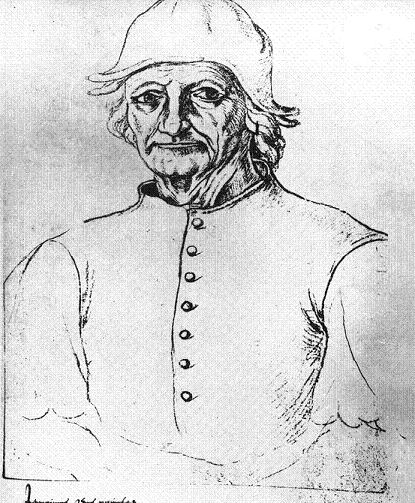
"So why should he speak to me, that crazy Dutchman, Flemming, German, whatever he was? Why should I respond to Bosch's visions of damnation, somewhere in myself, when- as a modern, skeptical, secular Jew- I'd believe in acupuncture, and orgone therapy before an afterlife? When more than anything in the world, I dread and loathe the brutal, hysterical religiosity from which these paintings spring: the fanatic righteousness that invented hell because heaven meant getting to watch you poor neighbors suffer forever? That old man in his self portrait with his reptilian mouth and his grim stare across five hundred years- why should his work have mattered so strangely to me for so long? Why should I feel that I know him?"
-Peter S. Beagle from The Garden of Earthly Delights
Like many teenagers with an interest in art, I was enamored of the Surrealistic paintings of Salvador Dali. Abstraction did nothing for my teenage imagination... but melting watches, burning giraffes, elephants on stilts and the like immediately seduced me with their mixture of polished "realism" and fantasy. Dali at his finest conveyed a certain disorienting unreality... but far too often he was much more about drama... show business... and histrionics. While he may have faded somewhat in my eyes... I will forever be indebted to him for having led me to this far more original... truly frightening... and consequently compelling painter.
"I was growing up in the years just after World War II, in the time when the Holocaust had no name because the fact of what had happened to the Jews of Europe was still too much for language to absorb. That fact was joined by another, this one almost nothing but a name, learned with my own: Hiroshima. Having learned of these horrendous events at an early age, it is hard for me to remember a time when I did not know, as simply as I knew that Joe DiMaggio was the best baseball player in the world, that there is nothing- nothing- that human beings will not do to each other, for the pure pleasure of it, and that their evil will neither be prevented in this world nor punished in the next. The Nazis may or may not have lost a war, but their howl of triumph echoes everywhere, every minute. Nothing is forbidden. There is no covenant. The lightning does not come. Civilization has always flourished in the shadow of this knowledge, and our own culture has even trained itself to climb it, like a morning-glory vine. We call it the "existential dilemma" and "the human condition", but Hieronymus Bosch's world called it the Devil."
Peter S. Beagle from The Garden of Earthly Delights
Hieronymus Bosch began his career in a manner innocuous enough, painting a traditional Biblical narrative, Ecce Homo (.c. 1476), illustrating the moment in which Pilate offers the people the chance of freeing Christ:
Even as early as this painting, Bosch exhibits his love of caricature, portraying the massed crowd as displaying a combination of brutality and mental deficiency.
By the 1480s, however, Bosch begins to create works that are the most inventive, and unusual as far as imagery. The art critic, Wilhelm Fraenger, put forth the highly controversial theory that the shift in Bosch's work was due to his acceptance into the Brotherhood of Our Lady, which Fraenger suggested had definite heretical leanings. In reality, the Brotherhood was not unlike many of the guilds (such as the Guild of St. Luke, the painter's guild) and charitable fraternal organizations, such as the Freemasons. Other, more credible, suggestions have been put forth proposing that Bosch was largely able to work independently as a result of his wife's wealth... and/or that his work... unique as it was... rapidly gained an audience. It is also quite likely that growing up in an extended family of artists working for the church, Bosch was more than familiar with the marvelous grotesques... part human, part animal, part plant... which medieval scribes in moments of daring and inventiveness would often slip into the borders of illuminated manuscripts.
One of the earlier paintings, now known only through a copy, is the marvelous Concert in an Egg:
This painting suggests an attempt at a musical performance led by a monk following a printed score... But the facial and bodily gestures suggest that this concert is doomed to ending as a cacophony... none of the performers seeming to be at all in tune with the conductor or each other. Bosch would return to this theme again... in a far more disturbing manner... with the scene of the infernal orchestra in the Hell panel of his masterwork, The Garden of Earthly Delights. In the present painting, the setting... in a giant egg... lends a definite surreal/dream-like nature, but almost certainly was intended to suggest the unnatural nature of this concert... and perhaps of mankind as a whole. In a further marvelous detail Bosch seems to almost play with the old "chicken or the egg?" question as a group of birds are seen nesting in the branches of the tree having grown from within the egg.
"There is no vice which will not receive its proper retribution..."
Thomas à Kempis- Imitation of Christ
Perhaps Bosch's first triptych , a form quite favored by the artist, was the Last Judgment c. 1485.
In this painting we are first presented with Bosch's horrific vision and horrible inventiveness in full force. Mankind is subjected to every possible torture instigated by animals, humans, machines, and mutant hybrids of all three. In a pitch-black landscape the condemned are impaled on tree branches, strung up like a huntsman's trophies by beasts of the forest, and menaced by giant animated blades. Many of the tortures clearly take the form of a "just" retribution (such as in Dante's Inferno)... perfectly suited to match the sinner's crime. A glutton (or perhaps a drunkard) is forced to drink until bloated from a pi** barrel. The lecherous and the vain women find themselves fondled by slimy hands... mocking the eyes which once caressed their nubile bodies and fed their vanity, while groups of mercenaries are hunted down and disemboweled by creatures of this netherworld.
The Haywain c. 1485-90 presented Bosch's view of the world as it is... a world clearly deserving of the eventual divine retribution of Hell.

In this painting, unlike the Last Judgment, in which flanking panels (not shown) largely continued the scenes of Hell and torture, Bosch presents a linear narrative (reading from left to right). The left panel shows a 4-part narrative of creation: the "Fall of the Rebel Angels", the "Creation of Eve", "The Temptation", and "The Expulsion." Already... from the very inception of creation and the Garden of Eden... sin and rebellion allude to the eventual retribution of Hell... or so Bosch suggests. In the middle panel we are presented with the passing parade of material desires... vanity, vanity, all is vanity... Bloated churchmen gather and hoard vast stock-piles of hay. Crowds gather around the passing haywain and struggle to snatch all they can clasp is their hands. Fights break out... throats are cut... blood is spilled... all over a few disputed scraps. Kings and rulers ride behind... believing that they control the direction the haywain takes. Vain women strive to be seen in their best dresses... seeking to catch the eye of a wealthy lover. Fools dance ecstatically and lovers engage in exchanges of poetry and furtive glances... but no one notices that the entire parade is led onward by demons and lecherous henchman of the devil... and so the people will soon arrive at the third panel... the fiery pit of hell... where tortures continue while demons struggle eternally building new dwelling places for the ever-increasing population of Hell.
The painting of St. John on Patmos c. 1490-1500:
presents a far more orthodox image... one that I would not have any problem imagining any other Flemish master of the period having painted. Of course there are still telling elements as in the rather strange angelic figure who dictates the Book of Revelations to John, and the rather weird demonic figure in the foreground. Eerily, this "demon's" face suggests nothing so much as the features of the artist himself.


 Go to Profile
 Mark as Read


