


Stlukesguild
Hieronymus Bosch c. 1450-1516-part 2

by , 11-18-2008 at 08:07 PM (8045 Views)
Three surviving panels by Bosch represent an intriguing view of impact of the passage of time upon art. One panel is the Death and the Miser in the National Gallery of Art in Washington D.C.
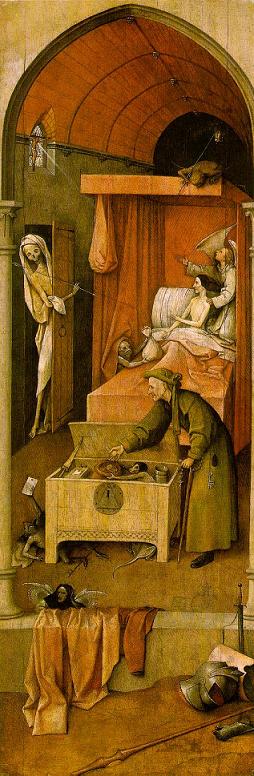
In this painting a miser... perhaps once a mercenary, as suggested by the armor and weapons placed so prominently in the foreground... is seen simultaneously in in two poses. He checks upon his wealth... locked away at the foot of the bed... as demons play with it... for surely it will prove his undoing. Further back in the bed he faces his impending doom... death enters with his arrow in hand. Ministering angels would lead the miser to repent and look upon the image of the crucified Christ seen in the stained glass window above... but his avarice is too much as he struggles to hold on to the bag of gold that a demon attempts to snatch away. The miser would rather save a few coins and lose his soul.
This painting was part of what is now assumed to have been a triptych... or larger multi-paneled painting. The second painting now exists in two pieces. The Louvre holds the so-called Ship of Fools:
While the Harvard Museum owns the fragment known as the Allegory of Gluttony and Lust:
Analysis and research has proven that these two paintings were once part of a single larger painting:
Drawings exist showing where the Ship of Fools was cut and where the owner intended to make a similar amendment to the Death of the Miser. Perhaps the owner wished to place both paintings within a pair of smaller frames already within his possession... or within an architectural niche that demanded the work be cropped. No matter the reason, we are lucky that the Death of the Miser survived intact and that the two portions of the Ship of Fools have also survived. Unfortunately... the middle panel, of which we know nothing, has been lost to history.
I might add two other intriguing facts about the Ship of Fools. We should recognize that the cropping of the Louvre panel may have accidentally lent the fragment in the Louvre a far greater compositional strength. As it now stands, one senses a greater peril... the group being lost at sea. By eliminating the nearby shore of the Harvard fragment, their situation appears far more precarious. But that is, of course, second guessing the artist. The other fact that immediately grabs one's attention with regard to this painting is that it is one of the first of Bosch's paintings to exhibit a painterly atmosphere that suggests some of the landscape elements of Leonardo DaVinci as well as the developments of Venetian painting.
Four paintings from around 1495-1500 all exhibit an even greater use of this painterly handling: The Crucifixion of St. Julia:
The Hermit Saints:
Saint Jerome in Prayer:
and St. John the Baptist in the Wilderness:
There are some unanswered questions I have about how a number of these (and other paintings from this period) ended up in Venice that need to be answered before I throw out any suppositions or even hypothosize as to Bosch having possibly traveled to Venice and the influence of the Venetian painters upon him... or vis-versa. Suffice to say that these paintings all bear a certain poetic nature... a certain atmospheric haze... that is suggestive of Bellini and especially Giorgione... (although they also shows clear influences of the Netherlandish Geertgen Tot Sint Jans). The paint handling, however, is incredibly similar to the work of the Venetians, and the fact that Bosch was referred to as "a very famous painter" at the time of his death, combined with the commission by Philip the Fair of Austria hints at the possibility of Bosch having been a more traveled artist than is often thought. (One might point out that his most immediate heir, Pieter Breughel, began his career with a period of study in Venice.) Unfortunately, the historical documentation is so scant.
Beyond the almost Venetian painterliness of these paintings, another element that runs through them all is a sort of hint of a fecund... and even over-ripe nature in the form of giant bursting seed pods and other bulbous natural forms, as well as stone that seems to melt... or soften into flesh. These are elements that will gain importance in Bosch masterpiece, The Garden of Earthly Delights.
The Mocking (or Crowning...) of Christ is certainly one of the major paintings of the same period:
Once again, the artist has simplified things... zooming in upon narrative, and focusing upon but a few protagonists. Christ, surrounded by four tormentors, looks out at us with a look of innocent questioning that leads us to question ourselves... our role... what we might do. In contrast to Christ, each tormentor is fixated upon Christ... each is caricatured so as to convey differing personalities. The elderly Pharisee to the lower left cracks a smile that is ever so slightly wicked... in spite of his feigned desire to comfort as seen in his hand gestures. He is surely a false prophet... at once Jewish (as suggested by his garb and the stereotypical "Jewish nose") and Islamic (as revealed with the Islamic crescent moon. Immediately above him is the most brutal tormentor... an enraged figure dressed in a turban who clutches the crown of thorns in his armor-encased hand and prepares to thrust it down upon the Lord. The blunted arrow through his turban is clearly symbolic of his impotence, for all his rage. All he can do is destroy what he does not understand... little realizing that the ideas and the beliefs that Christ represents will only grow and grow as a result. At the bottom right is the least of Christ's tormentors... the ignorant buffoon who mocks what he does not understand... clutching Christ's robe as if about to blurt out apishly, "Save me, Lord!" To the top right is the most disturbing of Christ's tormentors... and certainly one of the most disturbing and unnerving characters in the whole of Bosch's oeuvre. Even worse than the enraged figure... this is the face of evil itself. Garbed in a spiked collar and sporting armor and a headdress that suggests a mercenary (including a single oak leaf... a symbol of Satan), he places his arm around Christ... as if to confide in him just what he has in store while feigning concern... human feeling. He is like the Nazi death camp officer who plays with his victims... even comforting them... before he tortures and kills... not out of hatred or rage or stupidity or religious intolerance... but simply for "the pure pleasure of it".


 Go to Profile
 Mark as Read


