


Stlukesguild
Hieronymus Bosch c. 1450-1516-part 3

by , 11-18-2008 at 07:57 PM (25531 Views)
With The Garden of Earthly Delights (c. 1505) we come to Bosch's "masterpiece" and the painting for which he is deservedly most well-known. With this painting, Bosch pulled together various elements and threads that he had explored throughout the whole of his career and organized them into a single, virtually flawless, complex whole.
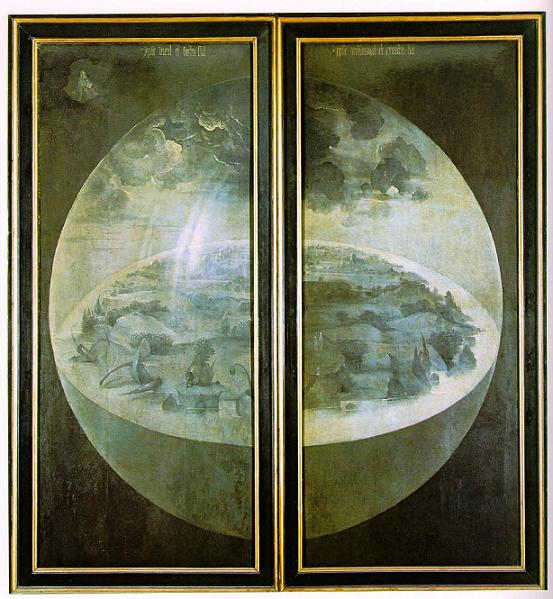
The painting, housed in the Prado, Madrid, is a triptych. We may as well start by looking at the exterior doors:
The exterior image presents a somewhat medieval concept of the earth as a flat land mass, water, and atmosphere above all contained within a sphere. The scene represents the first days of creation... before man or animals walk the earth. The grisaille "gray" or monochromatic painting is quite typical of the exterior wings of Flemish paintings. Only when one opens such altarpieces and enters in are they offered the full array of splendid color... not unlike Dorothy, upon leaving Kansas and entering the full technicolor world of Oz.
Most full color paintings of the Northern Renaissance began as grisaille under-paintings, where the artist might focus solely upon rendering form and value without the added concerns of color. Colors were applied later in transparent layers of paint known as "glazes". This technique was quite favored by the Venetians as well as the Flemish, although they preferred brown, ocher, red, and even green (Terra Verde) underpainting. Unlike other Flemish painters such as Jan van Eyck and Rogier van der Weyden who used numerous layers of color glazes to create a mirror-like smooth surface and capture the most subtle variations of light and shade and form, Bosch layered a few rapid layers of color with ala prima (wet into wet) highlights over his under-painting to achieve the final free and fluid appearance. His technique would be the major influence upon Breughel... and consequently upon the greatest Flemish painter, Peter Paul Rubens.
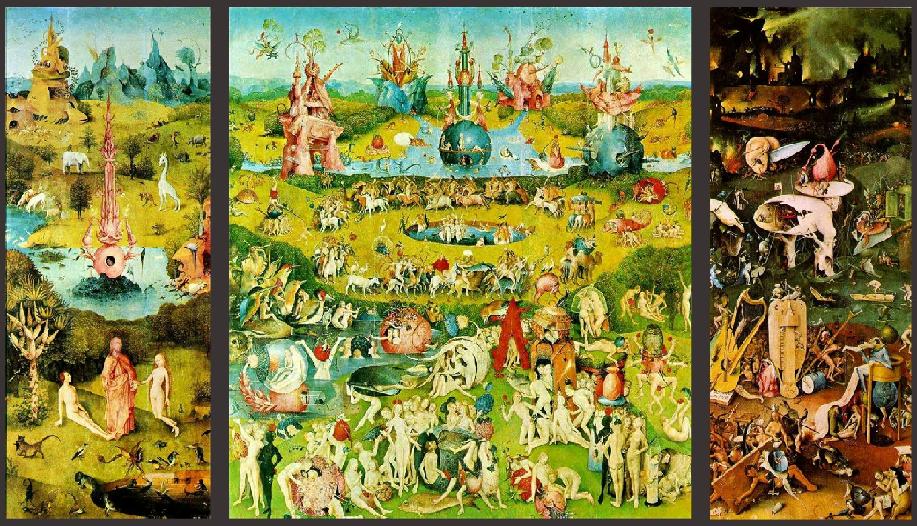
Upon opening the Garden of Earthly Delights we are presented with three distinct landscapes that share common ground-lines and compositional flow to create a unified whole:
In the first panel we are presented with a scene of the Garden of Eden. All manner of beasts live together in harmony. The dark and slimy creatures of the night can only be found hiding in the shadows and seeking safety in dank dark caves. Still all is not perfect... even in this earthly "paradise". As Christ himself joins our first parents in marriage, we see before them an intimation of the dark days to come. From a brackish swamp all manner of beasts... some deformed... mutant... arise. At the same time a cat can be seen strolling off with a mouse. This is not nature doing what it must to survive... this is one creature harming another "for the pure pleasure of it."
The central panel of the Garden of Earthly Delights suggests that the premonition of dark days to come has now become reality. The scene is a Bacchanal... an orgy of sensual and sensory excess.
Where the Biblical God had given mankind domination over the birds and the beasts of the fields, the scene now suggests nature gone wrong... or rather mankind now diminished within the scope of nature. Hundreds of tiny figures frolic and cavort amid giant over-sized birds, fruit, and bursting seed-pods. Everything suggests fecundity... ripeness on the verge of rottenness.
The entire scene is organized around a central Bacchanalian procession...
... of naked men on horseback... posing and preening and engaging in obscene acrobatics in an effort to attract the attention of the beautiful naked women lounging in the central pool.
In the distance, couples engage in sexual play of every sort beneath bizarre structures that suggest a merger of alien architecture, seed pods, shell fish, and melting flesh.
In spite of the obvious link with Surrealism... Bosch's strange imagery is not but fantasy. His symbolism is usually quite clear and purposeful.
The repetition of over-ripe fruit and seeds clearly alludes to a sensual excess: an excess of sexuality... gluttony... drunkeness.
In one particular grouping a cluster of naked men fall exhausted from within the dried leaves of a dead thistle.
To Bosch, homosexuality is clearly a waste of human sexuality... an impotent, dead act. But it is not the only sexual act to garner the artist's censure.
In another scene alluding to masturbation, Bosch suggests that in the act of onanism, the fruitful seed is but wasted upon dead branches and thorns. The abuser himself is already lost... slipping beneath the waters. Next to him a couple engage in mutual sexual play within a bubble... while below them another figure looks through a looking glass... (a symbol of looking into the future) and is confronted with the image of a rat... symbol of death and disease. (Interestingly enough it is the black rat that was the bearer of the bubonic plague that had so recently ravaged Europe... and still continued to do so in smaller outbreaks). It seems quite obvious that the lovers' bubble is about to burst.
Not all the scenes of sensual excess, however, are sexual in nature. Figures madly scrambling to grab hold of berries... gorging themselves upon the fruit... also allude to the sin of gluttony. Other figures with berries or flowers or grapes mounted on their heads...
... undoubtedly imply various forms of intoxication. The grape-headed lover warily eyed by his companion (above), for example, has clearly lost his head to the euphoria of wine drunkenness.
One of the most disturbing and foreboding images of Bosch's painting must certainly be that of the giant birds who watch human debauchery with a cold calculation.
For all the beauty of their plumage, one cannot help but remember certain unnerving scenes out of Hitchcock's The Birds. One imagines that Bosch had just such an intention... although one rooted more in Biblical prophesy:
And I saw an angel standing in the sun; and he cried with a loud voice, saying to all the fowls that fly in the midst of heaven, Come and gather yourselves together unto the supper of the great God; That ye may eat the flesh of kings, and the flesh of captains, and the flesh of mighty men, and the flesh of horses, and of them that sit on them, and the flesh of all men, both free and bond, both small and great.
-Revelation 19:17-18
But not all humanity is lost... or so Bosch suggests. In the lower left of the painting a group of people look back at the scene of Adam and Eve led by the gestures of a single figure...
...undoubtedly preaching to the group about the price of original sin. Intriguingly enough... Bosch is quite liberal for the time and place in which he lived... including a black African among the "elect" groupings in both corners.
In the right corner, a group looks back with expressions of dismay at what the world has come to.
In the bottom right of this grouping... partially hidden behind the looking glasses through which they see to the future... are the figures of Adam and Eve. And the future to which they look? That is to be revealed in the final... and most harrowing single panel ever produced by Bosch.
...looking at Michelangelo's paintings, it is hard not to feel that he looked on the Last Judgment mainly as an occasion for painting a splendid picture, while Bosch's visions seem to reek of hell itself.
-Timothy Foote- The World of Bruegel
Each darling sin will find its appropriate reward; for the proud, every kind of humiliation, for the covetous, the pinch of grinding poverty. Spend a hundred years of penance here on earth, it would be no match for one hour of that punishment. Here, we have intervals of rest, and our friends can comfort us; there is no respite for the damned, no consolation for the damned.
-Thomas à Kempis, Imitation of Christ
The third and culminating panel of Bosch's triptych represents Hell... and it is certainly one of the most malicious and virulent representation of Hell ever realized.

Hell itself seems to be a city on fire. The background reminds me of nothing so much as old photographs and newsreels of of London during the Blitz... or more recently, video footage of the night bombing of Baghdad. On a personal note, there have been times when I have driven at night through the industrial wasteland of Cleveland and thought that the smoldering fires belching forth from the steel mills into the night skies reminded me of nothing so much as Bosch's infernal visions. Perhaps this latter analogy is closer to what Bosch had intended, for surely the hell fire, the silhouetted ladders and scaffolding, and the infernal machinations suggest that the demons are ever occupied... building more and more for the ever expanding population of Hell.
Before this fiery landscape we find some of the most original and disturbing visions.
We are the hollow men
We are the stuffed men
Leaning together
Headpiece filled with straw. Alas!
Our dried voices, when
We whisper together
Are quiet and meaningless
As wind in dry grass
Or rats' feet over broken glass
In our dry cellar
Shape without form, shade without colour,
Paralysed force, gesture without motion;
Those who have crossed
With direct eyes, to death's other Kingdom
Remember us--if at all--not as lost
Violent souls, but only
As the hollow men
The stuffed men.
-T.S. Eliot, from The Hollow Men
Perhaps most memorable is the almost hallucinatory "tree-man". Where the Greco-Roman metamorphoses from human to plant (such as the myth of Daphne) have something magical about them, this figure... an aberrant fusion of man, tree, and egg... three symbols of life... speaks only of death. Branches weave through his eggshell torso like a rib cage... while his eggshell body is cracked, blanched, and hollow... empty, and without heart or soul. Drunken denizens of Hell now engage in drunken debauchery in his hollow body. For all his mass and sturdiness... he stands uncertainly... each tree leg growing out of a battered small boat. He stares back over his shoulder with an almost accusing attitude directed toward the viewer. "There, but for the grace of God...?"
To the immediate right of the tree man, a soldier in armor... a chalice stolen from the church firmly clutched in hand... is devoured by a ravening pack of dogs. The mercenary now finds out what it is to be on the receiving end of the ministrations of the "dogs of war".
Sound is one of the most powerfully depicted elements of Bosch's Hell. His Hell is certainly one of never-ending noise... a screeching cacophony in which the very musical instruments that once gave only passing pleasure and soothed the soul, now give eternal torment and torture to the damned.
Above the "tree-man" a pair of giant ears are pierced through with an arrow, and a giant knife blade extends between the two... slicing and maiming. Surely Bosch suggests that the ears themselves... the very organs which once gave such joy... now give nothing but pain.
Beneath the "tree-man" an infernal orchestra screeches and belches and squawks in a maddening clamor and clatter that torments the listener and the performers at one moment.

A red faced musician with an Islamic crescent mounted upon his head lets forth a loud blast upon his horn... in which another sufferer is wedged. Another member of the orchestra is buggered by his flute... perhaps forced to actually play his instrument in such a lowly manner. Another figure is literally crucified upon the very strings of the harp... perverting forever the celestial connotation of the instrument. The very "music" that they play is from such a low place that it is found scrawled upon the very a$@ of one of the damned. The heavenly choir was a favored theme of painters of the era. Hell being forever a mirror world of Heaven finds this choir and heavenly orchestra defiled... debauched... debased.
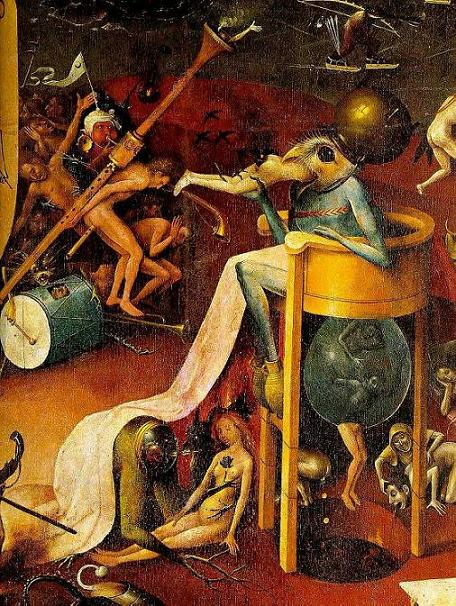
At the very bottom of Hell, quite naturally, we find Satan himself:
Bosch's Satan seems like a mutation... an unnatural merger between bird (one of those birds spoken of in Revelations who will eat of the flesh of man...?) and insect. At his feet a once-vain beauty is captive to the slimy caresses of a demon while forcing to stare at her reflection in the mirror mounted on the *** of another devil. Satan himself sits atop his "throne"... a gilded commode... and devours soul after soul. Literally responding to the old folk-saying that states that "the gate to Hell is through the Devil's ***"... sinners pass through Satan's bowels and into their final reward... the cesspool below.
The Garden of Earthly Delights is undoubtedly one of the most complex and multi-layered paintings ever rendered. The closest comparison in terms of literature must certainly be Dante's Comedia which is just as richly layered with symbol, allegory, and allusions to narrative from the the highest to the most vulgar sources. Like the Comedia, Bosch's painting clearly makes use of the contrast between horror and ugliness... and the most sensual and seductive beauty. Certainly, as with the Comedia... and Milton's Paradise Lost... Bosch intentionally suggests that a large reason for the attractiveness of sin is that it is so sensual and seductive.


 Go to Profile
 Mark as Read


