


Stlukesguild
Kitagawa Utamaro 喜多川 歌麿c. 1753-1806

by , 10-07-2008 at 01:27 AM (28262 Views)
Kitagawa Utamaro... generally referred to in the West simply as Utamaro was one of the greatest Japanese artists... a master of woodblock, painting, and drawing. He was reputedly born in Edo, Osaka, or Kyoto (the three largest Japanese cities) and his art consistently conveys an urban sophistication and subject matter. He was quite probably the pupil of Toriyama Sekien 鳥山 石燕 and possibly even his son. He was originally trained in the aristocratic Kano style of painting, but soon gravitated toward the more popular Ukiyo-e.
Ukiyo-e or "pictures of the 'floating world' " was a genre primarily of Japanese woodblock prints or woodcuts (although it also employed painting and drawing) produced between the 17th and the 20th centuries, featuring motifs of landscapes, illustrations of historical and fantastic narratives, erotica, and the theatre and pleasure quarters. The "floating world" (ukiyo) refers to the urban culture that bloomed especially in Edo (Tokyo) and was a world unto itself. While the traditional classes of Japanese society were bound by numerous strictures and prohibitions, the rising merchant class was relatively unregulated, therefore "floating."
Utamaro, rather than presenting the more "eternal" themes of gods, heroes, great rulers, etc... that were the themes of much aristocratic art, was fascinated with the subject of fleeting beauty. His work focused largely upon the world of women. He had the most sophisticated eye for capturing the telling gestures of lovers, mothers, courtesans, concubines, actresses, geisha, etc... involved in their activities of everyday life. The turn of a finger, the curling toes of a lover, the delicate act of applying make-up... one often senses that one has stumbled upon Utamaro's women in their most intimate or unguarded moments. This feeling is often heightened through the artist's masterful use of the point-of-view. We often approach Utamaro's women from behind and witness the scene as if a voyeur. It should not be surprising that Degas was probably the most inspired by Utamaro among the Japanese print masters.
Scenes of beautiful women... courtesans and geisha... looking at themselves in their mirrors were a favorite subject of Utamaro:
In the print just above a geisha applies the traditional white make-up of a geisha. In another marvelous erotic Shunga print (not shown here) a courtesan seems far more concerned with checking her reflection in the mirror than in the lovemaking (rather graphically depicted) at hand.
Utamaro was adept at portraying women of various social classes. In the following image we see working-class women employed at gathering the silkworms required for the creation of the marvelous silk kimonos worn by the wealthier classes:
Patterns of the traditional Japanese robe are exquisitely captured by Utamaro. His range of designs and colors (often reserved to the most subtle burgundies, plums, grays, ochres, and other earth-tones) are quite marvelous and and convey a subtle harmony and delicate refinement.
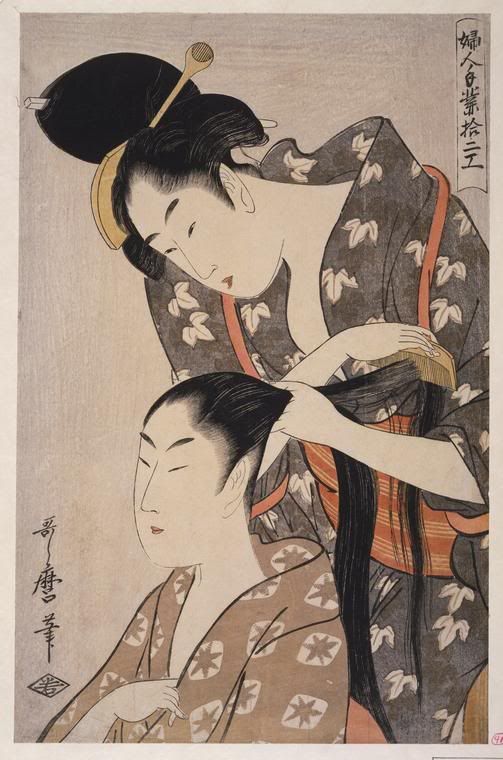
In several other prints Utamaro contrasts women of the various social strata. In one print a geisha is seen at her hairdresser:
In another charming print a geisha is seen interrupted at he mirror by her young son who has escaped the oversight of her maidservant. At the boy looks up at his mother she playfully sticks her tongue out at him while her maidservant charmingly muffles her laughter in her sleeve:
In still another image portraying the interactions of the different classes a wealthy geisha traveling (perhaps even shopping) with her maidservant who carries all of her needed boxes of supplies. The maidservant is not merely seen dressed in a more humble manner, but she carries a fan with a painted image of a Buddhist monk... conveying a sense of the greater faith or concern with the spiritual rather than the material of the humbler classes:
In one lovely suite of prints, Five Inks of the North Country, Utamaro presents images of the various levels of courtesans (usually living in the "North Country" or Northern suburbs of Edo) ranging from the lowest common prostitute, a slovenly overweight woman who lets it all hang out, to the highest caste of courtesan (shown below), a sophisticated looking woman shown immediately after washing her hair in the process of applying her make-up:
One of the most magical of Utamaro's prints is a scene showing a geisha in the act of lighting (or putting out) a lamp. The manner in which the artist has conveyed that which is seen in the full glow of the lamp-light as opposed to that which is in the shadow is absolutely marvelous... all the more so when one considers that the technique employed in Ekiyo-e woodblock prints demands a separate wood block to be cut and registered for each individual color!
It comes as no surprise, considering Utamaro's focus upon the life of women in the pleasure quarters, that the artist made his share of Shunga or erotic prints. The majority of Shunga prints are quite graphic to the point that they verge upon "pornographic"... albeit exquisitely gorgeous pornography. Utamaro, however, produced some of the most refined and subtle of all Shunga. The following elegant scene of lovers is not merely one of the most poignant and outstanding of all Shunga... but certainly one of the most memorable works of all Japanese art... and one of the loving and extraordinarily sensual works of erotic art ever produced:




 Go to Profile
 Mark as Read


