 Subscribe for ad free access & additional features for teachers. Authors: 267, Books: 3,607, Poems & Short Stories: 4,435, Forum Members: 71,154, Forum Posts: 1,238,602, Quizzes: 344
Gorgias
PERSONS OF THE DIALOGUE: Callicles, Socrates, Chaerephon, Gorgias, Polus.
SCENE: The house of Callicles.
CALLICLES: The wise man, as the proverb says, is late for a fray, but not
for a feast.
SOCRATES: And are we late for a feast?
CALLICLES: Yes, and a delightful feast; for Gorgias has just been
exhibiting to us many fine things.
SOCRATES: It is not my fault, Callicles; our friend Chaerephon is to
blame; for he would keep us loitering in the Agora.
CHAEREPHON: Never mind, Socrates; the misfortune of which I have been the
cause I will also repair; for Gorgias is a friend of mine, and I will make
him give the exhibition again either now, or, if you prefer, at some other
time.
CALLICLES: What is the matter, Chaerephon--does Socrates want to hear
Gorgias?
CHAEREPHON: Yes, that was our intention in coming.
CALLICLES: Come into my house, then; for Gorgias is staying with me, and
he shall exhibit to you.
SOCRATES: Very good, Callicles; but will he answer our questions? for I
want to hear from him what is the nature of his art, and what it is which
he professes and teaches; he may, as you (Chaerephon) suggest, defer the
exhibition to some other time.
CALLICLES: There is nothing like asking him, Socrates; and indeed to
answer questions is a part of his exhibition, for he was saying only just
now, that any one in my house might put any question to him, and that he
would answer.
SOCRATES: How fortunate! will you ask him, Chaerephon--?
CHAEREPHON: What shall I ask him?
SOCRATES: Ask him who he is.
CHAEREPHON: What do you mean?
SOCRATES: I mean such a question as would elicit from him, if he had been
a maker of shoes, the answer that he is a cobbler. Do you understand?
CHAEREPHON: I understand, and will ask him: Tell me, Gorgias, is our
friend Callicles right in saying that you undertake to answer any questions
which you are asked?
GORGIAS: Quite right, Chaerephon: I was saying as much only just now; and
I may add, that many years have elapsed since any one has asked me a new
one.
CHAEREPHON: Then you must be very ready, Gorgias.
GORGIAS: Of that, Chaerephon, you can make trial.
POLUS: Yes, indeed, and if you like, Chaerephon, you may make trial of me
too, for I think that Gorgias, who has been talking a long time, is tired.
CHAEREPHON: And do you, Polus, think that you can answer better than
Gorgias?
POLUS: What does that matter if I answer well enough for you?
CHAEREPHON: Not at all:--and you shall answer if you like.
POLUS: Ask:--
CHAEREPHON: My question is this: If Gorgias had the skill of his brother
Herodicus, what ought we to call him? Ought he not to have the name which
is given to his brother?
POLUS: Certainly.
CHAEREPHON: Then we should be right in calling him a physician?
POLUS: Yes.
CHAEREPHON: And if he had the skill of Aristophon the son of Aglaophon, or
of his brother Polygnotus, what ought we to call him?
POLUS: Clearly, a painter.
CHAEREPHON: But now what shall we call him--what is the art in which he is
skilled.
POLUS: O Chaerephon, there are many arts among mankind which are
experimental, and have their origin in experience, for experience makes the
days of men to proceed according to art, and inexperience according to
chance, and different persons in different ways are proficient in different
arts, and the best persons in the best arts. And our friend Gorgias is one
of the best, and the art in which he is a proficient is the noblest.
SOCRATES: Polus has been taught how to make a capital speech, Gorgias; but
he is not fulfilling the promise which he made to Chaerephon.
GORGIAS: What do you mean, Socrates?
SOCRATES: I mean that he has not exactly answered the question which he
was asked.
GORGIAS: Then why not ask him yourself?
SOCRATES: But I would much rather ask you, if you are disposed to answer:
for I see, from the few words which Polus has uttered, that he has attended
more to the art which is called rhetoric than to dialectic.
POLUS: What makes you say so, Socrates?
SOCRATES: Because, Polus, when Chaerephon asked you what was the art which
Gorgias knows, you praised it as if you were answering some one who found
fault with it, but you never said what the art was.
POLUS: Why, did I not say that it was the noblest of arts?
SOCRATES: Yes, indeed, but that was no answer to the question: nobody
asked what was the quality, but what was the nature, of the art, and by
what name we were to describe Gorgias. And I would still beg you briefly
and clearly, as you answered Chaerephon when he asked you at first, to say
what this art is, and what we ought to call Gorgias: Or rather, Gorgias,
let me turn to you, and ask the same question,--what are we to call you,
and what is the art which you profess?
GORGIAS: Rhetoric, Socrates, is my art.
SOCRATES: Then I am to call you a rhetorician?
GORGIAS: Yes, Socrates, and a good one too, if you would call me that
which, in Homeric language, 'I boast myself to be.'
SOCRATES: I should wish to do so.
GORGIAS: Then pray do.
SOCRATES: And are we to say that you are able to make other men
rhetoricians?
GORGIAS: Yes, that is exactly what I profess to make them, not only at
Athens, but in all places.
SOCRATES: And will you continue to ask and answer questions, Gorgias, as
we are at present doing, and reserve for another occasion the longer mode
of speech which Polus was attempting? Will you keep your promise, and
answer shortly the questions which are asked of you?
GORGIAS: Some answers, Socrates, are of necessity longer; but I will do my
best to make them as short as possible; for a part of my profession is that
I can be as short as any one.
SOCRATES: That is what is wanted, Gorgias; exhibit the shorter method now,
and the longer one at some other time.
GORGIAS: Well, I will; and you will certainly say, that you never heard a
man use fewer words.
SOCRATES: Very good then; as you profess to be a rhetorician, and a maker
of rhetoricians, let me ask you, with what is rhetoric concerned: I might
ask with what is weaving concerned, and you would reply (would you not?),
with the making of garments?
GORGIAS: Yes.
SOCRATES: And music is concerned with the composition of melodies?
GORGIAS: It is.
SOCRATES: By Here, Gorgias, I admire the surpassing brevity of your
answers.
GORGIAS: Yes, Socrates, I do think myself good at that.
SOCRATES: I am glad to hear it; answer me in like manner about rhetoric:
with what is rhetoric concerned?
GORGIAS: With discourse.
SOCRATES: What sort of discourse, Gorgias?--such discourse as would teach
the sick under what treatment they might get well?
GORGIAS: No.
SOCRATES: Then rhetoric does not treat of all kinds of discourse?
GORGIAS: Certainly not.
SOCRATES: And yet rhetoric makes men able to speak?
GORGIAS: Yes.
SOCRATES: And to understand that about which they speak?
GORGIAS: Of course.
SOCRATES: But does not the art of medicine, which we were just now
mentioning, also make men able to understand and speak about the sick?
GORGIAS: Certainly.
SOCRATES: Then medicine also treats of discourse?
GORGIAS: Yes.
SOCRATES: Of discourse concerning diseases?
GORGIAS: Just so.
SOCRATES: And does not gymnastic also treat of discourse concerning the
good or evil condition of the body?
GORGIAS: Very true.
SOCRATES: And the same, Gorgias, is true of the other arts:--all of them
treat of discourse concerning the subjects with which they severally have
to do.
GORGIAS: Clearly.
SOCRATES: Then why, if you call rhetoric the art which treats of
discourse, and all the other arts treat of discourse, do you not call them
arts of rhetoric?
GORGIAS: Because, Socrates, the knowledge of the other arts has only to do
with some sort of external action, as of the hand; but there is no such
action of the hand in rhetoric which works and takes effect only through
the medium of discourse. And therefore I am justified in saying that
rhetoric treats of discourse.
SOCRATES: I am not sure whether I entirely understand you, but I dare say
I shall soon know better; please to answer me a question:--you would allow
that there are arts?
GORGIAS: Yes.
SOCRATES: As to the arts generally, they are for the most part concerned
with doing, and require little or no speaking; in painting, and statuary,
and many other arts, the work may proceed in silence; and of such arts I
suppose you would say that they do not come within the province of
rhetoric.
GORGIAS: You perfectly conceive my meaning, Socrates.
SOCRATES: But there are other arts which work wholly through the medium of
language, and require either no action or very little, as, for example, the
arts of arithmetic, of calculation, of geometry, and of playing draughts;
in some of these speech is pretty nearly co-extensive with action, but in
most of them the verbal element is greater--they depend wholly on words for
their efficacy and power: and I take your meaning to be that rhetoric is
an art of this latter sort?
GORGIAS: Exactly.
SOCRATES: And yet I do not believe that you really mean to call any of
these arts rhetoric; although the precise expression which you used was,
that rhetoric is an art which works and takes effect only through the
medium of discourse; and an adversary who wished to be captious might say,
'And so, Gorgias, you call arithmetic rhetoric.' But I do not think that
you really call arithmetic rhetoric any more than geometry would be so
called by you.
GORGIAS: You are quite right, Socrates, in your apprehension of my
meaning.
SOCRATES: Well, then, let me now have the rest of my answer:--seeing that
rhetoric is one of those arts which works mainly by the use of words, and
there are other arts which also use words, tell me what is that quality in
words with which rhetoric is concerned:--Suppose that a person asks me
about some of the arts which I was mentioning just now; he might say,
'Socrates, what is arithmetic?' and I should reply to him, as you replied
to me, that arithmetic is one of those arts which take effect through
words. And then he would proceed to ask: 'Words about what?' and I should
reply, Words about odd and even numbers, and how many there are of each.
And if he asked again: 'What is the art of calculation?' I should say,
That also is one of the arts which is concerned wholly with words. And if
he further said, 'Concerned with what?' I should say, like the clerks in
the assembly, 'as aforesaid' of arithmetic, but with a difference, the
difference being that the art of calculation considers not only the
quantities of odd and even numbers, but also their numerical relations to
themselves and to one another. And suppose, again, I were to say that
astronomy is only words--he would ask, 'Words about what, Socrates?' and I
should answer, that astronomy tells us about the motions of the stars and
sun and moon, and their relative swiftness.
GORGIAS: You would be quite right, Socrates.
SOCRATES: And now let us have from you, Gorgias, the truth about rhetoric:
which you would admit (would you not?) to be one of those arts which act
always and fulfil all their ends through the medium of words?
GORGIAS: True.
SOCRATES: Words which do what? I should ask. To what class of things do
the words which rhetoric uses relate?
GORGIAS: To the greatest, Socrates, and the best of human things.
SOCRATES: That again, Gorgias is ambiguous; I am still in the dark: for
which are the greatest and best of human things? I dare say that you have
heard men singing at feasts the old drinking song, in which the singers
enumerate the goods of life, first health, beauty next, thirdly, as the
writer of the song says, wealth honestly obtained.
GORGIAS: Yes, I know the song; but what is your drift?
SOCRATES: I mean to say, that the producers of those things which the
author of the song praises, that is to say, the physician, the trainer, the
money-maker, will at once come to you, and first the physician will say:
'O Socrates, Gorgias is deceiving you, for my art is concerned with the
greatest good of men and not his.' And when I ask, Who are you? he will
reply, 'I am a physician.' What do you mean? I shall say. Do you mean
that your art produces the greatest good? 'Certainly,' he will answer,
'for is not health the greatest good? What greater good can men have,
Socrates?' And after him the trainer will come and say, 'I too, Socrates,
shall be greatly surprised if Gorgias can show more good of his art than I
can show of mine.' To him again I shall say, Who are you, honest friend,
and what is your business? 'I am a trainer,' he will reply, 'and my
business is to make men beautiful and strong in body.' When I have done
with the trainer, there arrives the money-maker, and he, as I expect, will
utterly despise them all. 'Consider Socrates,' he will say, 'whether
Gorgias or any one else can produce any greater good than wealth.' Well,
you and I say to him, and are you a creator of wealth? 'Yes,' he replies.
And who are you? 'A money-maker.' And do you consider wealth to be the
greatest good of man? 'Of course,' will be his reply. And we shall
rejoin: Yes; but our friend Gorgias contends that his art produces a
greater good than yours. And then he will be sure to go on and ask, 'What
good? Let Gorgias answer.' Now I want you, Gorgias, to imagine that this
question is asked of you by them and by me; What is that which, as you say,
is the greatest good of man, and of which you are the creator? Answer us.
GORGIAS: That good, Socrates, which is truly the greatest, being that
which gives to men freedom in their own persons, and to individuals the
power of ruling over others in their several states.
SOCRATES: And what would you consider this to be?
GORGIAS: What is there greater than the word which persuades the judges in
the courts, or the senators in the council, or the citizens in the
assembly, or at any other political meeting?--if you have the power of
uttering this word, you will have the physician your slave, and the trainer
your slave, and the money-maker of whom you talk will be found to gather
treasures, not for himself, but for you who are able to speak and to
persuade the multitude.
SOCRATES: Now I think, Gorgias, that you have very accurately explained
what you conceive to be the art of rhetoric; and you mean to say, if I am
not mistaken, that rhetoric is the artificer of persuasion, having this and
no other business, and that this is her crown and end. Do you know any
other effect of rhetoric over and above that of producing persuasion?
GORGIAS: No: the definition seems to me very fair, Socrates; for
persuasion is the chief end of rhetoric.
SOCRATES: Then hear me, Gorgias, for I am quite sure that if there ever
was a man who entered on the discussion of a matter from a pure love of
knowing the truth, I am such a one, and I should say the same of you.
GORGIAS: What is coming, Socrates?
SOCRATES: I will tell you: I am very well aware that I do not know what,
according to you, is the exact nature, or what are the topics of that
persuasion of which you speak, and which is given by rhetoric; although I
have a suspicion about both the one and the other. And I am going to ask--
what is this power of persuasion which is given by rhetoric, and about
what? But why, if I have a suspicion, do I ask instead of telling you?
Not for your sake, but in order that the argument may proceed in such a
manner as is most likely to set forth the truth. And I would have you
observe, that I am right in asking this further question: If I asked,
'What sort of a painter is Zeuxis?' and you said, 'The painter of figures,'
should I not be right in asking, 'What kind of figures, and where do you
find them?'
GORGIAS: Certainly.
SOCRATES: And the reason for asking this second question would be, that
there are other painters besides, who paint many other figures?
GORGIAS: True.
SOCRATES: But if there had been no one but Zeuxis who painted them, then
you would have answered very well?
GORGIAS: Quite so.
SOCRATES: Now I want to know about rhetoric in the same way;--is rhetoric
the only art which brings persuasion, or do other arts have the same
effect? I mean to say--Does he who teaches anything persuade men of that
which he teaches or not?
GORGIAS: He persuades, Socrates,--there can be no mistake about that.
SOCRATES: Again, if we take the arts of which we were just now speaking:--
do not arithmetic and the arithmeticians teach us the properties of number?
GORGIAS: Certainly.
SOCRATES: And therefore persuade us of them?
GORGIAS: Yes.
SOCRATES: Then arithmetic as well as rhetoric is an artificer of
persuasion?
GORGIAS: Clearly.
SOCRATES: And if any one asks us what sort of persuasion, and about what,
--we shall answer, persuasion which teaches the quantity of odd and even;
and we shall be able to show that all the other arts of which we were just
now speaking are artificers of persuasion, and of what sort, and about
what.
GORGIAS: Very true.
SOCRATES: Then rhetoric is not the only artificer of persuasion?
GORGIAS: True.
SOCRATES: Seeing, then, that not only rhetoric works by persuasion, but
that other arts do the same, as in the case of the painter, a question has
arisen which is a very fair one: Of what persuasion is rhetoric the
artificer, and about what?--is not that a fair way of putting the question?
GORGIAS: I think so.
SOCRATES: Then, if you approve the question, Gorgias, what is the answer?
GORGIAS: I answer, Socrates, that rhetoric is the art of persuasion in
courts of law and other assemblies, as I was just now saying, and about the
just and unjust.
SOCRATES: And that, Gorgias, was what I was suspecting to be your notion;
yet I would not have you wonder if by-and-by I am found repeating a
seemingly plain question; for I ask not in order to confute you, but as I
was saying that the argument may proceed consecutively, and that we may not
get the habit of anticipating and suspecting the meaning of one another's
words; I would have you develope your own views in your own way, whatever
may be your hypothesis.
GORGIAS: I think that you are quite right, Socrates.
SOCRATES: Then let me raise another question; there is such a thing as
'having learned'?
GORGIAS: Yes.
SOCRATES: And there is also 'having believed'?
GORGIAS: Yes.
SOCRATES: And is the 'having learned' the same as 'having believed,' and
are learning and belief the same things?
GORGIAS: In my judgment, Socrates, they are not the same.
SOCRATES: And your judgment is right, as you may ascertain in this way:--
If a person were to say to you, 'Is there, Gorgias, a false belief as well
as a true?'--you would reply, if I am not mistaken, that there is.
GORGIAS: Yes.
SOCRATES: Well, but is there a false knowledge as well as a true?
GORGIAS: No.
SOCRATES: No, indeed; and this again proves that knowledge and belief
differ.
GORGIAS: Very true.
SOCRATES: And yet those who have learned as well as those who have
believed are persuaded?
GORGIAS: Just so.
SOCRATES: Shall we then assume two sorts of persuasion,--one which is the
source of belief without knowledge, as the other is of knowledge?
GORGIAS: By all means.
SOCRATES: And which sort of persuasion does rhetoric create in courts of
law and other assemblies about the just and unjust, the sort of persuasion
which gives belief without knowledge, or that which gives knowledge?
GORGIAS: Clearly, Socrates, that which only gives belief.
SOCRATES: Then rhetoric, as would appear, is the artificer of a persuasion
which creates belief about the just and unjust, but gives no instruction
about them?
GORGIAS: True.
SOCRATES: And the rhetorician does not instruct the courts of law or other
assemblies about things just and unjust, but he creates belief about them;
for no one can be supposed to instruct such a vast multitude about such
high matters in a short time?
GORGIAS: Certainly not.
SOCRATES: Come, then, and let us see what we really mean about rhetoric;
for I do not know what my own meaning is as yet. When the assembly meets
to elect a physician or a shipwright or any other craftsman, will the
rhetorician be taken into counsel? Surely not. For at every election he
ought to be chosen who is most skilled; and, again, when walls have to be
built or harbours or docks to be constructed, not the rhetorician but the
master workman will advise; or when generals have to be chosen and an order
of battle arranged, or a position taken, then the military will advise and
not the rhetoricians: what do you say, Gorgias? Since you profess to be a
rhetorician and a maker of rhetoricians, I cannot do better than learn the
nature of your art from you. And here let me assure you that I have your
interest in view as well as my own. For likely enough some one or other of
the young men present might desire to become your pupil, and in fact I see
some, and a good many too, who have this wish, but they would be too modest
to question you. And therefore when you are interrogated by me, I would
have you imagine that you are interrogated by them. 'What is the use of
coming to you, Gorgias?' they will say--'about what will you teach us to
advise the state?--about the just and unjust only, or about those other
things also which Socrates has just mentioned?' How will you answer them?
GORGIAS: I like your way of leading us on, Socrates, and I will endeavour
to reveal to you the whole nature of rhetoric. You must have heard, I
think, that the docks and the walls of the Athenians and the plan of the
harbour were devised in accordance with the counsels, partly of
Themistocles, and partly of Pericles, and not at the suggestion of the
builders.
SOCRATES: Such is the tradition, Gorgias, about Themistocles; and I myself
heard the speech of Pericles when he advised us about the middle wall.
GORGIAS: And you will observe, Socrates, that when a decision has to be
given in such matters the rhetoricians are the advisers; they are the men
who win their point.
SOCRATES: I had that in my admiring mind, Gorgias, when I asked what is
the nature of rhetoric, which always appears to me, when I look at the
matter in this way, to be a marvel of greatness.
GORGIAS: A marvel, indeed, Socrates, if you only knew how rhetoric
comprehends and holds under her sway all the inferior arts. Let me offer
you a striking example of this. On several occasions I have been with my
brother Herodicus or some other physician to see one of his patients, who
would not allow the physician to give him medicine, or apply the knife or
hot iron to him; and I have persuaded him to do for me what he would not do
for the physician just by the use of rhetoric. And I say that if a
rhetorician and a physician were to go to any city, and had there to argue
in the Ecclesia or any other assembly as to which of them should be elected
state-physician, the physician would have no chance; but he who could speak
would be chosen if he wished; and in a contest with a man of any other
profession the rhetorician more than any one would have the power of
getting himself chosen, for he can speak more persuasively to the multitude
than any of them, and on any subject. Such is the nature and power of the
art of rhetoric! And yet, Socrates, rhetoric should be used like any other
competitive art, not against everybody,--the rhetorician ought not to abuse
his strength any more than a pugilist or pancratiast or other master of
fence;--because he has powers which are more than a match either for friend
or enemy, he ought not therefore to strike, stab, or slay his friends.
Suppose a man to have been trained in the palestra and to be a skilful
boxer,--he in the fulness of his strength goes and strikes his father or
mother or one of his familiars or friends; but that is no reason why the
trainers or fencing-masters should be held in detestation or banished from
the city;--surely not. For they taught their art for a good purpose, to be
used against enemies and evil-doers, in self-defence not in aggression, and
others have perverted their instructions, and turned to a bad use their own
strength and skill. But not on this account are the teachers bad, neither
is the art in fault, or bad in itself; I should rather say that those who
make a bad use of the art are to blame. And the same argument holds good
of rhetoric; for the rhetorician can speak against all men and upon any
subject,--in short, he can persuade the multitude better than any other man
of anything which he pleases, but he should not therefore seek to defraud
the physician or any other artist of his reputation merely because he has
the power; he ought to use rhetoric fairly, as he would also use his
athletic powers. And if after having become a rhetorician he makes a bad
use of his strength and skill, his instructor surely ought not on that
account to be held in detestation or banished. For he was intended by his
teacher to make a good use of his instructions, but he abuses them. And
therefore he is the person who ought to be held in detestation, banished,
and put to death, and not his instructor.
SOCRATES: You, Gorgias, like myself, have had great experience of
disputations, and you must have observed, I think, that they do not always
terminate in mutual edification, or in the definition by either party of
the subjects which they are discussing; but disagreements are apt to arise
--somebody says that another has not spoken truly or clearly; and then they
get into a passion and begin to quarrel, both parties conceiving that their
opponents are arguing from personal feeling only and jealousy of
themselves, not from any interest in the question at issue. And sometimes
they will go on abusing one another until the company at last are quite
vexed at themselves for ever listening to such fellows. Why do I say this?
Why, because I cannot help feeling that you are now saying what is not
quite consistent or accordant with what you were saying at first about
rhetoric. And I am afraid to point this out to you, lest you should think
that I have some animosity against you, and that I speak, not for the sake
of discovering the truth, but from jealousy of you. Now if you are one of
my sort, I should like to cross-examine you, but if not I will let you
alone. And what is my sort? you will ask. I am one of those who are very
willing to be refuted if I say anything which is not true, and very willing
to refute any one else who says what is not true, and quite as ready to be
refuted as to refute; for I hold that this is the greater gain of the two,
just as the gain is greater of being cured of a very great evil than of
curing another. For I imagine that there is no evil which a man can endure
so great as an erroneous opinion about the matters of which we are
speaking; and if you claim to be one of my sort, let us have the discussion
out, but if you would rather have done, no matter;--let us make an end of
it.
GORGIAS: I should say, Socrates, that I am quite the man whom you
indicate; but, perhaps, we ought to consider the audience, for, before you
came, I had already given a long exhibition, and if we proceed the argument
may run on to a great length. And therefore I think that we should
consider whether we may not be detaining some part of the company when they
are wanting to do something else.
CHAEREPHON: You hear the audience cheering, Gorgias and Socrates, which
shows their desire to listen to you; and for myself, Heaven forbid that I
should have any business on hand which would take me away from a discussion
so interesting and so ably maintained.
CALLICLES: By the gods, Chaerephon, although I have been present at many
discussions, I doubt whether I was ever so much delighted before, and
therefore if you go on discoursing all day I shall be the better pleased.
SOCRATES: I may truly say, Callicles, that I am willing, if Gorgias is.
GORGIAS: After all this, Socrates, I should be disgraced if I refused,
especially as I have promised to answer all comers; in accordance with the
wishes of the company, then, do you begin. and ask of me any question
which you like.
SOCRATES: Let me tell you then, Gorgias, what surprises me in your words;
though I dare say that you may be right, and I may have misunderstood your
meaning. You say that you can make any man, who will learn of you, a
rhetorician?
GORGIAS: Yes.
SOCRATES: Do you mean that you will teach him to gain the ears of the
multitude on any subject, and this not by instruction but by persuasion?
GORGIAS: Quite so.
SOCRATES: You were saying, in fact, that the rhetorician will have greater
powers of persuasion than the physician even in a matter of health?
GORGIAS: Yes, with the multitude,--that is.
SOCRATES: You mean to say, with the ignorant; for with those who know he
cannot be supposed to have greater powers of persuasion.
GORGIAS: Very true.
SOCRATES: But if he is to have more power of persuasion than the
physician, he will have greater power than he who knows?
GORGIAS: Certainly.
SOCRATES: Although he is not a physician:--is he?
GORGIAS: No.
SOCRATES: And he who is not a physician must, obviously, be ignorant of
what the physician knows.
GORGIAS: Clearly.
SOCRATES: Then, when the rhetorician is more persuasive than the
physician, the ignorant is more persuasive with the ignorant than he who
has knowledge?--is not that the inference?
GORGIAS: In the case supposed:--yes.
SOCRATES: And the same holds of the relation of rhetoric to all the other
arts; the rhetorician need not know the truth about things; he has only to
discover some way of persuading the ignorant that he has more knowledge
than those who know?
GORGIAS: Yes, Socrates, and is not this a great comfort?--not to have
learned the other arts, but the art of rhetoric only, and yet to be in no
way inferior to the professors of them?
SOCRATES: Whether the rhetorician is or not inferior on this account is a
question which we will hereafter examine if the enquiry is likely to be of
any service to us; but I would rather begin by asking, whether he is or is
not as ignorant of the just and unjust, base and honourable, good and evil,
as he is of medicine and the other arts; I mean to say, does he really know
anything of what is good and evil, base or honourable, just or unjust in
them; or has he only a way with the ignorant of persuading them that he not
knowing is to be esteemed to know more about these things than some one
else who knows? Or must the pupil know these things and come to you
knowing them before he can acquire the art of rhetoric? If he is ignorant,
you who are the teacher of rhetoric will not teach him--it is not your
business; but you will make him seem to the multitude to know them, when he
does not know them; and seem to be a good man, when he is not. Or will you
be unable to teach him rhetoric at all, unless he knows the truth of these
things first? What is to be said about all this? By heavens, Gorgias, I
wish that you would reveal to me the power of rhetoric, as you were saying
that you would.
GORGIAS: Well, Socrates, I suppose that if the pupil does chance not to
know them, he will have to learn of me these things as well.
SOCRATES: Say no more, for there you are right; and so he whom you make a
rhetorician must either know the nature of the just and unjust already, or
he must be taught by you.
GORGIAS: Certainly.
SOCRATES: Well, and is not he who has learned carpentering a carpenter?
GORGIAS: Yes.
SOCRATES: And he who has learned music a musician?
GORGIAS: Yes.
SOCRATES: And he who has learned medicine is a physician, in like manner?
He who has learned anything whatever is that which his knowledge makes him.
GORGIAS: Certainly.
SOCRATES: And in the same way, he who has learned what is just is just?
GORGIAS: To be sure.
SOCRATES: And he who is just may be supposed to do what is just?
GORGIAS: Yes.
SOCRATES: And must not the just man always desire to do what is just?
GORGIAS: That is clearly the inference.
SOCRATES: Surely, then, the just man will never consent to do injustice?
GORGIAS: Certainly not.
SOCRATES: And according to the argument the rhetorician must be a just
man?
GORGIAS: Yes.
SOCRATES: And will therefore never be willing to do injustice?
GORGIAS: Clearly not.
SOCRATES: But do you remember saying just now that the trainer is not to
be accused or banished if the pugilist makes a wrong use of his pugilistic
art; and in like manner, if the rhetorician makes a bad and unjust use of
his rhetoric, that is not to be laid to the charge of his teacher, who is
not to be banished, but the wrong-doer himself who made a bad use of his
rhetoric--he is to be banished--was not that said?
GORGIAS: Yes, it was.
SOCRATES: But now we are affirming that the aforesaid rhetorician will
never have done injustice at all?
GORGIAS: True.
SOCRATES: And at the very outset, Gorgias, it was said that rhetoric
treated of discourse, not (like arithmetic) about odd and even, but about
just and unjust? Was not this said?
GORGIAS: Yes.
SOCRATES: I was thinking at the time, when I heard you saying so, that
rhetoric, which is always discoursing about justice, could not possibly be
an unjust thing. But when you added, shortly afterwards, that the
rhetorician might make a bad use of rhetoric I noted with surprise the
inconsistency into which you had fallen; and I said, that if you thought,
as I did, that there was a gain in being refuted, there would be an
advantage in going on with the question, but if not, I would leave off.
And in the course of our investigations, as you will see yourself, the
rhetorician has been acknowledged to be incapable of making an unjust use
of rhetoric, or of willingness to do injustice. By the dog, Gorgias, there
will be a great deal of discussion, before we get at the truth of all this.
POLUS: And do even you, Socrates, seriously believe what you are now
saying about rhetoric? What! because Gorgias was ashamed to deny that the
rhetorician knew the just and the honourable and the good, and admitted
that to any one who came to him ignorant of them he could teach them, and
then out of this admission there arose a contradiction--the thing which you
dearly love, and to which not he, but you, brought the argument by your
captious questions--(do you seriously believe that there is any truth in
all this?) For will any one ever acknowledge that he does not know, or
cannot teach, the nature of justice? The truth is, that there is great
want of manners in bringing the argument to such a pass.
SOCRATES: Illustrious Polus, the reason why we provide ourselves with
friends and children is, that when we get old and stumble, a younger
generation may be at hand to set us on our legs again in our words and in
our actions: and now, if I and Gorgias are stumbling, here are you who
should raise us up; and I for my part engage to retract any error into
which you may think that I have fallen-upon one condition:
POLUS: What condition?
SOCRATES: That you contract, Polus, the prolixity of speech in which you
indulged at first.
POLUS: What! do you mean that I may not use as many words as I please?
SOCRATES: Only to think, my friend, that having come on a visit to Athens,
which is the most free-spoken state in Hellas, you when you got there, and
you alone, should be deprived of the power of speech--that would be hard
indeed. But then consider my case:--shall not I be very hardly used, if,
when you are making a long oration, and refusing to answer what you are
asked, I am compelled to stay and listen to you, and may not go away? I
say rather, if you have a real interest in the argument, or, to repeat my
former expression, have any desire to set it on its legs, take back any
statement which you please; and in your turn ask and answer, like myself
and Gorgias--refute and be refuted: for I suppose that you would claim to
know what Gorgias knows--would you not?
POLUS: Yes.
SOCRATES: And you, like him, invite any one to ask you about anything
which he pleases, and you will know how to answer him?
POLUS: To be sure.
SOCRATES: And now, which will you do, ask or answer?
POLUS: I will ask; and do you answer me, Socrates, the same question which
Gorgias, as you suppose, is unable to answer: What is rhetoric?
SOCRATES: Do you mean what sort of an art?
POLUS: Yes.
SOCRATES: To say the truth, Polus, it is not an art at all, in my opinion.
POLUS: Then what, in your opinion, is rhetoric?
SOCRATES: A thing which, as I was lately reading in a book of yours, you
say that you have made an art.
POLUS: What thing?
SOCRATES: I should say a sort of experience.
POLUS: Does rhetoric seem to you to be an experience?
SOCRATES: That is my view, but you may be of another mind.
POLUS: An experience in what?
SOCRATES: An experience in producing a sort of delight and gratification.
POLUS: And if able to gratify others, must not rhetoric be a fine thing?
SOCRATES: What are you saying, Polus? Why do you ask me whether rhetoric
is a fine thing or not, when I have not as yet told you what rhetoric is?
POLUS: Did I not hear you say that rhetoric was a sort of experience?
SOCRATES: Will you, who are so desirous to gratify others, afford a slight
gratification to me?
POLUS: I will.
SOCRATES: Will you ask me, what sort of an art is cookery?
POLUS: What sort of an art is cookery?
SOCRATES: Not an art at all, Polus.
POLUS: What then?
SOCRATES: I should say an experience.
POLUS: In what? I wish that you would explain to me.
SOCRATES: An experience in producing a sort of delight and gratification,
Polus.
POLUS: Then are cookery and rhetoric the same?
SOCRATES: No, they are only different parts of the same profession.
POLUS: Of what profession?
SOCRATES: I am afraid that the truth may seem discourteous; and I hesitate
to answer, lest Gorgias should imagine that I am making fun of his own
profession. For whether or no this is that art of rhetoric which Gorgias
practises I really cannot tell:--from what he was just now saying, nothing
appeared of what he thought of his art, but the rhetoric which I mean is a
part of a not very creditable whole.
GORGIAS: A part of what, Socrates? Say what you mean, and never mind me.
SOCRATES: In my opinion then, Gorgias, the whole of which rhetoric is a
part is not an art at all, but the habit of a bold and ready wit, which
knows how to manage mankind: this habit I sum up under the word
'flattery'; and it appears to me to have many other parts, one of which is
cookery, which may seem to be an art, but, as I maintain, is only an
experience or routine and not an art:--another part is rhetoric, and the
art of attiring and sophistry are two others: thus there are four
branches, and four different things answering to them. And Polus may ask,
if he likes, for he has not as yet been informed, what part of flattery is
rhetoric: he did not see that I had not yet answered him when he proceeded
to ask a further question: Whether I do not think rhetoric a fine thing?
But I shall not tell him whether rhetoric is a fine thing or not, until I
have first answered, 'What is rhetoric?' For that would not be right,
Polus; but I shall be happy to answer, if you will ask me, What part of
flattery is rhetoric?
POLUS: I will ask and do you answer? What part of flattery is rhetoric?
SOCRATES: Will you understand my answer? Rhetoric, according to my view,
is the ghost or counterfeit of a part of politics.
POLUS: And noble or ignoble?
SOCRATES: Ignoble, I should say, if I am compelled to answer, for I call
what is bad ignoble: though I doubt whether you understand what I was
saying before.
GORGIAS: Indeed, Socrates, I cannot say that I understand myself.
SOCRATES: I do not wonder, Gorgias; for I have not as yet explained
myself, and our friend Polus, colt by name and colt by nature, is apt to
run away. (This is an untranslatable play on the name 'Polus,' which means
'a colt.')
GORGIAS: Never mind him, but explain to me what you mean by saying that
rhetoric is the counterfeit of a part of politics.
SOCRATES: I will try, then, to explain my notion of rhetoric, and if I am
mistaken, my friend Polus shall refute me. We may assume the existence of
bodies and of souls?
GORGIAS: Of course.
SOCRATES: You would further admit that there is a good condition of either
of them?
GORGIAS: Yes.
SOCRATES: Which condition may not be really good, but good only in
appearance? I mean to say, that there are many persons who appear to be in
good health, and whom only a physician or trainer will discern at first
sight not to be in good health.
GORGIAS: True.
SOCRATES: And this applies not only to the body, but also to the soul: in
either there may be that which gives the appearance of health and not the
reality?
GORGIAS: Yes, certainly.
SOCRATES: And now I will endeavour to explain to you more clearly what I
mean: The soul and body being two, have two arts corresponding to them:
there is the art of politics attending on the soul; and another art
attending on the body, of which I know no single name, but which may be
described as having two divisions, one of them gymnastic, and the other
medicine. And in politics there is a legislative part, which answers to
gymnastic, as justice does to medicine; and the two parts run into one
another, justice having to do with the same subject as legislation, and
medicine with the same subject as gymnastic, but with a difference. Now,
seeing that there are these four arts, two attending on the body and two on
the soul for their highest good; flattery knowing, or rather guessing their
natures, has distributed herself into four shams or simulations of them;
she puts on the likeness of some one or other of them, and pretends to be
that which she simulates, and having no regard for men's highest interests,
is ever making pleasure the bait of the unwary, and deceiving them into the
belief that she is of the highest value to them. Cookery simulates the
disguise of medicine, and pretends to know what food is the best for the
body; and if the physician and the cook had to enter into a competition in
which children were the judges, or men who had no more sense than children,
as to which of them best understands the goodness or badness of food, the
physician would be starved to death. A flattery I deem this to be and of
an ignoble sort, Polus, for to you I am now addressing myself, because it
aims at pleasure without any thought of the best. An art I do not call it,
but only an experience, because it is unable to explain or to give a reason
of the nature of its own applications. And I do not call any irrational
thing an art; but if you dispute my words, I am prepared to argue in
defence of them.
Cookery, then, I maintain to be a flattery which takes the form of
medicine; and tiring, in like manner, is a flattery which takes the form of
gymnastic, and is knavish, false, ignoble, illiberal, working deceitfully
by the help of lines, and colours, and enamels, and garments, and making
men affect a spurious beauty to the neglect of the true beauty which is
given by gymnastic.
I would rather not be tedious, and therefore I will only say, after the
manner of the geometricians (for I think that by this time you will be able
to follow)
as tiring : gymnastic :: cookery : medicine;
or rather,
as tiring : gymnastic :: sophistry : legislation;
and
as cookery : medicine :: rhetoric : justice.
And this, I say, is the natural difference between the rhetorician and the
sophist, but by reason of their near connection, they are apt to be jumbled
up together; neither do they know what to make of themselves, nor do other
men know what to make of them. For if the body presided over itself, and
were not under the guidance of the soul, and the soul did not discern and
discriminate between cookery and medicine, but the body was made the judge
of them, and the rule of judgment was the bodily delight which was given by
them, then the word of Anaxagoras, that word with which you, friend Polus,
are so well acquainted, would prevail far and wide: 'Chaos' would come
again, and cookery, health, and medicine would mingle in an indiscriminate
mass. And now I have told you my notion of rhetoric, which is, in relation
to the soul, what cookery is to the body. I may have been inconsistent in
making a long speech, when I would not allow you to discourse at length.
But I think that I may be excused, because you did not understand me, and
could make no use of my answer when I spoke shortly, and therefore I had to
enter into an explanation. And if I show an equal inability to make use of
yours, I hope that you will speak at equal length; but if I am able to
understand you, let me have the benefit of your brevity, as is only fair:
And now you may do what you please with my answer.
POLUS: What do you mean? do you think that rhetoric is flattery?
SOCRATES: Nay, I said a part of flattery; if at your age, Polus, you
cannot remember, what will you do by-and-by, when you get older?
POLUS: And are the good rhetoricians meanly regarded in states, under the
idea that they are flatterers?
SOCRATES: Is that a question or the beginning of a speech?
POLUS: I am asking a question.
SOCRATES: Then my answer is, that they are not regarded at all.
POLUS: How not regarded? Have they not very great power in states?
SOCRATES: Not if you mean to say that power is a good to the possessor.
POLUS: And that is what I do mean to say.
SOCRATES: Then, if so, I think that they have the least power of all the
citizens.
POLUS: What! are they not like tyrants? They kill and despoil and exile
any one whom they please.
SOCRATES: By the dog, Polus, I cannot make out at each deliverance of
yours, whether you are giving an opinion of your own, or asking a question
of me.
POLUS: I am asking a question of you.
SOCRATES: Yes, my friend, but you ask two questions at once.
POLUS: How two questions?
SOCRATES: Why, did you not say just now that the rhetoricians are like
tyrants, and that they kill and despoil or exile any one whom they please?
POLUS: I did.
SOCRATES: Well then, I say to you that here are two questions in one, and
I will answer both of them. And I tell you, Polus, that rhetoricians and
tyrants have the least possible power in states, as I was just now saying;
for they do literally nothing which they will, but only what they think
best.
POLUS: And is not that a great power?
SOCRATES: Polus has already said the reverse.
POLUS: Said the reverse! nay, that is what I assert.
SOCRATES: No, by the great--what do you call him?--not you, for you say
that power is a good to him who has the power.
POLUS: I do.
SOCRATES: And would you maintain that if a fool does what he thinks best,
this is a good, and would you call this great power?
POLUS: I should not.
SOCRATES: Then you must prove that the rhetorician is not a fool, and that
rhetoric is an art and not a flattery--and so you will have refuted me; but
if you leave me unrefuted, why, the rhetoricians who do what they think
best in states, and the tyrants, will have nothing upon which to
congratulate themselves, if as you say, power be indeed a good, admitting
at the same time that what is done without sense is an evil.
POLUS: Yes; I admit that.
SOCRATES: How then can the rhetoricians or the tyrants have great power in
states, unless Polus can refute Socrates, and prove to him that they do as
they will?
POLUS: This fellow--
SOCRATES: I say that they do not do as they will;--now refute me.
POLUS: Why, have you not already said that they do as they think best?
SOCRATES: And I say so still.
POLUS: Then surely they do as they will?
SOCRATES: I deny it.
POLUS: But they do what they think best?
SOCRATES: Aye.
POLUS: That, Socrates, is monstrous and absurd.
SOCRATES: Good words, good Polus, as I may say in your own peculiar style;
but if you have any questions to ask of me, either prove that I am in error
or give the answer yourself.
POLUS: Very well, I am willing to answer that I may know what you mean.
SOCRATES: Do men appear to you to will that which they do, or to will that
further end for the sake of which they do a thing? when they take medicine,
for example, at the bidding of a physician, do they will the drinking of
the medicine which is painful, or the health for the sake of which they
drink?
POLUS: Clearly, the health.
SOCRATES: And when men go on a voyage or engage in business, they do not
will that which they are doing at the time; for who would desire to take
the risk of a voyage or the trouble of business?--But they will, to have
the wealth for the sake of which they go on a voyage.
POLUS: Certainly.
SOCRATES: And is not this universally true? If a man does something for
the sake of something else, he wills not that which he does, but that for
the sake of which he does it.
POLUS: Yes.
SOCRATES: And are not all things either good or evil, or intermediate and
indifferent?
POLUS: To be sure, Socrates.
SOCRATES: Wisdom and health and wealth and the like you would call goods,
and their opposites evils?
POLUS: I should.
SOCRATES: And the things which are neither good nor evil, and which
partake sometimes of the nature of good and at other times of evil, or of
neither, are such as sitting, walking, running, sailing; or, again, wood,
stones, and the like:--these are the things which you call neither good nor
evil?
POLUS: Exactly so.
SOCRATES: Are these indifferent things done for the sake of the good, or
the good for the sake of the indifferent?
POLUS: Clearly, the indifferent for the sake of the good.
SOCRATES: When we walk we walk for the sake of the good, and under the
idea that it is better to walk, and when we stand we stand equally for the
sake of the good?
POLUS: Yes.
SOCRATES: And when we kill a man we kill him or exile him or despoil him
of his goods, because, as we think, it will conduce to our good?
POLUS: Certainly.
SOCRATES: Men who do any of these things do them for the sake of the good?
POLUS: Yes.
SOCRATES: And did we not admit that in doing something for the sake of
something else, we do not will those things which we do, but that other
thing for the sake of which we do them?
POLUS: Most true.
SOCRATES: Then we do not will simply to kill a man or to exile him or to
despoil him of his goods, but we will to do that which conduces to our
good, and if the act is not conducive to our good we do not will it; for we
will, as you say, that which is our good, but that which is neither good
nor evil, or simply evil, we do not will. Why are you silent, Polus? Am I
not right?
POLUS: You are right.
SOCRATES: Hence we may infer, that if any one, whether he be a tyrant or a
rhetorician, kills another or exiles another or deprives him of his
property, under the idea that the act is for his own interests when really
not for his own interests, he may be said to do what seems best to him?
POLUS: Yes.
SOCRATES: But does he do what he wills if he does what is evil? Why do
you not answer?
POLUS: Well, I suppose not.
SOCRATES: Then if great power is a good as you allow, will such a one have
great power in a state?
POLUS: He will not.
SOCRATES: Then I was right in saying that a man may do what seems good to
him in a state, and not have great power, and not do what he wills?
POLUS: As though you, Socrates, would not like to have the power of doing
what seemed good to you in the state, rather than not; you would not be
jealous when you saw any one killing or despoiling or imprisoning whom he
pleased, Oh, no!
SOCRATES: Justly or unjustly, do you mean?
POLUS: In either case is he not equally to be envied?
SOCRATES: Forbear, Polus!
POLUS: Why 'forbear'?
SOCRATES: Because you ought not to envy wretches who are not to be envied,
but only to pity them.
POLUS: And are those of whom I spoke wretches?
SOCRATES: Yes, certainly they are.
POLUS: And so you think that he who slays any one whom he pleases, and
justly slays him, is pitiable and wretched?
SOCRATES: No, I do not say that of him: but neither do I think that he is
to be envied.
POLUS: Were you not saying just now that he is wretched?
SOCRATES: Yes, my friend, if he killed another unjustly, in which case he
is also to be pitied; and he is not to be envied if he killed him justly.
POLUS: At any rate you will allow that he who is unjustly put to death is
wretched, and to be pitied?
SOCRATES: Not so much, Polus, as he who kills him, and not so much as he
who is justly killed.
POLUS: How can that be, Socrates?
SOCRATES: That may very well be, inasmuch as doing injustice is the
greatest of evils.
POLUS: But is it the greatest? Is not suffering injustice a greater evil?
SOCRATES: Certainly not.
POLUS: Then would you rather suffer than do injustice?
SOCRATES: I should not like either, but if I must choose between them, I
would rather suffer than do.
POLUS: Then you would not wish to be a tyrant?
SOCRATES: Not if you mean by tyranny what I mean.
POLUS: I mean, as I said before, the power of doing whatever seems good to
you in a state, killing, banishing, doing in all things as you like.
SOCRATES: Well then, illustrious friend, when I have said my say, do you
reply to me. Suppose that I go into a crowded Agora, and take a dagger
under my arm. Polus, I say to you, I have just acquired rare power, and
become a tyrant; for if I think that any of these men whom you see ought to
be put to death, the man whom I have a mind to kill is as good as dead; and
if I am disposed to break his head or tear his garment, he will have his
head broken or his garment torn in an instant. Such is my great power in
this city. And if you do not believe me, and I show you the dagger, you
would probably reply: Socrates, in that sort of way any one may have great
power--he may burn any house which he pleases, and the docks and triremes
of the Athenians, and all their other vessels, whether public or private--
but can you believe that this mere doing as you think best is great power?
POLUS: Certainly not such doing as this.
SOCRATES: But can you tell me why you disapprove of such a power?
POLUS: I can.
SOCRATES: Why then?
POLUS: Why, because he who did as you say would be certain to be punished.
SOCRATES: And punishment is an evil?
POLUS: Certainly.
SOCRATES: And you would admit once more, my good sir, that great power is
a benefit to a man if his actions turn out to his advantage, and that this
is the meaning of great power; and if not, then his power is an evil and is
no power. But let us look at the matter in another way:--do we not
acknowledge that the things of which we were speaking, the infliction of
death, and exile, and the deprivation of property are sometimes a good and
sometimes not a good?
POLUS: Certainly.
SOCRATES: About that you and I may be supposed to agree?
POLUS: Yes.
SOCRATES: Tell me, then, when do you say that they are good and when that
they are evil--what principle do you lay down?
POLUS: I would rather, Socrates, that you should answer as well as ask
that question.
SOCRATES: Well, Polus, since you would rather have the answer from me, I
say that they are good when they are just, and evil when they are unjust.
POLUS: You are hard of refutation, Socrates, but might not a child refute
that statement?
SOCRATES: Then I shall be very grateful to the child, and equally grateful
to you if you will refute me and deliver me from my foolishness. And I
hope that refute me you will, and not weary of doing good to a friend.
POLUS: Yes, Socrates, and I need not go far or appeal to antiquity; events
which happened only a few days ago are enough to refute you, and to prove
that many men who do wrong are happy.
SOCRATES: What events?
POLUS: You see, I presume, that Archelaus the son of Perdiccas is now the
ruler of Macedonia?
SOCRATES: At any rate I hear that he is.
POLUS: And do you think that he is happy or miserable?
SOCRATES: I cannot say, Polus, for I have never had any acquaintance with
him.
POLUS: And cannot you tell at once, and without having an acquaintance
with him, whether a man is happy?
SOCRATES: Most certainly not.
POLUS: Then clearly, Socrates, you would say that you did not even know
whether the great king was a happy man?
SOCRATES: And I should speak the truth; for I do not know how he stands in
the matter of education and justice.
POLUS: What! and does all happiness consist in this?
SOCRATES: Yes, indeed, Polus, that is my doctrine; the men and women who
are gentle and good are also happy, as I maintain, and the unjust and evil
are miserable.
POLUS: Then, according to your doctrine, the said Archelaus is miserable?
SOCRATES: Yes, my friend, if he is wicked.
POLUS: That he is wicked I cannot deny; for he had no title at all to the
throne which he now occupies, he being only the son of a woman who was the
slave of Alcetas the brother of Perdiccas; he himself therefore in strict
right was the slave of Alcetas; and if he had meant to do rightly he would
have remained his slave, and then, according to your doctrine, he would
have been happy. But now he is unspeakably miserable, for he has been
guilty of the greatest crimes: in the first place he invited his uncle and
master, Alcetas, to come to him, under the pretence that he would restore
to him the throne which Perdiccas has usurped, and after entertaining him
and his son Alexander, who was his own cousin, and nearly of an age with
him, and making them drunk, he threw them into a waggon and carried them
off by night, and slew them, and got both of them out of the way; and when
he had done all this wickedness he never discovered that he was the most
miserable of all men, and was very far from repenting: shall I tell you
how he showed his remorse? he had a younger brother, a child of seven years
old, who was the legitimate son of Perdiccas, and to him of right the
kingdom belonged; Archelaus, however, had no mind to bring him up as he
ought and restore the kingdom to him; that was not his notion of happiness;
but not long afterwards he threw him into a well and drowned him, and
declared to his mother Cleopatra that he had fallen in while running after
a goose, and had been killed. And now as he is the greatest criminal of
all the Macedonians, he may be supposed to be the most miserable and not
the happiest of them, and I dare say that there are many Athenians, and you
would be at the head of them, who would rather be any other Macedonian than
Archelaus!
SOCRATES: I praised you at first, Polus, for being a rhetorician rather
than a reasoner. And this, as I suppose, is the sort of argument with
which you fancy that a child might refute me, and by which I stand refuted
when I say that the unjust man is not happy. But, my good friend, where is
the refutation? I cannot admit a word which you have been saying.
POLUS: That is because you will not; for you surely must think as I do.
SOCRATES: Not so, my simple friend, but because you will refute me after
the manner which rhetoricians practise in courts of law. For there the one
party think that they refute the other when they bring forward a number of
witnesses of good repute in proof of their allegations, and their adversary
has only a single one or none at all. But this kind of proof is of no
value where truth is the aim; a man may often be sworn down by a multitude
of false witnesses who have a great air of respectability. And in this
argument nearly every one, Athenian and stranger alike, would be on your
side, if you should bring witnesses in disproof of my statement;--you may,
if you will, summon Nicias the son of Niceratus, and let his brothers, who
gave the row of tripods which stand in the precincts of Dionysus, come with
him; or you may summon Aristocrates, the son of Scellius, who is the giver
of that famous offering which is at Delphi; summon, if you will, the whole
house of Pericles, or any other great Athenian family whom you choose;--
they will all agree with you: I only am left alone and cannot agree, for
you do not convince me; although you produce many false witnesses against
me, in the hope of depriving me of my inheritance, which is the truth. But
I consider that nothing worth speaking of will have been effected by me
unless I make you the one witness of my words; nor by you, unless you make
me the one witness of yours; no matter about the rest of the world. For
there are two ways of refutation, one which is yours and that of the world
in general; but mine is of another sort--let us compare them, and see in
what they differ. For, indeed, we are at issue about matters which to know
is honourable and not to know disgraceful; to know or not to know happiness
and misery--that is the chief of them. And what knowledge can be nobler?
or what ignorance more disgraceful than this? And therefore I will begin
by asking you whether you do not think that a man who is unjust and doing
injustice can be happy, seeing that you think Archelaus unjust, and yet
happy? May I assume this to be your opinion?
POLUS: Certainly.
SOCRATES: But I say that this is an impossibility--here is one point about
which we are at issue:--very good. And do you mean to say also that if he
meets with retribution and punishment he will still be happy?
POLUS: Certainly not; in that case he will be most miserable.
SOCRATES: On the other hand, if the unjust be not punished, then,
according to you, he will be happy?
POLUS: Yes.
SOCRATES: But in my opinion, Polus, the unjust or doer of unjust actions
is miserable in any case,--more miserable, however, if he be not punished
and does not meet with retribution, and less miserable if he be punished
and meets with retribution at the hands of gods and men.
POLUS: You are maintaining a strange doctrine, Socrates.
SOCRATES: I shall try to make you agree with me, O my friend, for as a
friend I regard you. Then these are the points at issue between us--are
they not? I was saying that to do is worse than to suffer injustice?
POLUS: Exactly so.
SOCRATES: And you said the opposite?
POLUS: Yes.
SOCRATES: I said also that the wicked are miserable, and you refuted me?
POLUS: By Zeus, I did.
SOCRATES: In your own opinion, Polus.
POLUS: Yes, and I rather suspect that I was in the right.
SOCRATES: You further said that the wrong-doer is happy if he be
unpunished?
POLUS: Certainly.
SOCRATES: And I affirm that he is most miserable, and that those who are
punished are less miserable--are you going to refute this proposition also?
POLUS: A proposition which is harder of refutation than the other,
Socrates.
SOCRATES: Say rather, Polus, impossible; for who can refute the truth?
POLUS: What do you mean? If a man is detected in an unjust attempt to
make himself a tyrant, and when detected is racked, mutilated, has his eyes
burned out, and after having had all sorts of great injuries inflicted on
him, and having seen his wife and children suffer the like, is at last
impaled or tarred and burned alive, will he be happier than if he escape
and become a tyrant, and continue all through life doing what he likes and
holding the reins of government, the envy and admiration both of citizens
and strangers? Is that the paradox which, as you say, cannot be refuted?
SOCRATES: There again, noble Polus, you are raising hobgoblins instead of
refuting me; just now you were calling witnesses against me. But please to
refresh my memory a little; did you say--'in an unjust attempt to make
himself a tyrant'?
POLUS: Yes, I did.
SOCRATES: Then I say that neither of them will be happier than the other,
--neither he who unjustly acquires a tyranny, nor he who suffers in the
attempt, for of two miserables one cannot be the happier, but that he who
escapes and becomes a tyrant is the more miserable of the two. Do you
laugh, Polus? Well, this is a new kind of refutation,--when any one says
anything, instead of refuting him to laugh at him.
POLUS: But do you not think, Socrates, that you have been sufficiently
refuted, when you say that which no human being will allow? Ask the
company.
SOCRATES: O Polus, I am not a public man, and only last year, when my
tribe were serving as Prytanes, and it became my duty as their president to
take the votes, there was a laugh at me, because I was unable to take them.
And as I failed then, you must not ask me to count the suffrages of the
company now; but if, as I was saying, you have no better argument than
numbers, let me have a turn, and do you make trial of the sort of proof
which, as I think, is required; for I shall produce one witness only of the
truth of my words, and he is the person with whom I am arguing; his
suffrage I know how to take; but with the many I have nothing to do, and do
not even address myself to them. May I ask then whether you will answer in
turn and have your words put to the proof? For I certainly think that I
and you and every man do really believe, that to do is a greater evil than
to suffer injustice: and not to be punished than to be punished.
POLUS: And I should say neither I, nor any man: would you yourself, for
example, suffer rather than do injustice?
SOCRATES: Yes, and you, too; I or any man would.
POLUS: Quite the reverse; neither you, nor I, nor any man.
SOCRATES: But will you answer?
POLUS: To be sure, I will; for I am curious to hear what you can have to
say.
SOCRATES: Tell me, then, and you will know, and let us suppose that I am
beginning at the beginning: which of the two, Polus, in your opinion, is
the worst?--to do injustice or to suffer?
POLUS: I should say that suffering was worst.
SOCRATES: And which is the greater disgrace?--Answer.
POLUS: To do.
SOCRATES: And the greater disgrace is the greater evil?
POLUS: Certainly not.
SOCRATES: I understand you to say, if I am not mistaken, that the
honourable is not the same as the good, or the disgraceful as the evil?
POLUS: Certainly not.
SOCRATES: Let me ask a question of you: When you speak of beautiful
things, such as bodies, colours, figures, sounds, institutions, do you not
call them beautiful in reference to some standard: bodies, for example,
are beautiful in proportion as they are useful, or as the sight of them
gives pleasure to the spectators; can you give any other account of
personal beauty?
POLUS: I cannot.
SOCRATES: And you would say of figures or colours generally that they were
beautiful, either by reason of the pleasure which they give, or of their
use, or of both?
POLUS: Yes, I should.
SOCRATES: And you would call sounds and music beautiful for the same
reason?
POLUS: I should.
SOCRATES: Laws and institutions also have no beauty in them except in so
far as they are useful or pleasant or both?
POLUS: I think not.
SOCRATES: And may not the same be said of the beauty of knowledge?
POLUS: To be sure, Socrates; and I very much approve of your measuring
beauty by the standard of pleasure and utility.
SOCRATES: And deformity or disgrace may be equally measured by the
opposite standard of pain and evil?
POLUS: Certainly.
SOCRATES: Then when of two beautiful things one exceeds in beauty, the
measure of the excess is to be taken in one or both of these; that is to
say, in pleasure or utility or both?
POLUS: Very true.
SOCRATES: And of two deformed things, that which exceeds in deformity or
disgrace, exceeds either in pain or evil--must it not be so?
POLUS: Yes.
SOCRATES: But then again, what was the observation which you just now
made, about doing and suffering wrong? Did you not say, that suffering
wrong was more evil, and doing wrong more disgraceful?
POLUS: I did.
SOCRATES: Then, if doing wrong is more disgraceful than suffering, the
more disgraceful must be more painful and must exceed in pain or in evil or
both: does not that also follow?
POLUS: Of course.
SOCRATES: First, then, let us consider whether the doing of injustice
exceeds the suffering in the consequent pain: Do the injurers suffer more
than the injured?
POLUS: No, Socrates; certainly not.
SOCRATES: Then they do not exceed in pain?
POLUS: No.
SOCRATES: But if not in pain, then not in both?
POLUS: Certainly not.
SOCRATES: Then they can only exceed in the other?
POLUS: Yes.
SOCRATES: That is to say, in evil?
POLUS: True.
SOCRATES: Then doing injustice will have an excess of evil, and will
therefore be a greater evil than suffering injustice?
POLUS: Clearly.
SOCRATES: But have not you and the world already agreed that to do
injustice is more disgraceful than to suffer?
POLUS: Yes.
SOCRATES: And that is now discovered to be more evil?
POLUS: True.
SOCRATES: And would you prefer a greater evil or a greater dishonour to a
less one? Answer, Polus, and fear not; for you will come to no harm if you
nobly resign yourself into the healing hand of the argument as to a
physician without shrinking, and either say 'Yes' or 'No' to me.
POLUS: I should say 'No.'
SOCRATES: Would any other man prefer a greater to a less evil?
POLUS: No, not according to this way of putting the case, Socrates.
SOCRATES: Then I said truly, Polus, that neither you, nor I, nor any man,
would rather do than suffer injustice; for to do injustice is the greater
evil of the two.
POLUS: That is the conclusion.
SOCRATES: You see, Polus, when you compare the two kinds of refutations,
how unlike they are. All men, with the exception of myself, are of your
way of thinking; but your single assent and witness are enough for me,--I
have no need of any other, I take your suffrage, and am regardless of the
rest. Enough of this, and now let us proceed to the next question; which
is, Whether the greatest of evils to a guilty man is to suffer punishment,
as you supposed, or whether to escape punishment is not a greater evil, as
I supposed. Consider:--You would say that to suffer punishment is another
name for being justly corrected when you do wrong?
POLUS: I should.
SOCRATES: And would you not allow that all just things are honourable in
so far as they are just? Please to reflect, and tell me your opinion.
POLUS: Yes, Socrates, I think that they are.
SOCRATES: Consider again:--Where there is an agent, must there not also be
a patient?
POLUS: I should say so.
SOCRATES: And will not the patient suffer that which the agent does, and
will not the suffering have the quality of the action? I mean, for
example, that if a man strikes, there must be something which is stricken?
POLUS: Yes.
SOCRATES: And if the striker strikes violently or quickly, that which is
struck will he struck violently or quickly?
POLUS: True.
SOCRATES: And the suffering to him who is stricken is of the same nature
as the act of him who strikes?
POLUS: Yes.
SOCRATES: And if a man burns, there is something which is burned?
POLUS: Certainly.
SOCRATES: And if he burns in excess or so as to cause pain, the thing
burned will be burned in the same way?
POLUS: Truly.
SOCRATES: And if he cuts, the same argument holds--there will be something
cut?
POLUS: Yes.
SOCRATES: And if the cutting be great or deep or such as will cause pain,
the cut will be of the same nature?
POLUS: That is evident.
SOCRATES: Then you would agree generally to the universal proposition
which I was just now asserting: that the affection of the patient answers
to the affection of the agent?
POLUS: I agree.
SOCRATES: Then, as this is admitted, let me ask whether being punished is
suffering or acting?
POLUS: Suffering, Socrates; there can be no doubt of that.
SOCRATES: And suffering implies an agent?
POLUS: Certainly, Socrates; and he is the punisher.
SOCRATES: And he who punishes rightly, punishes justly?
POLUS: Yes.
SOCRATES: And therefore he acts justly?
POLUS: Justly.
SOCRATES: Then he who is punished and suffers retribution, suffers justly?
POLUS: That is evident.
SOCRATES: And that which is just has been admitted to be honourable?
POLUS: Certainly.
SOCRATES: Then the punisher does what is honourable, and the punished
suffers what is honourable?
POLUS: True.
SOCRATES: And if what is honourable, then what is good, for the honourable
is either pleasant or useful?
POLUS: Certainly.
SOCRATES: Then he who is punished suffers what is good?
POLUS: That is true.
SOCRATES: Then he is benefited?
POLUS: Yes.
SOCRATES: Do I understand you to mean what I mean by the term 'benefited'?
I mean, that if he be justly punished his soul is improved.
POLUS: Surely.
SOCRATES: Then he who is punished is delivered from the evil of his soul?
POLUS: Yes.
SOCRATES: And is he not then delivered from the greatest evil? Look at
the matter in this way:--In respect of a man's estate, do you see any
greater evil than poverty?
POLUS: There is no greater evil.
SOCRATES: Again, in a man's bodily frame, you would say that the evil is
weakness and disease and deformity?
POLUS: I should.
SOCRATES: And do you not imagine that the soul likewise has some evil of
her own?
POLUS: Of course.
SOCRATES: And this you would call injustice and ignorance and cowardice,
and the like?
POLUS: Certainly.
SOCRATES: So then, in mind, body, and estate, which are three, you have
pointed out three corresponding evils--injustice, disease, poverty?
POLUS: True.
SOCRATES: And which of the evils is the most disgraceful?--Is not the most
disgraceful of them injustice, and in general the evil of the soul?
POLUS: By far the most.
SOCRATES: And if the most disgraceful, then also the worst?
POLUS: What do you mean, Socrates?
SOCRATES: I mean to say, that is most disgraceful has been already
admitted to be most painful or hurtful, or both.
POLUS: Certainly.
SOCRATES: And now injustice and all evil in the soul has been admitted by
us to be most disgraceful?
POLUS: It has been admitted.
SOCRATES: And most disgraceful either because most painful and causing
excessive pain, or most hurtful, or both?
POLUS: Certainly.
SOCRATES: And therefore to be unjust and intemperate, and cowardly and
ignorant, is more painful than to be poor and sick?
POLUS: Nay, Socrates; the painfulness does not appear to me to follow from
your premises.
SOCRATES: Then, if, as you would argue, not more painful, the evil of the
soul is of all evils the most disgraceful; and the excess of disgrace must
be caused by some preternatural greatness, or extraordinary hurtfulness of
the evil.
POLUS: Clearly.
SOCRATES: And that which exceeds most in hurtfulness will be the greatest
of evils?
POLUS: Yes.
SOCRATES: Then injustice and intemperance, and in general the depravity of
the soul, are the greatest of evils?
POLUS: That is evident.
SOCRATES: Now, what art is there which delivers us from poverty? Does not
the art of making money?
POLUS: Yes.
SOCRATES: And what art frees us from disease? Does not the art of
medicine?
POLUS: Very true.
SOCRATES: And what from vice and injustice? If you are not able to answer
at once, ask yourself whither we go with the sick, and to whom we take
them.
POLUS: To the physicians, Socrates.
SOCRATES: And to whom do we go with the unjust and intemperate?
POLUS: To the judges, you mean.
SOCRATES: --Who are to punish them?
POLUS: Yes.
SOCRATES: And do not those who rightly punish others, punish them in
accordance with a certain rule of justice?
POLUS: Clearly.
SOCRATES: Then the art of money-making frees a man from poverty; medicine
from disease; and justice from intemperance and injustice?
POLUS: That is evident.
SOCRATES: Which, then, is the best of these three?
POLUS: Will you enumerate them?
SOCRATES: Money-making, medicine, and justice.
POLUS: Justice, Socrates, far excels the two others.
SOCRATES: And justice, if the best, gives the greatest pleasure or
advantage or both?
POLUS: Yes.
SOCRATES: But is the being healed a pleasant thing, and are those who are
being healed pleased?
POLUS: I think not.
SOCRATES: A useful thing, then?
POLUS: Yes.
SOCRATES: Yes, because the patient is delivered from a great evil; and
this is the advantage of enduring the pain--that you get well?
POLUS: Certainly.
SOCRATES: And would he be the happier man in his bodily condition, who is
healed, or who never was out of health?
POLUS: Clearly he who was never out of health.
SOCRATES: Yes; for happiness surely does not consist in being delivered
from evils, but in never having had them.
POLUS: True.
SOCRATES: And suppose the case of two persons who have some evil in their
bodies, and that one of them is healed and delivered from evil, and another
is not healed, but retains the evil--which of them is the most miserable?
POLUS: Clearly he who is not healed.
SOCRATES: And was not punishment said by us to be a deliverance from the
greatest of evils, which is vice?
POLUS: True.
SOCRATES: And justice punishes us, and makes us more just, and is the
medicine of our vice?
POLUS: True.
SOCRATES: He, then, has the first place in the scale of happiness who has
never had vice in his soul; for this has been shown to be the greatest of
evils.
POLUS: Clearly.
SOCRATES: And he has the second place, who is delivered from vice?
POLUS: True.
SOCRATES: That is to say, he who receives admonition and rebuke and
punishment?
POLUS: Yes.
SOCRATES: Then he lives worst, who, having been unjust, has no deliverance
from injustice?
POLUS: Certainly.
SOCRATES: That is, he lives worst who commits the greatest crimes, and
who, being the most unjust of men, succeeds in escaping rebuke or
correction or punishment; and this, as you say, has been accomplished by
Archelaus and other tyrants and rhetoricians and potentates? (Compare
Republic.)
POLUS: True.
SOCRATES: May not their way of proceeding, my friend, be compared to the
conduct of a person who is afflicted with the worst of diseases and yet
contrives not to pay the penalty to the physician for his sins against his
constitution, and will not be cured, because, like a child, he is afraid of
the pain of being burned or cut:--Is not that a parallel case?
POLUS: Yes, truly.
SOCRATES: He would seem as if he did not know the nature of health and
bodily vigour; and if we are right, Polus, in our previous conclusions,
they are in a like case who strive to evade justice, which they see to be
painful, but are blind to the advantage which ensues from it, not knowing
how far more miserable a companion a diseased soul is than a diseased body;
a soul, I say, which is corrupt and unrighteous and unholy. And hence they
do all that they can to avoid punishment and to avoid being released from
the greatest of evils; they provide themselves with money and friends, and
cultivate to the utmost their powers of persuasion. But if we, Polus, are
right, do you see what follows, or shall we draw out the consequences in
form?
POLUS: If you please.
SOCRATES: Is it not a fact that injustice, and the doing of injustice, is
the greatest of evils?
POLUS: That is quite clear.
SOCRATES: And further, that to suffer punishment is the way to be released
from this evil?
POLUS: True.
SOCRATES: And not to suffer, is to perpetuate the evil?
POLUS: Yes.
SOCRATES: To do wrong, then, is second only in the scale of evils; but to
do wrong and not to be punished, is first and greatest of all?
POLUS: That is true.
SOCRATES: Well, and was not this the point in dispute, my friend? You
deemed Archelaus happy, because he was a very great criminal and
unpunished: I, on the other hand, maintained that he or any other who like
him has done wrong and has not been punished, is, and ought to be, the most
miserable of all men; and that the doer of injustice is more miserable than
the sufferer; and he who escapes punishment, more miserable than he who
suffers.--Was not that what I said?
POLUS: Yes.
SOCRATES: And it has been proved to be true?
POLUS: Certainly.
SOCRATES: Well, Polus, but if this is true, where is the great use of
rhetoric? If we admit what has been just now said, every man ought in
every way to guard himself against doing wrong, for he will thereby suffer
great evil?
POLUS: True.
SOCRATES: And if he, or any one about whom he cares, does wrong, he ought
of his own accord to go where he will be immediately punished; he will run
to the judge, as he would to the physician, in order that the disease of
injustice may not be rendered chronic and become the incurable cancer of
the soul; must we not allow this consequence, Polus, if our former
admissions are to stand:--is any other inference consistent with them?
POLUS: To that, Socrates, there can be but one answer.
SOCRATES: Then rhetoric is of no use to us, Polus, in helping a man to
excuse his own injustice, that of his parents or friends, or children or
country; but may be of use to any one who holds that instead of excusing he
ought to accuse--himself above all, and in the next degree his family or
any of his friends who may be doing wrong; he should bring to light the
iniquity and not conceal it, that so the wrong-doer may suffer and be made
whole; and he should even force himself and others not to shrink, but with
closed eyes like brave men to let the physician operate with knife or
searing iron, not regarding the pain, in the hope of attaining the good and
the honourable; let him who has done things worthy of stripes, allow
himself to be scourged, if of bonds, to be bound, if of a fine, to be
fined, if of exile, to be exiled, if of death, to die, himself being the
first to accuse himself and his own relations, and using rhetoric to this
end, that his and their unjust actions may be made manifest, and that they
themselves may be delivered from injustice, which is the greatest evil.
Then, Polus, rhetoric would indeed be useful. Do you say 'Yes' or 'No' to
that?
POLUS: To me, Socrates, what you are saying appears very strange, though
probably in agreement with your premises.
SOCRATES: Is not this the conclusion, if the premises are not disproven?
POLUS: Yes; it certainly is.
SOCRATES: And from the opposite point of view, if indeed it be our duty to
harm another, whether an enemy or not--I except the case of self-defence--
then I have to be upon my guard--but if my enemy injures a third person,
then in every sort of way, by word as well as deed, I should try to prevent
his being punished, or appearing before the judge; and if he appears, I
should contrive that he should escape, and not suffer punishment: if he
has stolen a sum of money, let him keep what he has stolen and spend it on
him and his, regardless of religion and justice; and if he have done things
worthy of death, let him not die, but rather be immortal in his wickedness;
or, if this is not possible, let him at any rate be allowed to live as long
as he can. For such purposes, Polus, rhetoric may be useful, but is of
small if of any use to him who is not intending to commit injustice; at
least, there was no such use discovered by us in the previous discussion.
CALLICLES: Tell me, Chaerephon, is Socrates in earnest, or is he joking?
CHAEREPHON: I should say, Callicles, that he is in most profound earnest;
but you may well ask him.
CALLICLES: By the gods, and I will. Tell me, Socrates, are you in
earnest, or only in jest? For if you are in earnest, and what you say is
true, is not the whole of human life turned upside down; and are we not
doing, as would appear, in everything the opposite of what we ought to be
doing?
SOCRATES: O Callicles, if there were not some community of feelings among
mankind, however varying in different persons--I mean to say, if every
man's feelings were peculiar to himself and were not shared by the rest of
his species--I do not see how we could ever communicate our impressions to
one another. I make this remark because I perceive that you and I have a
common feeling. For we are lovers both, and both of us have two loves
apiece:--I am the lover of Alcibiades, the son of Cleinias, and of
philosophy; and you of the Athenian Demus, and of Demus the son of
Pyrilampes. Now, I observe that you, with all your cleverness, do not
venture to contradict your favourite in any word or opinion of his; but as
he changes you change, backwards and forwards. When the Athenian Demus
denies anything that you are saying in the assembly, you go over to his
opinion; and you do the same with Demus, the fair young son of Pyrilampes.
For you have not the power to resist the words and ideas of your loves; and
if a person were to express surprise at the strangeness of what you say
from time to time when under their influence, you would probably reply to
him, if you were honest, that you cannot help saying what your loves say
unless they are prevented; and that you can only be silent when they are.
Now you must understand that my words are an echo too, and therefore you
need not wonder at me; but if you want to silence me, silence philosophy,
who is my love, for she is always telling me what I am now telling you, my
friend; neither is she capricious like my other love, for the son of
Cleinias says one thing to-day and another thing to-morrow, but philosophy
is always true. She is the teacher at whose words you are now wondering,
and you have heard her yourself. Her you must refute, and either show, as
I was saying, that to do injustice and to escape punishment is not the
worst of all evils; or, if you leave her word unrefuted, by the dog the god
of Egypt, I declare, O Callicles, that Callicles will never be at one with
himself, but that his whole life will be a discord. And yet, my friend, I
would rather that my lyre should be inharmonious, and that there should be
no music in the chorus which I provided; aye, or that the whole world
should be at odds with me, and oppose me, rather than that I myself should
be at odds with myself, and contradict myself.
CALLICLES: O Socrates, you are a regular declaimer, and seem to be running
riot in the argument. And now you are declaiming in this way because Polus
has fallen into the same error himself of which he accused Gorgias:--for he
said that when Gorgias was asked by you, whether, if some one came to him
who wanted to learn rhetoric, and did not know justice, he would teach him
justice, Gorgias in his modesty replied that he would, because he thought
that mankind in general would be displeased if he answered 'No'; and then
in consequence of this admission, Gorgias was compelled to contradict
himself, that being just the sort of thing in which you delight. Whereupon
Polus laughed at you deservedly, as I think; but now he has himself fallen
into the same trap. I cannot say very much for his wit when he conceded to
you that to do is more dishonourable than to suffer injustice, for this was
the admission which led to his being entangled by you; and because he was
too modest to say what he thought, he had his mouth stopped. For the truth
is, Socrates, that you, who pretend to be engaged in the pursuit of truth,
are appealing now to the popular and vulgar notions of right, which are not
natural, but only conventional. Convention and nature are generally at
variance with one another: and hence, if a person is too modest to say
what he thinks, he is compelled to contradict himself; and you, in your
ingenuity perceiving the advantage to be thereby gained, slyly ask of him
who is arguing conventionally a question which is to be determined by the
rule of nature; and if he is talking of the rule of nature, you slip away
to custom: as, for instance, you did in this very discussion about doing
and suffering injustice. When Polus was speaking of the conventionally
dishonourable, you assailed him from the point of view of nature; for by
the rule of nature, to suffer injustice is the greater disgrace because the
greater evil; but conventionally, to do evil is the more disgraceful. For
the suffering of injustice is not the part of a man, but of a slave, who
indeed had better die than live; since when he is wronged and trampled
upon, he is unable to help himself, or any other about whom he cares. The
reason, as I conceive, is that the makers of laws are the majority who are
weak; and they make laws and distribute praises and censures with a view to
themselves and to their own interests; and they terrify the stronger sort
of men, and those who are able to get the better of them, in order that
they may not get the better of them; and they say, that dishonesty is
shameful and unjust; meaning, by the word injustice, the desire of a man to
have more than his neighbours; for knowing their own inferiority, I suspect
that they are too glad of equality. And therefore the endeavour to have
more than the many, is conventionally said to be shameful and unjust, and
is called injustice (compare Republic), whereas nature herself intimates
that it is just for the better to have more than the worse, the more
powerful than the weaker; and in many ways she shows, among men as well as
among animals, and indeed among whole cities and races, that justice
consists in the superior ruling over and having more than the inferior.
For on what principle of justice did Xerxes invade Hellas, or his father
the Scythians? (not to speak of numberless other examples). Nay, but these
are the men who act according to nature; yes, by Heaven, and according to
the law of nature: not, perhaps, according to that artificial law, which
we invent and impose upon our fellows, of whom we take the best and
strongest from their youth upwards, and tame them like young lions,--
charming them with the sound of the voice, and saying to them, that with
equality they must be content, and that the equal is the honourable and the
just. But if there were a man who had sufficient force, he would shake off
and break through, and escape from all this; he would trample under foot
all our formulas and spells and charms, and all our laws which are against
nature: the slave would rise in rebellion and be lord over us, and the
light of natural justice would shine forth. And this I take to be the
sentiment of Pindar, when he says in his poem, that
'Law is the king of all, of mortals as well as of immortals;'
this, as he says,
'Makes might to be right, doing violence with highest hand; as I infer from
the deeds of Heracles, for without buying them--' (Fragm. Incert. 151
(Bockh).)
--I do not remember the exact words, but the meaning is, that without
buying them, and without their being given to him, he carried off the oxen
of Geryon, according to the law of natural right, and that the oxen and
other possessions of the weaker and inferior properly belong to the
stronger and superior. And this is true, as you may ascertain, if you will
leave philosophy and go on to higher things: for philosophy, Socrates, if
pursued in moderation and at the proper age, is an elegant accomplishment,
but too much philosophy is the ruin of human life. Even if a man has good
parts, still, if he carries philosophy into later life, he is necessarily
ignorant of all those things which a gentleman and a person of honour ought
to know; he is inexperienced in the laws of the State, and in the language
which ought to be used in the dealings of man with man, whether private or
public, and utterly ignorant of the pleasures and desires of mankind and of
human character in general. And people of this sort, when they betake
themselves to politics or business, are as ridiculous as I imagine the
politicians to be, when they make their appearance in the arena of
philosophy. For, as Euripides says,
'Every man shines in that and pursues that, and devotes the greatest
portion of the day to that in which he most excels,' (Antiope, fragm. 20
(Dindorf).)
but anything in which he is inferior, he avoids and depreciates, and
praises the opposite from partiality to himself, and because he thinks that
he will thus praise himself. The true principle is to unite them.
Philosophy, as a part of education, is an excellent thing, and there is no
disgrace to a man while he is young in pursuing such a study; but when he
is more advanced in years, the thing becomes ridiculous, and I feel towards
philosophers as I do towards those who lisp and imitate children. For I
love to see a little child, who is not of an age to speak plainly, lisping
at his play; there is an appearance of grace and freedom in his utterance,
which is natural to his childish years. But when I hear some small
creature carefully articulating its words, I am offended; the sound is
disagreeable, and has to my ears the twang of slavery. So when I hear a
man lisping, or see him playing like a child, his behaviour appears to me
ridiculous and unmanly and worthy of stripes. And I have the same feeling
about students of philosophy; when I see a youth thus engaged,--the study
appears to me to be in character, and becoming a man of liberal education,
and him who neglects philosophy I regard as an inferior man, who will never
aspire to anything great or noble. But if I see him continuing the study
in later life, and not leaving off, I should like to beat him, Socrates;
for, as I was saying, such a one, even though he have good natural parts,
becomes effeminate. He flies from the busy centre and the market-place, in
which, as the poet says, men become distinguished; he creeps into a corner
for the rest of his life, and talks in a whisper with three or four
admiring youths, but never speaks out like a freeman in a satisfactory
manner. Now I, Socrates, am very well inclined towards you, and my feeling
may be compared with that of Zethus towards Amphion, in the play of
Euripides, whom I was mentioning just now: for I am disposed to say to you
much what Zethus said to his brother, that you, Socrates, are careless
about the things of which you ought to be careful; and that you
'Who have a soul so noble, are remarkable for a puerile exterior;
Neither in a court of justice could you state a case, or give any reason or
proof,
Or offer valiant counsel on another's behalf.'
And you must not be offended, my dear Socrates, for I am speaking out of
good-will towards you, if I ask whether you are not ashamed of being thus
defenceless; which I affirm to be the condition not of you only but of all
those who will carry the study of philosophy too far. For suppose that
some one were to take you, or any one of your sort, off to prison,
declaring that you had done wrong when you had done no wrong, you must
allow that you would not know what to do:--there you would stand giddy and
gaping, and not having a word to say; and when you went up before the
Court, even if the accuser were a poor creature and not good for much, you
would die if he were disposed to claim the penalty of death. And yet,
Socrates, what is the value of
'An art which converts a man of sense into a fool,'
who is helpless, and has no power to save either himself or others, when he
is in the greatest danger and is going to be despoiled by his enemies of
all his goods, and has to live, simply deprived of his rights of
citizenship?--he being a man who, if I may use the expression, may be boxed
on the ears with impunity. Then, my good friend, take my advice, and
refute no more:
'Learn the philosophy of business, and acquire the reputation of wisdom.
But leave to others these niceties,'
whether they are to be described as follies or absurdities:
'For they will only
Give you poverty for the inmate of your dwelling.'
Cease, then, emulating these paltry splitters of words, and emulate only
the man of substance and honour, who is well to do.
SOCRATES: If my soul, Callicles, were made of gold, should I not rejoice
to discover one of those stones with which they test gold, and the very
best possible one to which I might bring my soul; and if the stone and I
agreed in approving of her training, then I should know that I was in a
satisfactory state, and that no other test was needed by me.
CALLICLES: What is your meaning, Socrates?
SOCRATES: I will tell you; I think that I have found in you the desired
touchstone.
CALLICLES: Why?
SOCRATES: Because I am sure that if you agree with me in any of the
opinions which my soul forms, I have at last found the truth indeed. For I
consider that if a man is to make a complete trial of the good or evil of
the soul, he ought to have three qualities--knowledge, good-will,
outspokenness, which are all possessed by you. Many whom I meet are unable
to make trial of me, because they are not wise as you are; others are wise,
but they will not tell me the truth, because they have not the same
interest in me which you have; and these two strangers, Gorgias and Polus,
are undoubtedly wise men and my very good friends, but they are not
outspoken enough, and they are too modest. Why, their modesty is so great
that they are driven to contradict themselves, first one and then the other
of them, in the face of a large company, on matters of the highest moment.
But you have all the qualities in which these others are deficient, having
received an excellent education; to this many Athenians can testify. And
you are my friend. Shall I tell you why I think so? I know that you,
Callicles, and Tisander of Aphidnae, and Andron the son of Androtion, and
Nausicydes of the deme of Cholarges, studied together: there were four of
you, and I once heard you advising with one another as to the extent to
which the pursuit of philosophy should be carried, and, as I know, you came
to the conclusion that the study should not be pushed too much into detail.
You were cautioning one another not to be overwise; you were afraid that
too much wisdom might unconsciously to yourselves be the ruin of you. And
now when I hear you giving the same advice to me which you then gave to
your most intimate friends, I have a sufficient evidence of your real good-
will to me. And of the frankness of your nature and freedom from modesty I
am assured by yourself, and the assurance is confirmed by your last speech.
Well then, the inference in the present case clearly is, that if you agree
with me in an argument about any point, that point will have been
sufficiently tested by us, and will not require to be submitted to any
further test. For you could not have agreed with me, either from lack of
knowledge or from superfluity of modesty, nor yet from a desire to deceive
me, for you are my friend, as you tell me yourself. And therefore when you
and I are agreed, the result will be the attainment of perfect truth. Now
there is no nobler enquiry, Callicles, than that which you censure me for
making,--What ought the character of a man to be, and what his pursuits,
and how far is he to go, both in maturer years and in youth? For be
assured that if I err in my own conduct I do not err intentionally, but
from ignorance. Do not then desist from advising me, now that you have
begun, until I have learned clearly what this is which I am to practise,
and how I may acquire it. And if you find me assenting to your words, and
hereafter not doing that to which I assented, call me 'dolt,' and deem me
unworthy of receiving further instruction. Once more, then, tell me what
you and Pindar mean by natural justice: Do you not mean that the superior
should take the property of the inferior by force; that the better should
rule the worse, the noble have more than the mean? Am I not right in my
recollection?
CALLICLES: Yes; that is what I was saying, and so I still aver.
SOCRATES: And do you mean by the better the same as the superior? for I
could not make out what you were saying at the time--whether you meant by
the superior the stronger, and that the weaker must obey the stronger, as
you seemed to imply when you said that great cities attack small ones in
accordance with natural right, because they are superior and stronger, as
though the superior and stronger and better were the same; or whether the
better may be also the inferior and weaker, and the superior the worse, or
whether better is to be defined in the same way as superior:--this is the
point which I want to have cleared up. Are the superior and better and
stronger the same or different?
CALLICLES: I say unequivocally that they are the same.
SOCRATES: Then the many are by nature superior to the one, against whom,
as you were saying, they make the laws?
CALLICLES: Certainly.
SOCRATES: Then the laws of the many are the laws of the superior?
CALLICLES: Very true.
SOCRATES: Then they are the laws of the better; for the superior class are
far better, as you were saying?
CALLICLES: Yes.
SOCRATES: And since they are superior, the laws which are made by them are
by nature good?
CALLICLES: Yes.
SOCRATES: And are not the many of opinion, as you were lately saying, that
justice is equality, and that to do is more disgraceful than to suffer
injustice?--is that so or not? Answer, Callicles, and let no modesty be
found to come in the way; do the many think, or do they not think thus?--I
must beg of you to answer, in order that if you agree with me I may fortify
myself by the assent of so competent an authority.
CALLICLES: Yes; the opinion of the many is what you say.
SOCRATES: Then not only custom but nature also affirms that to do is more
disgraceful than to suffer injustice, and that justice is equality; so that
you seem to have been wrong in your former assertion, when accusing me you
said that nature and custom are opposed, and that I, knowing this, was
dishonestly playing between them, appealing to custom when the argument is
about nature, and to nature when the argument is about custom?
CALLICLES: This man will never cease talking nonsense. At your age,
Socrates, are you not ashamed to be catching at words and chuckling over
some verbal slip? do you not see--have I not told you already, that by
superior I mean better: do you imagine me to say, that if a rabble of
slaves and nondescripts, who are of no use except perhaps for their
physical strength, get together, their ipsissima verba are laws?
SOCRATES: Ho! my philosopher, is that your line?
CALLICLES: Certainly.
SOCRATES: I was thinking, Callicles, that something of the kind must have
been in your mind, and that is why I repeated the question,--What is the
superior? I wanted to know clearly what you meant; for you surely do not
think that two men are better than one, or that your slaves are better than
you because they are stronger? Then please to begin again, and tell me who
the better are, if they are not the stronger; and I will ask you, great
Sir, to be a little milder in your instructions, or I shall have to run
away from you.
CALLICLES: You are ironical.
SOCRATES: No, by the hero Zethus, Callicles, by whose aid you were just
now saying many ironical things against me, I am not:--tell me, then, whom
you mean, by the better?
CALLICLES: I mean the more excellent.
SOCRATES: Do you not see that you are yourself using words which have no
meaning and that you are explaining nothing?--will you tell me whether you
mean by the better and superior the wiser, or if not, whom?
CALLICLES: Most assuredly, I do mean the wiser.
SOCRATES: Then according to you, one wise man may often be superior to ten
thousand fools, and he ought to rule them, and they ought to be his
subjects, and he ought to have more than they should. This is what I
believe that you mean (and you must not suppose that I am word-catching),
if you allow that the one is superior to the ten thousand?
CALLICLES: Yes; that is what I mean, and that is what I conceive to be
natural justice--that the better and wiser should rule and have more than
the inferior.
SOCRATES: Stop there, and let me ask you what you would say in this case:
Let us suppose that we are all together as we are now; there are several of
us, and we have a large common store of meats and drinks, and there are all
sorts of persons in our company having various degrees of strength and
weakness, and one of us, being a physician, is wiser in the matter of food
than all the rest, and he is probably stronger than some and not so strong
as others of us--will he not, being wiser, be also better than we are, and
our superior in this matter of food?
CALLICLES: Certainly.
SOCRATES: Either, then, he will have a larger share of the meats and
drinks, because he is better, or he will have the distribution of all of
them by reason of his authority, but he will not expend or make use of a
larger share of them on his own person, or if he does, he will be punished;
--his share will exceed that of some, and be less than that of others, and
if he be the weakest of all, he being the best of all will have the
smallest share of all, Callicles:--am I not right, my friend?
CALLICLES: You talk about meats and drinks and physicians and other
nonsense; I am not speaking of them.
SOCRATES: Well, but do you admit that the wiser is the better? Answer
'Yes' or 'No.'
CALLICLES: Yes.
SOCRATES: And ought not the better to have a larger share?
CALLICLES: Not of meats and drinks.
SOCRATES: I understand: then, perhaps, of coats--the skilfullest weaver
ought to have the largest coat, and the greatest number of them, and go
about clothed in the best and finest of them?
CALLICLES: Fudge about coats!
SOCRATES: Then the skilfullest and best in making shoes ought to have the
advantage in shoes; the shoemaker, clearly, should walk about in the
largest shoes, and have the greatest number of them?
CALLICLES: Fudge about shoes! What nonsense are you talking?
SOCRATES: Or, if this is not your meaning, perhaps you would say that the
wise and good and true husbandman should actually have a larger share of
seeds, and have as much seed as possible for his own land?
CALLICLES: How you go on, always talking in the same way, Socrates!
SOCRATES: Yes, Callicles, and also about the same things.
CALLICLES: Yes, by the Gods, you are literally always talking of cobblers
and fullers and cooks and doctors, as if this had to do with our argument.
SOCRATES: But why will you not tell me in what a man must be superior and
wiser in order to claim a larger share; will you neither accept a
suggestion, nor offer one?
CALLICLES: I have already told you. In the first place, I mean by
superiors not cobblers or cooks, but wise politicians who understand the
administration of a state, and who are not only wise, but also valiant and
able to carry out their designs, and not the men to faint from want of
soul.
SOCRATES: See now, most excellent Callicles, how different my charge
against you is from that which you bring against me, for you reproach me
with always saying the same; but I reproach you with never saying the same
about the same things, for at one time you were defining the better and the
superior to be the stronger, then again as the wiser, and now you bring
forward a new notion; the superior and the better are now declared by you
to be the more courageous: I wish, my good friend, that you would tell me,
once for all, whom you affirm to be the better and superior, and in what
they are better?
CALLICLES: I have already told you that I mean those who are wise and
courageous in the administration of a state--they ought to be the rulers of
their states, and justice consists in their having more than their
subjects.
SOCRATES: But whether rulers or subjects will they or will they not have
more than themselves, my friend?
CALLICLES: What do you mean?
SOCRATES: I mean that every man is his own ruler; but perhaps you think
that there is no necessity for him to rule himself; he is only required to
rule others?
CALLICLES: What do you mean by his 'ruling over himself'?
SOCRATES: A simple thing enough; just what is commonly said, that a man
should be temperate and master of himself, and ruler of his own pleasures
and passions.
CALLICLES: What innocence! you mean those fools,--the temperate?
SOCRATES: Certainly:--any one may know that to be my meaning.
CALLICLES: Quite so, Socrates; and they are really fools, for how can a
man be happy who is the servant of anything? On the contrary, I plainly
assert, that he who would truly live ought to allow his desires to wax to
the uttermost, and not to chastise them; but when they have grown to their
greatest he should have courage and intelligence to minister to them and to
satisfy all his longings. And this I affirm to be natural justice and
nobility. To this however the many cannot attain; and they blame the
strong man because they are ashamed of their own weakness, which they
desire to conceal, and hence they say that intemperance is base. As I have
remarked already, they enslave the nobler natures, and being unable to
satisfy their pleasures, they praise temperance and justice out of their
own cowardice. For if a man had been originally the son of a king, or had
a nature capable of acquiring an empire or a tyranny or sovereignty, what
could be more truly base or evil than temperance--to a man like him, I say,
who might freely be enjoying every good, and has no one to stand in his
way, and yet has admitted custom and reason and the opinion of other men to
be lords over him?--must not he be in a miserable plight whom the
reputation of justice and temperance hinders from giving more to his
friends than to his enemies, even though he be a ruler in his city? Nay,
Socrates, for you profess to be a votary of the truth, and the truth is
this:--that luxury and intemperance and licence, if they be provided with
means, are virtue and happiness--all the rest is a mere bauble, agreements
contrary to nature, foolish talk of men, nothing worth. (Compare
Republic.)
SOCRATES: There is a noble freedom, Callicles, in your way of approaching
the argument; for what you say is what the rest of the world think, but do
not like to say. And I must beg of you to persevere, that the true rule of
human life may become manifest. Tell me, then:--you say, do you not, that
in the rightly-developed man the passions ought not to be controlled, but
that we should let them grow to the utmost and somehow or other satisfy
them, and that this is virtue?
CALLICLES: Yes; I do.
SOCRATES: Then those who want nothing are not truly said to be happy?
CALLICLES: No indeed, for then stones and dead men would be the happiest
of all.
SOCRATES: But surely life according to your view is an awful thing; and
indeed I think that Euripides may have been right in saying,
'Who knows if life be not death and death life;'
and that we are very likely dead; I have heard a philosopher say that at
this moment we are actually dead, and that the body (soma) is our tomb
(sema (compare Phaedr.)), and that the part of the soul which is the seat
of the desires is liable to be tossed about by words and blown up and down;
and some ingenious person, probably a Sicilian or an Italian, playing with
the word, invented a tale in which he called the soul--because of its
believing and make-believe nature--a vessel (An untranslatable pun,--dia to
pithanon te kai pistikon onomase pithon.), and the ignorant he called the
uninitiated or leaky, and the place in the souls of the uninitiated in
which the desires are seated, being the intemperate and incontinent part,
he compared to a vessel full of holes, because it can never be satisfied.
He is not of your way of thinking, Callicles, for he declares, that of all
the souls in Hades, meaning the invisible world (aeides), these uninitiated
or leaky persons are the most miserable, and that they pour water into a
vessel which is full of holes out of a colander which is similarly
perforated. The colander, as my informer assures me, is the soul, and the
soul which he compares to a colander is the soul of the ignorant, which is
likewise full of holes, and therefore incontinent, owing to a bad memory
and want of faith. These notions are strange enough, but they show the
principle which, if I can, I would fain prove to you; that you should
change your mind, and, instead of the intemperate and insatiate life,
choose that which is orderly and sufficient and has a due provision for
daily needs. Do I make any impression on you, and are you coming over to
the opinion that the orderly are happier than the intemperate? Or do I
fail to persuade you, and, however many tales I rehearse to you, do you
continue of the same opinion still?
CALLICLES: The latter, Socrates, is more like the truth.
SOCRATES: Well, I will tell you another image, which comes out of the same
school:--Let me request you to consider how far you would accept this as an
account of the two lives of the temperate and intemperate in a figure:--
There are two men, both of whom have a number of casks; the one man has his
casks sound and full, one of wine, another of honey, and a third of milk,
besides others filled with other liquids, and the streams which fill them
are few and scanty, and he can only obtain them with a great deal of toil
and difficulty; but when his casks are once filled he has no need to feed
them any more, and has no further trouble with them or care about them.
The other, in like manner, can procure streams, though not without
difficulty; but his vessels are leaky and unsound, and night and day he is
compelled to be filling them, and if he pauses for a moment, he is in an
agony of pain. Such are their respective lives:--And now would you say
that the life of the intemperate is happier than that of the temperate? Do
I not convince you that the opposite is the truth?
CALLICLES: You do not convince me, Socrates, for the one who has filled
himself has no longer any pleasure left; and this, as I was just now
saying, is the life of a stone: he has neither joy nor sorrow after he is
once filled; but the pleasure depends on the superabundance of the influx.
SOCRATES: But the more you pour in, the greater the waste; and the holes
must be large for the liquid to escape.
CALLICLES: Certainly.
SOCRATES: The life which you are now depicting is not that of a dead man,
or of a stone, but of a cormorant; you mean that he is to be hungering and
eating?
CALLICLES: Yes.
SOCRATES: And he is to be thirsting and drinking?
CALLICLES: Yes, that is what I mean; he is to have all his desires about
him, and to be able to live happily in the gratification of them.
SOCRATES: Capital, excellent; go on as you have begun, and have no shame;
I, too, must disencumber myself of shame: and first, will you tell me
whether you include itching and scratching, provided you have enough of
them and pass your life in scratching, in your notion of happiness?
CALLICLES: What a strange being you are, Socrates! a regular mob-orator.
SOCRATES: That was the reason, Callicles, why I scared Polus and Gorgias,
until they were too modest to say what they thought; but you will not be
too modest and will not be scared, for you are a brave man. And now,
answer my question.
CALLICLES: I answer, that even the scratcher would live pleasantly.
SOCRATES: And if pleasantly, then also happily?
CALLICLES: To be sure.
SOCRATES: But what if the itching is not confined to the head? Shall I
pursue the question? And here, Callicles, I would have you consider how
you would reply if consequences are pressed upon you, especially if in the
last resort you are asked, whether the life of a catamite is not terrible,
foul, miserable? Or would you venture to say, that they too are happy, if
they only get enough of what they want?
CALLICLES: Are you not ashamed, Socrates, of introducing such topics into
the argument?
SOCRATES: Well, my fine friend, but am I the introducer of these topics,
or he who says without any qualification that all who feel pleasure in
whatever manner are happy, and who admits of no distinction between good
and bad pleasures? And I would still ask, whether you say that pleasure
and good are the same, or whether there is some pleasure which is not a
good?
CALLICLES: Well, then, for the sake of consistency, I will say that they
are the same.
SOCRATES: You are breaking the original agreement, Callicles, and will no
longer be a satisfactory companion in the search after truth, if you say
what is contrary to your real opinion.
CALLICLES: Why, that is what you are doing too, Socrates.
SOCRATES: Then we are both doing wrong. Still, my dear friend, I would
ask you to consider whether pleasure, from whatever source derived, is the
good; for, if this be true, then the disagreeable consequences which have
been darkly intimated must follow, and many others.
CALLICLES: That, Socrates, is only your opinion.
SOCRATES: And do you, Callicles, seriously maintain what you are saying?
CALLICLES: Indeed I do.
SOCRATES: Then, as you are in earnest, shall we proceed with the argument?
CALLICLES: By all means. (Or, 'I am in profound earnest.')
SOCRATES: Well, if you are willing to proceed, determine this question for
me:--There is something, I presume, which you would call knowledge?
CALLICLES: There is.
SOCRATES: And were you not saying just now, that some courage implied
knowledge?
CALLICLES: I was.
SOCRATES: And you were speaking of courage and knowledge as two things
different from one another?
CALLICLES: Certainly I was.
SOCRATES: And would you say that pleasure and knowledge are the same, or
not the same?
CALLICLES: Not the same, O man of wisdom.
SOCRATES: And would you say that courage differed from pleasure?
CALLICLES: Certainly.
SOCRATES: Well, then, let us remember that Callicles, the Acharnian, says
that pleasure and good are the same; but that knowledge and courage are not
the same, either with one another, or with the good.
CALLICLES: And what does our friend Socrates, of Foxton, say--does he
assent to this, or not?
SOCRATES: He does not assent; neither will Callicles, when he sees himself
truly. You will admit, I suppose, that good and evil fortune are opposed
to each other?
CALLICLES: Yes.
SOCRATES: And if they are opposed to each other, then, like health and
disease, they exclude one another; a man cannot have them both, or be
without them both, at the same time?
CALLICLES: What do you mean?
SOCRATES: Take the case of any bodily affection:--a man may have the
complaint in his eyes which is called ophthalmia?
CALLICLES: To be sure.
SOCRATES: But he surely cannot have the same eyes well and sound at the
same time?
CALLICLES: Certainly not.
SOCRATES: And when he has got rid of his ophthalmia, has he got rid of the
health of his eyes too? Is the final result, that he gets rid of them both
together?
CALLICLES: Certainly not.
SOCRATES: That would surely be marvellous and absurd?
CALLICLES: Very.
SOCRATES: I suppose that he is affected by them, and gets rid of them in
turns?
CALLICLES: Yes.
SOCRATES: And he may have strength and weakness in the same way, by fits?
CALLICLES: Yes.
SOCRATES: Or swiftness and slowness?
CALLICLES: Certainly.
SOCRATES: And does he have and not have good and happiness, and their
opposites, evil and misery, in a similar alternation? (Compare Republic.)
CALLICLES: Certainly he has.
SOCRATES: If then there be anything which a man has and has not at the
same time, clearly that cannot be good and evil--do we agree? Please not
to answer without consideration.
CALLICLES: I entirely agree.
SOCRATES: Go back now to our former admissions.--Did you say that to
hunger, I mean the mere state of hunger, was pleasant or painful?
CALLICLES: I said painful, but that to eat when you are hungry is
pleasant.
SOCRATES: I know; but still the actual hunger is painful: am I not right?
CALLICLES: Yes.
SOCRATES: And thirst, too, is painful?
CALLICLES: Yes, very.
SOCRATES: Need I adduce any more instances, or would you agree that all
wants or desires are painful?
CALLICLES: I agree, and therefore you need not adduce any more instances.
SOCRATES: Very good. And you would admit that to drink, when you are
thirsty, is pleasant?
CALLICLES: Yes.
SOCRATES: And in the sentence which you have just uttered, the word
'thirsty' implies pain?
CALLICLES: Yes.
SOCRATES: And the word 'drinking' is expressive of pleasure, and of the
satisfaction of the want?
CALLICLES: Yes.
SOCRATES: There is pleasure in drinking?
CALLICLES: Certainly.
SOCRATES: When you are thirsty?
SOCRATES: And in pain?
CALLICLES: Yes.
SOCRATES: Do you see the inference:--that pleasure and pain are
simultaneous, when you say that being thirsty, you drink? For are they not
simultaneous, and do they not affect at the same time the same part,
whether of the soul or the body?--which of them is affected cannot be
supposed to be of any consequence: Is not this true?
CALLICLES: It is.
SOCRATES: You said also, that no man could have good and evil fortune at
the same time?
CALLICLES: Yes, I did.
SOCRATES: But you admitted, that when in pain a man might also have
pleasure?
CALLICLES: Clearly.
SOCRATES: Then pleasure is not the same as good fortune, or pain the same
as evil fortune, and therefore the good is not the same as the pleasant?
CALLICLES: I wish I knew, Socrates, what your quibbling means.
SOCRATES: You know, Callicles, but you affect not to know.
CALLICLES: Well, get on, and don't keep fooling: then you will know what
a wiseacre you are in your admonition of me.
SOCRATES: Does not a man cease from his thirst and from his pleasure in
drinking at the same time?
CALLICLES: I do not understand what you are saying.
GORGIAS: Nay, Callicles, answer, if only for our sakes;--we should like to
hear the argument out.
CALLICLES: Yes, Gorgias, but I must complain of the habitual trifling of
Socrates; he is always arguing about little and unworthy questions.
GORGIAS: What matter? Your reputation, Callicles, is not at stake. Let
Socrates argue in his own fashion.
CALLICLES: Well, then, Socrates, you shall ask these little peddling
questions, since Gorgias wishes to have them.
SOCRATES: I envy you, Callicles, for having been initiated into the great
mysteries before you were initiated into the lesser. I thought that this
was not allowable. But to return to our argument:--Does not a man cease
from thirsting and from the pleasure of drinking at the same moment?
CALLICLES: True.
SOCRATES: And if he is hungry, or has any other desire, does he not cease
from the desire and the pleasure at the same moment?
CALLICLES: Very true.
SOCRATES: Then he ceases from pain and pleasure at the same moment?
CALLICLES: Yes.
SOCRATES: But he does not cease from good and evil at the same moment, as
you have admitted: do you still adhere to what you said?
CALLICLES: Yes, I do; but what is the inference?
SOCRATES: Why, my friend, the inference is that the good is not the same
as the pleasant, or the evil the same as the painful; there is a cessation
of pleasure and pain at the same moment; but not of good and evil, for they
are different. How then can pleasure be the same as good, or pain as evil?
And I would have you look at the matter in another light, which could
hardly, I think, have been considered by you when you identified them: Are
not the good good because they have good present with them, as the
beautiful are those who have beauty present with them?
CALLICLES: Yes.
SOCRATES: And do you call the fools and cowards good men? For you were
saying just now that the courageous and the wise are the good--would you
not say so?
CALLICLES: Certainly.
SOCRATES: And did you never see a foolish child rejoicing?
CALLICLES: Yes, I have.
SOCRATES: And a foolish man too?
CALLICLES: Yes, certainly; but what is your drift?
SOCRATES: Nothing particular, if you will only answer.
CALLICLES: Yes, I have.
SOCRATES: And did you ever see a sensible man rejoicing or sorrowing?
CALLICLES: Yes.
SOCRATES: Which rejoice and sorrow most--the wise or the foolish?
CALLICLES: They are much upon a par, I think, in that respect.
SOCRATES: Enough: And did you ever see a coward in battle?
CALLICLES: To be sure.
SOCRATES: And which rejoiced most at the departure of the enemy, the
coward or the brave?
CALLICLES: I should say 'most' of both; or at any rate, they rejoiced
about equally.
SOCRATES: No matter; then the cowards, and not only the brave, rejoice?
CALLICLES: Greatly.
SOCRATES: And the foolish; so it would seem?
CALLICLES: Yes.
SOCRATES: And are only the cowards pained at the approach of their
enemies, or are the brave also pained?
CALLICLES: Both are pained.
SOCRATES: And are they equally pained?
CALLICLES: I should imagine that the cowards are more pained.
SOCRATES: And are they not better pleased at the enemy's departure?
CALLICLES: I dare say.
SOCRATES: Then are the foolish and the wise and the cowards and the brave
all pleased and pained, as you were saying, in nearly equal degree; but are
the cowards more pleased and pained than the brave?
CALLICLES: Yes.
SOCRATES: But surely the wise and brave are the good, and the foolish and
the cowardly are the bad?
CALLICLES: Yes.
SOCRATES: Then the good and the bad are pleased and pained in a nearly
equal degree?
CALLICLES: Yes.
SOCRATES: Then are the good and bad good and bad in a nearly equal degree,
or have the bad the advantage both in good and evil? (i.e. in having more
pleasure and more pain.)
CALLICLES: I really do not know what you mean.
SOCRATES: Why, do you not remember saying that the good were good because
good was present with them, and the evil because evil; and that pleasures
were goods and pains evils?
CALLICLES: Yes, I remember.
SOCRATES: And are not these pleasures or goods present to those who
rejoice--if they do rejoice?
CALLICLES: Certainly.
SOCRATES: Then those who rejoice are good when goods are present with
them?
CALLICLES: Yes.
SOCRATES: And those who are in pain have evil or sorrow present with them?
CALLICLES: Yes.
SOCRATES: And would you still say that the evil are evil by reason of the
presence of evil?
CALLICLES: I should.
SOCRATES: Then those who rejoice are good, and those who are in pain evil?
CALLICLES: Yes.
SOCRATES: The degrees of good and evil vary with the degrees of pleasure
and of pain?
CALLICLES: Yes.
SOCRATES: Have the wise man and the fool, the brave and the coward, joy
and pain in nearly equal degrees? or would you say that the coward has
more?
CALLICLES: I should say that he has.
SOCRATES: Help me then to draw out the conclusion which follows from our
admissions; for it is good to repeat and review what is good twice and
thrice over, as they say. Both the wise man and the brave man we allow to
be good?
CALLICLES: Yes.
SOCRATES: And the foolish man and the coward to be evil?
CALLICLES: Certainly.
SOCRATES: And he who has joy is good?
CALLICLES: Yes.
SOCRATES: And he who is in pain is evil?
CALLICLES: Certainly.
SOCRATES: The good and evil both have joy and pain, but, perhaps, the evil
has more of them?
CALLICLES: Yes.
SOCRATES: Then must we not infer, that the bad man is as good and bad as
the good, or, perhaps, even better?--is not this a further inference which
follows equally with the preceding from the assertion that the good and the
pleasant are the same:--can this be denied, Callicles?
CALLICLES: I have been listening and making admissions to you, Socrates;
and I remark that if a person grants you anything in play, you, like a
child, want to keep hold and will not give it back. But do you really
suppose that I or any other human being denies that some pleasures are good
and others bad?
SOCRATES: Alas, Callicles, how unfair you are! you certainly treat me as
if I were a child, sometimes saying one thing, and then another, as if you
were meaning to deceive me. And yet I thought at first that you were my
friend, and would not have deceived me if you could have helped. But I see
that I was mistaken; and now I suppose that I must make the best of a bad
business, as they said of old, and take what I can get out of you.--Well,
then, as I understand you to say, I may assume that some pleasures are good
and others evil?
CALLICLES: Yes.
SOCRATES: The beneficial are good, and the hurtful are evil?
CALLICLES: To be sure.
SOCRATES: And the beneficial are those which do some good, and the hurtful
are those which do some evil?
CALLICLES: Yes.
SOCRATES: Take, for example, the bodily pleasures of eating and drinking,
which we were just now mentioning--you mean to say that those which promote
health, or any other bodily excellence, are good, and their opposites evil?
CALLICLES: Certainly.
SOCRATES: And in the same way there are good pains and there are evil
pains?
CALLICLES: To be sure.
SOCRATES: And ought we not to choose and use the good pleasures and pains?
CALLICLES: Certainly.
SOCRATES: But not the evil?
CALLICLES: Clearly.
SOCRATES: Because, if you remember, Polus and I have agreed that all our
actions are to be done for the sake of the good;--and will you agree with
us in saying, that the good is the end of all our actions, and that all our
actions are to be done for the sake of the good, and not the good for the
sake of them?--will you add a third vote to our two?
CALLICLES: I will.
SOCRATES: Then pleasure, like everything else, is to be sought for the
sake of that which is good, and not that which is good for the sake of
pleasure?
CALLICLES: To be sure.
SOCRATES: But can every man choose what pleasures are good and what are
evil, or must he have art or knowledge of them in detail?
CALLICLES: He must have art.
SOCRATES: Let me now remind you of what I was saying to Gorgias and Polus;
I was saying, as you will not have forgotten, that there were some
processes which aim only at pleasure, and know nothing of a better and
worse, and there are other processes which know good and evil. And I
considered that cookery, which I do not call an art, but only an
experience, was of the former class, which is concerned with pleasure, and
that the art of medicine was of the class which is concerned with the good.
And now, by the god of friendship, I must beg you, Callicles, not to jest,
or to imagine that I am jesting with you; do not answer at random and
contrary to your real opinion--for you will observe that we are arguing
about the way of human life; and to a man who has any sense at all, what
question can be more serious than this?--whether he should follow after
that way of life to which you exhort me, and act what you call the manly
part of speaking in the assembly, and cultivating rhetoric, and engaging in
public affairs, according to the principles now in vogue; or whether he
should pursue the life of philosophy;--and in what the latter way differs
from the former. But perhaps we had better first try to distinguish them,
as I did before, and when we have come to an agreement that they are
distinct, we may proceed to consider in what they differ from one another,
and which of them we should choose. Perhaps, however, you do not even now
understand what I mean?
CALLICLES: No, I do not.
SOCRATES: Then I will explain myself more clearly: seeing that you and I
have agreed that there is such a thing as good, and that there is such a
thing as pleasure, and that pleasure is not the same as good, and that the
pursuit and process of acquisition of the one, that is pleasure, is
different from the pursuit and process of acquisition of the other, which
is good--I wish that you would tell me whether you agree with me thus far
or not--do you agree?
CALLICLES: I do.
SOCRATES: Then I will proceed, and ask whether you also agree with me, and
whether you think that I spoke the truth when I further said to Gorgias and
Polus that cookery in my opinion is only an experience, and not an art at
all; and that whereas medicine is an art, and attends to the nature and
constitution of the patient, and has principles of action and reason in
each case, cookery in attending upon pleasure never regards either the
nature or reason of that pleasure to which she devotes herself, but goes
straight to her end, nor ever considers or calculates anything, but works
by experience and routine, and just preserves the recollection of what she
has usually done when producing pleasure. And first, I would have you
consider whether I have proved what I was saying, and then whether there
are not other similar processes which have to do with the soul--some of
them processes of art, making a provision for the soul's highest interest--
others despising the interest, and, as in the previous case, considering
only the pleasure of the soul, and how this may be acquired, but not
considering what pleasures are good or bad, and having no other aim but to
afford gratification, whether good or bad. In my opinion, Callicles, there
are such processes, and this is the sort of thing which I term flattery,
whether concerned with the body or the soul, or whenever employed with a
view to pleasure and without any consideration of good and evil. And now I
wish that you would tell me whether you agree with us in this notion, or
whether you differ.
CALLICLES: I do not differ; on the contrary, I agree; for in that way I
shall soonest bring the argument to an end, and shall oblige my friend
Gorgias.
SOCRATES: And is this notion true of one soul, or of two or more?
CALLICLES: Equally true of two or more.
SOCRATES: Then a man may delight a whole assembly, and yet have no regard
for their true interests?
CALLICLES: Yes.
SOCRATES: Can you tell me the pursuits which delight mankind--or rather,
if you would prefer, let me ask, and do you answer, which of them belong to
the pleasurable class, and which of them not? In the first place, what say
you of flute-playing? Does not that appear to be an art which seeks only
pleasure, Callicles, and thinks of nothing else?
CALLICLES: I assent.
SOCRATES: And is not the same true of all similar arts, as, for example,
the art of playing the lyre at festivals?
CALLICLES: Yes.
SOCRATES: And what do you say of the choral art and of dithyrambic
poetry?--are not they of the same nature? Do you imagine that Cinesias the
son of Meles cares about what will tend to the moral improvement of his
hearers, or about what will give pleasure to the multitude?
CALLICLES: There can be no mistake about Cinesias, Socrates.
SOCRATES: And what do you say of his father, Meles the harp-player? Did
he perform with any view to the good of his hearers? Could he be said to
regard even their pleasure? For his singing was an infliction to his
audience. And of harp-playing and dithyrambic poetry in general, what
would you say? Have they not been invented wholly for the sake of
pleasure?
CALLICLES: That is my notion of them.
SOCRATES: And as for the Muse of Tragedy, that solemn and august
personage--what are her aspirations? Is all her aim and desire only to
give pleasure to the spectators, or does she fight against them and refuse
to speak of their pleasant vices, and willingly proclaim in word and song
truths welcome and unwelcome?--which in your judgment is her character?
CALLICLES: There can be no doubt, Socrates, that Tragedy has her face
turned towards pleasure and the gratification of the audience.
SOCRATES: And is not that the sort of thing, Callicles, which we were just
now describing as flattery?
CALLICLES: Quite true.
SOCRATES: Well now, suppose that we strip all poetry of song and rhythm
and metre, there will remain speech? (Compare Republic.)
CALLICLES: To be sure.
SOCRATES: And this speech is addressed to a crowd of people?
CALLICLES: Yes.
SOCRATES: Then poetry is a sort of rhetoric?
CALLICLES: True.
SOCRATES: And do not the poets in the theatres seem to you to be
rhetoricians?
CALLICLES: Yes.
SOCRATES: Then now we have discovered a sort of rhetoric which is
addressed to a crowd of men, women, and children, freemen and slaves. And
this is not much to our taste, for we have described it as having the
nature of flattery.
CALLICLES: Quite true.
SOCRATES: Very good. And what do you say of that other rhetoric which
addresses the Athenian assembly and the assemblies of freemen in other
states? Do the rhetoricians appear to you always to aim at what is best,
and do they seek to improve the citizens by their speeches, or are they
too, like the rest of mankind, bent upon giving them pleasure, forgetting
the public good in the thought of their own interest, playing with the
people as with children, and trying to amuse them, but never considering
whether they are better or worse for this?
CALLICLES: I must distinguish. There are some who have a real care of the
public in what they say, while others are such as you describe.
SOCRATES: I am contented with the admission that rhetoric is of two sorts;
one, which is mere flattery and disgraceful declamation; the other, which
is noble and aims at the training and improvement of the souls of the
citizens, and strives to say what is best, whether welcome or unwelcome, to
the audience; but have you ever known such a rhetoric; or if you have, and
can point out any rhetorician who is of this stamp, who is he?
CALLICLES: But, indeed, I am afraid that I cannot tell you of any such
among the orators who are at present living.
SOCRATES: Well, then, can you mention any one of a former generation, who
may be said to have improved the Athenians, who found them worse and made
them better, from the day that he began to make speeches? for, indeed, I do
not know of such a man.
CALLICLES: What! did you never hear that Themistocles was a good man, and
Cimon and Miltiades and Pericles, who is just lately dead, and whom you
heard yourself?
SOCRATES: Yes, Callicles, they were good men, if, as you said at first,
true virtue consists only in the satisfaction of our own desires and those
of others; but if not, and if, as we were afterwards compelled to
acknowledge, the satisfaction of some desires makes us better, and of
others, worse, and we ought to gratify the one and not the other, and there
is an art in distinguishing them,--can you tell me of any of these
statesmen who did distinguish them?
CALLICLES: No, indeed, I cannot.
SOCRATES: Yet, surely, Callicles, if you look you will find such a one.
Suppose that we just calmly consider whether any of these was such as I
have described. Will not the good man, who says whatever he says with a
view to the best, speak with a reference to some standard and not at
random; just as all other artists, whether the painter, the builder, the
shipwright, or any other look all of them to their own work, and do not
select and apply at random what they apply, but strive to give a definite
form to it? The artist disposes all things in order, and compels the one
part to harmonize and accord with the other part, until he has constructed
a regular and systematic whole; and this is true of all artists, and in the
same way the trainers and physicians, of whom we spoke before, give order
and regularity to the body: do you deny this?
CALLICLES: No; I am ready to admit it.
SOCRATES: Then the house in which order and regularity prevail is good;
that in which there is disorder, evil?
CALLICLES: Yes.
SOCRATES: And the same is true of a ship?
CALLICLES: Yes.
SOCRATES: And the same may be said of the human body?
CALLICLES: Yes.
SOCRATES: And what would you say of the soul? Will the good soul be that
in which disorder is prevalent, or that in which there is harmony and
order?
CALLICLES: The latter follows from our previous admissions.
SOCRATES: What is the name which is given to the effect of harmony and
order in the body?
CALLICLES: I suppose that you mean health and strength?
SOCRATES: Yes, I do; and what is the name which you would give to the
effect of harmony and order in the soul? Try and discover a name for this
as well as for the other.
CALLICLES: Why not give the name yourself, Socrates?
SOCRATES: Well, if you had rather that I should, I will; and you shall say
whether you agree with me, and if not, you shall refute and answer me.
'Healthy,' as I conceive, is the name which is given to the regular order
of the body, whence comes health and every other bodily excellence: is
that true or not?
CALLICLES: True.
SOCRATES: And 'lawful' and 'law' are the names which are given to the
regular order and action of the soul, and these make men lawful and
orderly:--and so we have temperance and justice: have we not?
CALLICLES: Granted.
SOCRATES: And will not the true rhetorician who is honest and understands
his art have his eye fixed upon these, in all the words which he addresses
to the souls of men, and in all his actions, both in what he gives and in
what he takes away? Will not his aim be to implant justice in the souls of
his citizens and take away injustice, to implant temperance and take away
intemperance, to implant every virtue and take away every vice? Do you not
agree?
CALLICLES: I agree.
SOCRATES: For what use is there, Callicles, in giving to the body of a
sick man who is in a bad state of health a quantity of the most delightful
food or drink or any other pleasant thing, which may be really as bad for
him as if you gave him nothing, or even worse if rightly estimated. Is not
that true?
CALLICLES: I will not say No to it.
SOCRATES: For in my opinion there is no profit in a man's life if his body
is in an evil plight--in that case his life also is evil: am I not right?
CALLICLES: Yes.
SOCRATES: When a man is in health the physicians will generally allow him
to eat when he is hungry and drink when he is thirsty, and to satisfy his
desires as he likes, but when he is sick they hardly suffer him to satisfy
his desires at all: even you will admit that?
CALLICLES: Yes.
SOCRATES: And does not the same argument hold of the soul, my good sir?
While she is in a bad state and is senseless and intemperate and unjust and
unholy, her desires ought to be controlled, and she ought to be prevented
from doing anything which does not tend to her own improvement.
CALLICLES: Yes.
SOCRATES: Such treatment will be better for the soul herself?
CALLICLES: To be sure.
SOCRATES: And to restrain her from her appetites is to chastise her?
CALLICLES: Yes.
SOCRATES: Then restraint or chastisement is better for the soul than
intemperance or the absence of control, which you were just now preferring?
CALLICLES: I do not understand you, Socrates, and I wish that you would
ask some one who does.
SOCRATES: Here is a gentleman who cannot endure to be improved or to
subject himself to that very chastisement of which the argument speaks!
CALLICLES: I do not heed a word of what you are saying, and have only
answered hitherto out of civility to Gorgias.
SOCRATES: What are we to do, then? Shall we break off in the middle?
CALLICLES: You shall judge for yourself.
SOCRATES: Well, but people say that 'a tale should have a head and not
break off in the middle,' and I should not like to have the argument going
about without a head (compare Laws); please then to go on a little longer,
and put the head on.
CALLICLES: How tyrannical you are, Socrates! I wish that you and your
argument would rest, or that you would get some one else to argue with you.
SOCRATES: But who else is willing?--I want to finish the argument.
CALLICLES: Cannot you finish without my help, either talking straight on,
or questioning and answering yourself?
SOCRATES: Must I then say with Epicharmus, 'Two men spoke before, but now
one shall be enough'? I suppose that there is absolutely no help. And if
I am to carry on the enquiry by myself, I will first of all remark that not
only I but all of us should have an ambition to know what is true and what
is false in this matter, for the discovery of the truth is a common good.
And now I will proceed to argue according to my own notion. But if any of
you think that I arrive at conclusions which are untrue you must interpose
and refute me, for I do not speak from any knowledge of what I am saying; I
am an enquirer like yourselves, and therefore, if my opponent says anything
which is of force, I shall be the first to agree with him. I am speaking
on the supposition that the argument ought to be completed; but if you
think otherwise let us leave off and go our ways.
GORGIAS: I think, Socrates, that we should not go our ways until you have
completed the argument; and this appears to me to be the wish of the rest
of the company; I myself should very much like to hear what more you have
to say.
SOCRATES: I too, Gorgias, should have liked to continue the argument with
Callicles, and then I might have given him an 'Amphion' in return for his
'Zethus'; but since you, Callicles, are unwilling to continue, I hope that
you will listen, and interrupt me if I seem to you to be in error. And if
you refute me, I shall not be angry with you as you are with me, but I
shall inscribe you as the greatest of benefactors on the tablets of my
soul.
CALLICLES: My good fellow, never mind me, but get on.
SOCRATES: Listen to me, then, while I recapitulate the argument:--Is the
pleasant the same as the good? Not the same. Callicles and I are agreed
about that. And is the pleasant to be pursued for the sake of the good? or
the good for the sake of the pleasant? The pleasant is to be pursued for
the sake of the good. And that is pleasant at the presence of which we are
pleased, and that is good at the presence of which we are good? To be
sure. And we are good, and all good things whatever are good when some
virtue is present in us or them? That, Callicles, is my conviction. But
the virtue of each thing, whether body or soul, instrument or creature,
when given to them in the best way comes to them not by chance but as the
result of the order and truth and art which are imparted to them: Am I not
right? I maintain that I am. And is not the virtue of each thing
dependent on order or arrangement? Yes, I say. And that which makes a
thing good is the proper order inhering in each thing? Such is my view.
And is not the soul which has an order of her own better than that which
has no order? Certainly. And the soul which has order is orderly? Of
course. And that which is orderly is temperate? Assuredly. And the
temperate soul is good? No other answer can I give, Callicles dear; have
you any?
CALLICLES: Go on, my good fellow.
SOCRATES: Then I shall proceed to add, that if the temperate soul is the
good soul, the soul which is in the opposite condition, that is, the
foolish and intemperate, is the bad soul. Very true.
And will not the temperate man do what is proper, both in relation to the
gods and to men;--for he would not be temperate if he did not? Certainly
he will do what is proper. In his relation to other men he will do what is
just; and in his relation to the gods he will do what is holy; and he who
does what is just and holy must be just and holy? Very true. And must he
not be courageous? for the duty of a temperate man is not to follow or to
avoid what he ought not, but what he ought, whether things or men or
pleasures or pains, and patiently to endure when he ought; and therefore,
Callicles, the temperate man, being, as we have described, also just and
courageous and holy, cannot be other than a perfectly good man, nor can the
good man do otherwise than well and perfectly whatever he does; and he who
does well must of necessity be happy and blessed, and the evil man who does
evil, miserable: now this latter is he whom you were applauding--the
intemperate who is the opposite of the temperate. Such is my position, and
these things I affirm to be true. And if they are true, then I further
affirm that he who desires to be happy must pursue and practise temperance
and run away from intemperance as fast as his legs will carry him: he had
better order his life so as not to need punishment; but if either he or any
of his friends, whether private individual or city, are in need of
punishment, then justice must be done and he must suffer punishment, if he
would be happy. This appears to me to be the aim which a man ought to
have, and towards which he ought to direct all the energies both of himself
and of the state, acting so that he may have temperance and justice present
with him and be happy, not suffering his lusts to be unrestrained, and in
the never-ending desire satisfy them leading a robber's life. Such a one
is the friend neither of God nor man, for he is incapable of communion, and
he who is incapable of communion is also incapable of friendship. And
philosophers tell us, Callicles, that communion and friendship and
orderliness and temperance and justice bind together heaven and earth and
gods and men, and that this universe is therefore called Cosmos or order,
not disorder or misrule, my friend. But although you are a philosopher you
seem to me never to have observed that geometrical equality is mighty, both
among gods and men; you think that you ought to cultivate inequality or
excess, and do not care about geometry.--Well, then, either the principle
that the happy are made happy by the possession of justice and temperance,
and the miserable miserable by the possession of vice, must be refuted, or,
if it is granted, what will be the consequences? All the consequences
which I drew before, Callicles, and about which you asked me whether I was
in earnest when I said that a man ought to accuse himself and his son and
his friend if he did anything wrong, and that to this end he should use his
rhetoric--all those consequences are true. And that which you thought that
Polus was led to admit out of modesty is true, viz., that, to do injustice,
if more disgraceful than to suffer, is in that degree worse; and the other
position, which, according to Polus, Gorgias admitted out of modesty, that
he who would truly be a rhetorician ought to be just and have a knowledge
of justice, has also turned out to be true.
And now, these things being as we have said, let us proceed in the next
place to consider whether you are right in throwing in my teeth that I am
unable to help myself or any of my friends or kinsmen, or to save them in
the extremity of danger, and that I am in the power of another like an
outlaw to whom any one may do what he likes,--he may box my ears, which was
a brave saying of yours; or take away my goods or banish me, or even do his
worst and kill me; a condition which, as you say, is the height of
disgrace. My answer to you is one which has been already often repeated,
but may as well be repeated once more. I tell you, Callicles, that to be
boxed on the ears wrongfully is not the worst evil which can befall a man,
nor to have my purse or my body cut open, but that to smite and slay me and
mine wrongfully is far more disgraceful and more evil; aye, and to despoil
and enslave and pillage, or in any way at all to wrong me and mine, is far
more disgraceful and evil to the doer of the wrong than to me who am the
sufferer. These truths, which have been already set forth as I state them
in the previous discussion, would seem now to have been fixed and riveted
by us, if I may use an expression which is certainly bold, in words which
are like bonds of iron and adamant; and unless you or some other still more
enterprising hero shall break them, there is no possibility of denying what
I say. For my position has always been, that I myself am ignorant how
these things are, but that I have never met any one who could say
otherwise, any more than you can, and not appear ridiculous. This is my
position still, and if what I am saying is true, and injustice is the
greatest of evils to the doer of injustice, and yet there is if possible a
greater than this greatest of evils (compare Republic), in an unjust man
not suffering retribution, what is that defence of which the want will make
a man truly ridiculous? Must not the defence be one which will avert the
greatest of human evils? And will not the worst of all defences be that
with which a man is unable to defend himself or his family or his friends?
--and next will come that which is unable to avert the next greatest evil;
thirdly that which is unable to avert the third greatest evil; and so of
other evils. As is the greatness of evil so is the honour of being able to
avert them in their several degrees, and the disgrace of not being able to
avert them. Am I not right Callicles?
CALLICLES: Yes, quite right.
SOCRATES: Seeing then that there are these two evils, the doing injustice
and the suffering injustice--and we affirm that to do injustice is a
greater, and to suffer injustice a lesser evil--by what devices can a man
succeed in obtaining the two advantages, the one of not doing and the other
of not suffering injustice? must he have the power, or only the will to
obtain them? I mean to ask whether a man will escape injustice if he has
only the will to escape, or must he have provided himself with the power?
CALLICLES: He must have provided himself with the power; that is clear.
SOCRATES: And what do you say of doing injustice? Is the will only
sufficient, and will that prevent him from doing injustice, or must he have
provided himself with power and art; and if he have not studied and
practised, will he be unjust still? Surely you might say, Callicles,
whether you think that Polus and I were right in admitting the conclusion
that no one does wrong voluntarily, but that all do wrong against their
will?
CALLICLES: Granted, Socrates, if you will only have done.
SOCRATES: Then, as would appear, power and art have to be provided in
order that we may do no injustice?
CALLICLES: Certainly.
SOCRATES: And what art will protect us from suffering injustice, if not
wholly, yet as far as possible? I want to know whether you agree with me;
for I think that such an art is the art of one who is either a ruler or
even tyrant himself, or the equal and companion of the ruling power.
CALLICLES: Well said, Socrates; and please to observe how ready I am to
praise you when you talk sense.
SOCRATES: Think and tell me whether you would approve of another view of
mine: To me every man appears to be most the friend of him who is most
like to him--like to like, as ancient sages say: Would you not agree to
this?
CALLICLES: I should.
SOCRATES: But when the tyrant is rude and uneducated, he may be expected
to fear any one who is his superior in virtue, and will never be able to be
perfectly friendly with him.
CALLICLES: That is true.
SOCRATES: Neither will he be the friend of any one who is greatly his
inferior, for the tyrant will despise him, and will never seriously regard
him as a friend.
CALLICLES: That again is true.
SOCRATES: Then the only friend worth mentioning, whom the tyrant can have,
will be one who is of the same character, and has the same likes and
dislikes, and is at the same time willing to be subject and subservient to
him; he is the man who will have power in the state, and no one will injure
him with impunity:--is not that so?
CALLICLES: Yes.
SOCRATES: And if a young man begins to ask how he may become great and
formidable, this would seem to be the way--he will accustom himself, from
his youth upward, to feel sorrow and joy on the same occasions as his
master, and will contrive to be as like him as possible?
CALLICLES: Yes.
SOCRATES: And in this way he will have accomplished, as you and your
friends would say, the end of becoming a great man and not suffering
injury?
CALLICLES: Very true.
SOCRATES: But will he also escape from doing injury? Must not the very
opposite be true,--if he is to be like the tyrant in his injustice, and to
have influence with him? Will he not rather contrive to do as much wrong
as possible, and not be punished?
CALLICLES: True.
SOCRATES: And by the imitation of his master and by the power which he
thus acquires will not his soul become bad and corrupted, and will not this
be the greatest evil to him?
CALLICLES: You always contrive somehow or other, Socrates, to invert
everything: do you not know that he who imitates the tyrant will, if he
has a mind, kill him who does not imitate him and take away his goods?
SOCRATES: Excellent Callicles, I am not deaf, and I have heard that a
great many times from you and from Polus and from nearly every man in the
city, but I wish that you would hear me too. I dare say that he will kill
him if he has a mind--the bad man will kill the good and true.
CALLICLES: And is not that just the provoking thing?
SOCRATES: Nay, not to a man of sense, as the argument shows: do you think
that all our cares should be directed to prolonging life to the uttermost,
and to the study of those arts which secure us from danger always; like
that art of rhetoric which saves men in courts of law, and which you advise
me to cultivate?
CALLICLES: Yes, truly, and very good advice too.
SOCRATES: Well, my friend, but what do you think of swimming; is that an
art of any great pretensions?
CALLICLES: No, indeed.
SOCRATES: And yet surely swimming saves a man from death, and there are
occasions on which he must know how to swim. And if you despise the
swimmers, I will tell you of another and greater art, the art of the pilot,
who not only saves the souls of men, but also their bodies and properties
from the extremity of danger, just like rhetoric. Yet his art is modest
and unpresuming: it has no airs or pretences of doing anything
extraordinary, and, in return for the same salvation which is given by the
pleader, demands only two obols, if he brings us from Aegina to Athens, or
for the longer voyage from Pontus or Egypt, at the utmost two drachmae,
when he has saved, as I was just now saying, the passenger and his wife and
children and goods, and safely disembarked them at the Piraeus,--this is
the payment which he asks in return for so great a boon; and he who is the
master of the art, and has done all this, gets out and walks about on the
sea-shore by his ship in an unassuming way. For he is able to reflect and
is aware that he cannot tell which of his fellow-passengers he has
benefited, and which of them he has injured in not allowing them to be
drowned. He knows that they are just the same when he has disembarked them
as when they embarked, and not a whit better either in their bodies or in
their souls; and he considers that if a man who is afflicted by great and
incurable bodily diseases is only to be pitied for having escaped, and is
in no way benefited by him in having been saved from drowning, much less he
who has great and incurable diseases, not of the body, but of the soul,
which is the more valuable part of him; neither is life worth having nor of
any profit to the bad man, whether he be delivered from the sea, or the
law-courts, or any other devourer;--and so he reflects that such a one had
better not live, for he cannot live well. (Compare Republic.)
And this is the reason why the pilot, although he is our saviour, is not
usually conceited, any more than the engineer, who is not at all behind
either the general, or the pilot, or any one else, in his saving power, for
he sometimes saves whole cities. Is there any comparison between him and
the pleader? And if he were to talk, Callicles, in your grandiose style,
he would bury you under a mountain of words, declaring and insisting that
we ought all of us to be engine-makers, and that no other profession is
worth thinking about; he would have plenty to say. Nevertheless you
despise him and his art, and sneeringly call him an engine-maker, and you
will not allow your daughters to marry his son, or marry your son to his
daughters. And yet, on your principle, what justice or reason is there in
your refusal? What right have you to despise the engine-maker, and the
others whom I was just now mentioning? I know that you will say, 'I am
better, and better born.' But if the better is not what I say, and virtue
consists only in a man saving himself and his, whatever may be his
character, then your censure of the engine-maker, and of the physician, and
of the other arts of salvation, is ridiculous. O my friend! I want you to
see that the noble and the good may possibly be something different from
saving and being saved:--May not he who is truly a man cease to care about
living a certain time?--he knows, as women say, that no man can escape
fate, and therefore he is not fond of life; he leaves all that with God,
and considers in what way he can best spend his appointed term;--whether by
assimilating himself to the constitution under which he lives, as you at
this moment have to consider how you may become as like as possible to the
Athenian people, if you mean to be in their good graces, and to have power
in the state; whereas I want you to think and see whether this is for the
interest of either of us;--I would not have us risk that which is dearest
on the acquisition of this power, like the Thessalian enchantresses, who,
as they say, bring down the moon from heaven at the risk of their own
perdition. But if you suppose that any man will show you the art of
becoming great in the city, and yet not conforming yourself to the ways of
the city, whether for better or worse, then I can only say that you are
mistaken, Callides; for he who would deserve to be the true natural friend
of the Athenian Demus, aye, or of Pyrilampes' darling who is called after
them, must be by nature like them, and not an imitator only. He, then, who
will make you most like them, will make you as you desire, a statesman and
orator: for every man is pleased when he is spoken to in his own language
and spirit, and dislikes any other. But perhaps you, sweet Callicles, may
be of another mind. What do you say?
CALLICLES: Somehow or other your words, Socrates, always appear to me to
be good words; and yet, like the rest of the world, I am not quite
convinced by them. (Compare Symp.: 1 Alcib.)
SOCRATES: The reason is, Callicles, that the love of Demus which abides in
your soul is an adversary to me; but I dare say that if we recur to these
same matters, and consider them more thoroughly, you may be convinced for
all that. Please, then, to remember that there are two processes of
training all things, including body and soul; in the one, as we said, we
treat them with a view to pleasure, and in the other with a view to the
highest good, and then we do not indulge but resist them: was not that the
distinction which we drew?
CALLICLES: Very true.
SOCRATES: And the one which had pleasure in view was just a vulgar
flattery:--was not that another of our conclusions?
CALLICLES: Be it so, if you will have it.
SOCRATES: And the other had in view the greatest improvement of that which
was ministered to, whether body or soul?
CALLICLES: Quite true.
SOCRATES: And must we not have the same end in view in the treatment of
our city and citizens? Must we not try and make them as good as possible?
For we have already discovered that there is no use in imparting to them
any other good, unless the mind of those who are to have the good, whether
money, or office, or any other sort of power, be gentle and good. Shall we
say that?
CALLICLES: Yes, certainly, if you like.
SOCRATES: Well, then, if you and I, Callicles, were intending to set about
some public business, and were advising one another to undertake buildings,
such as walls, docks or temples of the largest size, ought we not to
examine ourselves, first, as to whether we know or do not know the art of
building, and who taught us?--would not that be necessary, Callicles?
CALLICLES: True.
SOCRATES: In the second place, we should have to consider whether we had
ever constructed any private house, either of our own or for our friends,
and whether this building of ours was a success or not; and if upon
consideration we found that we had had good and eminent masters, and had
been successful in constructing many fine buildings, not only with their
assistance, but without them, by our own unaided skill--in that case
prudence would not dissuade us from proceeding to the construction of
public works. But if we had no master to show, and only a number of
worthless buildings or none at all, then, surely, it would be ridiculous in
us to attempt public works, or to advise one another to undertake them. Is
not this true?
CALLICLES: Certainly.
SOCRATES: And does not the same hold in all other cases? If you and I
were physicians, and were advising one another that we were competent to
practise as state-physicians, should I not ask about you, and would you not
ask about me, Well, but how about Socrates himself, has he good health? and
was any one else ever known to be cured by him, whether slave or freeman?
And I should make the same enquiries about you. And if we arrived at the
conclusion that no one, whether citizen or stranger, man or woman, had ever
been any the better for the medical skill of either of us, then, by Heaven,
Callicles, what an absurdity to think that we or any human being should be
so silly as to set up as state-physicians and advise others like ourselves
to do the same, without having first practised in private, whether
successfully or not, and acquired experience of the art! Is not this, as
they say, to begin with the big jar when you are learning the potter's art;
which is a foolish thing?
CALLICLES: True.
SOCRATES: And now, my friend, as you are already beginning to be a public
character, and are admonishing and reproaching me for not being one,
suppose that we ask a few questions of one another. Tell me, then,
Callicles, how about making any of the citizens better? Was there ever a
man who was once vicious, or unjust, or intemperate, or foolish, and became
by the help of Callicles good and noble? Was there ever such a man,
whether citizen or stranger, slave or freeman? Tell me, Callicles, if a
person were to ask these questions of you, what would you answer? Whom
would you say that you had improved by your conversation? There may have
been good deeds of this sort which were done by you as a private person,
before you came forward in public. Why will you not answer?
CALLICLES: You are contentious, Socrates.
SOCRATES: Nay, I ask you, not from a love of contention, but because I
really want to know in what way you think that affairs should be
administered among us--whether, when you come to the administration of
them, you have any other aim but the improvement of the citizens? Have we
not already admitted many times over that such is the duty of a public man?
Nay, we have surely said so; for if you will not answer for yourself I must
answer for you. But if this is what the good man ought to effect for the
benefit of his own state, allow me to recall to you the names of those whom
you were just now mentioning, Pericles, and Cimon, and Miltiades, and
Themistocles, and ask whether you still think that they were good citizens.
CALLICLES: I do.
SOCRATES: But if they were good, then clearly each of them must have made
the citizens better instead of worse?
CALLICLES: Yes.
SOCRATES: And, therefore, when Pericles first began to speak in the
assembly, the Athenians were not so good as when he spoke last?
CALLICLES: Very likely.
SOCRATES: Nay, my friend, 'likely' is not the word; for if he was a good
citizen, the inference is certain.
CALLICLES: And what difference does that make?
SOCRATES: None; only I should like further to know whether the Athenians
are supposed to have been made better by Pericles, or, on the contrary, to
have been corrupted by him; for I hear that he was the first who gave the
people pay, and made them idle and cowardly, and encouraged them in the
love of talk and money.
CALLICLES: You heard that, Socrates, from the laconising set who bruise
their ears.
SOCRATES: But what I am going to tell you now is not mere hearsay, but
well known both to you and me: that at first, Pericles was glorious and
his character unimpeached by any verdict of the Athenians--this was during
the time when they were not so good--yet afterwards, when they had been
made good and gentle by him, at the very end of his life they convicted him
of theft, and almost put him to death, clearly under the notion that he was
a malefactor.
CALLICLES: Well, but how does that prove Pericles' badness?
SOCRATES: Why, surely you would say that he was a bad manager of asses or
horses or oxen, who had received them originally neither kicking nor
butting nor biting him, and implanted in them all these savage tricks?
Would he not be a bad manager of any animals who received them gentle, and
made them fiercer than they were when he received them? What do you say?
CALLICLES: I will do you the favour of saying 'yes.'
SOCRATES: And will you also do me the favour of saying whether man is an
animal?
CALLICLES: Certainly he is.
SOCRATES: And was not Pericles a shepherd of men?
CALLICLES: Yes.
SOCRATES: And if he was a good political shepherd, ought not the animals
who were his subjects, as we were just now acknowledging, to have become
more just, and not more unjust?
CALLICLES: Quite true.
SOCRATES: And are not just men gentle, as Homer says?--or are you of
another mind?
CALLICLES: I agree.
SOCRATES: And yet he really did make them more savage than he received
them, and their savageness was shown towards himself; which he must have
been very far from desiring.
CALLICLES: Do you want me to agree with you?
SOCRATES: Yes, if I seem to you to speak the truth.
CALLICLES: Granted then.
SOCRATES: And if they were more savage, must they not have been more
unjust and inferior?
CALLICLES: Granted again.
SOCRATES: Then upon this view, Pericles was not a good statesman?
CALLICLES: That is, upon your view.
SOCRATES: Nay, the view is yours, after what you have admitted. Take the
case of Cimon again. Did not the very persons whom he was serving
ostracize him, in order that they might not hear his voice for ten years?
and they did just the same to Themistocles, adding the penalty of exile;
and they voted that Miltiades, the hero of Marathon, should be thrown into
the pit of death, and he was only saved by the Prytanis. And yet, if they
had been really good men, as you say, these things would never have
happened to them. For the good charioteers are not those who at first keep
their place, and then, when they have broken-in their horses, and
themselves become better charioteers, are thrown out--that is not the way
either in charioteering or in any profession.--What do you think?
CALLICLES: I should think not.
SOCRATES: Well, but if so, the truth is as I have said already, that in
the Athenian State no one has ever shown himself to be a good statesman--
you admitted that this was true of our present statesmen, but not true of
former ones, and you preferred them to the others; yet they have turned out
to be no better than our present ones; and therefore, if they were
rhetoricians, they did not use the true art of rhetoric or of flattery, or
they would not have fallen out of favour.
CALLICLES: But surely, Socrates, no living man ever came near any one of
them in his performances.
SOCRATES: O, my dear friend, I say nothing against them regarded as the
serving-men of the State; and I do think that they were certainly more
serviceable than those who are living now, and better able to gratify the
wishes of the State; but as to transforming those desires and not allowing
them to have their way, and using the powers which they had, whether of
persuasion or of force, in the improvement of their fellow citizens, which
is the prime object of the truly good citizen, I do not see that in these
respects they were a whit superior to our present statesmen, although I do
admit that they were more clever at providing ships and walls and docks,
and all that. You and I have a ridiculous way, for during the whole time
that we are arguing, we are always going round and round to the same point,
and constantly misunderstanding one another. If I am not mistaken, you
have admitted and acknowledged more than once, that there are two kinds of
operations which have to do with the body, and two which have to do with
the soul: one of the two is ministerial, and if our bodies are hungry
provides food for them, and if they are thirsty gives them drink, or if
they are cold supplies them with garments, blankets, shoes, and all that
they crave. I use the same images as before intentionally, in order that
you may understand me the better. The purveyor of the articles may provide
them either wholesale or retail, or he may be the maker of any of them,--
the baker, or the cook, or the weaver, or the shoemaker, or the currier;
and in so doing, being such as he is, he is naturally supposed by himself
and every one to minister to the body. For none of them know that there is
another art--an art of gymnastic and medicine which is the true minister of
the body, and ought to be the mistress of all the rest, and to use their
results according to the knowledge which she has and they have not, of the
real good or bad effects of meats and drinks on the body. All other arts
which have to do with the body are servile and menial and illiberal; and
gymnastic and medicine are, as they ought to be, their mistresses. Now,
when I say that all this is equally true of the soul, you seem at first to
know and understand and assent to my words, and then a little while
afterwards you come repeating, Has not the State had good and noble
citizens? and when I ask you who they are, you reply, seemingly quite in
earnest, as if I had asked, Who are or have been good trainers?--and you
had replied, Thearion, the baker, Mithoecus, who wrote the Sicilian
cookery-book, Sarambus, the vintner: these are ministers of the body,
first-rate in their art; for the first makes admirable loaves, the second
excellent dishes, and the third capital wine;--to me these appear to be the
exact parallel of the statesmen whom you mention. Now you would not be
altogether pleased if I said to you, My friend, you know nothing of
gymnastics; those of whom you are speaking to me are only the ministers and
purveyors of luxury, who have no good or noble notions of their art, and
may very likely be filling and fattening men's bodies and gaining their
approval, although the result is that they lose their original flesh in the
long run, and become thinner than they were before; and yet they, in their
simplicity, will not attribute their diseases and loss of flesh to their
entertainers; but when in after years the unhealthy surfeit brings the
attendant penalty of disease, he who happens to be near them at the time,
and offers them advice, is accused and blamed by them, and if they could
they would do him some harm; while they proceed to eulogize the men who
have been the real authors of the mischief. And that, Callicles, is just
what you are now doing. You praise the men who feasted the citizens and
satisfied their desires, and people say that they have made the city great,
not seeing that the swollen and ulcerated condition of the State is to be
attributed to these elder statesmen; for they have filled the city full of
harbours and docks and walls and revenues and all that, and have left no
room for justice and temperance. And when the crisis of the disorder
comes, the people will blame the advisers of the hour, and applaud
Themistocles and Cimon and Pericles, who are the real authors of their
calamities; and if you are not careful they may assail you and my friend
Alcibiades, when they are losing not only their new acquisitions, but also
their original possessions; not that you are the authors of these
misfortunes of theirs, although you may perhaps be accessories to them. A
great piece of work is always being made, as I see and am told, now as of
old; about our statesmen. When the State treats any of them as
malefactors, I observe that there is a great uproar and indignation at the
supposed wrong which is done to them; 'after all their many services to the
State, that they should unjustly perish,'--so the tale runs. But the cry
is all a lie; for no statesman ever could be unjustly put to death by the
city of which he is the head. The case of the professed statesman is, I
believe, very much like that of the professed sophist; for the sophists,
although they are wise men, are nevertheless guilty of a strange piece of
folly; professing to be teachers of virtue, they will often accuse their
disciples of wronging them, and defrauding them of their pay, and showing
no gratitude for their services. Yet what can be more absurd than that men
who have become just and good, and whose injustice has been taken away from
them, and who have had justice implanted in them by their teachers, should
act unjustly by reason of the injustice which is not in them? Can anything
be more irrational, my friends, than this? You, Callicles, compel me to be
a mob-orator, because you will not answer.
CALLICLES: And you are the man who cannot speak unless there is some one
to answer?
SOCRATES: I suppose that I can; just now, at any rate, the speeches which
I am making are long enough because you refuse to answer me. But I adjure
you by the god of friendship, my good sir, do tell me whether there does
not appear to you to be a great inconsistency in saying that you have made
a man good, and then blaming him for being bad?
CALLICLES: Yes, it appears so to me.
SOCRATES: Do you never hear our professors of education speaking in this
inconsistent manner?
CALLICLES: Yes, but why talk of men who are good for nothing?
SOCRATES: I would rather say, why talk of men who profess to be rulers,
and declare that they are devoted to the improvement of the city, and
nevertheless upon occasion declaim against the utter vileness of the city:
--do you think that there is any difference between one and the other? My
good friend, the sophist and the rhetorician, as I was saying to Polus, are
the same, or nearly the same; but you ignorantly fancy that rhetoric is a
perfect thing, and sophistry a thing to be despised; whereas the truth is,
that sophistry is as much superior to rhetoric as legislation is to the
practice of law, or gymnastic to medicine. The orators and sophists, as I
am inclined to think, are the only class who cannot complain of the
mischief ensuing to themselves from that which they teach others, without
in the same breath accusing themselves of having done no good to those whom
they profess to benefit. Is not this a fact?
CALLICLES: Certainly it is.
SOCRATES: If they were right in saying that they make men better, then
they are the only class who can afford to leave their remuneration to those
who have been benefited by them. Whereas if a man has been benefited in
any other way, if, for example, he has been taught to run by a trainer, he
might possibly defraud him of his pay, if the trainer left the matter to
him, and made no agreement with him that he should receive money as soon as
he had given him the utmost speed; for not because of any deficiency of
speed do men act unjustly, but by reason of injustice.
CALLICLES: Very true.
SOCRATES: And he who removes injustice can be in no danger of being
treated unjustly: he alone can safely leave the honorarium to his pupils,
if he be really able to make them good--am I not right? (Compare Protag.)
CALLICLES: Yes.
SOCRATES: Then we have found the reason why there is no dishonour in a man
receiving pay who is called in to advise about building or any other art?
CALLICLES: Yes, we have found the reason.
SOCRATES: But when the point is, how a man may become best himself, and
best govern his family and state, then to say that you will give no advice
gratis is held to be dishonourable?
CALLICLES: True.
SOCRATES: And why? Because only such benefits call forth a desire to
requite them, and there is evidence that a benefit has been conferred when
the benefactor receives a return; otherwise not. Is this true?
CALLICLES: It is.
SOCRATES: Then to which service of the State do you invite me? determine
for me. Am I to be the physician of the State who will strive and struggle
to make the Athenians as good as possible; or am I to be the servant and
flatterer of the State? Speak out, my good friend, freely and fairly as
you did at first and ought to do again, and tell me your entire mind.
CALLICLES: I say then that you should be the servant of the State.
SOCRATES: The flatterer? well, sir, that is a noble invitation.
CALLICLES: The Mysian, Socrates, or what you please. For if you refuse,
the consequences will be--
SOCRATES: Do not repeat the old story--that he who likes will kill me and
get my money; for then I shall have to repeat the old answer, that he will
be a bad man and will kill the good, and that the money will be of no use
to him, but that he will wrongly use that which he wrongly took, and if
wrongly, basely, and if basely, hurtfully.
CALLICLES: How confident you are, Socrates, that you will never come to
harm! you seem to think that you are living in another country, and can
never be brought into a court of justice, as you very likely may be brought
by some miserable and mean person.
SOCRATES: Then I must indeed be a fool, Callicles, if I do not know that
in the Athenian State any man may suffer anything. And if I am brought to
trial and incur the dangers of which you speak, he will be a villain who
brings me to trial--of that I am very sure, for no good man would accuse
the innocent. Nor shall I be surprised if I am put to death. Shall I tell
you why I anticipate this?
CALLICLES: By all means.
SOCRATES: I think that I am the only or almost the only Athenian living
who practises the true art of politics; I am the only politician of my
time. Now, seeing that when I speak my words are not uttered with any view
of gaining favour, and that I look to what is best and not to what is most
pleasant, having no mind to use those arts and graces which you recommend,
I shall have nothing to say in the justice court. And you might argue with
me, as I was arguing with Polus:--I shall be tried just as a physician
would be tried in a court of little boys at the indictment of the cook.
What would he reply under such circumstances, if some one were to accuse
him, saying, 'O my boys, many evil things has this man done to you: he is
the death of you, especially of the younger ones among you, cutting and
burning and starving and suffocating you, until you know not what to do; he
gives you the bitterest potions, and compels you to hunger and thirst. How
unlike the variety of meats and sweets on which I feasted you!' What do
you suppose that the physician would be able to reply when he found himself
in such a predicament? If he told the truth he could only say, 'All these
evil things, my boys, I did for your health,' and then would there not just
be a clamour among a jury like that? How they would cry out!
CALLICLES: I dare say.
SOCRATES: Would he not be utterly at a loss for a reply?
CALLICLES: He certainly would.
SOCRATES: And I too shall be treated in the same way, as I well know, if I
am brought before the court. For I shall not be able to rehearse to the
people the pleasures which I have procured for them, and which, although I
am not disposed to envy either the procurers or enjoyers of them, are
deemed by them to be benefits and advantages. And if any one says that I
corrupt young men, and perplex their minds, or that I speak evil of old
men, and use bitter words towards them, whether in private or public, it is
useless for me to reply, as I truly might:--'All this I do for the sake of
justice, and with a view to your interest, my judges, and to nothing else.'
And therefore there is no saying what may happen to me.
CALLICLES: And do you think, Socrates, that a man who is thus defenceless
is in a good position?
SOCRATES: Yes, Callicles, if he have that defence, which as you have often
acknowledged he should have--if he be his own defence, and have never said
or done anything wrong, either in respect of gods or men; and this has been
repeatedly acknowledged by us to be the best sort of defence. And if any
one could convict me of inability to defend myself or others after this
sort, I should blush for shame, whether I was convicted before many, or
before a few, or by myself alone; and if I died from want of ability to do
so, that would indeed grieve me. But if I died because I have no powers of
flattery or rhetoric, I am very sure that you would not find me repining at
death. For no man who is not an utter fool and coward is afraid of death
itself, but he is afraid of doing wrong. For to go to the world below
having one's soul full of injustice is the last and worst of all evils.
And in proof of what I say, if you have no objection, I should like to tell
you a story.
CALLICLES: Very well, proceed; and then we shall have done.
SOCRATES: Listen, then, as story-tellers say, to a very pretty tale, which
I dare say that you may be disposed to regard as a fable only, but which,
as I believe, is a true tale, for I mean to speak the truth. Homer tells
us (Il.), how Zeus and Poseidon and Pluto divided the empire which they
inherited from their father. Now in the days of Cronos there existed a law
respecting the destiny of man, which has always been, and still continues
to be in Heaven,--that he who has lived all his life in justice and
holiness shall go, when he is dead, to the Islands of the Blessed, and
dwell there in perfect happiness out of the reach of evil; but that he who
has lived unjustly and impiously shall go to the house of vengeance and
punishment, which is called Tartarus. And in the time of Cronos, and even
quite lately in the reign of Zeus, the judgment was given on the very day
on which the men were to die; the judges were alive, and the men were
alive; and the consequence was that the judgments were not well given.
Then Pluto and the authorities from the Islands of the Blessed came to
Zeus, and said that the souls found their way to the wrong places. Zeus
said: 'I shall put a stop to this; the judgments are not well given,
because the persons who are judged have their clothes on, for they are
alive; and there are many who, having evil souls, are apparelled in fair
bodies, or encased in wealth or rank, and, when the day of judgment
arrives, numerous witnesses come forward and testify on their behalf that
they have lived righteously. The judges are awed by them, and they
themselves too have their clothes on when judging; their eyes and ears and
their whole bodies are interposed as a veil before their own souls. All
this is a hindrance to them; there are the clothes of the judges and the
clothes of the judged.--What is to be done? I will tell you:--In the first
place, I will deprive men of the foreknowledge of death, which they possess
at present: this power which they have Prometheus has already received my
orders to take from them: in the second place, they shall be entirely
stripped before they are judged, for they shall be judged when they are
dead; and the judge too shall be naked, that is to say, dead--he with his
naked soul shall pierce into the other naked souls; and they shall die
suddenly and be deprived of all their kindred, and leave their brave attire
strewn upon the earth--conducted in this manner, the judgment will be just.
I knew all about the matter before any of you, and therefore I have made my
sons judges; two from Asia, Minos and Rhadamanthus, and one from Europe,
Aeacus. And these, when they are dead, shall give judgment in the meadow
at the parting of the ways, whence the two roads lead, one to the Islands
of the Blessed, and the other to Tartarus. Rhadamanthus shall judge those
who come from Asia, and Aeacus those who come from Europe. And to Minos I
shall give the primacy, and he shall hold a court of appeal, in case either
of the two others are in any doubt:--then the judgment respecting the last
journey of men will be as just as possible.'
From this tale, Callicles, which I have heard and believe, I draw the
following inferences:--Death, if I am right, is in the first place the
separation from one another of two things, soul and body; nothing else.
And after they are separated they retain their several natures, as in life;
the body keeps the same habit, and the results of treatment or accident are
distinctly visible in it: for example, he who by nature or training or
both, was a tall man while he was alive, will remain as he was, after he is
dead; and the fat man will remain fat; and so on; and the dead man, who in
life had a fancy to have flowing hair, will have flowing hair. And if he
was marked with the whip and had the prints of the scourge, or of wounds in
him when he was alive, you might see the same in the dead body; and if his
limbs were broken or misshapen when he was alive, the same appearance would
be visible in the dead. And in a word, whatever was the habit of the body
during life would be distinguishable after death, either perfectly, or in a
great measure and for a certain time. And I should imagine that this is
equally true of the soul, Callicles; when a man is stripped of the body,
all the natural or acquired affections of the soul are laid open to view.--
And when they come to the judge, as those from Asia come to Rhadamanthus,
he places them near him and inspects them quite impartially, not knowing
whose the soul is: perhaps he may lay hands on the soul of the great king,
or of some other king or potentate, who has no soundness in him, but his
soul is marked with the whip, and is full of the prints and scars of
perjuries and crimes with which each action has stained him, and he is all
crooked with falsehood and imposture, and has no straightness, because he
has lived without truth. Him Rhadamanthus beholds, full of all deformity
and disproportion, which is caused by licence and luxury and insolence and
incontinence, and despatches him ignominiously to his prison, and there he
undergoes the punishment which he deserves.
Now the proper office of punishment is twofold: he who is rightly punished
ought either to become better and profit by it, or he ought to be made an
example to his fellows, that they may see what he suffers, and fear and
become better. Those who are improved when they are punished by gods and
men, are those whose sins are curable; and they are improved, as in this
world so also in another, by pain and suffering; for there is no other way
in which they can be delivered from their evil. But they who have been
guilty of the worst crimes, and are incurable by reason of their crimes,
are made examples; for, as they are incurable, the time has passed at which
they can receive any benefit. They get no good themselves, but others get
good when they behold them enduring for ever the most terrible and painful
and fearful sufferings as the penalty of their sins--there they are,
hanging up as examples, in the prison-house of the world below, a spectacle
and a warning to all unrighteous men who come thither. And among them, as
I confidently affirm, will be found Archelaus, if Polus truly reports of
him, and any other tyrant who is like him. Of these fearful examples,
most, as I believe, are taken from the class of tyrants and kings and
potentates and public men, for they are the authors of the greatest and
most impious crimes, because they have the power. And Homer witnesses to
the truth of this; for they are always kings and potentates whom he has
described as suffering everlasting punishment in the world below: such
were Tantalus and Sisyphus and Tityus. But no one ever described
Thersites, or any private person who was a villain, as suffering
everlasting punishment, or as incurable. For to commit the worst crimes,
as I am inclined to think, was not in his power, and he was happier than
those who had the power. No, Callicles, the very bad men come from the
class of those who have power (compare Republic). And yet in that very
class there may arise good men, and worthy of all admiration they are, for
where there is great power to do wrong, to live and to die justly is a hard
thing, and greatly to be praised, and few there are who attain to this.
Such good and true men, however, there have been, and will be again, at
Athens and in other states, who have fulfilled their trust righteously; and
there is one who is quite famous all over Hellas, Aristeides, the son of
Lysimachus. But, in general, great men are also bad, my friend.
As I was saying, Rhadamanthus, when he gets a soul of the bad kind, knows
nothing about him, neither who he is, nor who his parents are; he knows
only that he has got hold of a villain; and seeing this, he stamps him as
curable or incurable, and sends him away to Tartarus, whither he goes and
receives his proper recompense. Or, again, he looks with admiration on the
soul of some just one who has lived in holiness and truth; he may have been
a private man or not; and I should say, Callicles, that he is most likely
to have been a philosopher who has done his own work, and not troubled
himself with the doings of other men in his lifetime; him Rhadamanthus
sends to the Islands of the Blessed. Aeacus does the same; and they both
have sceptres, and judge; but Minos alone has a golden sceptre and is
seated looking on, as Odysseus in Homer declares that he saw him:
'Holding a sceptre of gold, and giving laws to the dead.'
Now I, Callicles, am persuaded of the truth of these things, and I consider
how I shall present my soul whole and undefiled before the judge in that
day. Renouncing the honours at which the world aims, I desire only to know
the truth, and to live as well as I can, and, when I die, to die as well as
I can. And, to the utmost of my power, I exhort all other men to do the
same. And, in return for your exhortation of me, I exhort you also to take
part in the great combat, which is the combat of life, and greater than
every other earthly conflict. And I retort your reproach of me, and say,
that you will not be able to help yourself when the day of trial and
judgment, of which I was speaking, comes upon you; you will go before the
judge, the son of Aegina, and, when he has got you in his grip and is
carrying you off, you will gape and your head will swim round, just as mine
would in the courts of this world, and very likely some one will shamefully
box you on the ears, and put upon you any sort of insult.
Perhaps this may appear to you to be only an old wife's tale, which you
will contemn. And there might be reason in your contemning such tales, if
by searching we could find out anything better or truer: but now you see
that you and Polus and Gorgias, who are the three wisest of the Greeks of
our day, are not able to show that we ought to live any life which does not
profit in another world as well as in this. And of all that has been said,
nothing remains unshaken but the saying, that to do injustice is more to be
avoided than to suffer injustice, and that the reality and not the
appearance of virtue is to be followed above all things, as well in public
as in private life; and that when any one has been wrong in anything, he is
to be chastised, and that the next best thing to a man being just is that
he should become just, and be chastised and punished; also that he should
avoid all flattery of himself as well as of others, of the few or of the
many: and rhetoric and any other art should be used by him, and all his
actions should be done always, with a view to justice.
Follow me then, and I will lead you where you will be happy in life and
after death, as the argument shows. And never mind if some one despises
you as a fool, and insults you, if he has a mind; let him strike you, by
Zeus, and do you be of good cheer, and do not mind the insulting blow, for
you will never come to any harm in the practice of virtue, if you are a
really good and true man. When we have practised virtue together, we will
apply ourselves to politics, if that seems desirable, or we will advise
about whatever else may seem good to us, for we shall be better able to
judge then. In our present condition we ought not to give ourselves airs,
for even on the most important subjects we are always changing our minds;
so utterly stupid are we! Let us, then, take the argument as our guide,
which has revealed to us that the best way of life is to practise justice
and every virtue in life and death. This way let us go; and in this exhort
all men to follow, not in the way to which you trust and in which you
exhort me to follow you; for that way, Callicles, is nothing worth.
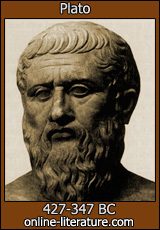
| Art of Worldly Wisdom Daily In the 1600s, Balthasar Gracian, a jesuit priest wrote 300 aphorisms on living life called "The Art of Worldly Wisdom." Join our newsletter below and read them all, one at a time. |
Sonnet-a-Day Newsletter Shakespeare wrote over 150 sonnets! Join our Sonnet-A-Day Newsletter and read them all, one at a time. |
