


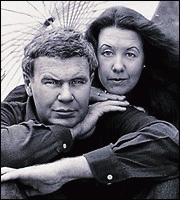
I remember seeing, a while ago, in another thread, that baddad had never read as much poetry by Raymond Carver as his brilliant prose. He lived a short life, married to fellow poet, Tess Gallagher. I adore Carver's contemporary poetry, especially as a fellow Oregonian, his most popular being "What The Doctor Said" and "Late Fragment" (engraved on his gravestone). I apologize for taking so long in making this thread, but finally found the time to outline some of my favorites. Additionally, I apologize in advance for the long length.
Hamid Ramouz (1818-1906)
This morning I began a poem on Hamid Ramouz -
soldier, scholar, desert explorer -
who died by his own hand, gunshot, at eighty-eight.
I had tried to read the dictionary entry on that curious man
to my son - we were after something on Raleigh -
but he was impatient, and rightly so.
It happened months ago, the boy is with his mother now,
but I remembered the name: Ramouz -
and a poem began to take shape.
All morning I sat at the table,
hands moving back and forth over limitless waste,
as I tried to recall that strange life.
-----
Looking For Work
I've always wanted brook trout
for breakfast.
Suddenly, I find a new path
to the waterfall.
I begin to hurry.
Wake up,
my wife says,
you're dreaming.
But when I try to rise,
the house tilts.
Who's dreaming?
It's noon, she says.
My new shoes wait by the door.
They are gleaming.
-----
This Room
This room for instance:
is that an empty coach
that waits below?
Promises, promises,
tell them nothing
for my sake.
I remember parasols,
an esplanade beside the sea,
yet these flowers . . .
Must I ever remain behind -
listening, smoking,
scribbling down the next far thing?
I light a cigarette
and adjust the window shade.
There is a noise in the street
growing fainter, fainter.
-----
The Mailman As Cancer Patient
Hanging around the house each day
the mailman never smiles; he tires
easily, is losing weight,
that's all; they'll hold the job -
besides, he needed a rest.
He will not hear it discussed.
As he walks the empty rooms, he
thinks of crazy things
like Tommy and Jimmy Dorsey,
shaking hands with Franklin D. Roosevelt
at Grand Coulee Dam,
New Year's Eve parties he liked best;
enough things to fill a book
he tells his wife, who
also thinks crazy things
yet keeps on working.
But sometimes at night
the mailman dreams he rises from his bed
puts on his clothes and goes
out, trembling with joy . . .
He hates those dreams
for when he wakes
there's nothing left; it is
as if he'd never been
anywhere, never done anything;
there is just the room,
the early morning without sun,
the sound of a doorknob
turning slowly.
-----
Our First House In Sacramento
This much is clear to me now - even then
our days were numbered. After our first week
in the house that came furnished
with somebody else's things, a man appeared
one night with a baseball bat. And raised it.
I was not the man he thought I was.
Finally, I got him to believe it.
He wept from frustration after his anger
left him. None of this had anything to do
with Beatlemania. The next week these friends
of ours from the bar where we all drank
brought friends of theirs to our house -
and we played poker. I lost the grocery money
to a stranger. Who went on to quarrel
with his wife. In his frustration
he drove his fist through the kitchen wall.
Then he, too, disappeared from my life forever.
When we left that house where nothing worked
any longer, we left at midnight
with a U-Haul trailer and a lantern.
Who knows what passed through the neighbors' minds
when they saw a family leaving their house
in the middle of the night?
The lantern moving behind the curtainless
windows. The shadows going from room to room,
gathering their things into boxes.
I saw firsthand
what frustration can do to a man.
Make him weep, make him throw his fist
through a wall. Set him to dreaming
of the house that's his
at the end of the long road. A house
filled with music, ease, and generosity.
A house that hasn't been lived in yet.
-----
My Dad's Wallet
Long before he thought of his own death,
my dad said he wanted to lie close
to his parents. He missed them so
after they went away.
He said this enough that my mother remembered,
and I remembered. But when the breath
left his lungs and all signs of life
had faded, he found himself in a town
512 miles away from where he wanted most to be.
My dad, though. He was restless
even in death. Even in death
he had this one last trip to take.
All his life he liked to wander,
and now he had one more place to get to.
The undertaker said he'd arrange it,
not to worry. Some poor light
from the window fell on the dusty floor
where we waited that afternoon
until the man came out of the back room
and peeled off his rubber gloves.
He carried the smell of formaldehyde with him.
He was a big man, this undertaker said.
Then began to tell us why
he liked living in his small town.
This man who'd just opened my dad's veins.
How much is it going to cost? I said.
He took out his pad and pen and began
to write. First, the preparation chares.
Then he figured the transportation
of the remains at 22 cents a mile.
But this was a round-trip for the undertaker,
don't forget. Plus, say, six meals
and two nights in a motel. He figured
some more. Add a surcharge of
$210 for his time and trouble,
and there you have it.
He thought we might argue.
There was a spot of color on
each of his cheeks as he looked up
from his figures. The same poor light
fell in the same poor place on
the dusty floor. My mother nodded
as if she understood. But she
hadn't understood a word of it.
None of it had made any sense to her,
beginning with the time she left home
with my dad. She only knew
that whatever was happening
was going to take money.
She reached into her purse and brought up
my dad's wallet. The three of us
in that little room that afternoon.
Our breath coming and going.
We stared at the wallet for a minute.
Nobody said anything.
All the life had gone out of that wallet.
It was old and rent and soiled.
But it was my dad's wallet. And she opened
it and looked inside. Drew out
a handful of money that would go
toward this last, most astounding, trip.
-----
For Tess
Out on the Strait the water is whitecapping,
as they say here. It's rough, and I'm glad
I'm not out. Glad I fished all day
on Morse Creek, casting a red Daredevil back
and forth. I didn't catch anything. No bites
even, not one. But it was okay. It was fine!
I carried your dad's pocketknife and was followed
for a while by a dog its owner called Dixie.
At times I felt so happy I had to quit
fishing. Once I lay on the bank with my eyes closed,
listening to the sound the water made,
and to the wind in the tops of the trees. The same wind
that blows out on the Strait, but a different wind, too.
For a while I even let myself imagine I had died -
and that was all right, at least for a couple
of minutes, until it really sank in: Dead.
As I was lying there with my eyes closed,
just after I'd imagined what it might be like
if in fact I never got up again, I thought of you.
I opened my eyes then and got right up
and went back to being happy again.
I'm grateful to you, you see. I wanted to tell you.
-----
In The Lobby Of The Hotel Del Mayo
The girl in the lobby reading a leather-bound book.
The main the lobby using a broom.
The boy in the lobby watering plants.
The desk clerk looking at his nails.
The woman in the lobby writing a letter.
The old man in the lobby sleeping in his chair.
The fan in the lobby revolving slowly overhead.
Another hot Sunday afternoon.
Suddenly, the girl lays her finger between the pages of her book.
The man leans on his broom and looks.
The boy stops in his tracks.
The desk clerk raises his eyes and stares.
The woman quits writing.
The old man stirs and wakes up.
What is it?
Someone is running up from the harbor.
Someone who has the sun behind him.
Someone who is barechested.
Waving his arms.
It's clear something terrible has happened.
The man is running straight for the hotel.
His lips are working themselves into a scream.
Everyone in the lobby will recall their terror.
Everyone will remember this moment for the rest of their lives.
-----
What The Doctor Said
He said it doesn't look good
he said it looks bad in fact real bad
he said I counted thirty-two of them on one lung before
I quit counting them
I said I'm glad I wouldn't want to know
about any more being there than that
he said are you a religious man do you kneel down
in forest groves and let yourself ask for help
when you come to a waterfall
mist blowing against your face and arms
do you stop and ask for understanding at those moments
I said not yet but I intend to start today
he said I'm real sorry he said
I wish I had some other kind of news to give you
I said Amen and he said something else
I didn't catch and not knowing what else to do
and not wanting him to have to repeat it
and me to have to fully digest it
I just looked at him
for a minute and he looked back it was then
I jumped up and shook hands with this man who'd just given me
something no one else on earth had ever given me
I may even have thanked him habit being so strong.
-----
Late Fragment
And did you get what
you wanted from this life, even so?
I did.
And what did you want?
To call myself beloved, to feel myself
beloved on the earth.

 Reply With Quote