Buying through this banner helps support the forum!
Page 9 of 12 FirstFirst ... 456789101112 LastLast
Results 121 to 135 of 172

Thread: mythology and religion in art

  1. #121
    Artist and Bibliophile stlukesguild's Avatar
    Join Date
    Jul 2006
    Location
    The USA... or thereabouts
    Posts
    6,083
    Blog Entries
    78
    Lions had been indigenous to Europe as is well demonstrated by the verses of the Iliad in which Homer frequently compares the heros to lions, and these beasts had not been forgotten by Europeans, hence the title of the crusader king Richard "the Lion Hearted"...

    OK... I should clarify this. Lions and elephants were known in Europe... certainly to the Romans. The Greeks may have known of them through trade with Africa. Elephants would have been known to the Romans as employed by the Carthaginians. Such animals were not, however, known to the majority of Europeans from the fall of Rome until at least the late Renaissance in the sense that they had any real grasp as to how these animals looked as opposed to the wolf, bear, and other animals that were native to the region. Most of the portrayals of Lions and Elephants and other non-native beasts are rather comic... and based solely upon hearsay and written descriptions:


    These artists almost certainly never saw a real lion. There representations were probably based upon myth, legend, written descriptions... and if they were lucky... an image from an antique text illustrating the animal.

    As we move later into the Middle-Ages and Renaissance there are records of carnivals and zoos and the private collections of the wealthy having lions, tigers and other wild beasts. These images suggest a passing familiarity with the actual animals:


    As we move into the later Renaissance and the Baroque, it becomes clear that artists have now had time to make serious studies as to anatomy of the Lion:


    -Albrecht Durer


    -Peter Paul Rubens

    Both Durer and Rubens would have been among the most sophisticated, educated, and well-traveled artists and so they would have had far more opportunity to see a lion or tiger or elephant in captivity. The majority of the population would have only known of such through representations in art... and as most art was reserved for the wealthy, it would have only been through the art in the church or in folk art and commercial prints.

    Well into the 19th and 20th centuries our concepts of Asia, the Middle-East, and Africa were limited to their representations in art as well.
    Beware of the man with just one book. -Ovid
    The man who doesn't read good books has no advantage over the man who can't read them.- Mark Twain
    My Blog: Of Delicious Recoil
    http://stlukesguild.tumblr.com/

  2. #122
    Banned
    Join Date
    Jun 2011
    Location
    Where the rain doesn't stop.....
    Posts
    763
    Blog Entries
    1
    Interesting theme. I love lions. Goddess also liked lions.

    We have to talk about Sphinx too. I will explore that subject later. I am not done with Greek mythology, yet.


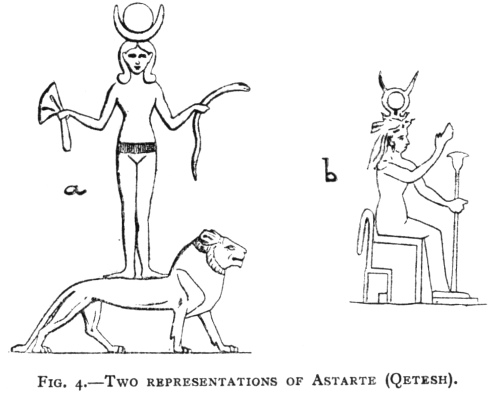
    ) The mother-goddess standing upon a lioness (which is her Sekhet form): she is wearing her girdle, and upon her head is the moon and the cow's horns, conventionalized so as to simulate the crescent moon. Her hair is represented in the conventional form which is sometimes used as Hathor's symbol. In her hands are the serpent and the lotus, which again are merely forms of the goddess herself.

    (b) Another picture of Astarte (from Roscher's "Lexikon") holding the papyrus sceptre which at times is regarded as an animate form of the mother-goddess herself and as such a thunder weapon.

  3. #123
    Banned
    Join Date
    Jun 2011
    Location
    Where the rain doesn't stop.....
    Posts
    763
    Blog Entries
    1
    Let's go back to Iris, goddess of rainbow.

    In the earlier poets, and even in Theocritus (xvii. 134) and Virgil (Aen. v. 610) Iris appears as a virgin goddess; but according to later writers, she was married to Zephyrus, and became by him the mother of Eros. (Eustath. ad Hom. pp. 391, 555; Plut. Amat. 20.)

    Nonnus, Dionysiaca 31. 103 ff (trans. Rouse) (Greek epic C5th A.D.) :
    "The wife of Zephyros (West-Wind), Iris (Rainbow), the messenger of Zeus . . . Iris, goldenwing bride of plant nourishing Zephyrus, happy mother of Eros (Love) [i.e. the eros Pothos]."
    http://www.theoi.com/Pontios/Iris.html


    Zephyrus was the god of the west wind, one of the four directional Anemoi (Wind-Gods). He was also the god of spring, husband of Chloris (Flora), and father of Karpos (Fruit).

    Pseudo-Hyginus, Preface (trans. Grant) (Roman mythographer C2nd A.D.) :
    "From Astraeus and Aurora [Eos] : Zephyrus, Boreas, Notus, Favonius ."
    Zephyrus' most famous myth told the story of his rivalry with the god Apollo for the love of Hyacinthus . One day he spied the pair playing a game of quoits in a meadow, and in a jealous rage, struck the disc with a gust of wind, causing it to veer off course and strike the boy in the head, killing him instantly. Apollo in his grief, then transformed the dying boy into a larkspur flower.
    http://www.theoi.com/Titan/AnemosZephyros.html
    Nonnus, Dionysiaca 29. 95 ff :
    "Apollo bemoaned Hyacinthus, struck by the quoit which brought him quick death, and reproached the blast of Zephyrus (the West Wind’s) jealous gale."

    Ovid, Fasti 5. 223 ff (trans.Boyle) (Roman poetry C1st B.C. to C1st A.D.) :
    "I [Chloris] first made a flower from Therapnean blood [of Hyacinthus, the love of Zephyrus], and its petal still inscribes the lament."
    http://www.theoi.com/Titan/AnemosZephyros.html


    Zephyrus & Hyacinthus

    Museum Collection: Museum of Fine Arts, Boston, Massachusetts, USA

    Date: ca 490 - 480 BC
    Period: Late Archaic

    SUMMARY

    Two figures representing either Zephyrus, the winged god of the west wind, holding his lover Hyacinthus in a close embrace; or an allegorical depiction of Love (Eros) desiring and seizing the beauty of youth.


    Zephyrus became the father of the horses Xanthus and Balius, which belonged to Achilles (Hom. Il. xvi. 150, &c.); but he was married to Chloris, whom he had carried off by force, and by whom he had a son Carpus. (Ov. Fast. v. 197; Serv. ad Virg. Eclog. v. 48.)


    Ovid, Fasti 5. 197 ff (trans.Boyle) (Roman poetry C1st B.C. to C1st A.D.) :
    "I [the Roman goddess Flora] was Chloris (Flower), nymph of the happy fields [Elysion], the homes of the blessed (you hear) in earlier times. To describe my beauty would mar my modesty: it found my mother a son-in law god. It was spring, I wandered; Zephyrus (the West Wind) saw me, I left. He pursues, I run : he was the stronger; and Boreas gave his brother full rights of rape by robbing Erechtheus’ house of its prize [Oreithyia]. But he makes good the rape by naming me his bride, and I have no complaints about my marriage. I enjoy perpetual spring: the year always shines, trees are leafing, the soild always fodders. I have a fruitful garden in my dowered fields, fanned by breezes, fed by limpid fountains. My husband filled it with well-bred flowers, saying : `Have jurisdiction of the flower, goddess.'"
    http://www.theoi.com/Titan/AnemosZephyros.html


    The wedding of Zephyrus and Chloris. Ancient Roman fresco (54-68 d.C.), Pompeii, Italy.


    William-Adolphe Bouguereau, Flora And Zephyr


    John William Waterhouse, Flora and the Zephyrs


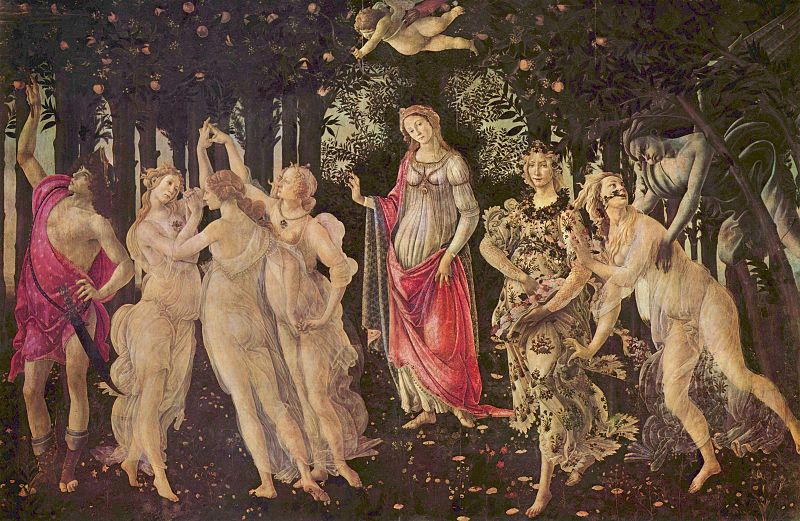
    Sandro Botticelli, Primavera


    Sandro Botticelli


    Antoine Watteau


    Frederic Schall, Zephyr Crowning Flora


    Flora and Zephyrus


    Warsaw, Lazienki


    Zephyrus by Antonio Bonazza, Upper Gardens of Peterhof.

  4. #124
    Banned
    Join Date
    Jun 2011
    Location
    Where the rain doesn't stop.....
    Posts
    763
    Blog Entries
    1

    Thumbs down Ancient Greece

    A few discussions encouraged me to look at the history of Greece.

    from http://www.ancientgreece.com/s/Culture/

    NEOLITHIC PERIOD OD (6000 - 2900 BC)

    According to historians and archeological findings, the Neolithic Age in Greece lasted from 6800 to 3200 BC. The most domesticated settlements were in Near East of Greece.

    EARLY BRONZE AGE (2900 - 2000BC)

    The Greek Bronze Age or the Early Helladic Era started around 2800 BC and lasted till 1050 BC in Crete while in the Aegean islands it started in 3000 BC.

    Minoan Age(2000 - 1400 BC )

    Bronze Age civilization, centering on the island of Crete. It was named after the legendary king Minos. It is divided into three periods: the early Minoan period (c.3000-2200 B.C.), the Middle Minoan period (c.2200-1500 B.C.) and the Late Minoan period (c.1500-1000 B.C.).


    The Minoans seem to have worshipped primarily goddesses, which has sometimes been described as a "matriarchal religion". Although there is some evidence of male gods, depictions of Minoan goddesses vastly outnumber depictions of anything that could be considered a Minoan god. While some of these depictions of women are speculated to be images of worshippers and priestesses officiating at religious ceremonies, as opposed to the deity herself, there still seem to be several goddesses including a Mother Goddess of fertility, a Mistress of the Animals, a protectress of cities, the household, the harvest, and the underworld, and more. Some have argued that these are all aspects of a single Great Goddess. They are often represented byserpents, birds, poppies, and a somewhat vague shape of an animal upon the head.

    A major festive celebration was exemplified in the famous athletic Minoan bull dance, represented at large in the frescoes of Knossos and inscribed in miniature seals.

    The Minoan horn-topped altars, since Evans' time conventionally called "Horns of Consecration" are represented in seal impressions, and survive in examples as far afield as Cyprus.

    Minoan sacred symbols include the bull and its horns of consecration, the labrys (double-headed axe), the pillar, the serpent, the sun-disk, and the tree. However, recently a completely different interpretation of these symbols, focusing on apiculture instead of religious significance, has been suggested.

    Evidence that suggests the Minoans may have performed human sacrifice has been found at three sites: (1) Anemospilia, in a MMII building near Mt. Juktas, interpreted as a temple, (2) an EMII sanctuary complex at Fournou Korifi in south central Crete, and (3) Knossos, in an LMIB building known as the "North House. (explanation of abbreviations)
    http://en.wikipedia.org/wiki/File:Sn...ete_1600BC.jpg

    from http://www.ancientgreece.com/s/Culture/

    Mycenaean Age (600 - 1100 BC)

    The Mycenaean Age dates from around 1600 BC to 1100 BC, during the Bronze Age.

    Religion

    Little is known about the religious practices of the Mycenaeans. Only a few texts depict the name of Gods. A popular deity was Poseidon, (at the time probably associated with earthquakes). Other important Gods included the Lady of the Labyrinth and Diwia (Sea Goddess). Other members of the pantheon of which evidence has been found include Zeus-Hera, Ares, Hermes, Athena, Artemis, Dionysus and Erinya.
    There are very few temples or shrines that have been found where religious practices might have been exercised: So we can assume all rituals took place on open ground or in peak sanctuaries. Some shrines that are found have a tripartite structural design.
    Minoans had a strong influence on most of the religious practices and rituals practised by the Mycenaeans.

    The Dark Ages (1100 - 750 BC)

    The period between the fall of the Mycenean civilizations and the readoption of writing in the eigth or seventh century BC. After the Trojan Wars the Mycenaeans went through a period of civil war, the country was weak and a tribe called the Dorians took over. Some speculate that Dorian invaders from the north with iron weapons laid waste the Mycenaean culture. Others look to internal dissent, uprising and rebellion, or perhaps some combination.


    Archaic Period (750 - 500 BC)

    The Archaic Period in Greece refers to the years between 750 and 480 B.C., more particularly from 620 to 480 B.C. The age is defined through the development of art at this time, specifically through the style of pottery and sculpture, showing the specific characteristics that would later be developed into the more naturalistic style of the Classical period. The Archaic is one of five periods that Ancient Greek history can be divided into; it was preceded by the Dark Ages and followed by the Classical period. The Archaic period saw advancements in political theory, especially the beginnings of democracy, as well as in culture and art. The knowledge and use of written language which was lost in the Dark Ages was re-established.

    Classical Period (500-336 BC)

    Classical period of ancient Greek history, is fixed between about 500 B. C., when the Greeks began to come into conflict with the kingdom of Persia to the east, and the death of the Macedonian king and conqueror Alexander the Great in 323 B.C. In this period Athens reached its greatest political and cultural heights: the full development of the democratic system of government under the Athenian statesman Pericles; the building of the Parthenon on the Acropolis; the creation of the tragedies of Sophocles, Aeschylus and Euripides; and the founding of the philosophical schools of Socrates and Plato.

    Hellenistic Period (336-146 BC)

    Hellenistic Period between the conquest of the Persian Empire by Alexander the Great and the establishment of Roman supremacy, in which Greek culture and learning were pre-eminent in the Mediterranean and Asia Minor. It is called Hellenistic (Greek, Hellas, "Greece") to distinguish it from the Hellenic culture of classical Greece.


    Oligarchies and tyrannies, meaning "ruled by a few”, ruled in this way until Ancient Greek democracy emerged around the 6'th century B. C. But democracy began as an expanded version of the original oligarchy as all women, slaves and foreigners were excluded from democracy. This new political system required a complex set of laws in order to keep this complicated social structure organized. The birth of Western philosophy occurred in Miletus with the philosopher and thinker Thales, and early literary output, such as the Homeric epics and the poetry of Hesiod, began in Ionia. Archaic Period brought about the solidification of the Greeks' religion, mythology and founding history.
    http://www.ancientgreece.com/s/ArchaicPeriod/
    from http://www.ancientgreece.com/s/Culture/

    Government

    c.800 BC
    The majority of Greek states were governed by groups of rich landowners, called aristocrats; this word is derived from 'aristoi', meaning best people. This was a system known as 'oligarchy' the rule by the few.

    c.750 BC
    Athenian power in the Archaic Period was controlled by Aeropagus, or council. Their policies were delivered through three magistrates called Archons.

    c.500 BC
    Democracy was introduced by an aristocrat, Cleisthenes. Who was from family of the Alcmaeonids in 508 BC, after 2 years of civil war, they used the help of Spartans to secure power.


    Ancient Greek Theatre

    The Greek theatre history began with festivals honoring their gods. A god, Dionysus, was honored with a festival called by "City Dionysia". In Athens, during this festival, men used to perform songs to welcome Dionysus. Plays were only presented at City Dionysia festival.
    Athens was the main center for these theatrical traditions. Athenians spread these festivals to its numerous allies in order to promote a common identity.
    The cast of a Greek play in the Dionysia was comprised of amateurs, not professionals (all male).

    Ancient Greek Everyday Life

    Men if they were not training in military, or discussing politics went to the Theatre for entertainment. To watch dramas that they could relate to, including tragedies and comedies. These often involved current politics and gods in some form. It is thought that women were not allowed to watch theatre or perform at the theatre, although male actors did play women roles.
    Lives of Women in Ancient Greece were closely tied to domestic work, spinning, weaving and other domestic duties. They were not involved in public life or in politics. The live were normally quite confined to the house although one public duty was acting as a priestess at a temple.

    Ancient Greek Games
    Greek boys played games like hockey, which were not part of the Olympic Games. The Ancient Greek boys usually played games naked, so girls were forbidden to watch.

    Olympics
    The Greeks invented athletic contests and held them in honour of their gods. The Isthmos game were staged every two years at the Isthmos of Corinth. The Pythian games took place every four years near Delphi. The most famous games held at Olympia, South- West of Greece, which took place every four years. The ancient Olympics seem to have begun in the early 700 BC, in honour of Zeus. No women were allowed to watch the games and only Greek nationals could participate. One of the ancient wonders was a statue of Zeus at Olympia, made of gold and ivory by a Greek sculptor Pheidias. This was placed inside a Temple, although it was a towering 42 feet high.
    The games at Olympia were greatly expanded from a one-day festival of athletics and wrestling to, in 472 BC, five days with many events. The order of the events is not precisely known, but the first day of the festival was devoted to sacrifices. On the Middle Day of the festival 100 oxen were sacrificed in honor of a God. Athletes also often prayed and made small sacrifices themselves..
    On the second day, the foot-race, the main event of the games, took place in the stadium, an oblong area enclosed by sloping banks of earth.
    At Olympia there were 4 different types of races; The first was stadion, the oldest event of the Games, where runners sprinted for 1 stade, the length of the stadium(192m). The other races were a 2-stade race (384 m.), and a long-distance run which ranged from 7 to 24 stades (1,344 m. to 4,608 m.).The fourth type of race involved runners wearing full amor, which was 2-4 stade race (384 m. to 768 m.), used to build up speed and stamina for military purposes.
    On other days, wrestling, boxing, and the pancratium, a combination of the two, were held. In wrestling, the aim was to throw the opponent to the ground three times, on either his hip, back or shoulder. In ancient Greek wrestling biting and genital holds were illegal.

    Boxing became more and more brutal; at first the pugilists wound straps of soft leather over their fingers as a means of deadening the blows, but in later times hard leather, sometimes weighted with metal, was used. In the pancratium, the most rigorous of the sports, the contest continued until one or the other of the participants acknowledged defeat.

    Horse-racing, in which each entrant owned his horse, was confined to the wealthy but was nevertheless a popular attraction. The course was 6 laps of the track, with separate races for whereupon the rider would have no stirrups. It was only wealthy people that could pay for such training, equipment, and feed of both the rider and the horses. So whichever horse won it was not the rider who was awarded the Olive wreath but the owner. There were also Chariot races, that consisted of both 2-horse and 4-horse chariot races, with separate races for chariots drawn by foals. There was also a race was between carts drawn by a team of 2 mules, which was 12 laps of the stadium track.

  5. #125
    Banned
    Join Date
    Jun 2011
    Location
    Where the rain doesn't stop.....
    Posts
    763
    Blog Entries
    1

    Avalokiteshvara

    Quote Originally Posted by Paulclem View Post
    As god of the dead (Yama) and snarling monster Avalokiteshvara also holds the “wheel of life” in his claws, which is in truth a “death wheel” (a sign of rebirth) in Buddhism. Among the twelve fundamental evils etched into the rim of the wheel which make an earthly/human existence appear worthless can be found “sexual love”, “pregnancy” and “birth”.

    This information is incorrect. Yama is not the wrathful incarnation of Avolokiteshvara. It is Mahalkala. (Scroll down the link below)

    http://www.exoticindiaart.com/article/mahakala/

    The site you have referenced has an agenda against HH The Dalai Lama, and it looks like Tibetan Buddhism in paticular. For example -

    Among the twelve fundamental evils etched into the rim of the wheel which make an earthly/human existence appear worthless can be found “sexual love”, “pregnancy” and “birth”.

    This quote is completely misleading. The 12 Dependant Links around the outside of the Wheel Of Life do not suggest that human life is worthless. They are inteded to signify the process by which reincarnation, birth ageing sickness and death work. I think the site is intended to mislead.

    I went back to your post and to do more reading.
    On website you have posted it is said that in the the Gelukpa order of Tibetan Buddhism “manifestation Mahakala is considered to be the fierce and powerful emanation of Avalokiteshvara, the bodhisattva of compassion”.

    But Avalokitasvara has 33 different manifestations, including female manifestations, all to suit the minds of various beings. These are found in the Lotus Sūtra chapter 25.
    http://en.wikipedia.org/wiki/Avalokite%C5%9Bvara

    It is more complex if we consider that we have Hinayana Buddhism, Mahayana Buddhism, and Tantric Buddhism. The author was talking about tantric doctrine.


    In the face of this splendor of light it is all too easy to forget that Avalokiteshvara also has his shady side. Every Buddha and every Bodhisattva — tantric doctrine says — can appear in a peaceful and a terrible form. This is also true for the Bodhisattva of supreme compassion. Among his eleven heads can be found the terrifying head of Yama, the god of the dead. He and Avalokiteshvara form a unit. Hence, as the “king of all demons” (one ofYama’s epithets), the “light god” also reigns over the various Buddhist hells.

    Yama is depicted on Tibetan thangkas as a horned demon with a crown of human skulls and an aroused penis. Usually he is dancing wildly upon a bull beneath the weight of which a woman, with whom the animal is copulating, is being crushed. Fokke Sierksma and others see in this scene an attack on a pre-Buddhist (possibly matriarchal) fertility rite (Sierksma, 1966, p. 215).

    As god of the dead (Yama) and snarling monster Avalokiteshvara also holds the “wheel of life” in his claws, which is in truth a “death wheel” (a sign of rebirth) in Buddhism. Among the twelve fundamental evils etched into the rim of the wheel which make an earthly/human existence appear worthless can be found “sexual love”, “pregnancy” and “birth”.
    http://www.bibliotecapleyades.net/so.../Part-2-01.htm

    I was more interested in the fact that Avalokiteshvara’s portrait displayed the feminine traits. The androgyny or hermaphrodite is pervasive in Greek mythology.

  6. #126
    Awesome, I haven't seen ever before like this collection under one place, I was just scrolling my mouse to see where is the end of this page. I like this thread. Interesting indeed to watch as well as read. Nice one.

  7. #127
    Banned
    Join Date
    Jun 2011
    Location
    Where the rain doesn't stop.....
    Posts
    763
    Blog Entries
    1
    Quote Originally Posted by paulanderson114 View Post
    Awesome, I haven't seen ever before like this collection under one place, I was just scrolling my mouse to see where is the end of this page. I like this thread. Interesting indeed to watch as well as read. Nice one.
    LOL! I hear you…….but I love art so much so that I couldn’t resist posting the paintings…… Can you image how this tread would look like if I knew all painters?

    I have found more entertaining and pleasurable to learn about mythology and religion using art than a dry reading.

  8. #128
    TobeFrank Paulclem's Avatar
    Join Date
    Jul 2009
    Location
    Coventry, West Midlands
    Posts
    6,363
    Blog Entries
    36
    Quote Originally Posted by ftil View Post
    I went back to your post and to do more reading.
    On website you have posted it is said that in the the Gelukpa order of Tibetan Buddhism “manifestation Mahakala is considered to be the fierce and powerful emanation of Avalokiteshvara, the bodhisattva of compassion”.

    But Avalokitasvara has 33 different manifestations, including female manifestations, all to suit the minds of various beings. These are found in the Lotus Sūtra chapter 25.
    http://en.wikipedia.org/wiki/Avalokite%C5%9Bvara

    It is more complex if we consider that we have Hinayana Buddhism, Mahayana Buddhism, and Tantric Buddhism. The author was talking about tantric doctrine.


    I was more interested in the fact that Avalokiteshvara’s portrait displayed the feminine traits. The androgyny or hermaphrodite is pervasive in Greek mythology.
    Thanks - you brought the link forward. I hadn't seen that you had done this when I was replying to you on the other thread.

    Avalokitasvara has 33 different manifestations

    Yes true, but then I didn't say otherwise. My point was that Avolokitesvara is not Yama the Lord of death and rules over the hells. It was actually this that alerted my suspicions about the book/site. It is such a basic mistake - if that is what it is - that I looked further into it. I concluded that it was not a mistake, but an intentional detail.

    What is difficult is that the wrathful forms of Buddhas like Mahakala are still motivated by compassion for all living beings. It's just that it is a different expression of compassion. In the pictures of hells, you see the wrathful forms - scary and powerful, but appropriate to a realm where beings are reborn due to the execution of hateful karma. You need a different aspect to deal with such situations and beings.

    In terms of personal practice, the wrathful forms make use of those negative aspects of the human and turn them into the path.

    It is more complex if we consider that we have Hinayana Buddhism, Mahayana Buddhism, and Tantric Buddhism. The author was talking about tantric doctrine.

    I won't repeat what I put about this. Just to add that a Buddha is motivated by compassion - Bodhicitta - an endless wish to liberate all beings from suffering by whatever skillful means at their disposal. This includes the Wrathful manifestations. The quote

    In the face of this splendor of light it is all too easy to forget that Avalokiteshvara also has his shady side.

    makes no sense in the light of a Buddha's boundless compassion. Buddhas don't have shady sides, though to a person who is familiar with Christian iconography, but no Buddhist knowledge, it is easy to assume so as they appear to be Demons. The original Christian Missionaries to Lhasa thought that the Tibetans were Demon worshippers. It makes sense given their own views, but it betrays a complete misunderstanding of Buddhist iconography. The site does this too, though I don't think the motives are so innocent.

    I was more interested in the fact that Avalokiteshvara’s portrait displayed the feminine traits. The androgyny or hermaphrodite is pervasive in Greek mythology.

    The Chinese version of Avolokiteshvara is Quan Yin - a female.

    I'll have another look at the book and see what I can find.

    I have to say that it is difficult for me to read this site - it is so vehemently anti-Tibetan Buddhist. The most disturbing thing about it is the almost truths it is peddling, and the horrible implications.

    “Therefore Dharma is of the shape of a zero; and as the sun is also of the shape of a zero, Dharma is identified with the sun. Moreover, Dharma moves in the void, and void is the sky, and the sun moves in the sky and hence the sun is Dharma”

    The zero shape is associated with Emptiness, but this has nothing to do with a sun cult. The sun itself is subject to Emptiness and has no inherent existence. The sun is often used as an analogy for the Dharma, as has been said, but the analogy is intended to convey the positive nature of, and non-discriminating nature of the Dharma.

    The column of fire is both a symbol for the axis of the world and for the human spine up which the Kundalini ascends. It further has a clear phallic character.

    I have seen Kundalini referred to in Hindu texts but not Buddhist. It is not a phallic symbol in the Buddhist texts, but represents the channels through which the inner winds flow. The phallic image is associated with Hindu iconography.

    This close relation of the Buddha figure to fire has induced such discriminating authors as the Indian religious studies scholar, Ananda Coomaraswamy, to see in Shakyamuni an incarnation of Agni, the Indian god of fire (Coomaraswamy, 1979, p. 65).

    We can criticise this quote by Ananda Coomaraswamybecause he is combining Hinduism and equating it with Buddhism. From a brief reading of his biography, I suspect that his understanding of art and iconography - whilst being sincere, was not informed by insights into practice. Incidentally, he may havebeen influenced by the assertions of Hindus that Buddhism is merely a branch of Hinduism, which it is not.

    “It is the all-consuming, flaming power, the inner blaze which overwhelms everything, which has filled the religious life of the people in its thrall since the awakening of Indian thought: the power of the Tapas ... Here, Tapas is the creative principle, which functions in both the material and the spiritual [domains] ... It is 'enthusiasm', in its most lowly form a straw fire fed by blind emotion, in its highest, the flame of inspiration nourished by unmediated perception. Both have the nature of fire” (Govinda, 1991, p. 188). With this citation Govinda leaves us with no doubt that Tantric Buddhism represents a universal fire cult. [1]

    This is a very misleading paragraph.

    It is 'enthusiasm', in its most lowly form a straw fire fed by blind emotion, in its highest, the flame of inspiration nourished by unmediated perception. Both have the nature of fire”

    This refers directly to the utilisation of negative emotions - anger etc - by the Tantric Practitioner via the inner winds. It is a misinterpretation and has nothing to do with a fire cult.

    the Fourteenth Dalai Lama writes in a commentary upon the Kalachakra Tantra, “practitioners of which especially should keep the pledge of restraining from, or abandoning, the bliss of emission, even though making use of a consort”

    Again, this is a quotation ut of context. Tantric Practice does involve a consort - but not a physical one. This is where the misapprehension of the meaning has arisen in modern references to tantra. It is part of a meditational practice, but the quote, taken out of context as it is, implies that it woud be a physical one.

    After their deaths, upright Buddhists are reborn here from out of a lotus flower. They all move through this hereafter in a golden body. Women, however, are unwelcome. If they have earned great merit during their earthly existence, then they are granted the right to change their sex and they are permitted to enter Amitabha’s land after they have been incarnated as men.

    There cetainly has been a patriarchal attitude to women in Buddhism, but there is a female Buddha - Tara, who is revered by Tibetans. The Buddha also established Nuns, though cultural norms often intrude upon how males and females are regarded.

    In the light of his qualities as “fire god”, “lord of the West”, and “patron of science”, Amitabha could indeed be regarded as the regent of our modern age, then the last two hundred years of western civilization and technological development have been predominantly dominated by the element of fire: electricity, light, explosions, and the modern art of war count as part of this just as much as the greenhouse effect and worldwide desertification. The great inventions — the steam engine, dynamite, the automobile, the airplane, rockets, and finally the atomic bomb — are also the handiwork of “fire”. The fiery element rules the world as never before in history.

    This is a scandalous paragraph. It seems to imply that Amitabha - Buddha of Light's influence has resulted in all the faults of this and the last century. Buddhas don't rule the world, but are dedicated to the relief of beings in it. You remember you said there are consequences for peddling untruths? Tell the author of this.

    I haven't finished page one of this. Can you see why I take issue with this book?

  9. #129
    Banned
    Join Date
    Jun 2011
    Location
    Where the rain doesn't stop.....
    Posts
    763
    Blog Entries
    1
    I want to keep this tread as it was my original purpose to open it. I have moved art from Ovid and Metamorphosis tread that was a discussion tread not to have .... discussion tread. One of the reasons for doing it is the fact that mythology and religion is a huge subject and I don’t think that I will ever be comfortable to discuss it. Scholars who studied that subject in depth pointed out many contradictions depending what historian they take into consideration. For example, some historians believed that Venus was born in sea-foam from the castrated genitals of the sky-god Uranus whereas others believed that she was born out of egg. Similarly, Eros was a son of Venus in one myth in another a son of Iris.
    I am more interested in finding the common themes or archetypes in all religions. Joseph Campbell who spent his entire career came to that conclusion. I have come to the same conclusion and I want it to be a focus of my explorations.

    Secondly, I don't like influence people what I think. I prefer to ask questions than to look for the answer since when we accept a belief we close our minds for alternative explanations.

    Finally, I have asked the moderators on Picture/Images How to tread to clarify about posting art. Some members interpreted the new rules as not posting art on the discussion treads. They continue posting art but I prefer to wait for the clarification.
    My intentions was not to have a discussion tread and it would be sad this tread to end.
    Last edited by ftil; 11-28-2011 at 03:22 PM.

  10. #130
    TobeFrank Paulclem's Avatar
    Join Date
    Jul 2009
    Location
    Coventry, West Midlands
    Posts
    6,363
    Blog Entries
    36
    I posted my comments above with sincerity. I hope you take them in that spirit, though I'm not asking you to agree with them, just consider them.

  11. #131
    Banned
    Join Date
    Jun 2011
    Location
    Where the rain doesn't stop.....
    Posts
    763
    Blog Entries
    1
    Quote Originally Posted by Paulclem View Post
    I posted my comments above with sincerity. I hope you take them in that spirit, though I'm not asking you to agree with them, just consider them.
    I appreciate your effort to answer it. It was a purpose of this tread to bring information so that if somebody is interested he or she may explore it further. If people are interested in Buddhism they may also look at references based on which the book was written, and perhaps, read some of the work to make own conclusions. Therefore, I always post a link.

  12. #132
    confidentially pleased cacian's Avatar
    Join Date
    Nov 2011
    Location
    London
    Posts
    13,930
    I have always wondered at the way mythology and gods are portrayed in pictures.
    My question is:

    why are all gods/goddesses/angels are portrayed naked/without clothes on?
    it may never try
    but when it does it sigh
    it is just that
    good
    it fly

  13. #133
    Registered User
    Join Date
    Sep 2011
    Posts
    3,890
    Quote Originally Posted by cacian View Post
    I have always wondered at the way mythology and gods are portrayed in pictures.
    My question is:

    why are all gods/goddesses/angels are portrayed naked/without clothes on?
    Epicurus would probably say that it is because people want to make sure that they have no dirty body.

  14. #134
    Existentialist Varenne Rodin's Avatar
    Join Date
    Dec 2010
    Location
    West
    Posts
    1,409
    Blog Entries
    6
    I love those lions by Rubens, stlukesguild! Amazing. Thank you for posting that.

  15. #135
    confidentially pleased cacian's Avatar
    Join Date
    Nov 2011
    Location
    London
    Posts
    13,930
    Quote Originally Posted by cafolini View Post
    Epicurus would probably say that it is because people want to make sure that they have no dirty body.
    Good thinking there cafolini.
    Last edited by cacian; 11-29-2011 at 04:01 AM.
    it may never try
    but when it does it sigh
    it is just that
    good
    it fly

Page 9 of 12 FirstFirst ... 456789101112 LastLast

Similar Threads

  1. Banned books
    By Lara in forum General Literature
    Replies: 250
    Last Post: 12-12-2015, 04:16 PM
  2. Why I believe in God?
    By laidbackperson in forum Religious Texts
    Replies: 938
    Last Post: 11-27-2011, 05:49 PM
  3. The Man with the Blue Guitar
    By Virgil in forum Poems, Poets, and Poetry
    Replies: 50
    Last Post: 07-09-2009, 11:36 PM
  4. The novel
    By Newcomer in forum Jane Eyre
    Replies: 23
    Last Post: 03-06-2009, 09:29 AM
  5. Why do you conceive the Bible is difficult?
    By Deng Xiang in forum Religious Texts
    Replies: 65
    Last Post: 09-12-2008, 09:01 PM

Posting Permissions

  • You may not post new threads
  • You may not post replies
  • You may not post attachments
  • You may not edit your posts
  •