Page 4 of 8 FirstFirst 12345678 LastLast
Results 46 to 60 of 119

Thread: who's your favorite poet? why?

  1. #46
    biting writer
    Join Date
    Sep 2007
    Location
    when it is not pc, philly
    Posts
    2,184
    Quote Originally Posted by stlukesguild View Post
    [COLOR="DarkRed"]
    Jozie... I can't say I was ever so fully seduced by a mentor... although I did have a few. The first had a marvelously absurd sense of humor and painted Expressionist paintings with blaring colors, shimmering brush-work, and emotion-laden imagery (read: sex!) while all the other faculty were abstract formalists. In literary terms he was Blake or Rimbaud... or at least Ginsberg... while they were all Richard Wilbur. I eventually outgrew his influence... and yet I now see certain formal elements that echo (albeit it in a very different manner) some of his. My other mentors included a feisty Scotsman (who may have been the most marvelous painter of the lot) who had a penchant for a single adjective beginning with F and spoken with the most marvelous Scottish brogue, and a Pole who had survived the Nazis and Stalin (although not without consequences). He had the most magnificent bio and in spite of the complete loss of his one arm (thanks to Stalinist guards at a gulag) and the fact that he stood no more than 5' 4"... he could absolutely dominate any discussion ( in spite of the fact that I stood 6 foot, 200 pounds). He also had an uncanny talent for observation and listening and was a master of the Socratic method. He never told you what to do. He merely asked questions... questions that I still think about today. In spite of this I broke free of all of them. My own work has little in common with them (although I may find some links if I stretch the imagination) and is clearly my own... for better or worse.
    Well, this is what I mean. I am leagues beyond the promise he once saw in me, and from what I can gather, his growth apparently stopped at a certain count in the alphabet and hasn't made the final leap toward brilliance being willing to accommodate certain accepted social norms. It isn't so much what my personal feelings amount to; it is just, what's the point at this stage in our lives? I am not a scholar, just a mid-term writer trying to be creative about keeping her tush out of a nursing home.

    I do enjoy his work though, and intend to buy one of his titles. I will debate the rest.

    I need to read Rimbaud and Rilke, at some point. As to this contest between Ovid and Dante, I am not so studied in Ovid--read yes, but not studied--to say one thing or another, but they played different roles in their respective eras, and I am not sure that mutual appreciation of the two necessitates saying which is better.

    Quote Originally Posted by JBI View Post
    - you really cannot separate the past from the present in the way you can with prose - even the most abstract, most radical poets are still dependent on the past masters - the language of poetry is flexible in time - the spoken Italian language is in itself, the spoken Italian language because of the Catholic Florentine culture you dismissed - the past cannot be broken - the influences cannot be ignored.
    Which is why I *balk* at singling out favorites, because poetry is a network of generation building. I do not *dismiss* the rise of the Italian city states after empire. My experience is simply different than luke's, from the start. I discovered Creeley before I knew what Beat poetry meant, and then in a series of coincidences, I studied under his student, and then met him--but this was my way through to Renaissance Italy and England. I did not just land in university and go plop! (In American high school I am foggy on my English lit track, but it was mainly the American modernists, Fitz, Steinbeck, etc.)

    I just don't see how Dante can be a *favorite*. To me, calling il somma poeta "my favorite" rather downplays the achievement of the Comedia


    Within poetry is the capturing of time, that is able to repeat itself. Every poem dies, but is reborn with every reading, and made to live again. Dante is as a part of the stillness of time as any poet. Quite simply though, I strain to come up with a figure who really mastered language and metaphor the way Dante did. As one of my professors kept telling me, you need to read Dante, and then you need to read him in Italian. There is nothing without Dante - there is no poetry. I strain to come up with a rival for him.
    Sure there was. Latin, and then Greek before that, and goodness knows what Asia was up to. Poetry doesn't begin history with Dante, JBI, nor is the Comedia the end of history, in that sense.

  2. #47
    Artist and Bibliophile stlukesguild's Avatar
    Join Date
    Jul 2006
    Location
    The USA... or thereabouts
    Posts
    6,083
    Blog Entries
    78
    I just don't see how Dante can be a *favorite*. To me, calling il somma poeta "my favorite" rather downplays the achievement of the Comedia

    Again... that is something I can't quite fathom. A "favorite" artist in any genre would seem to be the one who has made the deepest impact upon you personally and to whom you return to again and again... regardless of whether he or she is truly one of the absolute greats. If you ask me who is my favorite composer I will not hesitate to say J.S. Bach. I return to his music more than to any other. This does not mean I cannot appreciate Miles Davis, Johnny Cash, or the Rolling Stones... nor that there are not times that I'd rather listen to them than the Well Tempered Clavier again.

    The same holds true of Dante. There are any number of modern and contemporary poets I turn to repeatedly: Rilke, Baudelaire, Verlaine, Rimbaud, T.S. Eliot, Garcia-Lorca... but none captivates me and calls me back as much as Dante. There is such a wealth there: violence, lust, passionate emotion, rage, history, philosophy... poetry of all the senses: sight, sound, scent, touch... and absolutely transcendent and visionary poetry. On the other hand... had the question been "Who is your favorite writer?" I just might have gone with Borges... in spite of the fact that I acknowledge Dante and certainly Shakespeare (among others) as being far greater writers.

    With art... however... my choice would not be one of the two or three artists most universally acknowledged as giants. Indeed, he doesn't even hold that rank within the 20th century. If you ask me who the greatest artist of all time was I would not hesitate a second. It is unquestionably Michelangelo. No one else comes close. After that? Rembrandt. He is the Shakespeare of painting... the greatest creator of characters... personalities who are so fleshed out you imagine you know them better than you know most real people. The 20th century? Again, that's easy. Picasso. There is no competition. And yet my favorite artist may just be Pierre Bonnard:


    Again, I suspect that as an artist working in the same field we are more attracted to the work of artists who inspire or even predict our own work than we are of artists who we imagine as having given the biggest aesthetic
    bang for our buck... or so is my thinking.
    Beware of the man with just one book. -Ovid
    The man who doesn't read good books has no advantage over the man who can't read them.- Mark Twain
    My Blog: Of Delicious Recoil
    http://stlukesguild.tumblr.com/

  3. #48
    Artist and Bibliophile stlukesguild's Avatar
    Join Date
    Jul 2006
    Location
    The USA... or thereabouts
    Posts
    6,083
    Blog Entries
    78
    There's so much there to love. Not just the literature, but the philosophy, the history, the art, and the architecture too. As an artist, surely you must appreciate this.

    Actually I... and I'm not alone in this... have long imagined the Romans in contrast to the Greeks as being not unlike the United States in contrast to Europe. In both instances we have a younger republic that rapidly declines into decadence (without any period of civilization in between, as Oscar Wilde might have suggested). The art is initially stodgy... pragmatic... practical:


    bombastic... and admittedly stiff:


    It lacks any of the grace and fluidity of Greek art... in spite of the fact that it is modeled almost exclusively upon Greek art:


    From the very start the sea-going Greeks have an appreciation of flowing, organic lines and forms. With the female nude Greek sculpture reached its peak. There is nothing in Roman art to match the sensuality and grace of Praxiteles:


    The harsh naturalism and overwrought, clunky forms of Roman portraiture...


    are almost laughable in comparison with the soft and atmospheric... "impressionistic" images of the Greek ideal of female beauty:


    Indeed it may be an exaggeration... but one that has much truth to it... to suggest that Greek art is an art of sophistication, sensuality, and "feminine" beauty:


    ... even when the subject is male:


    ... while Roman sculpture is clearly masculine... an art of crude brute force


    Of course where Rome does succeed marvelously is in the field of architecture... or more accurately, engineering. The innovations and the technology and the sheer labor employed in Roman architecture clearly outstripped all rivals:


    In this sense the analogy between Rome and the United States remains true, for certainly it was the technological wonder of the Brooklyn Bridge, the Golden Gate Bridge, the interstate highways, the hydro-electric dams, and the skyscrapers of Chicago and New York that awed the world far before American painting had made the least mark.

    Of course I am speaking of Rome of the Republic and the peak of the Empire. As Rome began to decline and slip into decadence its art actually blossomed. We begin to discover the most "expressionistic" distortions:


    A huge influence upon the Roman art of this period is that of contact with Eastern cultures. It is commonly known that Rome had a huge impact upon the art of India and Egypt... but the "Eastern" cultures... especially the Persians... had a major impact upon the art of Rome. This influence helped the Romans break free from the academicism rooted in Greek classicism. The Eastern influence becomes quite apparent in the art of the mosaic:


    The Eastern influences will become ever more obvious with the fall of Rome and the rise of the Eastern Roman Empire or Byzantium. The Byzantine Empire will explode with the most absolute wealth of visual splendor:


    Beware of the man with just one book. -Ovid
    The man who doesn't read good books has no advantage over the man who can't read them.- Mark Twain
    My Blog: Of Delicious Recoil
    http://stlukesguild.tumblr.com/

  4. #49
    Registered User
    Join Date
    May 2009
    Location
    Glasgow/Perth/Perthshire, Scotland
    Posts
    119
    I really can't choose a favourite, the ones that always jump to mind:

    Seamus Heaney (he's just ****ing excellent. Blackberry picking has always been one of my favourites)
    Norman Mcaig (for his imagery mostly. It's so excellent.

    '
    Straws like tame lightnings lie about the grass
    And hang zigzag on hedges. Green as glass
    The water in the horse-trough shines.
    Nine ducks go wobbling by in two straight lines.'


    John Donne (best love poetry ever?)
    Last edited by meh!; 05-12-2009 at 08:18 PM.

  5. #50
    biting writer
    Join Date
    Sep 2007
    Location
    when it is not pc, philly
    Posts
    2,184
    I suppose I am wading into trouble here, but when has that stopped me. Let me tackle this issue about favorite, first. To me the word implies an indulgence: my favorite ice cream is Ben & Jerry's for which I need a certain amount of restraint; my favorite rock music is Elton John, hands down, an attachment I haven't outgrown, and McGuire is my favorite poet for various reasons, and since this is sort of a semi-public community, I will restrain my characteristic confessional mode any further there (happy about that?).

    But is a favorite the best thing, the most authentic, or the greatest? Or is it an intimacy which socially we are given permission to expose? This is the crux of the issue for me. Favorite poems are less of an attachment than the greatest poems, or poetry that moves me most profoundly due to something about the poem or the poet, or even poetry worthy enough to love. I love Dante; I love The Divine Comedy, but I do not wear terza rima on my wrist like a charm bracelet, even as I allow for an exasperation with Italian provincialism. Every society and culture is probably grounded in provincialism to some degree, but the Roman mentality excels at it since losing world domination, and because of Dante, the Roman mentality hasn't stopped being entirely indignant since. I even have an editorial on file that claims Italian Popes were necessary for Catholicism because you had to wield your authority like an emperor, and JP2 could not because he used his authority in part to break Communism. I find the writer's train of thought interesting, but it is still, as always, more modern Italian whining. They will never rule the world again, but hey, we can cry about it in our thousand year old palaces and aqueducts while we drown in the Mediterranean in our own garbage. Provincialism as high art, indeed!

    Then again, I'm Italian.

    I will save poetic inter-connectedness for another day, since JBI put his stamp on that issue first, but I would hope those who have favorite poets allow for curiosity to branch out into influences and discoveries.

    I am slightly more comfortable selecting favorite poems, now that I've finished turning blue, but it is still rather a parlor game with ice cream scoops.

    Now we can resume our normal programming, which was already in progress.

  6. #51
    Alea iacta est. mortalterror's Avatar
    Join Date
    Mar 2008
    Location
    LA
    Posts
    1,914
    Blog Entries
    39
    Surely, a man who loves color as much as you would have no objection to this:


    And their statues were hardly rigid as you imply.


    Although they did like to do things on a colossal scale.

    They also did some amazing relief work.


    And they loved everything around them to be beautiful and ornate.


    There's no beating them for architecture. What you call bombastic, I call heroic.


    They invented the mosaic and did it as well as the Byzantines ever did.


    I think if you do some independent research, you will find that there is far more to the Romans than what you were taught in art school. It wasn't too long ago that people called the middle ages the Dark Ages and taught that it was a time of primitive and unsophisticated art and I know you have a taste for them.
    Last edited by mortalterror; 05-13-2009 at 04:53 PM.
    "So-Crates: The only true wisdom consists in knowing that you know nothing." "That's us, dude!"- Bill and Ted
    "This ain't over."- Charles Bronson
    Feed the Hungry!

  7. #52
    Artist and Bibliophile stlukesguild's Avatar
    Join Date
    Jul 2006
    Location
    The USA... or thereabouts
    Posts
    6,083
    Blog Entries
    78
    ...their (Roman) statues were hardly rigid as you imply. Although they did like to do things on a colossal scale. They also did some amazing relief work. And they loved everything around them to be beautiful and ornate. There's no beating them for architecture. What you call bombastic, I call heroic. They invented the mosaic and did it as well as the Byzantines ever did. I think if you do some independent research, you will find that there is far more to the Romans than what you were taught in art school. It wasn't too long ago that people called the middle ages the Dark Ages and taught that it was a time of primitive and unsophisticated art and I know you have a taste for them.

    Mortal... whatever I know of literature absolutely pales beside what I know of art and art history. I am far more versed in Roman art than was necessitated by my formal studies of ancient art history. In no way do I question the merit of Roman architecture. They were brilliant engineers and put these skills to work in created some of the most marvelous architectural creations. The Roman Coliseum...


    ... was unrivaled as an arena until the late 20th century. In many ways it remains unrivaled. I was brilliantly designed in order to allow for rapid dispersal of crowds. Beyond the three tiers of seating there were multiple subterranean levels where animals, prisoners, gladiators, etc... were housed. In spite of this they were able to flood the field in order to carry out mock naval battles.

    With the Pantheon the Roman succeeded in creating the first true hemispheric dome.


    The dome, as a work of architecture, can be imagined as a series of arches 360-degrees in the round. The arch succeeds in standing by bracing the thrust of one side of the arch against the opposing thrust. It essentially works in a manner not unlike leaning two playing cards against each other to create a house of cards. The keystone, where the two opposing arms of the arch meet is essential... and yet the Roman Pantheon succeeded in creating a dome with a wide oculus:


    The Romans were able to achieve this... and to have it still standing nearly 2000 years later... as a result of their mastery of certain engineering skills including the use of ribbed vaulting, the decreasing thickness of the shell of the actual dome as it moves ever upward and out from the supporting walls, and especially their absolute genius with concrete.

    Brilliant works of Roman architecture can be found not only in Rome:


    ...but also France...


    ...Germany...


    ... the Middle East...


    ... and even Britain:


    Architecture in unquestionably THE Roman contribution to Western Civilization.

    Their sculpture, however, leaves something to be desired. Little can be said of painting for so little of any real merit remains... outside of the lovely works discovered in Pompeii... especially in the magnificent Villa of Mysteries...


    Pre-Roman art... the art of the Etruscans... was quite brilliant, fantastic, and original:


    While it is clear that Etruscan art has built upon influences as diverse as Greek and Minoan, Scythian, Celtic, Persian, and Asian... their art is truly unique and displays forms and genre unseen anywhere else.

    With the establishment of the Roman Republic art served the pragmatic needs of the Roman desire to remember and be remembered. The wild fantasies of the Etruscans and the ideals of beauty of the Greeks...


    ... were abandoned, In their place we have the harsh realism of Roman portraiture. This was especially true of sculpture:


    As the Republic became the Empire there developed an obsession for all things Greek. Building upon Greek classicism was seen as a means of conveying a legitimacy to the Empire by suggesting that Rome was an extension of Greece and the Empire of Alexander. This is played out in Virgil's epic, the Aeneid, in which Rome is imagined as a continuation of Homer's Troy. In a manner it is not unlike the use of Neo-Classical architecture in French, German, British, Russian, American, etc... public building as a means of conveying a legitimacy, solidity, and sense of historic continuity.

    To fuel the desire for Greek-style sculpture the Romans employed several methods. They simply stole everything they could from the conquered Greeks and shipped it en masse to Rome. A few of the best original Greek bronzes have been found as part of Roman shipwrecks. They also employed... through coercion or force... every Greek artist... especially sculptors... they could. Finally, through various mechanical means including the use of calipers and other devises... they made endless copies of Greek art. The result was loss of originality... a stiff pseudo-classicism. Unfortunately, some of the greatest Greek sculpture (such as the so-called Apollo Belvedere) is known only through stiff Roman copies which convey nothing of the fluidity of the known Greek original bronzes and marbles.

    Some of the most important commissions achieved a level of classical beauty:


    But it often remained marred by a certain stiffness of lack of fluidity, an obsession for realism that conflicted with the classical ideal, and a degree of bombast. Certainly, there are exceptions (there are always exceptions in art) such as the relief sculpture on the Ara Pacis or the Column or Trajan... but by and large Roman art of the Republic and the early Empire cannot begin to compete with the achievements of Greece or Persia.

    As the Empire began to decline the art devolved into a sort of "mannerism":


    The outrageously ornate manner and rather effete styling had a definite expressiveness to it... but this in itself was equally indebted to the Greeks... in this case Greek Alexandrian/Hellenistic sculpture such as found upon the ornate Temple at Pergamon or the famed Laocoon, which was certainly known at this time through endless copies (Pliny the Elder claims the original was owned by the Emperor Titus but it was unearthed near the Golden Palace of Nero).


    In spite of the obvious indebtedness to Greek art, the Roman sculpture of this period displayed a far greater fluidity and lack of stiffness common to earlier periods. While the stylizations may owe to Greece, there is a far greater originality and inventiveness in the actual imagery which is no longer so completely indebted to Greek models.

    Roman art (sculpture) really comes into its own, however, during the period of Constantine. The famous Four Tetrarchs may owe more to Persian than Greek art, but it is entirely unique and powerfully conveys the uncertainties of the period as the four "Ceasars" each hold on to each other warily...


    The fragmentary colossal portrait of Constantine (can anyone look at this work and not think of Ozymandias?


    brings something truly new. The forms are greatly simplified... abstracted... and yet we are not seeing anything like the Greek sculptural classical ideal. The facial features are cut incredibly deep and convey an emotion not seen since the ancient Messopotamian Abu-figures...


    This work will become THE model for later Christian art with large-eyed figures looking up into heaven. Of course the contributions of the Roman Empire continue well into the Middle Ages in the form of the art of the Eastern Roman Empire or Byzantine Empire but I somewhat suspect, Mortal, that for you the Roman Empire is that of Julius Caesar, Augustus Caesar, etc... the Roman Empire proper. I will admit that it is more than likely that a great deal of art of real merit was lost during all the subsequent destruction wrought by the barbarians, time, and the church (the church being the most destructive).
    Beware of the man with just one book. -Ovid
    The man who doesn't read good books has no advantage over the man who can't read them.- Mark Twain
    My Blog: Of Delicious Recoil
    http://stlukesguild.tumblr.com/

  8. #53
    Artist and Bibliophile stlukesguild's Avatar
    Join Date
    Jul 2006
    Location
    The USA... or thereabouts
    Posts
    6,083
    Blog Entries
    78
    Oh... by the way... my favorite poet? Did I mention Dante?
    Beware of the man with just one book. -Ovid
    The man who doesn't read good books has no advantage over the man who can't read them.- Mark Twain
    My Blog: Of Delicious Recoil
    http://stlukesguild.tumblr.com/

  9. #54
    ignoramus et ignorabimus Mr Endon's Avatar
    Join Date
    Feb 2009
    Posts
    305
    Well then, stlukesguild, if you don't mind this seems like an opportune time to bring this up again:

    I'm sorry, I know this isn't the right place for it, but I can see some serious Dante lovers. Can you suggest me a decent translation (if there is such thing) of The Divine Comedy, if possible a good bilingual edition? Many thanks.
    I like my needy peddling admixed with relevant information, so I announce that Ernst Jandl is my favourite German poet.

  10. #55
    biting writer
    Join Date
    Sep 2007
    Location
    when it is not pc, philly
    Posts
    2,184
    Quote Originally Posted by stlukesguild View Post
    Oh... by the way... my favorite poet? Did I mention Dante?
    I brought up Manzoni because I Promessi Sposi is, surprisingly lacking in shallowness and the tiresome didactic sensibility of the English novel of manners. Sometimes it pays to branch out luke, to read good literary critics, and to refine our terms of engagement, and reconsider the field. Dante is simply too large for me to put him on par with the sentiments of Julie Andrews in The Sound of Music. I thought you would have picked someone along the lines of your Italian modernist who earned Bly's acclaim, whose name escapes me in my reluctant laziness to go dig him up in the book club threads.

  11. #56
    Alea iacta est. mortalterror's Avatar
    Join Date
    Mar 2008
    Location
    LA
    Posts
    1,914
    Blog Entries
    39
    StLukes I did not mean to imply that you didn't know your art history. My intent was to show that the traditional opinion of Roman art may be mistaken and in light of recent archeological findings is open to reinterpretation. However, your initial offerings were a far cry from the glamour shots we're used to seeing from you when you discourse upon art history. Even I don't like those first examples you gave of Roman art. They are mostly second class works photographed in unflattering ways. Their lighting, framing, and angles could all be better. It's as if their insignificance were a forgone conclusion, and they were being put forth not as examples of beauty but as examples of how poor Roman art was in comparison to x. I know this is your thesis, and you are under no constraint to make my case for me, but shouldn't a period be judged by the very best it produced rather than the run of the mill. The early pictures you posted are all drab, lifeless, colorless, and stiff. You say as much. But your criticisms do not apply so well to the pictures I've put up which are full of energy, light, fluidity, and hint that there is more to Roman aesthetics than what is commonly thought.

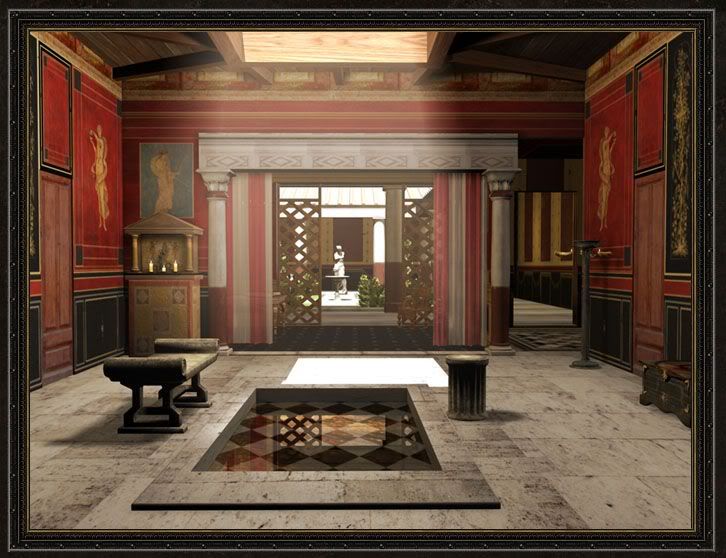
    Take this reconstructed Roman interior for example. It is spartan, almost utilitarian, yet sophisticated. The room is filled with natural light and looks out onto a garden. It is tastefully, conservatively decorated, and somewhat reminiscent of the Japanese.

    Here, we see again not Roman bombast but restraint and minimalism.

    Look at that beautiful green hue, and the way these fluted columns draw the eye up, and up, and up to contemplate the empty space. There is force, and silence, a quiet simplicity in all of these.

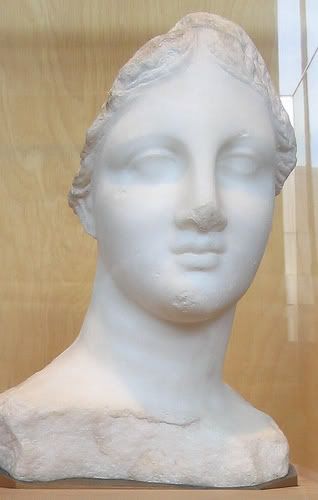
    You say that Roman aesthetics were too masculine, that they couldn't do fluidity or the feminine. But isn't this woman refined, gentile?

    Isn't this graceful? Look at the way her body sways and dances with the flower, the incline of her neck, and the flowing waves of her gown.

    Look at this enigmatic face gazing out of the mosaic. Soft, contained, expressive as if she had some secret all her own.

    Nothing harsh and masculine here.

    Augustus found Rome brick and left it marble. Alaric found it marble and left it gravel. So much is lost and missing, melted down for lime, or bronze for canons. This was burned. That decayed. Yet, of what remains there is still an abundance of great mosaics to judge them by.

    These aren't those brown drab little things you showed initially. These are strong competitors for anything in Byzantium.

    This mosaic of Alexander the Great could be something out of Da Vinci's sketches there is so much energy, motion, action, and detail.

    As a fan of patterns and color, doesn't this appeal to you? Doesn't it seem vaguely modern? It's all so complex and involved.

    But they could do simplicity as well.

    It's not all big, rigid, domineering, masculine art. From what I understand, as much of Roman painting survives as Greek, and for my money there's one area the Romans surpassed them.

    This mural could have been made in the Renaissance. It's beautiful, and look at those artificial windows!

    You say the Romans didn't do statues well. That they just copied the Greeks. That they didn't innovate. That was virtue number one of Roman aesthetics: the Mos Maiorum. The Romans revered their ancestors and tried to keep a continuity between modern and traditional practices. It was a religious thing with them the same as it was with the Egyptians and we don't come down on them for not changing what they did for centuries at a time. Innovation is not everything. As a lover of Bach you must understand that.

    Besides, I really like the Hellenistic look, and the Pergamene Baroque. This new more naturalistic style, that shows the warts, lines, and age of people is really appealing. For the first time we get man as he is and not his ideal. There is more going on with these aged, withered figures than just pure pathos. This may be a foreign concept to Americans who like the Greeks worship youth; but the Romans revered age, as the Japanese do even now. They'd put old men's heads on strong young bodies because of an innate sense of gravitas.

    Look at this boxer. I've seen pictures of Ali looking just this way after a fight. He looks tired, but strong. He's got something of the look which the Dying Gaul has, which made it so popular with the Romans.

    You called Roman statuary "rigid, stiff, harsh". Those words are a little judgemental. Can't this be solid, strong, contained, powerful, commanding, quiet. Does everyone have to be contorting themselves and leaping about to impress you? And why does everything have to be feminine and dainty? Why can't we have an art for the BAMFs of the world? Something that's loud, mean, dirty, kicks you in the face and won't be ignored. I'm talking Beethoven, not Mozart. I'm talking rock and roll.

    This isn't a traditional beauty. It's the beauty of the common man shown in all it's glory. This man's face has a force of personality in every line and a gaze that pins the viewer to his seat and stares right through him.

    And this! If men were green this could be a real person.

    I'm not saying you have to like it. But judge the age by it's best representatives and not by it's worst.
    "So-Crates: The only true wisdom consists in knowing that you know nothing." "That's us, dude!"- Bill and Ted
    "This ain't over."- Charles Bronson
    Feed the Hungry!

  12. #57
    Artist and Bibliophile stlukesguild's Avatar
    Join Date
    Jul 2006
    Location
    The USA... or thereabouts
    Posts
    6,083
    Blog Entries
    78
    Can you suggest me a decent translation (if there is such thing) of The Divine Comedy, if possible a good bilingual edition? Many thanks.

    It was in John Ciardi's translation that I was first introduced to dante, so I will always have a soft spot for that one. Some have argued that he is too fluid... but then no translator can capture all of Dante. Allen Mandelbaum is also to be recommended as is Mark Musa. I might also suggest Robert Pinskey's Inferno and W.S. Merwin's Purgatorio. The Mandelbaum is a duo-language text... at least in the edition I own. I also would not underestimate the classic Longfellow translation.
    Last edited by stlukesguild; 05-14-2009 at 08:13 PM.
    Beware of the man with just one book. -Ovid
    The man who doesn't read good books has no advantage over the man who can't read them.- Mark Twain
    My Blog: Of Delicious Recoil
    http://stlukesguild.tumblr.com/

  13. #58
    biting writer
    Join Date
    Sep 2007
    Location
    when it is not pc, philly
    Posts
    2,184
    I am not an expert on translating Italian, and certainly not the vernacular of Dante, but I would second luke on Mandelbaum for a student of world classics. In maturity I would then look at other editions, like the early Harvard translations. I am hoping to go *home* for a visit soon to Rome and Tuscany, and I am going about it by reading everything I can on modern Italy, which has probably altered my perspective a great deal from those of the norm.

  14. #59
    Artist and Bibliophile stlukesguild's Avatar
    Join Date
    Jul 2006
    Location
    The USA... or thereabouts
    Posts
    6,083
    Blog Entries
    78
    ...your initial offerings were a far cry from the glamour shots we're used to seeing from you when you discourse upon art history. Even I don't like those first examples you gave of Roman art. They are mostly second class works photographed in unflattering ways. Their lighting, framing, and angles could all be better. It's as if their insignificance were a forgone conclusion, and they were being put forth not as examples of beauty but as examples of how poor Roman art was in comparison to x. I know this is your thesis, and you are under no constraint to make my case for me, but shouldn't a period be judged by the very best it produced rather than the run of the mill.

    Of course. And I might note that the portraits from the period of the Republic and the famed Caesar Augustus of Prima Porta are certainly among some of the finest sculptural works of Rome. They also remain deeply indebted to Greek art while lacking the movement and fluidity of the Greek works:


    ...there is more to Roman aesthetics than what is commonly thought.

    Certainly.

    Take this reconstructed Roman interior for example. It is spartan, almost utilitarian, yet sophisticated. The room is filled with natural light and looks out onto a garden. It is tastefully, conservatively decorated, and somewhat reminiscent of the Japanese.

    I almost see it as more Chinese in its aesthetic... but either way it is indeed a splendid example of Roman painting and interior design. Is it from Pompeii?

    Here, we see again not Roman bombast but restraint and minimalism.

    Look at that beautiful green hue, and the way these fluted columns draw the eye up, and up, and up to contemplate the empty space. There is force, and silence, a quiet simplicity in all of these.


    And I have no argument with you with regard to Roman architecture. I'' state it again that architecture is probably their greatest contribution.

    You say that Roman aesthetics were too masculine, that they couldn't do fluidity or the feminine. But isn't this woman refined, gentile? Isn't this graceful? Look at the way her body sways and dances with the flower, the incline of her neck, and the flowing waves of her gown. Look at this enigmatic face gazing out of the mosaic. Soft, contained, expressive as if she had some secret all her own. Nothing harsh and masculine here.


    Yes... these are some lovely exceptions. Again, the stiffness or rigidity of which I speak owes much to the Roman habit of mechanically copying Greek originals. There is also the obsession for geometric form as opposed to the organic forms found in Greek, Minoan, Persian, Asian, and even Etruscan art of the time. This does not result in an inherent inferiority... but it can lend a certain rigidity to the work. Again there are lovely exceptions such as the marvelous impressionistic woman seen from behind.

    Augustus found Rome brick and left it marble. Alaric found it marble and left it gravel. So much is lost and missing, melted down for lime, or bronze for canons. This was burned. That decayed. Yet, of what remains there is still an abundance of great mosaics to judge them by.

    Unfortunately time has taken its toll on all of these cultures. It is more than likely that the vast majority of nudes... especially the (gasp!) female nudes... were destroyed by the early Christian church. Many of the works which did survive were either hidden, buried and lost for ages, or mistaken for something they weren't: a portrait of the Virgin Mary or St. Mark on Horseback:


    Who knows what has been lost of Rome... or Greece. And considering the Greek habit of brightly painting their bronze and marble sculpture, who knows what our response might have been to these works in their original state.

    Roman mosaics, I agree, are impressive... although I certainly lean more toward the Byzantine:


    Of course it must be admitted there is a huge difference in intent between the Byzantine focus upon the transcendent and spiritual and the Roman art of the concrete. The goal of the Byzantine was to virtually disintegrate the solid forms into a "thousand points of light" as it were. I should also admit that there is a certain prejudice against Roman art as the model for the expression of power in totalitarian states from Napoleon to Hitler to Stalin.

    This mosaic of Alexander the Great could be something out of Da Vinci's sketches there is so much energy, motion, action, and detail.

    Lovely piece... unfortunately it is a Roman copy of a Greek painting.

    You say the Romans didn't do statues well. That they just copied the Greeks. That they didn't innovate. That was virtue number one of Roman aesthetics: the Mos Maiorum. The Romans revered their ancestors and tried to keep a continuity between modern and traditional practices. It was a religious thing with them the same as it was with the Egyptians and we don't come down on them for not changing what they did for centuries at a time. Innovation is not everything. As a lover of Bach you must understand that.

    There is a fine line between revering the past and stagnation... as well as between innovation and mere novelty. American art, for example, never came into its own until it could assimilate the influences of Europe without slavish imitation... and until it evolved into something unique that was more than a mere whim of fashion. Egyptian art slipped into a long period of decline and imitations of Greco-Roman models. Most of the Roman art... especially the sculpture... of the Republic and the early Empire simply strikes me as immature and overly stiff... not unlike the art of the American republic prior to the mid-20th century. Again... as always... there are exceptions.

    Besides, I really like the Hellenistic look, and the Pergamene Baroque. This new more naturalistic style, that shows the warts, lines, and age of people is really appealing. For the first time we get man as he is and not his ideal. There is more going on with these aged, withered figures than just pure pathos. This may be a foreign concept to Americans who like the Greeks worship youth; but the Romans revered age, as the Japanese do even now. They'd put old men's heads on strong young bodies because of an innate sense of gravitas.

    And certainly I admire Greek Hellenistic art as well. The portrait of Mausolus (above) is magnificent... to say nothing of the Temple of Zeus from Pergamon. As I suggested in the previous post it is the latter "mannerist" sculpture of the Romans (such as the portrait of Comodus-previous post) where Roman sculpture first seems to come into its own... in spite of being clearly rooted in Greek models. All great art has its predecessors, but here the Romans seem to break free from them and develop something truly their own.

    You called Roman statuary "rigid, stiff, harsh". Those words are a little judgemental. Can't this be solid, strong, contained, powerful, commanding, quiet. Does everyone have to be contorting themselves and leaping about to impress you?

    In the visual arts... when one speaks of "movement"... it need not be merely obvious movement of leaping about. Movement also refers to the manner in which there is a gestural flow within the image... even if the figure is stationary. In the Augustus of Prima Porta, for example, the flow is impeded by the crudely overwrought drapery and ornately detailed breast-plate. Neither is there as smooth of a flow in the pose of the body (in spite of the contraposto) as there is in Praxiteles' Hermes or the Comodus.

    And why does everything have to be feminine and dainty? Why can't we have an art for the BAMFs of the world? Something that's loud, mean, dirty, kicks you in the face and won't be ignored. I'm talking Beethoven, not Mozart. I'm talking rock and roll.

    Because something lacks a rigidity or excessive masculinity (although I hate using that term) need not mean that it is inherently dainty, simpering, and limp-wristed:


    There is certainly a sensuality and a fluidity without surrendering a muscularity and definite strength. There have been endless eras of the most refined visual aesthetics (the Italian Renaissance, the Elizabethans, the Edo period Japanese) and yet this in no way curtailed their blood lust. They were just as quick to shove in the knife as any Roman.
    Last edited by stlukesguild; 05-14-2009 at 10:10 PM.
    Beware of the man with just one book. -Ovid
    The man who doesn't read good books has no advantage over the man who can't read them.- Mark Twain
    My Blog: Of Delicious Recoil
    http://stlukesguild.tumblr.com/

  15. #60
    Alea iacta est. mortalterror's Avatar
    Join Date
    Mar 2008
    Location
    LA
    Posts
    1,914
    Blog Entries
    39
    Quote Originally Posted by stlukesguild View Post
    I almost see it as more Chinese in its aesthetic... but either way it is indeed a splendid example of Roman painting and interior design. Is it from Pompeii?
    I believe so. I tried to check, but I'm having trouble finding the place I got the photo.

    Quote Originally Posted by stlukesguild View Post
    Roman mosaics, I agree, are impressive... although I certainly lean more toward the Byzantine:
    Those are very nice.

    Quote Originally Posted by stlukesguild View Post
    I should also admit that there is a certain prejudice against Roman art as the model for the expression of power in totalitarian states from Napoleon to Hitler to Stalin.
    I think the main prejudice against Roman art is that it is so like Greek art but not quite. It always invites an unfavorable comparison, whereas if it were compared to other locales and time periods I think it would come off better. If we forget for a moment that there ever was a Greek civilization and just judge each piece without context, names, dates, or history, I think the appraisals would be kinder.

    I love the Greeks. I just don't think that should interfere with my appreciation of the Romans. Do we need to compare every Elizabethan play to Shakespeare? What good does that serve? And after a certain period, say 146 BCE, Greece is a province of Rome. Yet, we don't consider Laocoon to be a Roman work. It was commissioned by a Roman from Greek artists who had been in the Empire for more than a century; but we still call them Greeks. I mean, most of Greek art and philosophy wasn't Greek either. It was Turkish, and Thracian, and Macedonian. But the Greeks get credit for everything.

    Even with writers clearly working within the geographic boundaries and time frame of Rome we sometimes give credit to the Greeks. Guys like Plutarch for instance. It's one of those gray areas like who can properly claim T.S. Eliot.


    Quote Originally Posted by stlukesguild View Post
    This mosaic of Alexander the Great could be something out of Da Vinci's sketches there is so much energy, motion, action, and detail.

    Lovely piece... unfortunately it is a Roman copy of a Greek painting.
    Dang. Well, I never claimed to be an art historian.

    By the way, I liked your latest batch of pictures.
    "So-Crates: The only true wisdom consists in knowing that you know nothing." "That's us, dude!"- Bill and Ted
    "This ain't over."- Charles Bronson
    Feed the Hungry!

Page 4 of 8 FirstFirst 12345678 LastLast

Similar Threads

  1. Favorite Poet
    By Admin in forum Poems, Poets, and Poetry
    Replies: 104
    Last Post: 10-04-2009, 03:51 PM
  2. Petrarch's Love is having a birthday!
    By andave_ya in forum General Chat
    Replies: 33
    Last Post: 02-15-2009, 02:57 PM
  3. Happy Belated Birthday, Mortis Anarchy!
    By Scheherazade in forum General Chat
    Replies: 12
    Last Post: 01-02-2009, 03:31 AM
  4. Favorite Poet
    By sherlock in forum Poems, Poets, and Poetry
    Replies: 2
    Last Post: 01-08-2008, 12:14 AM
  5. My Favorite Chinese Poet
    By joynone in forum Poems, Poets, and Poetry
    Replies: 7
    Last Post: 12-19-2006, 10:57 PM

Posting Permissions

  • You may not post new threads
  • You may not post replies
  • You may not post attachments
  • You may not edit your posts
  •