Page 7 of 10 FirstFirst ... 2345678910 LastLast
Results 91 to 105 of 148

Thread: Greatest Culture...

  1. #91
    Bibliophile JBI's Avatar
    Join Date
    Feb 2007
    Location
    Toronto
    Posts
    6,360
    Quote Originally Posted by mortalterror View Post
    Fascinating, JBI. I hadn't made the comparison of the Han Dynasty to the Roman Empire before, but it's staring me in the face now. However, I did a quick internet search and unearthed this article http://www.chinahistoryforum.com/ind...ope-and-china/ comparing their respective economies. At least in that article and in the studies he cites The Roman Empire was slightly more prosperous and there is reason to believe that medieval Europe when considered as a whole would be the near equal of China economically if not technologically. Also, I know that the Chinese invented many things before the West, but I've heard that they were very secretive and often would not share their advances; leading Western countries to re-invent them independently much later. Is there actual evidence that Gutenberg and other inventors had knowledge of the Chinese machines before they reproduced them here? For instance, I think Egypt invented paper on it's own, and that's where the Greeks and other Europeans got it from.
    The secretive and restrictive policy is generally an outcropping of post-Mongolian Chinese policy. The Tang and much of the Song benefited greatly from foreign export and trade. The general problem is Europe got most of these things through their enemies, namely Turkey, who had imported them on other roots.

    There is significant debate mind you, but most generally see the link, as Marco Polo seemed to make it clear, with Chinese technology and importing goods. Granted Europe did generate their own, later equivalents, but still many were imported. As for China history Forum, I have posted there, but their stuff is mostly done by amateurs and undergraduates, as can be seen by the poster bellow literally butchering the work to shreds. For a general political comparison try Conceiving the Empire - China and Rome Compared which though not economic in focus, centers around more the political history.

  2. #92
    Bibliophile JBI's Avatar
    Join Date
    Feb 2007
    Location
    Toronto
    Posts
    6,360
    Quote Originally Posted by The Atheist View Post
    No, I don't forget that at all; Europe has never had the majority of population, as anyone who can count will tell you.

    Nice of you to completely avoid presenting evidence for your claims, however. Is that an admission that your "facts" were in fact "fantasy"?

    Even when you try to present examples of Chinese influence, you come up with a couple of false positives:

    Printing and the idea for paper both came to China from Africa. Printing had been old for centuries before China got in on the act. Certainly the Chinese refined manufacture of paper from papyrus to fibres, but I would have expected you to know that the root word for "paper" is "papyrus" and that China - as they still do - picked up someone else's discovery and went with it.

    You're also assuming I don't have a good grasp of world history and you would be utterly incorrect. I understand exactly where Chinese influence was and has been, and it has never dominated the world.

    At times the Chinese did indeed have as wide an influence as the Roman Empire, but you totally ignore the irrefutable evidence that the Chinese influence did not create a lasting legacy of culture in any way, whereas it is equally obvious that the Roman did.

    Except for gunpowder.

    Thanks, China.

    Instead of worrying about what you think I do and don't know, why don't you attempt to make an actual case for your revisionist historical beliefs? I'm pretty sure I could make a more coherent case for Egypt than China.
    What utter nonsense again. Papyrus and Paper are not the same thing, though they are similar in function, hence their shared etymology. As for non-lasting influence, are you kidding? How do you measure something like that, and how are you so dismissive?

    You are so full of nonsense its insufferable. The greater the population in the cultural sphere, clearly the greater the influence. Why bother with a few small barbarian countries on the fringes of civilization when the majority of the world is in your cultural sphere. That is the general argument which shows Europe as the borderlands of civilization long into the renaissance. Cut the crap, you bigot.

  3. #93
    Ecurb Ecurb's Avatar
    Join Date
    Jan 2007
    Location
    Eugene, OR
    Posts
    2,444
    Quote Originally Posted by stlukesguild View Post
    ...in order for film to be a “true” art, there needs to be ONE artist to admire.

    That is surely one of the dumbest things I've read here in some time. You are living in a 19th century Romantic fantasy of the sole artist/visionary/prophet.
    ".
    Are you able to read? If you were, you would recognize that my post clearly DISAGREED with the notion that there needs to be one artist to admire. In fact, that was the entire point of my post. Your "cut and dispute" method of posting (a silly method) simply allowed you to remove one of my statements from its context, then rudely insult it as if it were something I was actually arguing FOR instead of AGAINST. That's not only illiterate, but ill mannered.

    In addition, it is you, not I who "needs to educate yourself about just how a film is created." It is created by a collection of artists: actors, cinematographers, directors, sreenplay writers, etc. The director does NOT necessarily have the "ultimate say over the music, cinematography, etc." Although many modern directors have more say than they did in the past, in the case of many great Hollywood films the producer (not the director) had the ultimate say over casting, music, and even editing.

    Perhaps you should return to bragging about your extensive library, and resist making idiotic comments like these, which serve only to make you look foolish.

  4. #94
    Registered User
    Join Date
    Sep 2011
    Posts
    3,890
    Quote Originally Posted by stlukesguild View Post
    But even the best films are inferior art. You might say that America is unequivocally top for popular entertainment, but for "Culture" with a capital C you have to produce better arguments if you want to pitch for yankees.

    I'm sorry. I'm as big of a cultural elitist as anyone on this site... but that's just pure ignorance? Please explain to us just what imaginary separation there is between what you deem as "Popular Culture" ("Entertainment", "Low Art", etc...) vs "High Art"/"Culture"? Silly me... but I thought the novel began as a literary form deemed as "Low" popular entertainment. The same was true of opera. How are the grandiose theatrical paintings of Peter Paul Rubens inherently superior to the greatest Hollywood films?

    The whole division between "High" and "Low" was promoted by the upper classes as a means of maintaining an illusion of cultural superiority after popular culture became increasingly dominant. We have little record of the popular music of the past centuries due to the simple facts that the masses generally didn't have the time or financial ability to create or support music. Whatever popular music there was rarely survived due to the fact that the amateur popular (folk) musicians lacked the ability to read or write (and thus preserve) music. With the innovation of recording technology the best popular music... be it Duke Ellington, Miles Davis, the Rolling Stones etc... is not only able to survive... but also is able to reach a far larger audience than ever before possible. Ravel, George Gershwin, Milhaud, Shostakovitch, Osvaldo Golijov, Philip Glass... nearly any Modern "classical" composer you dare name has been profoundly impacted by popular music... and written music that blurs any distinction between "classical" and "popular" music. There is no reason to assume that "Summertime", "Stormy Weather" or "Norwegian Wood" will not continue to be recognized (as they now are) as "standards" or "classics". Neither is there any reason to assume that "Vertigo" is not every bit as great as "The Liver is the ****'s Comb".

    But certainly... we are all open to a logical reason why Die Zauberflote, Hansel und Gretel, Offenbach, Andy Warhol, and Johann Strauss Jr. are all "High Art/Culture" while Miles Davis, Casablanca, F.W. Murnau, and R. Crumb are all "Low Art/Entertainment".
    This is a very good post.

  5. #95
    Artist and Bibliophile stlukesguild's Avatar
    Join Date
    Jul 2006
    Location
    The USA... or thereabouts
    Posts
    6,083
    Blog Entries
    78
    Quote Originally Posted by Ecurb View Post
    Are you able to read? If you were, you would recognize that my post clearly DISAGREED with the notion that there needs to be one artist to admire. In fact, that was the entire point of my post. Your "cut and dispute" method of posting (a silly method) simply allowed you to remove one of my statements from its context, then rudely insult it as if it were something I was actually arguing FOR instead of AGAINST. That's not only illiterate, but ill mannered.

    In addition, it is you, not I who "needs to educate yourself about just how a film is created." It is created by a collection of artists: actors, cinematographers, directors, sreenplay writers, etc. The director does NOT necessarily have the "ultimate say over the music, cinematography, etc." Although many modern directors have more say than they did in the past, in the case of many great Hollywood films the producer (not the director) had the ultimate say over casting, music, and even editing.

    Perhaps you should return to bragging about your extensive library, and resist making idiotic comments like these, which serve only to make you look foolish.
    Hmmm... indeed I did misread the post. My mistake.

    On the other hand... "illiterate"... "foolish"... criticism of my manner of posting. I could respond in like with a slew of personal insults but ultimately you are not worth the effort.
    Beware of the man with just one book. -Ovid
    The man who doesn't read good books has no advantage over the man who can't read them.- Mark Twain
    My Blog: Of Delicious Recoil
    http://stlukesguild.tumblr.com/

  6. #96
    Clinging to Douvres rocks Gilliatt Gurgle's Avatar
    Join Date
    Jun 2009
    Location
    Texas
    Posts
    2,716
    Quote Originally Posted by stlukesguild View Post
    ....St. Peter's is generally acknowledged as one of the greatest works of Art of the Renaissance. Obviously it wasn't constructed by one man... but neither was it designed by one artist. Among the major names that were employed in the design of St. Peters are Bramante, Michelangelo, Raphael, and Bellini....
    Minor correction or, let's at least consider an addition; don't forget Gian Lorenzo Bernini, who was responsible for many of the great sculptures within the Basilica proper including the Baldacchino, but even more so for designing the most prominent feature in your photo, that being the Piazza of St. Peters including the monumental colonnades surrounding the Piazza.

    As for my thoughts on cultural influences, I'm partial to Country Docs comments on Texas, but outside of that, Atheist beat me to the punch on China and gunpowder. Gunpowder has been quite an influence around the world in the past few hundred years.
    Of all time? ... I'll throw in Greek/ Roman for the west and China for the east.

    Something that came to mind, how about the Arab-Islamic influence at least in terms of math, science and medicine?
    "Mongo only pawn in game of life" - Mongo

    http://www.youtube.com/watch?v=SKRma7PDW10

  7. #97
    Artist and Bibliophile stlukesguild's Avatar
    Join Date
    Jul 2006
    Location
    The USA... or thereabouts
    Posts
    6,083
    Blog Entries
    78
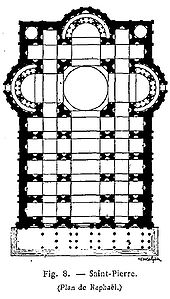
    Yes Bernini not Bellini. Bellini probably just popped into my mind in connection with the painting Fete Champetre which I had just posted. I actually love Bernini's work... and one must credit him for attempting to counter the stupid additions made by Raphael and Maderno to the building. Bramante's original plan was a central plan... based upon the Greek Cross:


    Raphael pushed to extend the central nave to echo the classical Roman basilicas thus changing the floor-plan to a Roman cross:


    In spite of whatever disagreements Michelangelo had over the years with Bramante, he sought to return to something closer to Bramante's original concept. He cut back on the length of the extension to the original cruciform plan:


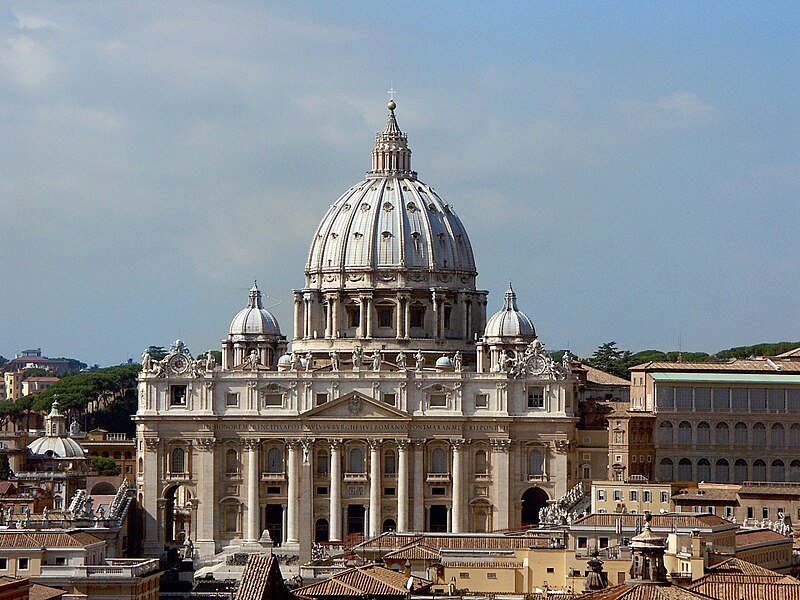
    The shortened nave also allowed for the entire dome... designed by Michelangelo... to be seen properly from ground level. Today this can only be seen from above... as in this view from the Castel Sant Angelo


    (or from the rear). The later addition by the architect, Maderno completely ruined the view of Michelangelo's dome.

    Beware of the man with just one book. -Ovid
    The man who doesn't read good books has no advantage over the man who can't read them.- Mark Twain
    My Blog: Of Delicious Recoil
    http://stlukesguild.tumblr.com/

  8. #98
    Registered User Darcy88's Avatar
    Join Date
    Oct 2009
    Location
    British Columbia, Canada
    Posts
    1,963
    Blog Entries
    3
    Quote Originally Posted by stlukesguild View Post
    If we are talking 20th century popular music, I think the British are the equals of the Americans: The Beatles, The Rolling Stones, Led Zeppelin, The Who, The Clash, The Sex Pistols, David Bowie, Radiohead, The Smiths, Pink Floyd, Joy Division, The Stone Roses...that is a pretty impressive list (actually, to be specific, they are all English).

    The problem here is that you are focusing upon a single branch of "popular music"... ie. rock/pop from the Beatles forward. Undoubtedly there are some impressive names here... but the United States wholly owns Jazz which a good many would argue is a far greater musical genre: W.C. Handy, Louis Armstrong, Fats Waller, Bix Beiderbeck, Duke Ellington, Benny Goodman, Glenn Miller, Charlie Parker, Ella Fitzgerald, Thelonius Monk, Miles Davis, John Coletrane, Dave Brubeck, Bill Evans, Gil Evans, Dizzie Gillespie, Count Basie, and the list goes on and on. You could then add the jazz/blues vocalists to this list: Billie Holiday, Ella Fitzgerald, Frank Sinatra, Sarah Vaughan, Tony Bennett, Nat King Cole, Julie London, etc... Then what about the Blues? Muddy Waters, B.B. King, John Lee Hooker, Big Joe Turner, Blind Lemon Jefferson, Robert Johnson, Bessie Smith, Willie Dixon, Howlin' Wolf, Slim Harpo, etc... on through Stevie ray Vaughan, etc... And what of R & B? I'm speaking of the original Rhythm & Blues in which acted as the transitional movement from jazz to rock & roll in which the rhythm section of the old jazz big bands broke away after the big bands were no longer financially viable: Cab Calloway, T-Bone Walker, Big Joe Turner, Fats Domino, Ray Charles, Bo Diddley, etc... Bluegrass/Country/Western? The Carter Family, The Stanley Brothers, The Louvin Brothers, Hank Williams, Bill Monroe, Flatt and Scruggs, Johnny Cash, Willie Nelson, Patsy Cline, etc...

    And then... American rock isn't all that bad either: Elvis, Chuck Berry, Little Richard, Jerry Lee Lewis, Carl Perkins, Buddy Holly, Big Mamma Thornton, The Beach Boys, The Byrds, Bob Dylan, CCR, the Grateful Dead, Jefferson Airplane, the Allman Brothers, Lynyrd Skynyrd, Jimi Hendrix...

    And are we ignoring the contributions of black musicians after the 1950s? Sam Cooke, Otis Redding, Wilson Pickett, Aretha Franklin, Smokey Robinson, Marvin Gaye, Stevie Wonder and the whole of Motown, Michael Jackson, Al Green, the Temptations, etc...

    I agree. I hear this Britain > America in 20th century music thing so often but if you really examine the totality of American music it is pretty clear that the quality of output exceeds that of Britain.
    “To practice any art, no matter how well or badly, is a way to make your soul grow. So do it.”

    - Kurt Vonnegut

  9. #99
    Orwellian The Atheist's Avatar
    Join Date
    Mar 2007
    Location
    The George Orwell sub-forum
    Posts
    4,638
    Quote Originally Posted by Mr.lucifer View Post
    Im sorry but that is an over-simplification of what films can do.
    Sure it is. I agree with you entirely.

    I wasn't damning them with faint praise so much as being lazy.
    Go to work, get married, have some kids, pay your taxes, pay your bills, watch your tv, follow fashion, act normal, obey the law and repeat after me: "I am free."

    Anon

  10. #100
    King of Dreams MorpheusSandman's Avatar
    Join Date
    Feb 2008
    Location
    The Heart of the Dreaming
    Posts
    3,097
    Lots of good discussion here, so many good (and several bad) posts to respond to:

    Quote Originally Posted by mortalterror View Post
    For film, it shouldn't even be a contest… Germany gave us Expressionism and Fritz Lang.
    No Murnau, Lubitsch, or the German New Wave (Fassbinder, Herzog, Wenders)?

    Quote Originally Posted by mortalterror View Post
    Britain gave us Hitchcock and David Lean.
    Please don’t forget Powell/Pressburger, Roeg, Reed, and Davies!

    Quote Originally Posted by mortalterror View Post
    I don't know anyone who thinks that Vertigo is the greatest film ever. It's not even the greatest British film ever. That is probably David Lean's adaptation of Dr. Zhivago, and that is as great a piece of art as any opera, which is what it should be compared to.
    I think one thing to consider about those film lists is that a film can reach #1 simply by being high on a great many lists as opposed to being #1 on those lists. So maybe, eg, 2001: ASO appears as #1 on more people’s lists, but is equally absent from many other lists because it’s a film that’s always divided critics, so it ends up being ranked lower than Vertigo by virtue of it being more controversial.

    I wouldn’t name Vertigo the greatest film either; personally, I think Seven Samurai and 2001:ASO are definitively better, and I honestly prefer Hitch’s Rear Window to Vertigo. However, I simply can’t agree that Dr. Zhivago is any way better; I always found that to be the most turgid and cinematically dull of Lean’s epics (but that’s individual tastes for you). However, I wouldn’t consider Vertigo a “British” film anyway given that it was made/produced in Hollywood (that’s one dilemma with regards to determining what country films come from; most tend to go by a combination of where they’re produced and shot). Personally, I’d put several of Powell/Pressburger’s (Life and Death of Colonel Blimp, A Matter of Life and Death, I Know Where I’m Going!, A Canterbury Tale), a few of Davies (Distant Voices, Still Lives and The Long Day Closes) and Roeg’s (Don’t Look Now) ahead of Zhivago.

    Quote Originally Posted by mortalterror View Post
    Opera and cinema are both combinations of writing, acting, music, and visuals. I'd say that Pulp Fiction, Gone With the Wind, Schindler's List, 2001 A Space Odyssey, Goodfellas, 8 1/2, Wild Strawberries, Seven Samurai, Andrei Rublev, Citizen Kane, and Casablanca count as great examples of art. Cinema is only a century old so it may not have had enough time to produce it's Shakespeare, Mozart, or Michelangelo, but it's done pretty well for all that. Kubrick, Fellini, Bergman, or Kurosawa are probably worth as much to the history of this young art as Monteverdi was to a nascent opera.
    The core art of cinema is mise-en-scene (what’s in front of the camera & how it moves) and editing; both of which make it a unique art-form separate from all others. Opera doesn’t have the “camera as narrator” aspect, and that’s a crucial difference. Cinema is young, true, but it’s evolved faster than most arts because, for one, it had a whole lot of past culture to draw from, two, the technology itself grew so rapidly, and, three, it came to prominence in the century of globalization. As for the latter, filmmakers soon had access not just to films and filmmakers from their own country, but those of every other country. So I don’t think it’s fair to compare its growth with that of, say, opera or the novel; but I agree with you about the worthiness of its best works and artists.


    Quote Originally Posted by JBI View Post
    The thing I don't get it this - some people think there is no such thing as an aesthetic criteria, the problem is they don't understand their own theory. Post-modernism says the canon is assembled from a ruling class's Aesthetic criteria - usually attributed to white, male, Christians and usually they throw dead in there too. My point is, what better criteria has one actually proposed to replace this. If we agree that criterias are biased, as they assuredly are, the question remains, is this actually a bad thing?
    I don’t think most that criticize the “dead, white, hetero, male, Christian” canon are arguing for it being completely replaced so much as they’re arguing for attention being paid to other sets of aesthetic criteria. The problem is that they tend to lack anything approaching a majority voice. Even most of the, eg, feminist critics I know of read, enjoy, and praise much of the classic canon, while, at the same time, trying to bring more attention to authors that appeal uniquely to their sensibilities.


    Quote Originally Posted by WICKES View Post
    It's odd that the British, who never produced any great classical composers
    This is the point where Henry Purcell and RV Williams bops you upside the head from their respective graves.


    Quote Originally Posted by mal4mac View Post
    But even the best films are inferior art.
    Complete and utter nonsense, as others have said. The only people that make this argument tend to be ignorant of what makes film a unique art form to begin with; they tend to judge it on the same standards as literature (plays, novels, etc.), which is obviously not a battle film can win. The battle it can win, though, is showing how all of film’s components (mise-en-scene, editing, sound, music, acting) can come together to create something that is as profound—emotionally, aesthetically, thematically, etc.—as the best of the other arts.

    Quote Originally Posted by mal4mac View Post
    It's interesting that top film critics, with rounded cultural pretensions, often make this argument. Bryan Appleyard is famous for it in the UK, another critic who often points this out is Ronald Bergen:
    The problem is that he presents no legitimate argument; WHY wouldn’t Vertigo “stand a chance” against Don G., The Divine Comedy, Ulysses, Hamlet, or Beethoven’s 9th? Being a lover of all those works, I don’t see Vertigo as being inferior at all. It’s certainly capable of provoking as many interpretations as Don G. and Hamlet, as capable of being appreciated technically as Ulysses, as capable at eliciting our awe as the 9th (though I honestly don’t know how to compare it with the Comedy)…. so where, exactly, is it lacking?


    Quote Originally Posted by The Atheist View Post
    Movies are just stage plays done for mass audiences, and the best of them can actually offer more than the story that spawned them.
    Actually, it’s the thinking that “movies are just plays for mass audiences” that prevented them (and still prevents them to some extent) from being taken seriously as an art-form. The best films tend to break away strongly from the theatrical traditions, leaning more heavily on what is communicable via the camera and editing, as opposed to relying on language and acting as theater does. One reason Hitch is so revered is because he showed how crucial framing and editing was; Rear Window is a master class on how to construct a film via point-of-view editing; there are long stretches where it’s nothing but Stewart’s character looking and Hitch cutting to what he’s looking at. Hitch builds up an entire film out of this voyeuristic notion, not unlike how Beethoven created an entire symphony on almost nothing but a 4-note motif, and it’s extraordinary what complexity (aesthetic, emotional, thematic) is built up from something so simple. Vertigo does this a lot too, though it plays with larger structural devices more akin to, say, Beethoven’s 9th as opposed to his 5th.


    Quote Originally Posted by Mr.lucifer View Post
    art films are for a refined audience like serious literature.
    Not just art films, though. Hitchcock is more refined than most art-film directors, much like how Shakespeare was popular enough for mass audiences but refined enough for refined ones as well.

    Quote Originally Posted by Mr.lucifer View Post
    Ozu is certainly the greatest Japanese artist of the 20th century, and Tarkovsky is definitely the best narrative artist of Russia since Tolstoy died.
    I go back and forth between Ozu, Mizoguchi, and Kurosawa. I find it hard to state a definitive “winner” because the three of them were so different, but equally accomplished in their own respects. If we’re talking artistry, though, I think Mizoguchi is probably more complex/refined than either Ozu or Kurosawa. I’d also place Eisenstein (and maybe Kalatazov) ahead of Tarkovsy… I’ve never really gotten what the big deal over Tarkovsky was. I tend to prefer the directors he inspired far more than Tarkovsky himself.


    Quote Originally Posted by Ecurb View Post
    The problem with film (at least it’s a problem to some people) is that it is such a corporate art form.
    Depends on the film. This describes Hollywood, but less so small-budget art-house and independent films. A lot of filmmakers prefer small budgets because they’re allowed more freedom, as there’s less pressure to make the money back. Even in Hollywood there have been many filmmakers (like Kubrick and Hitchcock) that had complete autonomy because of their success.

    Quote Originally Posted by Ecurb View Post
    First of all, the “auteur theory” of film, in which the director is the key “artist” is clearly silly. Why is the director so much more important than the screenplay writer, or the producer, or the cinematographer? For drama, it’s the other way around. Shakespeare is the great artist, not some famous director.
    If you had actually read the texts that initially advocated the auteur theory (Truffaut and Sarris, especially) you’d already have an answer to your question. Firstly, the auteur theory was never meant as a blanket theory to describe every film and filmmaker, it was designed to single out those directors whom had a singular, identifiable style (visually, thematically, etc.) throughout their work, regardless of their collaborators. There’s no other explanation as to why there are so many consistencies throughout the cinema of Hitchcock, Kubrick, Ford, Welles, et al. without the auteur theory.

    The simple answer to your “why is the director more important than…” is that they aren’t always. This is heavily dependent on the era, country, and director we’re discussing. Hollywood’s golden age, eg, was quite homogeneous; it was a factory in which every member of the production (writers, directors, DPs, etc.) were interchangeable. It’s why a film like The Wizard of Oz could have a change of directors mid-way through, but no noticeable change in style. In that time of filmmaking, producers arguably WERE more important as they were the ones that had to oversee productions. I’d argue that, eg, Daryl Zanuck, David O. Selznick, and Irving Thalberg were as much “auteurs” as any director ever was.

    However, the focus on directors comes mostly from the fact that, during production, the director is the person telling everyone else what to do. So while you may praise a cinematographer for a certain shot, you may praise the director choosing to put the camera there; while you may praise an actor for a performance, you may praise the director for allowing/provoking them to give that performance. There are also more examples of directors having ultimate control more than any other member of the production does. Hitchcock, Kubrick, Wilder, Ford, Hawks, et al. often had a guiding hand in every single phase of the production including the writing. It’s well known that Hitch co-wrote most all of his best films, even though he never took a credit.

    Writers generally aren’t as praised because writing alone usually can’t make a film great (there are a few exceptions), because how a filmmaker presents what is written had a tremendous effect on how well it works. Hitch even told Truffaut that the reason he chose such terrible source material for Psycho was to show how a master could take atrocious writing and turn it into a cinematic masterpiece solely through the directorial art, and this “bad/mediocre writing -> masterful directing -> masterpiece film” is far more common than “great writing -> bad/mediocre directing -> masterpiece film”.


    Quote Originally Posted by stlukesguild View Post
    I'm sorry. I'm as big of a cultural elitist as anyone on this site... but that's just pure ignorance? Please explain to us just what imaginary separation there is between what you deem as "Popular Culture" ("Entertainment", "Low Art", etc...) vs "High Art"/"Culture"? Silly me... but I thought the novel began as a literary form deemed as "Low" popular entertainment. The same was true of opera. How are the grandiose theatrical paintings of Peter Paul Rubens inherently superior to the greatest Hollywood films?

    The whole division between "High" and "Low" was promoted by the upper classes as a means of maintaining an illusion of cultural superiority after popular culture became increasingly dominant. We have little record of the popular music of the past centuries due to the simple facts that the masses generally didn't have the time or financial ability to create or support music. Whatever popular music there was rarely survived due to the fact that the amateur popular (folk) musicians lacked the ability to read or write (and thus preserve) music. With the innovation of recording technology the best popular music... be it Duke Ellington, Miles Davis, the Rolling Stones etc... is not only able to survive... but also is able to reach a far larger audience than ever before possible. Ravel, George Gershwin, Milhaud, Shostakovitch, Osvaldo Golijov, Philip Glass... nearly any Modern "classical" composer you dare name has been profoundly impacted by popular music... and written music that blurs any distinction between "classical" and "popular" music. There is no reason to assume that "Summertime", "Stormy Weather" or "Norwegian Wood" will not continue to be recognized (as they now are) as "standards" or "classics". Neither is there any reason to assume that "Vertigo" is not every bit as great as "The Liver is the ****'s Comb".

    But certainly... we are all open to a logical reason why Die Zauberflote, Hansel und Gretel, Offenbach, Andy Warhol, and Johann Strauss Jr. are all "High Art/Culture" while Miles Davis, Casablanca, F.W. Murnau, and R. Crumb are all "Low Art/Entertainment".
    Excellent post, Luke!


    Quote Originally Posted by JCamilo View Post
    The thing is movie technology changes way too fast, so it is an artform much more dynamic for a proper judgment of vallue. Of course, we all feel many directors are notable, but lets see how many are timeless.
    I’ve never been of the mind that the evolving technology of film has had any effect on the artistic quality of film, though I do understand what you mean about our aesthetic criteria changing because of it… on the other hand, I greatly admire (and enjoy) Guy Maddin’s modern silent films. What you say about directors requiring the test of time is true, though, but I can only see the likes of Hitch, Welles, Kubrick, and a handful of others being praised more and more as time goes on. At least, I see no signs of the trend reversing itself.
    "As far as we can discern, the sole purpose of human existence is to kindle a light of meaning in the darkness of mere being." --Carl Gustav Jung

    "To absent friends, lost loves, old gods, and the season of mists; and may each and every one of us always give the devil his due." --Neil Gaiman; The Sandman Vol. 4: Season of Mists

    "I'm on my way, from misery to happiness today. Uh-huh, uh-huh, uh-huh, uh-huh" --The Proclaimers

  11. #101
    Alea iacta est. mortalterror's Avatar
    Join Date
    Mar 2008
    Location
    LA
    Posts
    1,914
    Blog Entries
    39
    Quote Originally Posted by stlukesguild View Post
    The whole division between "High" and "Low" was promoted by the upper classes as a means of maintaining an illusion of cultural superiority after popular culture became increasingly dominant. We have little record of the popular music of the past centuries due to the simple facts that the masses generally didn't have the time or financial ability to create or support music. Whatever popular music there was rarely survived due to the fact that the amateur popular (folk) musicians lacked the ability to read or write (and thus preserve) music. With the innovation of recording technology the best popular music... be it Duke Ellington, Miles Davis, the Rolling Stones etc... is not only able to survive... but also is able to reach a far larger audience than ever before possible. Ravel, George Gershwin, Milhaud, Shostakovitch, Osvaldo Golijov, Philip Glass... nearly any Modern "classical" composer you dare name has been profoundly impacted by popular music... and written music that blurs any distinction between "classical" and "popular" music. There is no reason to assume that "Summertime", "Stormy Weather" or "Norwegian Wood" will not continue to be recognized (as they now are) as "standards" or "classics". Neither is there any reason to assume that "Vertigo" is not every bit as great as "The Liver is the ****'s Comb".
    Actually, the popular music composers were frequently able to leave records and sheet music for their songs since at least the Renaissance. I've been enjoying a lot of old ballads, hymns, seasonal songs, and sea shanties from centuries ago. Guys like Francis James Child and other scholars have been kind enough to compile the songs into comprehensive scholarly collections the way the 19th century folklorists the Brothers Grimm collected the people's stories. Just as the Grimm Brothers were able to unearth Snow White or Sleeping Beauty, the old songbooks are like a mine full of priceless gems. Here are a few selections:

    Tam Lin is a Scottish ballad by Robert Wedderburn written in 1548. It's about a young woman who falls in love with an enchanted knight, who is enslaved by the queen of the fairies.
    http://www.youtube.com/watch?v=jy3ihk205ew

    Then there's The Three Ravens, from 1611 by Thomas Ravencroft, sung by Andreas Scholl a favorite classical singer of yours. He actually released a whole CD of old English Ballads. The song is about three ravens conversing over the body of a fallen knight, and how his hounds, hawks, and a pregnant doe symbolizing his subjects and lover keep the birds of prey away and honor him in death.
    http://www.youtube.com/watch?v=R1JScWuKnI0

    The Sailor's Hornpipe was an anonymous tune composed by British sailors and first written down in 1770.
    http://www.youtube.com/watch?v=D_JeKZd9ecE

    Anyone who's grown up in a Protestant church will be familiar with the 1779 hymn Amazing Grace by John Newton.
    http://www.youtube.com/watch?v=GYMLMj-SibU

    Three fun sea shanties, Spanish Ladies, Drunken Sailor, and Dead Man's Chest.
    http://www.youtube.com/watch?v=PZfYtCLA23s
    http://www.youtube.com/watch?v=qGyPuey-1Jw
    http://www.youtube.com/watch?v=nzcv5TJkJBA

    A patriotic Scottish song The Bonnie Banks o' Loch Lomond, and a whiskey drinking hard fighting Irish song Whiskey in the Jar (1870 Colm O Lochlainn).
    http://www.youtube.com/watch?v=1uZ-p-tN8Gs
    http://www.youtube.com/watch?v=boanuwUMNNQ

    Two great 1862 war tunes from different sides of the world. 1862 George F. Root- Battle Cry of Freedom, a hit for the Union and then slightly altered for the Confederacy as well. John Owen- Men of Harlech, a welsh regimental song about a famous siege.
    http://www.youtube.com/watch?v=5kWADI4umuM
    http://www.youtube.com/watch?v=I2Gxd9zhsag

    And even Neapolitan classics popular with Italian opera singers today. Luigi Denza- Funiculi, Funicula:
    http://www.youtube.com/watch?v=XaO1GrltxwM

    So you see, we have good records of popular music even predating recording technology, and some of those tunes are still popular today. Just think of the works of Stephen Foster or Gilbert and Sullivan.

    1549 Robert Wedderburn- Tam Lin (ballad)
    1580 Richard Jones- Greensleeves (ballad)
    1599 John Farmer- Fair Phyllis (madrigal)
    1602 William Shakespeare- Feste's Song (show tune)
    1611 Thomas Ravencroft- The Three Ravens (ballad)
    1719 Isaac Watts- Joy to the World (hymn)
    1740 James Thomson- Rule, Britannia! (anthem)
    1758 Richard Shuckburgh- Yankee Doodle (anthem)
    1770 Anonymous- The Sailor's Hornpipe (sea song)
    1779 John Newton- Amazing Grace (hymn)
    1788 Robert Burns- Auld Lang Syne (folk)
    1792 Claude Joseph Rouget de Lisle- The Marseillaise (anthem)
    1796 Anonymous- Spanish Ladies (sea shanty)
    1800s
    1814 Francis Scott Key- The Star-Spangled Banner (anthem)
    1839 Anonymous- Drunken Sailor (sea shanty)
    1841 Sarah Flower Adams- Nearer, My God, To Thee (hymn)
    1841 Anonymous- The Bonnie Banks o' Loch Lomond (folk)
    1847 Adolphe Adam- O Holy Night (hymn)
    1847 Stephen Foster- Oh Susannah (minstrel)
    1850 Daniel Decatur Emmett- Dixie (minstrel)
    1852 Frederick Oakeley- O Come All Ye Faithful (hymn)
    1855 William H. Cummings- Hark! The Herald Angels Sing (hymn)
    1855 Joseph M. Scriven- What a Friend We Have in Jesus (hymn)
    1857 James Lord Pierpont- Jingle Bells (carol)
    1858 Charles H. Brown- The Yellow Rose of Texas (folk)
    1859 John Freeman Young- Silent Night (hymn)
    1862 Julia Ward Howe- Battle Hymn of the Republic (hymn)
    1862 George F. Root- Battle Cry of Freedom (folk)
    1862 John Owen- Men of Harlech (march)
    1862 Wallis Willis- Swing Low, Sweet Chariot (hymn)
    1863 Patrick Gilmore- When Johnny Comes Marching Home (folk)
    1863 John Henry Hopkins, Jr.- We Three Kings (hymn)
    1868 Philips Brooks- O Little Town of Bethlehem (hymn)
    1870 Colm O Lochlainn- Whiskey in the Jar (folk)
    1871 Eugene Pottier- The Internationale (anthem)
    1873 Brewster M. Higley- Home on the Range (folk)
    1874 Jesus Gonzalez Rubio- Jarabe Tapatio (mariachi)
    1879 Gilbert and Sullivan- Major-General's Song (operetta)
    1880 Luigi Denza- Funiculi, Funicula (Neapolitan)
    1884 Percy Montrose- Oh My Darling, Clementine (ballad)
    1885 J.E. Clark- Away in a Manger (hymn)
    1885 Carl Gustav Boberg- How Great Thou Art (hymn)
    1889 Charles David Tillman- Old-Time Religion (gospel)
    1891 Young E. Allison- Dead Man's Chest (sea shanty)
    1894 Anonymous- I've Been Working on the Railroad (folk)
    1896 John Philip Sousa- Stars and Stripes Forever (march)
    1899 Joseph E. Howard, Ida Emerson- Hello! Ma Baby (minstrel)
    "So-Crates: The only true wisdom consists in knowing that you know nothing." "That's us, dude!"- Bill and Ted
    "This ain't over."- Charles Bronson
    Feed the Hungry!

  12. #102
    Alea iacta est. mortalterror's Avatar
    Join Date
    Mar 2008
    Location
    LA
    Posts
    1,914
    Blog Entries
    39
    Quote Originally Posted by The Atheist View Post
    Even when you try to present examples of Chinese influence, you come up with a couple of false positives:

    Printing and the idea for paper both came to China from Africa. Printing had been old for centuries before China got in on the act. Certainly the Chinese refined manufacture of paper from papyrus to fibres, but I would have expected you to know that the root word for "paper" is "papyrus" and that China - as they still do - picked up someone else's discovery and went with it.

    You're also assuming I don't have a good grasp of world history and you would be utterly incorrect. I understand exactly where Chinese influence was and has been, and it has never dominated the world.

    At times the Chinese did indeed have as wide an influence as the Roman Empire, but you totally ignore the irrefutable evidence that the Chinese influence did not create a lasting legacy of culture in any way, whereas it is equally obvious that the Roman did.

    Except for gunpowder.

    Thanks, China.
    I have to agree with JBI here, Atheist. China was as influential in Asia as Rome was in Europe. Korea, Japan, and Vietnam, were all writing, and dressing in the Chinese fashion until about a thousand years ago. And all the places calling themselves China after the earlier dynasties are certainly influenced by ancient Chinese empires. Asian culture is basically dominated by China in the East, India in the West, and both influenced each other greatly. If you look at the painting styles of India or the middle east you can see similar treatment of clouds and rocks, the influence of Chinese landscape painting.

    The real question in terms of Chinese influence to ask is which dynasty was the most influential, because the different empires and dynasties that comprised China during it's thousands of years of history had different cultures. The Roman Empire is still largely like the Roman Republic only much larger, but the Byzantine Empire and Italy are something different culturally. The Han Dynasty would be equivalent to the Roman Empire and it would be fair to compare the two cultures achievements within a similar block of years. By isolating these distinct cultures, we show that they are different from the Song, the Tang, the Ming etc. when China wasn't really the same entity any more than Europe was. JBI is sort of taking liberties considering China as a continuous whole, which I'm sure he knows is not the case. For the sake of this discussion, we should probably also consider the Gupta Empire rather than just all of India.

    Quote Originally Posted by MorpheusSandman View Post
    No Murnau, Lubitsch, or the German New Wave (Fassbinder, Herzog, Wenders)?
    I like Lubitsch and Wenders, the others not so much. I might throw a little love Pabst's way for The Threepenny Opera though.

    Quote Originally Posted by MorpheusSandman View Post
    Please don’t forget Powell/Pressburger, Roeg, Reed, and Davies!
    I wasn't really trying to list everyone, but Powell/Pressburger is a good pull. I like their work, especially Colonel Blimp and The Red Shoes.

    Quote Originally Posted by MorpheusSandman View Post
    I think one thing to consider about those film lists is that a film can reach #1 simply by being high on a great many lists as opposed to being #1 on those lists. So maybe, eg, 2001: ASO appears as #1 on more people’s lists, but is equally absent from many other lists because it’s a film that’s always divided critics, so it ends up being ranked lower than Vertigo by virtue of it being more controversial.

    I wouldn’t name Vertigo the greatest film either; personally, I think Seven Samurai and 2001:ASO are definitively better, and I honestly prefer Hitch’s Rear Window to Vertigo. However, I simply can’t agree that Dr. Zhivago is any way better; I always found that to be the most turgid and cinematically dull of Lean’s epics (but that’s individual tastes for you). However, I wouldn’t consider Vertigo a “British” film anyway given that it was made/produced in Hollywood (that’s one dilemma with regards to determining what country films come from; most tend to go by a combination of where they’re produced and shot). Personally, I’d put several of Powell/Pressburger’s (Life and Death of Colonel Blimp, A Matter of Life and Death, I Know Where I’m Going!, A Canterbury Tale), a few of Davies (Distant Voices, Still Lives and The Long Day Closes) and Roeg’s (Don’t Look Now) ahead of Zhivago.
    You must be on crack. Zhivago is divine. And Lean made other films which are also better than Vertigo or Rear Window: Lawrence of Arabia, A Passage to India, The Bridge on the River Kwai. I see what you are saying about determining whether a film is a British film or a Hollywood film is sometimes tricky. Milos Forman is a Czech, but when he filmed Amadeus an adaptation of a play by an English playwright, shot in Prague and Vienna with American actors, American money, and American crews he made a Hollywood movie. I feel that the bulk of the creators were American so we can claim it, sort of like how a lot of Hollywood films and tv shows are shot abroad in places like Canada.

    Quote Originally Posted by MorpheusSandman View Post
    The core art of cinema is mise-en-scene (what’s in front of the camera & how it moves) and editing; both of which make it a unique art-form separate from all others.
    It can be, just like the core of painting can be color, or the core of music harmony, or the core of writing style, character, or plot.

    Quote Originally Posted by MorpheusSandman View Post
    Opera doesn’t have the “camera as narrator” aspect, and that’s a crucial difference. Cinema is young, true, but it’s evolved faster than most arts because, for one, it had a whole lot of past culture to draw from, two, the technology itself grew so rapidly, and, three, it came to prominence in the century of globalization. As for the latter, filmmakers soon had access not just to films and filmmakers from their own country, but those of every other country. So I don’t think it’s fair to compare its growth with that of, say, opera or the novel; but I agree with you about the worthiness of its best works and artists.
    Agreed. It's had it's advantages.

    Quote Originally Posted by MorpheusSandman View Post
    Complete and utter nonsense, as others have said. The only people that make this argument tend to be ignorant of what makes film a unique art form to begin with; they tend to judge it on the same standards as literature (plays, novels, etc.), which is obviously not a battle film can win. The battle it can win, though, is showing how all of film’s components (mise-en-scene, editing, sound, music, acting) can come together to create something that is as profound—emotionally, aesthetically, thematically, etc.—as the best of the other arts.

    The problem is that he presents no legitimate argument; WHY wouldn’t Vertigo “stand a chance” against Don G., The Divine Comedy, Ulysses, Hamlet, or Beethoven’s 9th? Being a lover of all those works, I don’t see Vertigo as being inferior at all. It’s certainly capable of provoking as many interpretations as Don G. and Hamlet, as capable of being appreciated technically as Ulysses, as capable at eliciting our awe as the 9th (though I honestly don’t know how to compare it with the Comedy)…. so where, exactly, is it lacking?
    I had a group of friends over to watch Vertigo a few years back and it quickly devolved into us making fun of the film for one thing or another. The high point, as I remember was when Jimmy Stewart talks his girlfriend into wearing his old flame's clothes and dying her hair the same color. He's upset that she's resisting his obsession and blurts out "It couldn't mean anything to you!" Also, the weirdness of the plot, the fake picture reincarnation story, hiring a look alike actress to fake your wife's death, and the whole plan hinging on hiring a detective who's afraid of heights to be the witness? C'mon son, that's terrible writing. That film lives by Jimmy Stewart's acting and the cool effect Hitchcock would do with camera focus, lighting, and editing. That scene in the bookstore was pretty dope though. For the best Hitchcock, I don't go Rear Window, North By Northwest, or Psycho either. I like Strangers on a Train and Rope, with those long tracking shots. Lifeboat was good too. He had a John Steinbeck script for that.

    Quote Originally Posted by MorpheusSandman View Post
    I go back and forth between Ozu, Mizoguchi, and Kurosawa. I find it hard to state a definitive “winner” because the three of them were so different, but equally accomplished in their own respects. If we’re talking artistry, though, I think Mizoguchi is probably more complex/refined than either Ozu or Kurosawa. I’d also place Eisenstein (and maybe Kalatazov) ahead of Tarkovsy… I’ve never really gotten what the big deal over Tarkovsky was. I tend to prefer the directors he inspired far more than Tarkovsky himself.
    You think Mizoguchi is more artsy than Kurosawa? Have you seen Dreams or Dodes'ka-den? And Tarkovsky is awesome. Watch Andrei Rublev if you haven't. That long seen where the Huns invade the village is masterful, as good as any war scene ever, like the beginning of Saving Private Ryan good. There's so much going on, and it all looks super realistic. If you like a Bergman film I don't see why you wouldn't like a Tarkovsky film. Then Solaris, the use of color, and Stalker what fantastic minimalism, like a Beckett play.

    Quote Originally Posted by MorpheusSandman View Post
    However, the focus on directors comes mostly from the fact that, during production, the director is the person telling everyone else what to do. So while you may praise a cinematographer for a certain shot, you may praise the director choosing to put the camera there; while you may praise an actor for a performance, you may praise the director for allowing/provoking them to give that performance. There are also more examples of directors having ultimate control more than any other member of the production does. Hitchcock, Kubrick, Wilder, Ford, Hawks, et al. often had a guiding hand in every single phase of the production including the writing. It’s well known that Hitch co-wrote most all of his best films, even though he never took a credit.
    He also meticulously story boarded the shots beforehand so he didn't need to hold his cinematographer's hand.

    Quote Originally Posted by MorpheusSandman View Post
    Writers generally aren’t as praised because writing alone usually can’t make a film great (there are a few exceptions), because how a filmmaker presents what is written had a tremendous effect on how well it works. Hitch even told Truffaut that the reason he chose such terrible source material for Psycho was to show how a master could take atrocious writing and turn it into a cinematic masterpiece solely through the directorial art, and this “bad/mediocre writing -> masterful directing -> masterpiece film” is far more common than “great writing -> bad/mediocre directing -> masterpiece film”.
    But why handicap yourself like that? The odds of making a great film are better with great source material, and I hate watching Hitchcock movies because of the stupid writing.

    Quote Originally Posted by MorpheusSandman View Post
    I’ve never been of the mind that the evolving technology of film has had any effect on the artistic quality of film, though I do understand what you mean about our aesthetic criteria changing because of it… on the other hand, I greatly admire (and enjoy) Guy Maddin’s modern silent films. What you say about directors requiring the test of time is true, though, but I can only see the likes of Hitch, Welles, Kubrick, and a handful of others being praised more and more as time goes on. At least, I see no signs of the trend reversing itself.
    There are a few notable exceptions like The Passion of Joan of Arc, City Lights, or Metropolis but on average I think that film is much better post 1930s sound era. And with a few exceptions (Schindler's List, Raging Bull) films are better with color than in black and white. I think the best period for film is probably post 1960. We'll have to wait and see what the new 3D era has in store, but I haven't seen anything yet that makes me think "Wow, this is totally better!"
    "So-Crates: The only true wisdom consists in knowing that you know nothing." "That's us, dude!"- Bill and Ted
    "This ain't over."- Charles Bronson
    Feed the Hungry!

  13. #103
    Bibliophile JBI's Avatar
    Join Date
    Feb 2007
    Location
    Toronto
    Posts
    6,360
    I would never propose the propaganda model of China as an entity with 5000 years of history that seems so preached by both educators and textbooks in China. In truth, even in written Chinese I refuse to use the terms "China (中国)" or "Chinese (中国的“ when dealing with anything pre 1911, as a principal.

    Still, in terms of the Sinosphere as a cultural phenomenon, through just linguistic developments we can see a sort of dominance spreading to the beginnings of central Asia, out through the far reaches of Japan, and down to Indonesia. This is a given, from just the spread of language and aspects of language. This also is markedly continuous, in terms of the letter sets, from the collapse of the Han through the modern Era, with literacy in classical Chinese being almost required by educated elites in Vietnam, China (Qing Empire), Japan, Korea, etc. until the modern era.

    But then, we have a problem, can we even call the Roman republic the same as the Roman Empire? Politically they are structurally different, though culturally there is a continuity. Can we call the Han China? Where is the line drawn on "civilization" or "culture" when countries are new, and borders always fluctuating.

    Like I mentioned on the first page, it is difficult to see history as either isolated, or as specific "cultures" when borders of culture did not exist, and cultural interaction has been going on for 2000 years, from Portugal to Japan.

    When we think of even music, or art, it is enough just to note that Titian was working much for Austrian patrons, and Da Vinci was in France for much of his career just to blur borders. I like to take Erasmus as a classical example showing that Europe pre-empire was very much a sort of borderless cultural exchange, especially when the literate population conversed in Latin texts.

    We should not imagine borders where they don't exist mind you, especially when dealing with cultures that don't fit schemes that easily. Aristotle, in terms of country of Origin, seems to be Greek by today's definition, despite being Athenian in thought, and Macedonian in application.
    Last edited by JBI; 05-23-2013 at 12:53 PM.

  14. #104
    Ecurb Ecurb's Avatar
    Join Date
    Jan 2007
    Location
    Eugene, OR
    Posts
    2,444


    If you had actually read the texts that initially advocated the auteur theory (Truffaut and Sarris, especially) you’d already have an answer to your question. Firstly, the auteur theory was never meant as a blanket theory to describe every film and filmmaker, it was designed to single out those directors whom had a singular, identifiable style (visually, thematically, etc.) throughout their work, regardless of their collaborators. There’s no other explanation as to why there are so many consistencies throughout the cinema of Hitchcock, Kubrick, Ford, Welles, et al. without the auteur theory......
    I own one of Sarris's books (the one in which he ranks all the Hollywood directors, as if posting in a thread on Literary Forum), and I agree that the actual auteur theorists (I haven’t read enough Truffaut to remember it well) are more reasonable than some less sophisticated individuals who misunderstand their theories about the "personal touch" in corporate films. Sarris thought that DESPITE the fact that film is a cooperative art form, the "signature" of pantheon directors could be seen in their films, and it is worth studying the body of work of Ford, Hawkes, Lubitsch, et. al. in order to distinguish that touch. Even a bad movie directed by a great director (Sarris thought) provides worthwhile viewing.

    My own tastes in film criticism lead me to admire Pauline Kael, who famously battled with Sarris through the years. Perhaps, however, that’s because I like her literary style more than Sarris’s, not because I think her judgments superior.

    Gone with the Wind is the classic example of a Hollywood film that reflected the producer’s influence more than the director’s.

    Obviously, the director is an important figure in filmmaking. He or she is also important to drama – but the playwright gets the glory in the theater, while the director gets it in film. Elia Kazan supposedly worked with Tennessee Williams to rewrite entire acts of his famous plays (Cat on a Hot Tin Roof, I think) so that they would “work” on stage. But nobody calls Kazan the author (or even “auteur”) of “Cat”.

    To some extent, this is reasonable, because film is more of a visual art, while drama is more literary. Indeed, the notion that the director is the “author” of film is dependent on the notion that film is more a visual art form than a literary one.

    I recently attended a film festival where they showed “Three Burials of Melquiades Estrada” (great movie, by the way), along with a lecture by Guillermo Arriaga, who wrote the screenplay. Arriaga has since gone on to direct his own movies, but I doubt he’d agree that Tommy Lee Jones (in his directorial debut) was more the author of “Three Burials” than he was.

  15. #105
    Registered User
    Join Date
    Aug 2009
    Posts
    3,093
    Quote Originally Posted by mortalterror View Post
    Cinema is only a century old so it may not have had enough time to produce it's Shakespeare, Mozart, or Michelangelo, but it's done pretty well for all that.
    It hasn't done well at all. You should watch the BBC programme on F. Scott Fitzgerald, shown last Saturday on BBC 2, which gives an account of how American film producers destroyed one of America's greatest writers. Film has done very badly because it is controlled by money men and ego-maniacs who think they can rewrite the work of great authors.

    The move from baroque forms of music to classic (J.C Bach, Haydn, Mozart...) took decades. If film has taken over a hundred years and still hasn't become a really good art form then something is very wrong in the state of California.

Page 7 of 10 FirstFirst ... 2345678910 LastLast

Similar Threads

  1. This Culture
    By munkinhead in forum Personal Poetry
    Replies: 1
    Last Post: 12-29-2011, 10:04 AM
  2. Feminine culture
    By G L Wilson in forum General Literature
    Replies: 5
    Last Post: 07-29-2011, 02:33 PM
  3. Women with culture!
    By mercy_mankind in forum General Chat
    Replies: 63
    Last Post: 01-27-2008, 11:51 PM
  4. Culture Against Man
    By starrwriter in forum General Chat
    Replies: 10
    Last Post: 12-15-2005, 01:20 PM
  5. tourism and culture
    By dayananda in forum General Chat
    Replies: 8
    Last Post: 09-18-2003, 10:48 PM

Posting Permissions

  • You may not post new threads
  • You may not post replies
  • You may not post attachments
  • You may not edit your posts
  •